Introduction: Why You Need These Libraries?
In C++ development, while the standard library is powerful, it sometimes does not fully meet our needs. At this point, some third-party libraries that have been validated in practical applications can significantly enhance our development efficiency. The libraries I will introduce today are high-quality tools that I have verified in actual projects, and they can help you:
- Reduce the time spent reinventing the wheel
- Improve code quality and performance
- Simplify the implementation of complex tasks
📚 The C++ Knowledge Base is now live on ima! The content covered by the knowledge base is shown in the image below👇👇👇
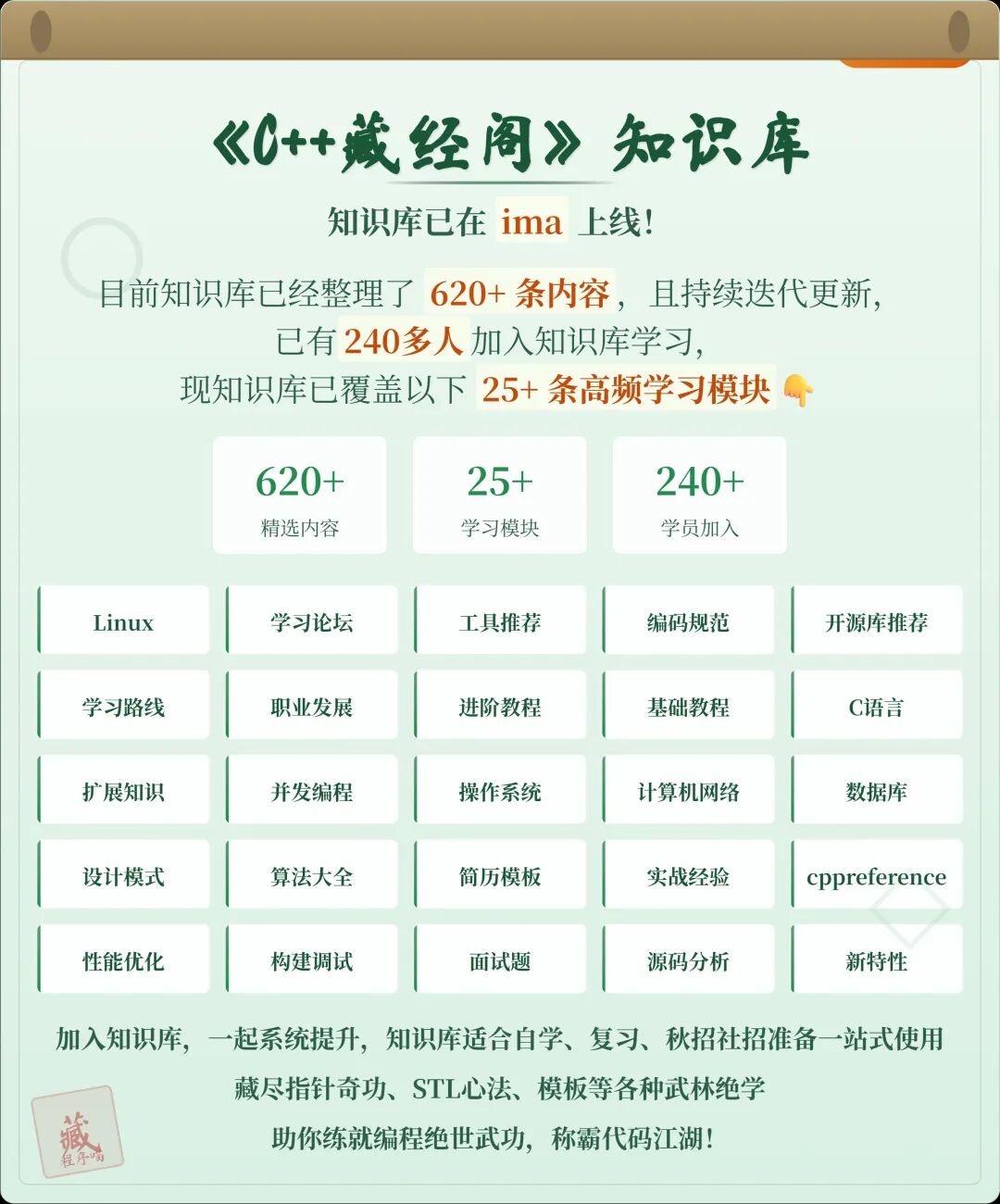
📌 Students interested in the knowledge base can add the assistant on WeChat (cppmiao24) with the note 【Knowledge Base】 or click 👉 C++ Knowledge Base (tap to jump) to view the complete introduction of the knowledge base~
1. fmtlib: A Modern Formatting Library
Why Choose fmtlib?
<span><iostream></span> and <span>printf</span> each have their pros and cons, while fmtlib perfectly combines the advantages of both:
- Type safety
- Strong extensibility
- Excellent performance (5-10 times faster than iostream)
Basic Usage
#include <fmt/core.h>

int main() {
    fmt::print("Hello, {}!\n", "world");  // Type-safe formatting
    std::string s = fmt::format("The answer is {}", 42);
}
Advanced Features
- Custom type formatting
- Compile-time format string checking (C++20)
- Memory efficient (supports custom allocators)
2. spdlog: A High-Performance Logging Library
Core Advantages
- Extremely fast performance (can log millions of messages per second)
- Thread-safe
- Rich output format and destination support
Quick Start
#include <spdlog/spdlog.h>

int main() {
    // Create console logger
    auto console = spdlog::stdout_color_mt("console");

    // Set log level
    spdlog::set_level(spdlog::level::debug);

    // Log messages
    console->info("Welcome to spdlog!");
    console->error("Some error message");
}
Useful Features
- Asynchronous logging (does not affect main thread performance)
- Log file rotation
- Custom formats and filters
3. range-v3: Modern Range Handling
Why Do You Need range-v3?
While the standard library algorithms are powerful, they are often not intuitive to use. range-v3 provides:
- A more intuitive functional programming style
- Lazy evaluation
- Better composability
Example Code
#include <range/v3/all.hpp>
#include <vector>

int main() {
    std::vector<int> numbers{1, 2, 3, 4, 5};

    auto result = numbers
        | ranges::views::filter([](int n){ return n % 2 == 0; })
        | ranges::views::transform([](int n){ return n * 2; });

    for(int n : result) {
        fmt::print("{}\n", n);
    }
}
Main Features
- Fully compatible with C++20 ranges
- Rich views and operation adapters
- Excellent documentation and community support
4. entt: Modern Entity Component System (ECS)
Advantages of ECS Architecture
- Better cache utilization
- More flexible component composition
- Simpler system design
Basic Usage
#include <entt/entt.hpp>

struct Position { float x, y; };
struct Velocity { float dx, dy; };

void update(entt::registry& registry) {
    registry.view<Position, Velocity>().each([](auto& pos, auto& vel) {
        pos.x += vel.dx;
        pos.y += vel.dy;
    });
}
Performance Characteristics
- Zero-cost abstraction
- Extremely low memory overhead
- Highly optimized query system
5. cpp-httplib: Simple HTTP Service
Why Choose It?
- Single header file design
- No external dependencies
- Supports HTTPS (requires OpenSSL)
Creating a Simple Server
#include <httplib.h>

int main() {
    httplib::Server svr;

    svr.Get("/hello", [](const httplib::Request&, httplib::Response& res) {
        res.set_content("Hello World!", "text/plain");
    });

    svr.listen("0.0.0.0", 8080);
}
Client Example
httplib::Client cli("http://example.com");
auto res = cli.Get("/api/data");
if (res && res->status == 200) {
    fmt::print("{}\n", res->body);
}
6. Catch2: A Modern Testing Framework
Main Features
- Simple testing macros
- Rich assertions
- Beautiful output format
Testing Example
#define CATCH_CONFIG_MAIN
#include <catch2/catch.hpp>

int factorial(int n) {
    return n <= 1 ? 1 : n * factorial(n-1);
}

TEST_CASE("Factorials are computed", "[factorial]") {
    REQUIRE(factorial(1) == 1);
    REQUIRE(factorial(2) == 2);
    REQUIRE(factorial(10) == 3628800);
}
Advanced Features
- Benchmarking support
- Data-driven testing
- Tags and filters
Usage Recommendations
- Assess Needs: Choose the appropriate library based on project characteristics
- Version Control: Manage dependencies using package managers or git submodules
- Performance Testing: Evaluate the performance impact of libraries on critical paths
- Long-term Maintenance: Consider the activity level and community support of the library
These libraries can significantly enhance your development efficiency, but remember: introducing any third-party dependency should be carefully considered. It is recommended to start with small-scale trials and gradually assess whether they are truly suitable for your project.
Conclusion
There are many high-quality libraries worth trying in the modern C++ ecosystem. The libraries introduced in this article excel in their respective fields and can help you write cleaner, more efficient, and more maintainable code. Which of these libraries have you used? Or do you have other recommended libraries? Feel free to share your experiences in the comments!
Many students are currently preparing for the autumn recruitment but struggle to present impressive projects. For the project part of interviews, we have launched the C++ Training Camp, which not only provides systematic learning of C++ foundational and advanced knowledge but also allows you to choose projects for practical experience, building from 0 to 1. Instructors will review your code, provide guidance, and a wealth of learning materials will be available for lifetime access.
Students interested can directly add WeChat (cppmiao24) to quickly learn about the detailed introduction of the training camp~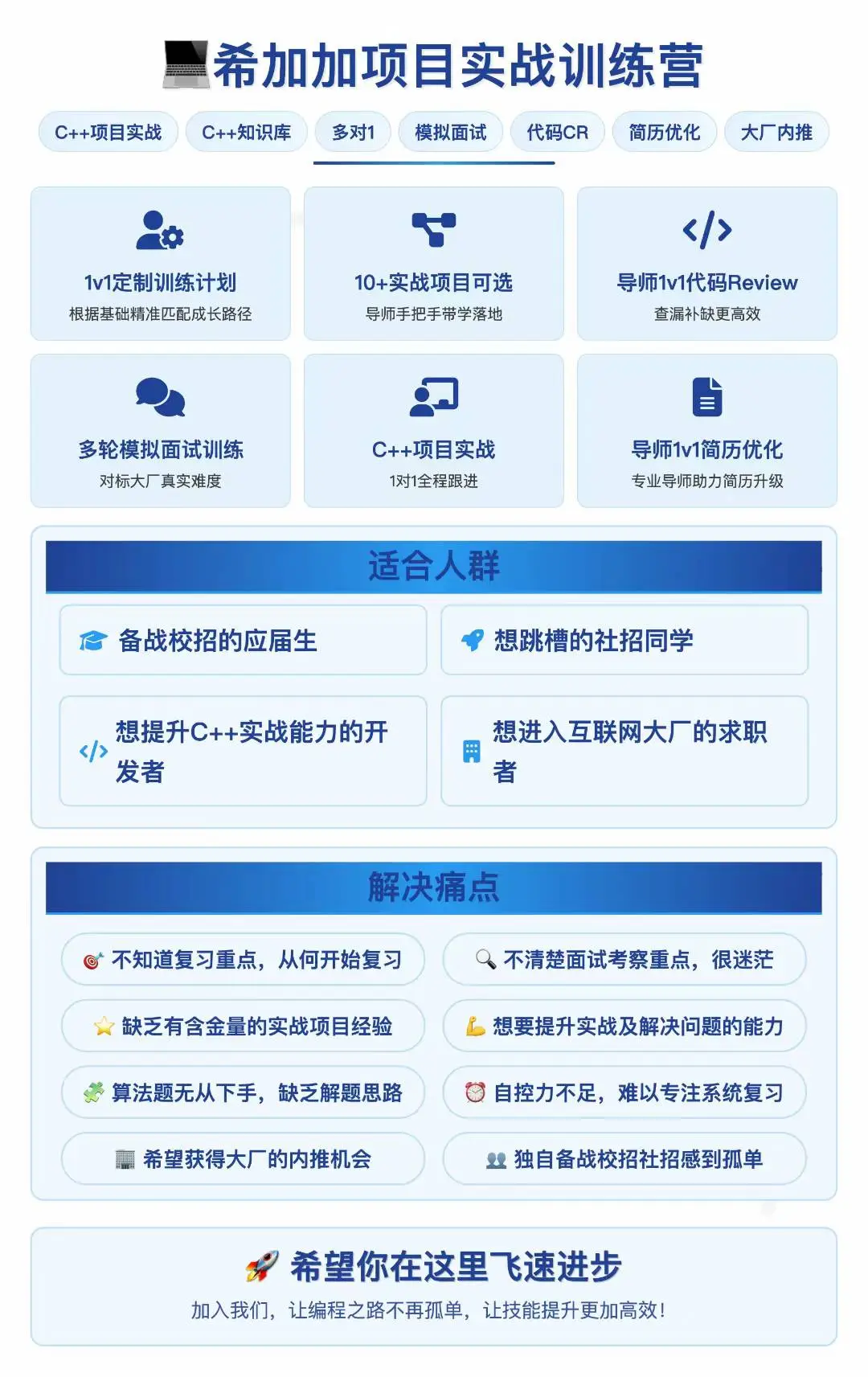
Once the project is ready, you are just one step away from taking off!
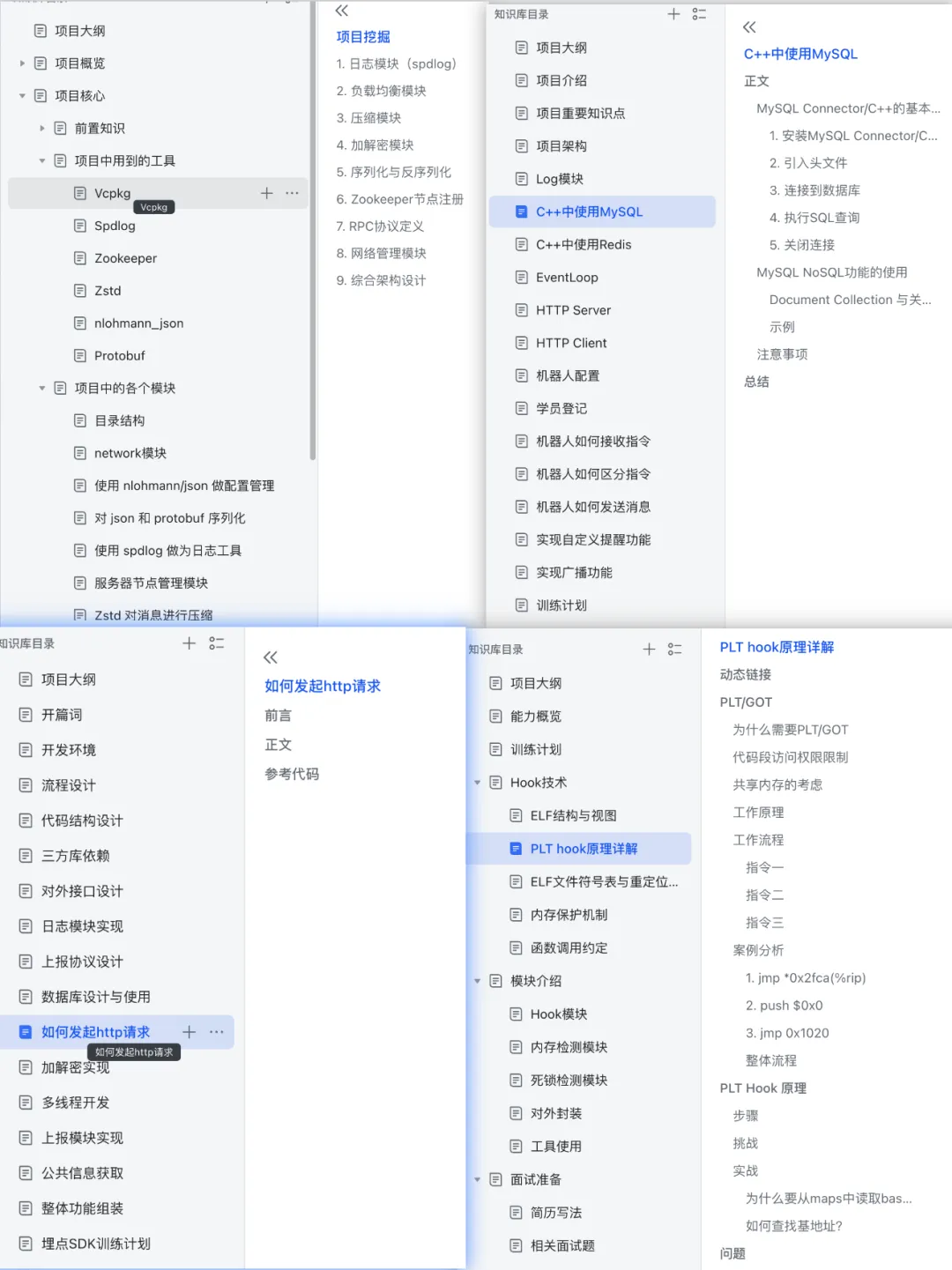
Trust me, these projects will definitely help you improve significantly! Below are the documentation for some of these projects
Target Audience for the Training Camp:
- Graduates preparing for spring and autumn recruitment, both majoring and non-majoring in relevant fields are welcome,
- Students with less than 3 years of work experience looking to switch jobs
- If you have the following concerns, feel free to contact us, and we are willing to provide help and support
- Not sure what content to review or how to start reviewing.
- Unclear about the key points of interview assessments, low review efficiency.
- Lack of valuable practical project experience.
- Want to improve practical skills and problem-solving abilities.
- Struggling with algorithm questions, lacking problem-solving ideas and common templates.
- Lacking self-discipline, finding it hard to focus on systematic review.
- Hoping to get internal referral opportunities from large companies.
- Feeling lonely while preparing for campus recruitment and social recruitment alone, wanting to find study partners.
Not Suitable for:
- People lacking patience and perseverance, eager for quick success
- Those with weak logical thinking in programming and unwilling to improve
- People who only want quick results without focusing on foundational learning
Recommended Reading:
Writing a “Genshin Impact” cheat in C++? A comprehensive analysis from technology to law
Debugging tools for C++ engineers: 3 niche but efficient tools
Debugging hell escape guide: Full chain troubleshooting for C++ core crashes