News Summary
-
Arm Helium technology, as a new M-Profile Vector Extension vector enhancement scheme, brings enhanced computing capabilities to the Armv8.1-M architecture.
-
The new architecture can increase machine learning capabilities for the smallest edge devices by 15 times and improve signal processing performance by 5 times.
-
The new architecture is designed for the next generation of Cortex-M processors, suitable for small embedded devices that require local decision-making.
Today, Arm announcedthe launch of Arm Helium technology based on the M-Profile Vector Extension (MVE) vector enhancement scheme for its next generation Armv8.1-M architecture.This new technology will help developers simplify the software development process and significantly enhance the machine learning and signal processing capabilities of future Cortex-M series processors.
The industry is accelerating the creation of a world with trillions of connected devices, and to achieve this vision, we must find effective ways to expand the computing capabilities of numerous constrained devices at the network edge. By enhancing the computing power of these devices, developers can write machine learning (ML) applications directly for the devices and enable autonomous decision-making locally, thereby improving data security while reducing network energy consumption, latency, and bandwidth usage.
To achieve this goal, Arm has introduced Arm Helium technology, designed for Arm Cortex-M series processors, which enhances the computing performance of the Armv8.1-M architecture through the M-Profile Vector Extension vector extension based on the security foundation of Arm TrustZone. Helium will provide up to 15 times the machine learning performance improvement and up to 5 times the signal processing performance improvement for future Arm Cortex-M series processors, eliminating the performance challenges that limit the use of low-cost, energy-efficient devices, thus bringing new market opportunities to our partners.
Next-Level Computing Performance
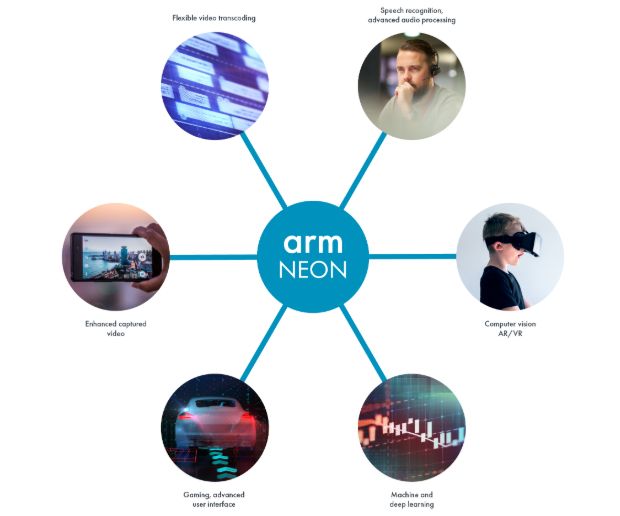
Advanced digital signal processing (DSP) can be extended to more Cortex-A architecture components through Arm Neon technology. For resource-constrained applications, Arm has also added DSP extension schemes to its higher-performance Cortex-M processor series (including Cortex-M4, Cortex-M7, Cortex-M33, and Cortex-M35P). Both technologies can be used to accelerate machine learning computations for specific applications.
For the most resource-constrained embedded systems, power efficiency is a top priority. Previous solutions paired Cortex processors with DSP processors within SoC chips, but this approach also increased the complexity of hardware and software design. As we seek to integrate more machine learning capabilities into these devices, existing SoC development challenges will become more pronounced, requiring developers to possess higher levels of expertise when using different toolchains, programming, debugging, and various complex proprietary security solutions.
The Armv8.1-M architecture equipped with Helium technology can overcome these challenges, providing not only real-time control program code, machine learning, and DSP execution capabilities but also maintaining efficiency. As a result, millions of software developers will be able to run various DSP functions and securely extend a wide range of intelligent applications to a broader array of devices, enhancing signal processing support for three key categories of emerging applications: vibration and motion, voice and sound, and vision and image. The next generation of Cortex-M architecture SoCs equipped with Helium technology will improve the user experience of various future devices, including sensor hub devices, wearables, audio devices, and industrial applications.
In addition to improving performance and reducing development costs, SoC design and development teams will also immediately gain the following advantages:
-
Through functional integration,optimize costs, power consumption, and design investment
-
Utilizing the design of Armv8.1-M that adheres to the Platform Security Architecture (PSA) specifications to achievesimplified TrustZone deployment
-
a single toolchain covering the development of control and signal processing software
-
simplified software development, thanks to the mature Helium ecosystem providing comprehensive tools, models, and libraries, many of which have been widely used by Cortex-M developers
Simplifying the Software Development Process
With Helium’s unified toolchain, libraries, and models, software development will become simpler. The Helium toolchain includes Arm Development Studio, covering Arm Keil MDK, Arm models (immediately usable for code modeling), and various software libraries, including CMSIS-DSP and CMSIS-NN, allowing developers to choose the most suitable resources based on their needs. For signal processing applications, we have simplified the process by eliminating the need for dedicated DSPs or functional accelerators and removing a layer of design complexity.
Driving Next-Generation Embedded and IoT Devices
Helium brings the value of the Arm Project Trillium initiative to various machine learning applications, extending the support capabilities of frameworks and libraries down to the hardware level. Since SoC developers must develop suitable solutions under various constraints of performance, chip area, power consumption, and cost, there is no single product that can meet the needs of all applications.
We have now launched Helium-specific toolchains and models, and it is expected that partner manufacturers will successively release chips using Helium technology over the next two years. For more information on the enhanced features of the Armv8.1-M architecture, please click “Read the Original” to access the technical white paper.
 Long press to follow and unlock more exciting updates
Arm Connects the Future
WeChat ID: Arm_IoT