Author: Yue Bo, Sun Zhijie, Zeng Qi.The Value of Data: Redefining New Productivity in the Digital AgeIn economic terms, data factors have dual connotations: first, data becomes the production material itself, that is, the factorization of data; second, data acts as a factor in the modern economic system, changing the forms and nature of existing production factors, that is, the digitalization of factors.The factorization and assetization of data lead to digital industrialization.American quantum physicist John Wheeler proposed that “everything comes from bits,” stating that “information (data) is the fundamental basis of the universe’s existence.” Data, as a carrier of information recorded electronically, has always been an important part of social production and business activities, bringing economic benefits to users or owners. Today, with the rapid development of digital technology, various digital technologies have made the collection, transmission, analysis, and storage of massive data economically feasible. Data itself possesses the value of production factors, becoming a new type of production factor. Currently, with the large-scale cross-domain applications of technologies such as big data, cloud computing, blockchain, and artificial intelligence, service products and business models centered around data as the core production factor are maturing. In fields such as digital twins, data security, data storage, data analysis, and digital marketing, a large number of new species enterprises like unicorns and Nezha enterprises have emerged, giving rise to several new tracks in the data service industry. This also marks the increasing economic value of digital factors and the realization of industrialization of digital technology. Meanwhile, big data standards and ownership in various industries are gradually established and developed, and various new infrastructures such as 5G, data centers, supercomputing centers, AI open innovation platforms, and public technology platforms are accelerating their implementation. This enables the entire process of data factors from generation to use to be measurable, priceable, and exchangeable, allowing specific data resources with significance to become tradable virtual assets, leading to the emergence of various data exchanges.Column: Hangzhou High-tech Zone Releases the First National Group Standard for Data Intellectual Property Pledge
In March of this year, the Hangzhou High-tech Zone (Binjiang) Market Supervision Bureau, in conjunction with the Zhejiang Provincial Intellectual Property Research and Service Center and seven other units, released the first national group standard related to data intellectual property pledges, titled “Data Intellectual Property Pledge Service Procedures.” The group standard was jointly drafted by these units, first conducting data collection and information desensitization, utilizing a blockchain public proof platform to upload enterprise data, ensuring that the data cannot be tampered with. Then, the verification results of the data chain are confirmed, and a public proof certificate for data intellectual property is issued, transforming data into quantifiable and rights-confirmed digital assets. Ultimately, enterprises can pledge the assessed data assets to obtain loans. The standardization of the data intellectual property pledge process and the formation of group standards have allowed the market to recognize the transformation of data assets, effectively assisting small and medium-sized enterprises in converting data intellectual property achievements into core assets, thereby effectively smoothing the capital chain of enterprises. Just ten days after the release of the group standard, five enterprises in the high-tech zone have tried data intellectual property pledges, collectively obtaining financing of 20 million yuan.
Digitalization and Virtualization of Factors Lead to Industrial Digitalization.Since the outbreak of the information technology revolution, with the widespread application of digital technologies such as information and communication technology (ICT), big data, artificial intelligence, and blockchain, data factors have accelerated their penetration into various fields of the traditional real economy, continuously highlighting their multiplier effect on improving production efficiency. We believe that the reason why digitalization has become an unstoppable historical trend in the development of human economic society lies in the data factors, which have brought profound changes to various production factors, that is, the digitalization of factors. With characteristics such as non-consumable, zero marginal cost, connectivity, and programmability, big data has given various traditional production materials a “liquidity,” allowing for further flexibility in the allocation of resource factors, making the cross-temporal and spatial migration of factor value possible, thus completely overturning the traditional ways of human understanding and transforming the material world.Column: Virtual Digital Humans
AI technology highlights the digital characteristics of virtual humans, bringing large-scale commercial applications and initiating the process of labor factor virtualization and digitalization.In the 1980s, virtual humans transformed from concept to entity, embedding digital factors into the complex labor factor of “human.” With the development of AI technology and accelerated iteration of technologies such as machine learning, 2D virtual humans have been “revived” as 3D virtual digital humans, closer to real humans in terms of appearance, actions, and intelligence. At the same time, AI algorithm technology has reduced the production costs of digital humans, allowing for their widespread application in the entertainment and media industries, and virtual customer service, virtual teachers, and intelligent medical assistants have also begun to appear in finance, education, and healthcare sectors. The metaverse has spawned a new track for virtual digital humans, bringing a new form of labor factors. The metaverse brings humanity into a space where the virtual and real merge, and virtual digital humans have become a new form of human-machine interaction. Service-oriented virtual humans can engage in production and services, executing standardized tasks in the form of virtual avatars. With the continuous improvement of image recognition technology and human body recognition algorithms, virtual digital humans will transition from customization to generalization, from the commercial side to the user side, driving a disruptive transformation of labor factor forms.
The Impact of Data: Giving Rise to New Economic Momentum, New Paradigms, and New EcologiesData-Driven Companies Become New Momentum for Economic Growth.Comparing the top 10 global listed companies by market value in 2000 and 2020, the number of internet platform companies surged from 1 to 7. This most outstanding group of global enterprises has undergone a significant transformation in just two decades, indicating that the locomotive of global economic growth has shifted from financial and energy oligarchs to digital economy platform enterprises that have been established for decades, over a decade, or even just a few years. Moreover, according to the Great Wall Strategic Consulting’s tracking research on global unicorn companies, 63.6% of unicorn companies globally are born from the digital economy, with seven countries, including China, the United States, the United Kingdom, India, and Germany, having five or more digital economy unicorn companies. This indicates that when data becomes a new type of production factor, emerging enterprises that understand how to utilize this new factor represent a more advanced productivity, while traditional large enterprises that represent backward productivity will gradually be replaced. In fact, for a regional economic entity, the so-called process of digital transformation is essentially the birth, growth, and eventual market competition victory of new species enterprises driven by data factors. In this process, the regional economic entity itself will complete the transformation and upgrading of its industrial structure and the succession of development momentum, ultimately achieving a shift in economic paradigms.Column: Key Findings on Global Digital Economy Unicorns
In 2020, there were 501 global digital economy unicorn companies, with the leading role of super unicorn companies further strengthened.In 2020, there were 501 global digital economy unicorn companies with a total valuation of $1,644.375 billion, with an average valuation of $32.82 billion per company. In 2020, 18 super unicorn companies emerged in the global digital economy sector, accounting for 3.6% of the total number of unicorns, but nearly 40% of the valuation of global digital economy unicorns was contributed by these 18 super unicorn companies.
In 2020, global digital economy unicorn companies received over $85.573 billion in financing.In 2020, 275 global digital economy unicorn companies received new financing, with a financing scale approaching one trillion. Capital has a high interest in digital economy unicorn companies in the fields of healthcare, life services, financial services, new retail, and enterprise services. In 2020, in the fields of internet education, travel services, and life services, two digital economy unicorn companies in each field obtained over $1 billion in massive financing in a single round.
Serial entrepreneurs, technical experts, and industry experts are the main groups of founders of digital economy unicorn companies.In 2020, 28.3% of digital economy unicorn founders globally were serial entrepreneurs, 26.1% had backgrounds as technical personnel or field experts, 22.2% had previously served as executives in enterprises (of which 60% of entrepreneurs with executive backgrounds are Chinese), and 14.3% were first-time entrepreneurs; additionally, 86 digital economy unicorn companies’ founders had composite backgrounds. Furthermore, 10.7% of digital economy unicorn companies were incubated through large enterprise platforms.
Data-Driven ‘Four New’ Paradigm Co-Builds New Ecology of Digital Economy.Under the influence of data as a transformative factor, a digital economy ecology centered around data factors, powered by digital technology, and based on digital infrastructure is gradually nurturing and growing. “New scenarios, new species, new tracks, and new governance” emerge interlaced and mutually reinforcing, forming a new economic development paradigm that is distinctly different from the traditional industrial economy and enabling a virtuous cycle of the digital economy ecology (as shown in the figure below). Firstly, new scenarios. Scenario innovation in the context of the new economy specifically refers to the commercialization of new technologies in specific situations and businesses, forming a large amount of real data around meeting genuine market demands, which feeds back into the iterative upgrade of technology research and development, achieving a win-win of research breakthroughs and scenario explosions. The emergence of a new scenario indicates that a new technology has found a feasible business model, passed market verification in a short time, formed a data-driven business closed loop, and signifies entrepreneurial success. Secondly, new species. In recent years, high-value enterprises recognized by capital, such as unicorns, potential unicorns, and Nezha enterprises, as well as various platform-type digital enterprises, have emerged. The essential difference between these new species enterprises and traditional enterprises is that they treat data as the source of innovation and core asset, achieving explosive growth with zero marginal costs. Thirdly, new tracks. The cross-domain integration of the digital economy and the real economy is an important source for the emergence of new tracks. Digital technologies such as big data, cloud computing, the Internet of Things, artificial intelligence, 5G, and blockchain are applied across the real economy, promoting the digital transformation and upgrading of industries, continuously giving rise to new industries, new business forms, and new models. Once concentrated and explosive in a certain field, opening up massive markets worth hundreds of billions or even trillions, new tracks are formed, creating new momentum for industrial development. Fourthly, new governance. The development of the new economy compels the government to continuously deepen reforms and innovate governance. With the support of continuously upgraded digital technologies, big data, cloud computing, and artificial intelligence have become important driving forces for enhancing governance effectiveness and precision, promoting government and enterprise to move towards joint governance innovation, forming a new mechanism for digital governance characterized by precise warnings, credit self-discipline, and ecological co-governance.
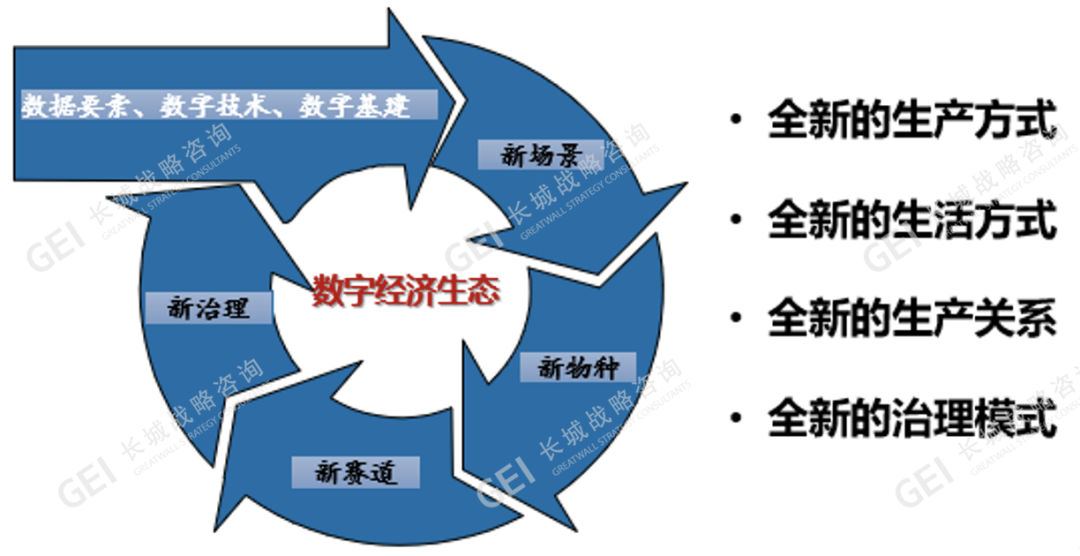
Figure: Composition of Digital Economy EcologyThis article is excerpted from the Great Wall Strategic Consulting Corporate Research Report No. 374, “Data-Driven High-Quality Development of High-Tech Zones” (published in June 2022).
This article is reproduced from the “GEI New Economy Outlook” WeChat public account.