According to a report from Electronic Enthusiasts Network (by Huang Jingjing), at the 2025 LoRa Innovation Forum, Mike Wong, Vice President of Sales for Semtech Asia Pacific, Olivier Beaujard, Senior Director of the Semtech LoRa Ecosystem and Chairman of the LoRa Alliance, and Shahar Feldman, Senior Director of Product Marketing at Semtech, shared exciting insights on the latest technological products and application prospects of LoRa.
Features of the LR2021 Transceiver
Based on the fourth generation of LoRa technology,Semtech has launched the LR2021,which is the first chip in the LoRa Plus series. The LoRa Plus series, as a fourth-generation product, inherits the long-range and low-power advantages of traditional LoRa while significantly enhancing data transmission capabilities, specifically designed for high data rate AIoT applications.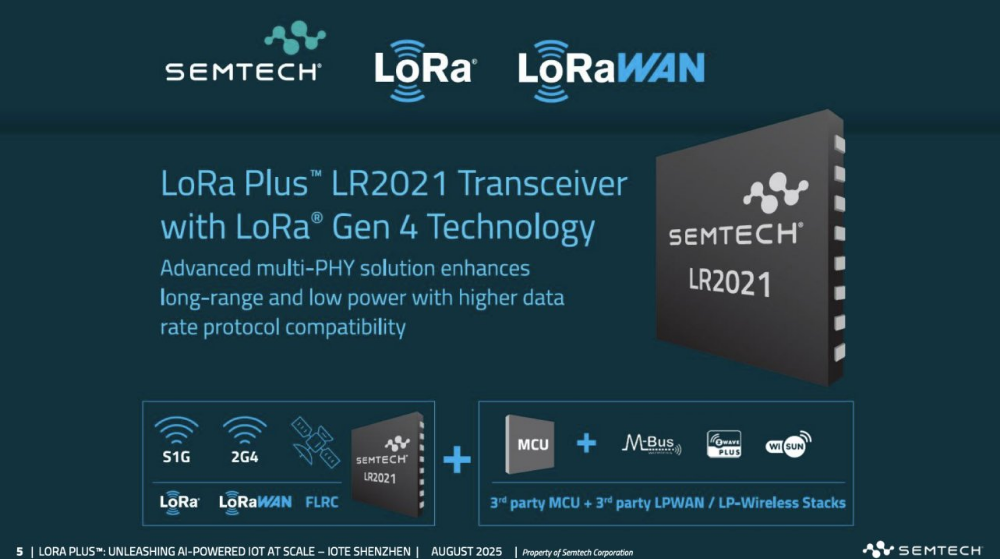 The LR2021 transceiver supports Sub-GHz, 2.4 GHz ISM bands, and authorized S-band ground and satellite communication networks.It expands the physical layer modulation methods to achieve Fast Long Range Communication (FLRC) and, after integrating third-party protocol stacks, can be compatible with various low-power wireless protocols, including Amazon Sidewalk, Meshtastic, W-MBUS, Wi-SUN FSK, and Z-Wave.It supports FLRC up to 2.6 Mbps, LoRa, FSK, OOK, O-QPSK, and LR-FHSS modulation methods up to 200 kbps. Utilizing a single-ended front-end design, it supports multi-region operation. The transmission power ranges from +22 dBm to -10 dBm, achieving best-in-class energy efficiency. The multi-spreading factor (SF) receiver features a low noise figure and improved CAD (Channel Activity Detection) function, with optimal LoRa sensitivity at SF12/125 kHz reaching -142 dBm. It enhances frequency offset tolerance without the need for a temperature-compensated crystal oscillator (TCXO) and large thermal relief devices.
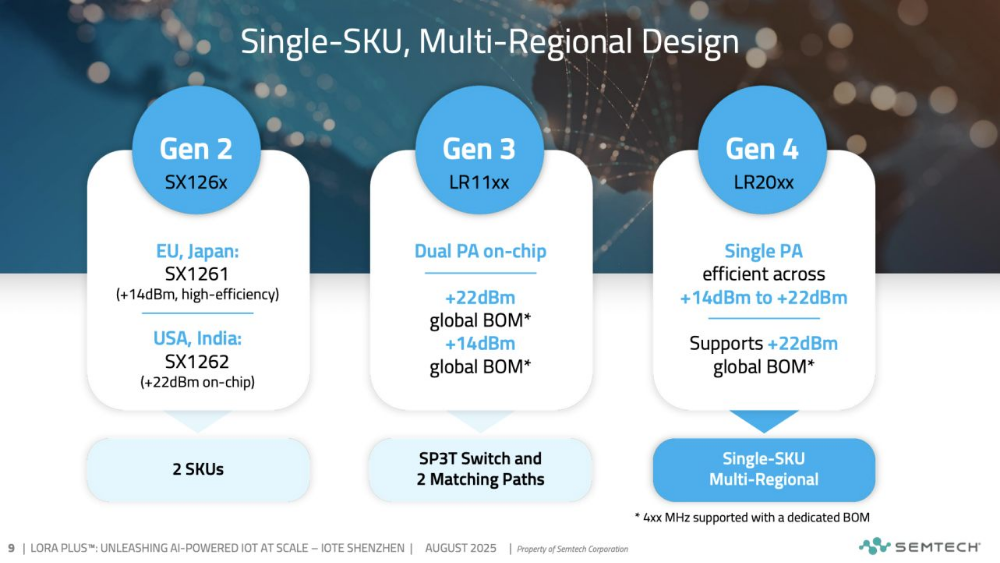 Due to its data rate of up to 2.6 Mbps, with excellent link budget and efficiency, it can achieve audio streaming and image transmission. It supports a wide range of applications from small payload sensor data to high-definition image transmission.Advanced RF and analog architecture support multi-region deployment through a single SKU design, and the higher integration compared to previous generation LoRa transceivers reduces BOM costs, PCB area, and power consumption.At the same time, it maintains backward compatibility with previous generation LoRa devices, ensuring seamless integration with LoRaWAN.The LR2021 meets the demands of AI-supported edge devices for low power, long-range transmission, and excellent penetration capabilities. It can support sensor data transmission, suitable for applications such as gunshot detection, glass break detection, license plate recognition, and fall detection, and can operate for years on a small battery.
Supporting a Wider Range of AIoT Applications
The upgrade of LoRatechnology will empower numerous application scenarios. During the conference, in an interview with media including Electronic Enthusiasts Network,Mike Wong, Vice President of Sales for Semtech Asia Pacific,used agricultural scenarios as an example, stating that the deployment and maintenance costs of sensors on large farms are relatively high, and the areas are vast, especially in remote regions, making operation and maintenance challenging. There is a pressing need for technologies likeLoRa.At the same time, drones are increasingly being adopted in industrial and agricultural fields, and combiningLoRatechnology can facilitate agricultural monitoring from the air, replacing the traditional method of deploying sensors on the ground.Artificial intelligence is profoundly changing the wireless connectivity market,and LoRatechnology is actively promoting the intelligent development of various applications.Mike Wongstated that, for example, fall detection sensors installed in restrooms,as well as animal recognition, license plate, and facial recognition, some scenarios have privacy concerns and data security requirements, and these edge scenarios require local computing power, whilethe high data rate, low power consumption, and long-range characteristics of new products like the LR2021 perfectly meet these needs.In the industrial market, according to Shahar Feldman, Senior Director of Product Marketing at Semtech,automakers like Mercedes-Benz and Volvohave widely deployed LoRa sensors in their global factories for environmental monitoring and equipment status management. LoRais favored by industrial customers for its private networking capabilities and security.LoRais increasingly being applied in manufacturing plants, smart buildings, and other fields.He further stated that for the new LR2021 product, it can simplify complexity and enhance performance for European utilities that need to support both LoRaWAN and W-MBUS, or North American utilities that require LoRaWAN and Wi-Sun FSK, or security systems and smart home applications that need long-range LoRa connections with protocols like Z-Wave.
The LoRa Ecosystem is Growing Stronger
Olivier Beaujard, Chairman of the LoRa Alliance, introduced that there are currently over 400 members of the LoRa Alliance worldwide. These members cover all aspects from chip design to solution development, providing customers with diverse choices. The LoRaWAN network has also covered multiple countries and regions, with over 180 globally.However, there are only 20 members from China in the alliance, and these companies place great importance onLoRa‘s overseas market business. Therefore, Semtech is also very willing to help Chinese companies expand into overseas markets.Olivier Beaujard, Senior Director of the Semtech LoRa Ecosystem, pointed out that Chinese companies have significant advantages in hardware design and supply chain support, and we will actively promote domestic companies to participate in understanding the overseas IoT ecosystem, launching LoRa products that meet the needs of overseas customers, and expanding broader overseas markets.
Conclusion
Compared to other wireless connectivity technologies,cellular networks have high rates and coverage, but high power consumption and expensive traffic,Wi-Fi and Bluetooth have high rates but limited distances,LoRatraditionally has the characteristics of long-range and low power consumption, while the launch of the LoRa Plus series strengthens this critical feature of high-speed transmission, further expandingLoRa‘s advantages in the wireless connectivity field. Data shows that the global AIoT market is expected to grow from $11 billion in 2024 to $48 billion by 2030, with a compound annual growth rate (CAGR) exceeding 20%. The Chinese market is also growing in sync, from $7.2 billion to $22 billion.With the rapid growth of the AIoT market, it is foreseeable that the launch of the fourth generation ofLoRatechnology and new products will open up the upward channel for LoRa in the AIoT era.

Disclaimer: This article is originally from Electronic Enthusiasts Network, please indicate the source when reprinting. For group communication, please add WeChat elecfans999,for submission of interview requests, please send an email to [email protected].
More Hot Articles to Read
-
Commercialization Turning Point of Satellite Communication: T/R Chip Integration + GaN Empowerment, Entering Miniaturization
-
Tesla AI Chip Strategy Upgrade, “Epic” Chip Takes Over Dojo
-
Not HBM, Ultra-High Bandwidth DRAM for Edge AI! These Manufacturers Focus on Stacking Solutions!
-
Domestic Analog Chip Strong Recovery in the First Half of the Year, Manufacturer Revenue Soars Over 100%
-
Broadcom Receives OpenAI “Billion Dollar Order”, AI Chip Business Revenue Increases Significantly
Click to Follow and Star Us
Set us as a star to not miss any updates!