

Think Tank Highlights #GlobalDefenseTrends #USMilitaryUpdates #RussianMilitaryUpdates #TaiwanNews #WeChatStore
#SouthKorea #Raytheon #Japan #ElectronicWarfare #NortheastAsiaMilitaryTrends #Drones

First-Person Perspective (FPV) Drone Technology in the Russia-Ukraine Conflict
Author: Military Eagle Think Tank Member Source: Military Eagle Dynamics
In the ongoing Russia-Ukraine conflict, there is a continued in-depth report on the military equipment used by both the Russian and Ukrainian armies, symbolizing the terrifying power and technological complexity of modern warfare. This article delves into the First-Person Perspective (FPV) drone technology. Originally designed for entertainment and competition, this technology has now been repurposed for military operations, marking a significant development in battlefield reconnaissance and engagement.
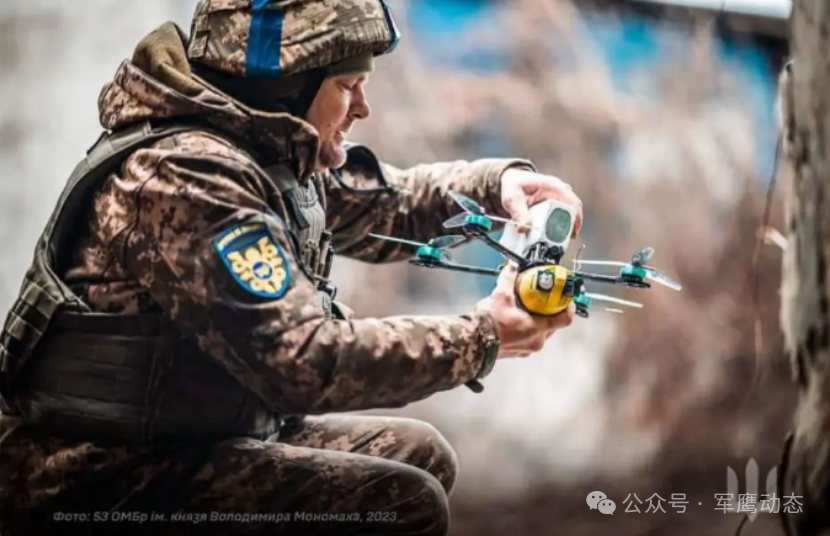 ▲FPV drone systems extensively used by Ukraine
The First-Person Perspective (FPV) refers to a method for controlling drones or other remotely operated vehicles, where the operator uses real-time video provided by a camera mounted on the drone.FPV drones have revolutionized military tactics in the Russia-Ukraine conflict, posing a significant threat to traditional defense systems due to their unique immersive surveillance and precision strike capabilities. These devices were initially used for drone racing and leisure, providing pilots with an unprecedented flying experience, allowing them to view in real-time through onboard cameras, simulating the impression inside the drone. This innovation enables high-precision reconnaissance and surveillance, as well as executing targeted strikes with extraordinary agility and caution, challenging traditional methods.
Since the onset of the Russia-Ukraine conflict on February 24, 2022, Ukraine has been at the forefront of using FPV (First-Person Perspective) drone technology, effectively countering Russian offensives with cost-effective measures while protecting human lives. Ukraine has innovatively utilized various sizes of drones, ranging from compact models to those weighing over 454 kilograms. Ukraine has integrated domestic innovations with international technologies, such as Turkey’s Bayraktar TB2 and commercial FPV drones like DJI Mavic and Phantom. This diverse fleet of drones has played a crucial role in enhancing Ukraine’s situational awareness on the battlefield, providing significant advantages in monitoring, intelligence gathering, and precision strikes against Russian offensives. The strategic deployment of these drones highlights a significant shift in modern warfare, effectively adapting to the evolving dynamics of conflict using advanced technology.
Ukrainians adopted these drones early on, equipping them with various specific devices, including high-definition cameras for intelligence gathering and advanced transmission systems to extend their range. Bombing devices suitable for transporting and deploying various effective payloads, from small explosive devices to electronic jamming equipment, enhance the effectiveness of drones in offensive and surveillance roles. These capabilities have led to the destruction of numerous Russian armored vehicles and air defense systems, which are far more expensive to build than Ukraine’s FPV drones. This technology was first used on a large scale in the Ukrainian theater, forcing armies worldwide to adapt, as Ukraine successfully repelled the world’s second-largest army, contrary to initial predictions.
The cameras mounted on FPV drones are designed to provide a wide field of view and are often adjustable to meet the specific needs of each mission. They play a crucial role in allowing detailed and real-time information gathering, which is vital for strategic decision-making on the battlefield. Furthermore, these drones’ capability to carry various payloads, from advanced surveillance equipment to small explosive devices, demonstrates their adaptability to diverse operational scenarios.
Image transmission is achieved through low-latency video transmission systems, ensuring a smooth and delay-free image stream to the pilot. This feature is essential for maintaining a high level of responsiveness during operations where every second counts. These systems can operate on different frequencies to reduce interference, ensuring reliable communication even in hostile environments.
The modularity of FPV drones is another significant technological asset. Depending on mission requirements, they can be equipped with different payloads, making these devices highly flexible and effective in executing various tasks. This ability to quickly adapt to changing demands is especially valuable in military environments, where conditions can evolve rapidly.
In terms of deployment, FPV drones stand out for their portability and cost-effectiveness. Their relatively low cost and ease of deployment allow them to be used by a wide range of users, from professional military units to less equipped groups, democratizing aerial reconnaissance and attack capabilities.OSD (On-Screen Display) functionality enhances the piloting experience by providing real-time basic flight information, such as battery voltage, flight time, and altitude. This enhanced situational awareness is essential for operations where precision and efficiency are critical.
As the Russia-Ukraine conflict evolves, both sides have adjusted their use of FPV drones to better address the challenges posed by this new technology. On the Ukrainian side, the most significant innovation has been the development of specialized FPV drone-designed EFP-S (Explosive Formed Penetrator – Impact) armor-piercing ammunition. These lightweight munitions capable of penetrating armored vehicles mark a significant advancement in Ukraine’s offensive capabilities.
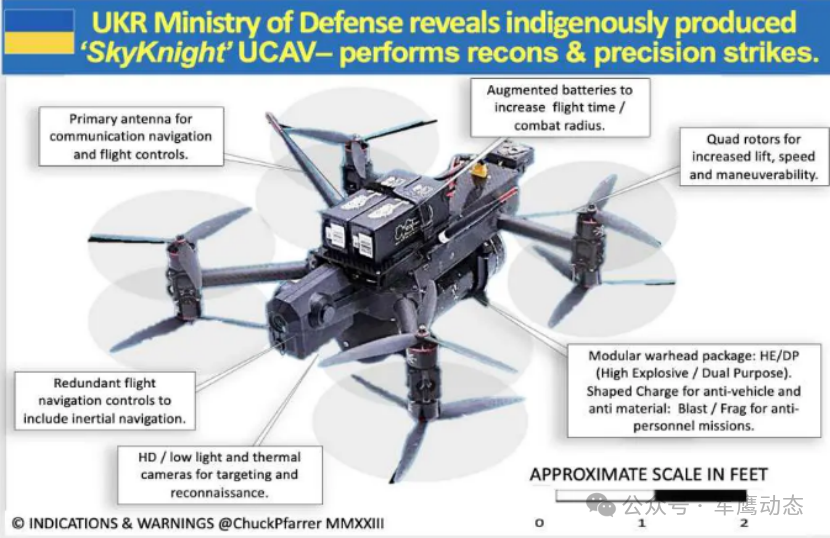 ▲The Ukrainian Ministry of Defense reveals that the domestically produced “SkyKnight” drone system is capable of reconnaissance and precision strikes
As shown in the image above, the Ukrainian Ministry of Defense has launched the “SkyKnight,” a self-developed drone system that demonstrates advancements in Ukrainian defense technology. This sophisticated unmanned aircraft is designed for reconnaissance missions and precision strikes, including a primary antenna for essential functions such as communication, navigation, and flight control. To ensure expanded operational capabilities, its design incorporates enhanced batteries to increase flight time and operational radius.
“SkyKnight” is equipped with quadrotors to improve its lift, speed, and maneuverability, which are critical characteristics for maneuvering in challenging battlefield conditions. It also features redundant flight navigation controls, including an inertial navigation system, and is equipped with high-definition, low-light, and thermal imaging devices for comprehensive target locating and reconnaissance missions. The modular warhead package of the drone further enhances its versatility, enabling it to carry high-explosive / dual-purpose (HE/DP) munitions, shaped charges for anti-vehicle and anti-material purposes, and explosive / fragile warheads for personnel-targeting missions. This fusion of capabilities makes the “SkyKnight” drone system a powerful tool in modern warfare, providing opportunities for future military operations.
The DJI FPV is a racing drone, as shown in the image below, which has been modified for military use, capable of launching anti-armor shaped munitions. Utilizing first-person video links, it achieves precise targeting of moving targets and navigates stationary targets using GPS, GLONASS, and GALILEO. This drone flies at 40 Kph for 20 minutes, accelerating from 0 to 100 Kph in just two seconds, with a top speed of 140 Kph. It is controlled via a VR headset, ensuring an immersive first-person flight control experience, and is equipped with a flight controller.
This drone is equipped with a 4K camera capable of recording at various frame rates, enhancing its reconnaissance capabilities. Its versatility extends to carrying a range of weapon payloads, including RPG-7 anti-armor munitions capable of penetrating over 500 millimeters of rolled homogeneous armor, showcasing its formidable anti-armor capabilities. This complex technological integration makes the DJI FPV racing drone a versatile tool in modern warfare, bridging the gap between commercial technology and military applications.
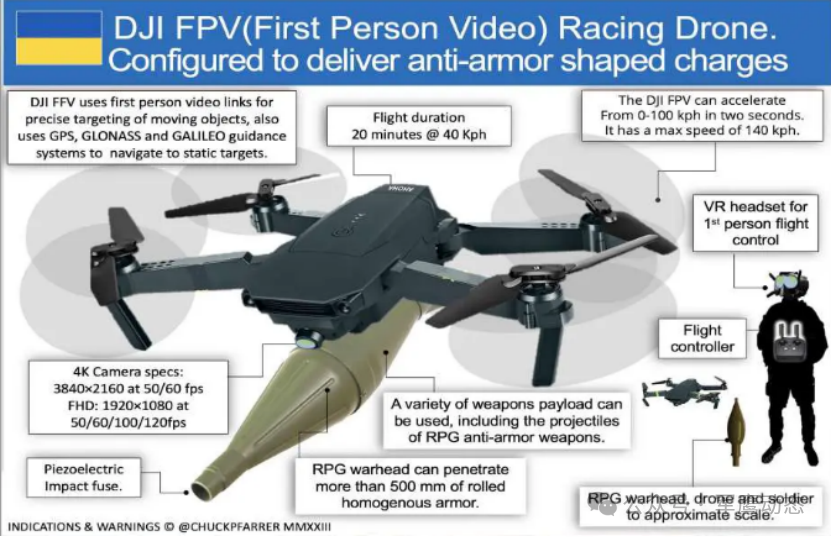 ▲DJI FPV racing drone, configured to launch anti-armor shaped munitions