Org. Process Res.Dev. 2012, 16, 87–95. DOI: 10.1021/op2002497
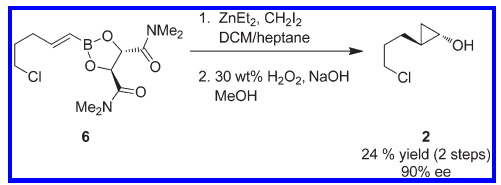
◆Initial attempts to perform a diastereoselective cyclopropanation of a tartaramide-modified vinyl boronate 6 gave a 24% yield of 2 after oxidative cleavage, with significant process impurities which could only be removed after a difficult chromatography.
◆Treatment of commercially available pinacolvinyl boronate 4 with bis-iodomethylzinc (Zn(CH2I)2) prepared from diethylzinc and diiodomethane gave poor conversion (<5%), even after prolonged reaction times at room temperature. The electron-deficient nature of this alkene combined with the lack of a coordinating group was suspected as the cause of this poor reactivity.
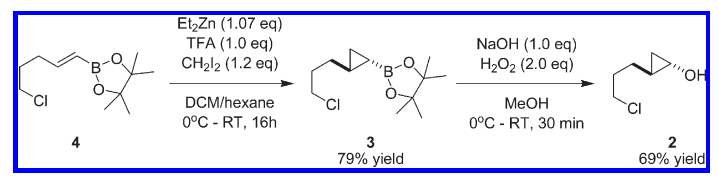
◆Therefore, the use of the trifluoroacetic acid-modified reagent developed by Shi and co-workers was attempted, and it showed a dramatic increase in reactivity at room temperature. After formation of the iodomethyl zinc trifluoroacetate (ICH2ZnO2CCF3) from diethylzinc, trifluoroacetic acid, and diiodomethane in a dichloromethane (DCM)/hexane mixture at 0oC, addition of vinyl boronate 4 followed by stirring at room temperature for 16h gave >98% conversion to the cyclopropyl boronate 3 in 79% isolated yield after only an acidic aqueous workup.
Note
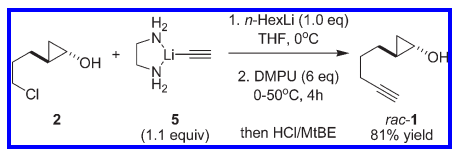
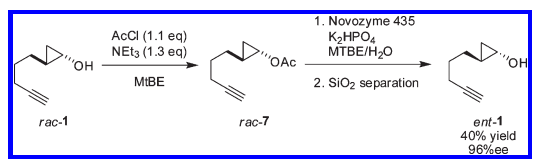
◆The safety use of lithium acetylide-ethylene diamine complex 5 and an enzymatic resolution of aracemic cyclopropanol acetate process was developed.