

Click the blue text above to follow us

📋📋📋 The content of this article is as follows: 🎁🎁🎁
Table of Contents
💥1 Overview
📚2 Results
🎉3 References
🌈4 Matlab Code, Data, Documentation



1 Overview

The Monte Carlo method is used to simulate the charging methods of electric vehicles, including regular charging, fast charging, and battery swapping charging curves, and to study the impact of these methods on the daily load curve. Additionally, the effects of uncontrolled charging, controlled charging, and controlled discharging curves on the daily load curve will be explored. By simulating these charging methods, we can gain insights into the impact of electric vehicles on the power grid under different charging modes, providing important references for the future popularization of electric vehicles and the planning of charging infrastructure. The Monte Carlo simulation is a commonly used numerical simulation method that can be applied to study the charging loads of different types of electric vehicles. In this study, you can follow these steps for simulation:
-
Data Collection: Collect charging demand data for different types of electric vehicles. This can include vehicle types, charging methods (regular charging, fast charging, battery swapping), charging times, charging power, etc. This data can be obtained from actual charging station usage records, user surveys, or other data sources.
-
Parameter Setting: Set necessary parameters for the simulation, such as the simulation time period, the number and location of charging stations, and the performance parameters of the charging equipment. These parameters can be set based on existing actual conditions or estimated through previous studies or professional knowledge.
-
Simulation Process: Use the Monte Carlo method for simulation. For each simulation iteration, randomly select electric vehicles and charging demands that conform to actual distributions and simulate their charging processes. Determine charging power and duration based on vehicle types and charging methods. Considering the limitations of charging stations and power supply capacity, simulate the queuing of electric vehicles or adjust the usage of charging stations.
-
Data Analysis: Perform statistical analysis on the simulation results. Metrics such as charging station utilization, distribution of charging duration, and average waiting time can be calculated to evaluate the characteristics and influencing factors of charging loads for different types of electric vehicles. The simulation results can also be visualized for a more intuitive understanding of the distribution and trends of charging loads. Through such Monte Carlo simulation studies, you can obtain information about the charging loads of different types of electric vehicles, helping to optimize the layout and arrangement of charging stations, and improve charging services and system performance. Please note that before conducting Monte Carlo simulations, ensure that the collected data and set parameters are accurate and reasonable to ensure the reliability of the simulation results.
Monte Carlo Simulation Study of Different Types of Electric Vehicle Charging Loads
1. Introduction
With the popularization of electric vehicles, predicting charging loads has become an important part of planning electric vehicle charging infrastructure. The Monte Carlo simulation, as a commonly used forecasting method, can effectively address the uncertainties and randomness in charging load predictions. This study aims to use the Monte Carlo method to simulate the charging loads of different types of electric vehicles (including private cars, taxis, government vehicles, and buses) under different charging methods (regular charging, fast charging, battery swapping), providing references for the planning and management of electric vehicle charging facilities.
2. Introduction to Monte Carlo Method
The Monte Carlo method is a numerical computation method based on random sampling, which estimates the output characteristics of a system by generating a large number of random numbers and combining them with the input-output relationships of the model. In charging load simulations, the Monte Carlo method can simulate the driving and charging processes of electric vehicles, generating a large amount of sample data, and analyzing and calculating these data to obtain the probability distribution of charging loads.
3. Data Collection and Parameter Setting
-
Data Collection
-
Collect charging demand data for different types of electric vehicles, including vehicle types, charging methods, charging times, charging power, etc.
-
Collect driving data for electric vehicles, including daily driving mileage, starting charging times, etc.
Parameter Setting
-
Set the simulation time period, such as one day or one week.
-
Set the number and location of charging stations, as well as the performance parameters of the charging equipment.
-
Set the number and type distribution of electric vehicles based on actual conditions.
4. Simulation Process
-
Regular Charging Simulation
-
For each electric vehicle, randomly generate charging duration and charging power based on its daily driving mileage and starting charging time.
-
Consider the limitations of charging stations and power supply capacity, simulating the queuing of electric vehicles or adjusting the usage of charging stations.
Fast Charging Simulation
-
Set the charging power and charging time distribution of fast charging stations.
-
Simulate the charging process of electric vehicles at fast charging stations based on their starting charging times and charging demands.
-
Consider the capacity limitations and charging time windows of fast charging stations, simulating the charging behavior of electric vehicles.
Battery Swapping Simulation
-
Set the number of batteries and charging capacity at battery swapping stations.
-
Simulate the charging behavior of electric vehicles at battery swapping stations based on their driving demands and starting charging times.
-
Consider the operating hours and battery inventory situation of battery swapping stations, simulating the battery swapping process of electric vehicles.
5. Results Analysis
-
Charging Load Distribution
-
Analyze the charging load distribution of different types of electric vehicles under different charging methods, including charging times, charging power, and charging amounts.
-
Compare the charging load characteristics of different types of electric vehicles, exploring their differences and reasons.
Charging Station Utilization
-
Calculate the utilization rate of charging stations to evaluate the operational efficiency of charging facilities.
-
Analyze the relationship between charging station utilization and factors such as the number of electric vehicles, charging methods, and charging times.
Impact of Charging Loads on the Power Grid
-
Analyze the impact of different types of electric vehicles under different charging methods on the power grid load, including peak load, load fluctuations, etc.
-
Explore how to optimize charging strategies to reduce peak loads and load fluctuations on the power grid, improving the stability and economy of the grid.
6. Conclusion and Recommendations
This study used the Monte Carlo method to simulate the charging loads of different types of electric vehicles under different charging methods, obtaining the probability distribution and characteristics of charging loads. By analyzing the utilization of charging stations and the impact of charging loads on the power grid, recommendations for optimizing charging strategies were proposed. In the future, further research and improvement of charging load simulation methods and algorithms can be conducted to meet the growing demand of the electric vehicle market.



2 Results
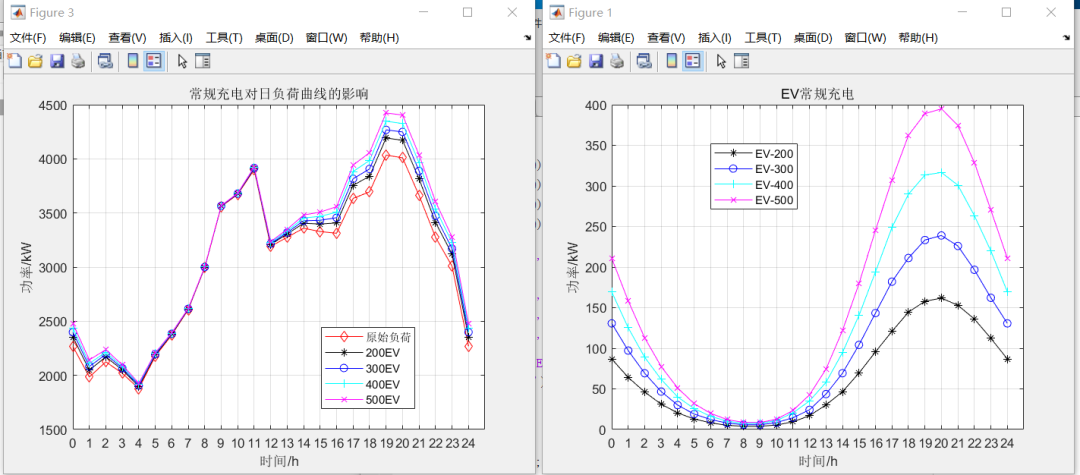
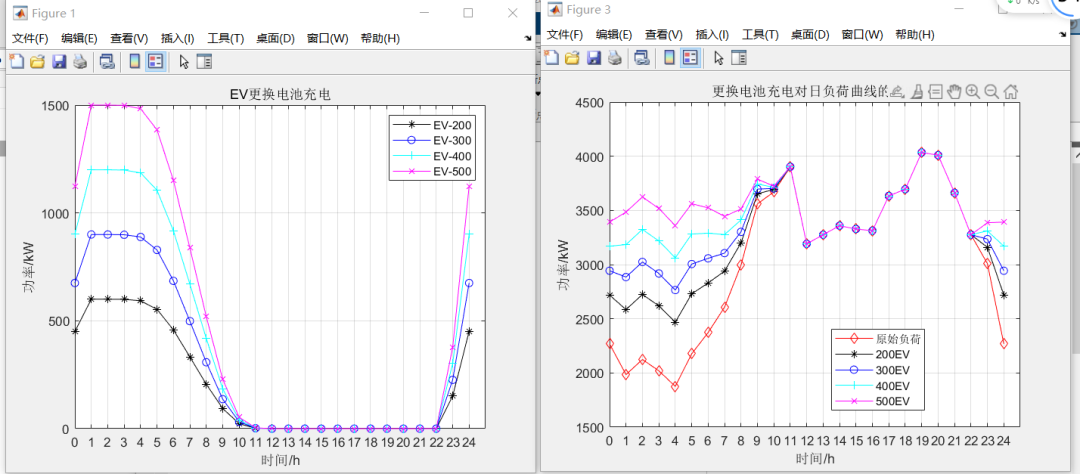
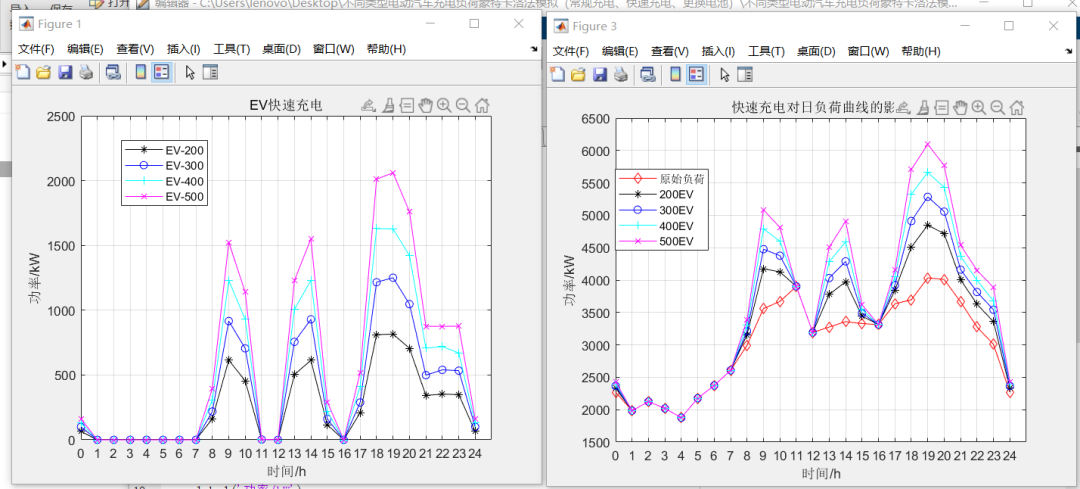 Document Explanation:




3References
Some content in this article is sourced from the internet, and references will be noted. If there are any inaccuracies, please feel free to contact us for removal.

[1] Pang Peichuan, Zeng Cheng, Yang Biao, et al. Calculation of Electric Vehicle Charging Load Using Monte Carlo Simulation Method [J]. Communication Power Supply Technology, 2016(1):4. DOI:10.3969/j.issn.1009-3664.2016.01.060.
[2] Chen Peng, Meng Qinghai, Zhao Yanjin. Calculation of Electric Vehicle Charging Load Based on Monte Carlo Method [J]. Electrical Manufacturing, 2016(011):011.



4 Matlab Code, Data, Documentation
Public Account Lychee Research Society
MATLAB| Optimizing Shared Energy Storage Considering Economic Consumption of Microgrid New Energy
2023-12-18
MATLAB| Real-time Scheduling Strategy for Electric Vehicles Based on V2G Technology
2023-10-19
MATLAB| Large-scale Electric Vehicle Spatiotemporal Scheduling Based on Two-layer Optimization
2023-10-10
MATLAB| Distributed Robust Optimization Scheduling Model for Electric Vehicle Clusters Connected to the Grid
2023-08-28
MATLAB| Two-layer Optimization Scheduling Strategy for Large-scale Electric Vehicle Access to the Grid [IEEE 33 Nodes]
2023-08-28
One-way/Two-way V2G Environment Distributed Power Supply and Electric Vehicle Charging Station Joint Configuration Method (Matlab Code Implementation)
2023-08-27
MATLAB| Distributed Power Supply and Electric Vehicle Charging Station Joint Configuration Method Considering Dispatchable Charging Load Space
2023-08-26
MATLAB| Optimization Configuration Method for Electric Vehicle Charging Stations with Multiple Types of Charging Piles
2023-08-25
MATLAB| Convex Optimization Algorithm for Electric Vehicle Optimization Scheduling Based on Model Predictive Control (MPC)
2023-07-04
MATLAB| Optimization Configuration Method for Electric Vehicle Charging Stations with Multiple Types of Charging Piles
2023-06-16
MATLAB| Location and Capacity Determination of Electric Vehicle Battery Swapping Stations
2023-06-15
MATLAB| Ordered Charging Scheduling Method for Electric Vehicles Considering Different Charging Demands
2023-06-13
Research on Fuel Cell Hybrid Electric Vehicle Based on ADMM Two-layer Convex Optimization (Matlab Code Implementation)
2023-05-04
Path Optimization with Time Windows Based on Electric Vehicles (Python Code Implementation)
2023-04-20
Distributed Optimization of Electric Vehicle Charging Station Ordered Charging Scheduling Based on Monte Carlo and Lagrangian (Time-of-Use Pricing Scheduling) (Matlab Code Implementation)
2023-04-19

Electric Vehicle Charging Station Planning Considering Traffic Network Flow (Matlab Code Implementation)
2023-04-16
Distributed Power Supply and Electric Vehicle Charging Station Joint Configuration Method Considering Dispatchable Charging Load Space (Matlab Code Implementation)
2023-04-14
Research on Game Theory in Distributed Model Predictive Control of Electric Vehicles and Power Grid Systems (Matlab Code Implementation)
2023-04-01
One-way/Two-way V2G Environment Distributed Power Supply and Electric Vehicle Charging Station Joint Configuration Method (Matlab Code Implementation)
2023-03-21

Optimization Scheduling of Electric Vehicle Charging and Discharging (Matlab Code Implementation)
2023-03-07
Optimal Location and Capacity Determination of Electric Vehicle Charging Stations [Two Methods] (Matlab Code Implementation)
2023-02-25
Research on V2G Charging and Discharging Based on Particle Swarm Optimization Algorithm (Matlab Code Implementation)
2023-02-20
Research on Coordinated Scheduling of Microgrid Multi-time Scale Considering Electric Vehicle Flexibility (Matlab Code Implementation)
2023-01-30
Real-time Scheduling Strategy for Electric Vehicles Based on V2G Technology (Matlab Code Implementation)
2023-01-27
Research on Electric Vehicle Charging Load Optimization under Peak and Valley Time-of-Use Pricing Guided by Multi-objective Optimization Genetic Algorithm NSGAII (Matlab Code Implementation)
2023-01-23
Research on Monte Carlo Simulation of Electric Vehicle Charging Load Curve (Charging Start Time, Charging Amount, Charging Power) (Matlab Code Implementation)
2022-12-29
Simulating Large-scale Electric Vehicle Charging Behavior (Matlab Implementation)
2022-12-07
Particle Swarm Algorithm Solving Environmental Economic Dispatch of Power Systems + Microgrid Dispatch (Wind, Solar, Electric Vehicles, Diesel Generators, Main Grid) (Python Code Implementation)
2022-12-02
Simulating Large-scale Electric Vehicle Charging Behavior (Matlab Implementation)
2022-11-15