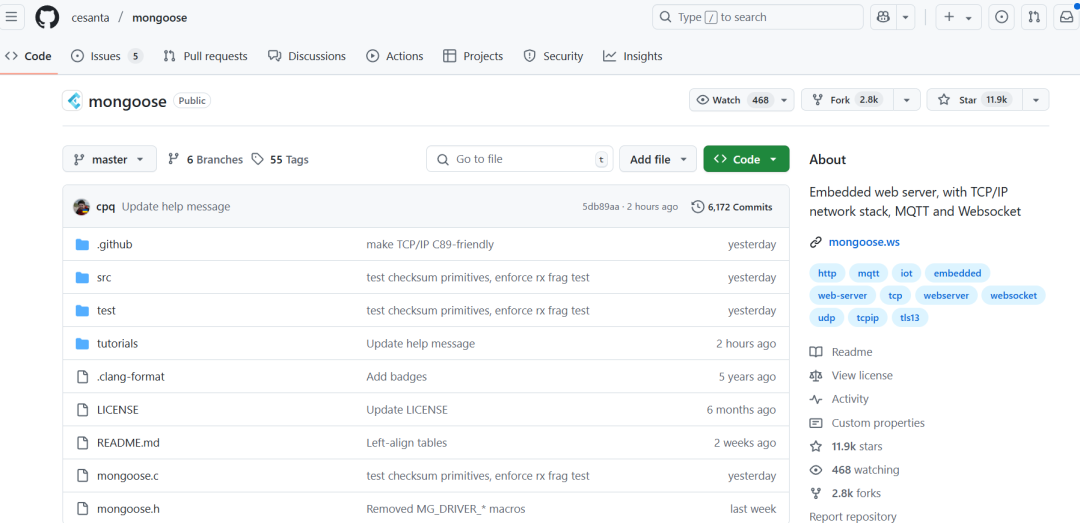
What is Mongoose Imagine being able to run HTTP, WebSocket, MQTT, etc., on your microcontroller, STM32, ESP32, or even a spacecraft from Beijing to Mars, using just a <span>.c</span> + a <span>.h</span>. This is Mongoose, a C/C++ networking library that has been shining since 2004. It uses an event-driven, non-blocking API to make connecting and online enabling network devices fast and stable.
What Problems Does It Solve
- • Zero dependencies: No need to piece together a bunch of third-party libraries for network protocols; just copy
<span>mongoose.c/h</span>and you’re good to go. - • Multi-protocol support: TCP, UDP, HTTP, WebSocket, MQTT… all built-in, making it easy and convenient.
- • Cross-platform: Runs on bare metal, RTOS, Linux, or Windows, with a single codebase.
- • Extremely small footprint: The code and runtime usage are very light, making it especially suitable for devices with severe memory and Flash constraints.
- • Secure and reliable: Comes with TLS 1.3 ECC, and can also interface with mbedTLS and OpenSSL, with security audits and fuzz testing available year-round.
Quick Start: Python Code Example The following Python snippet demonstrates how to call the REST API running on Mongoose to get the current time. Assume you have already implemented the <span>/api/time/get</span> endpoint in C on your device:
import requests
import time

MG_SERVER ="http://192.168.4.1:8000/api/time/get"

def fetch_time():
    try:
        resp = requests.get(MG_SERVER, timeout=2)
        data = resp.json()
        print("Current device time:", time.strftime("%Y-%m-%d %H:%M:%S", time.localtime(data["time"])))
    except Exception as e:
        print("Request failed:", e)

if __name__ == "__main__":
    while True:
        fetch_time()
        time.sleep(5)
Run this snippet on your management server or test script to easily pull and monitor the device time at regular intervals.
Pros and Cons Comparison
| Advantages | Disadvantages |
Zero dependencies, just copy <span>mongoose.c/h</span> |
API may require adjustment for newcomers to the event-driven model. |
| Supports HTTP, WebSocket, MQTT, CoAP… | Documentation examples are biased towards C/C++, with less rich bindings for other languages. |
| Cross-platform: bare metal, RTOS, Linux, Windows | If extreme performance is desired, writing a custom protocol stack can sometimes allow for finer optimization. |
| Built-in TLS, high security | Commercial licensing fees can be relatively high (differences between GPLv2 free version and commercial version). |
| Community + commercial dual support, with cases across industries and aerospace | Debugging requires tracking the event loop, making step-by-step debugging slightly complex. |
Conclusion Mongoose acts like a “network engine” for embedded devices, allowing you to focus on business logic without worrying about various protocols, cross-platform issues, memory usage, and security. Whether you are working on smart home applications, industrial automation, or adding a web front end to a Mars rover, Mongoose can assist you.
Project Address: https://github.com/cesanta/mongoose