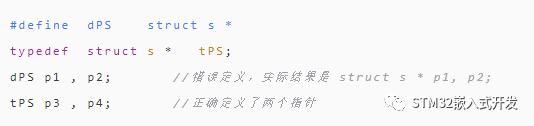
Use the preprocessor directive #define to declare a constant that indicates how many seconds are in a year (ignoring leap years):
#define SECONDS_PER_YEAR (60 * 60 * 24 * 365)ULWrite a standard macro MIN that takes two parameters and returns the smaller one:
#define MIN(A,B) ((A) <= (B) ? (A):(B))What is the purpose of the preprocessor identifier #error:
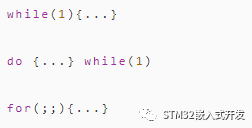
#error : Stop compilation and display error messageInfinite loops are often used in embedded systems; how would you write an infinite loop in C:
Define the following using the variable a:
-
Integer: int a;
-
Pointer to an integer: int * a;
-
Pointer to a pointer that points to an integer: int ** a;
-
Array of 10 integers: int a[10];
-
Array of 10 pointers, where each pointer points to an integer: int * a[10];
-
Pointer to an array of 10 integers: int (* a)[10];
-
Pointer to a function that takes an integer parameter and returns an integer: int (* a)(int);
Please write down two functions of static:

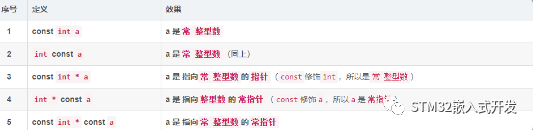
The function of the const keyword:

Additionally, using const to define a variable:
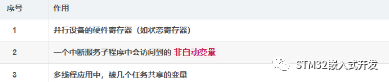
The function of volatile:
A variable defined as volatile may be changed unexpectedly, and the optimizer must re-read the value of this variable instead of using a backup stored in a register.
Example of a volatile variable:
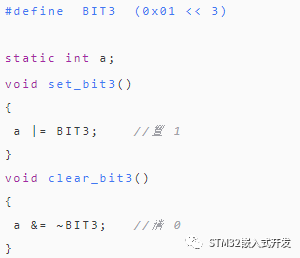
Embedded systems often require users to perform bit operations on variables or registers:
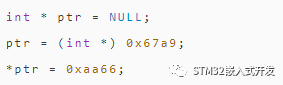
Embedded systems often require programmers to access specific memory locations, for example, setting the value of an integer variable at absolute address 0x67a9 to 0xaa66:
The concept of interrupts:
When an event occurs, the CPU stops executing the current program and switches to execute the program that handles the event. After handling the event, it returns to continue executing the original program.
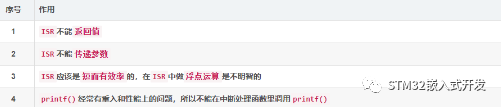
ISR: Interrupt Service Routines.
What is the output of the following code?
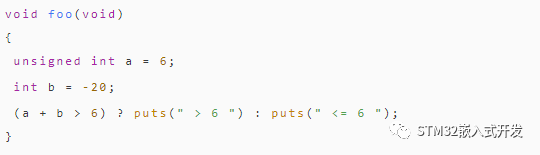
When there are signed and unsigned types in an expression, all operands are automatically converted to unsigned types, so -20 becomes a very large positive integer, and the result of the expression is greater than 6, thus the output is > 6.
Dynamic memory allocation:

The typedef statement is used to define a new name for basic data types and exported data types: