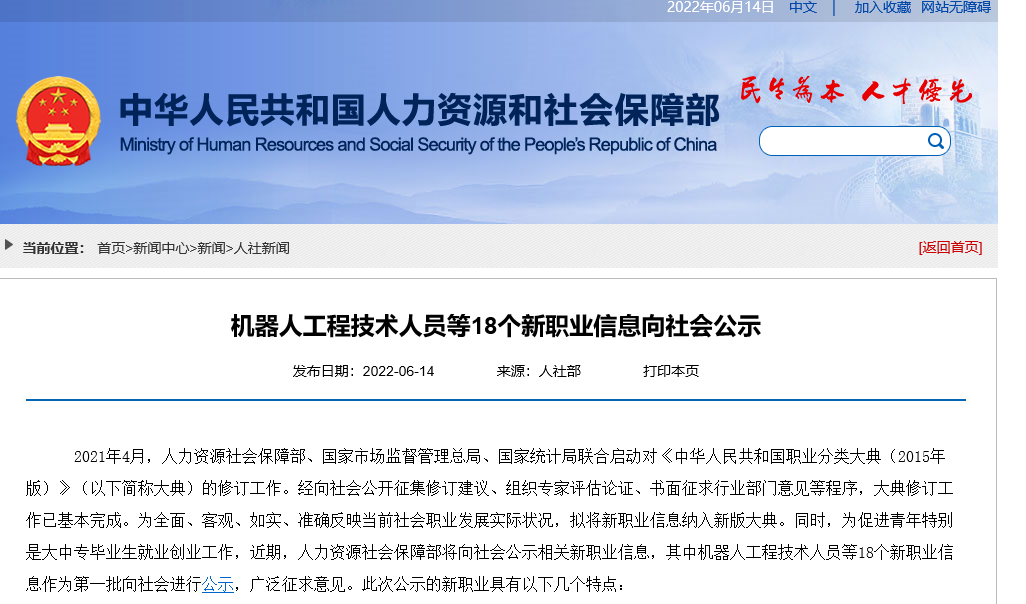
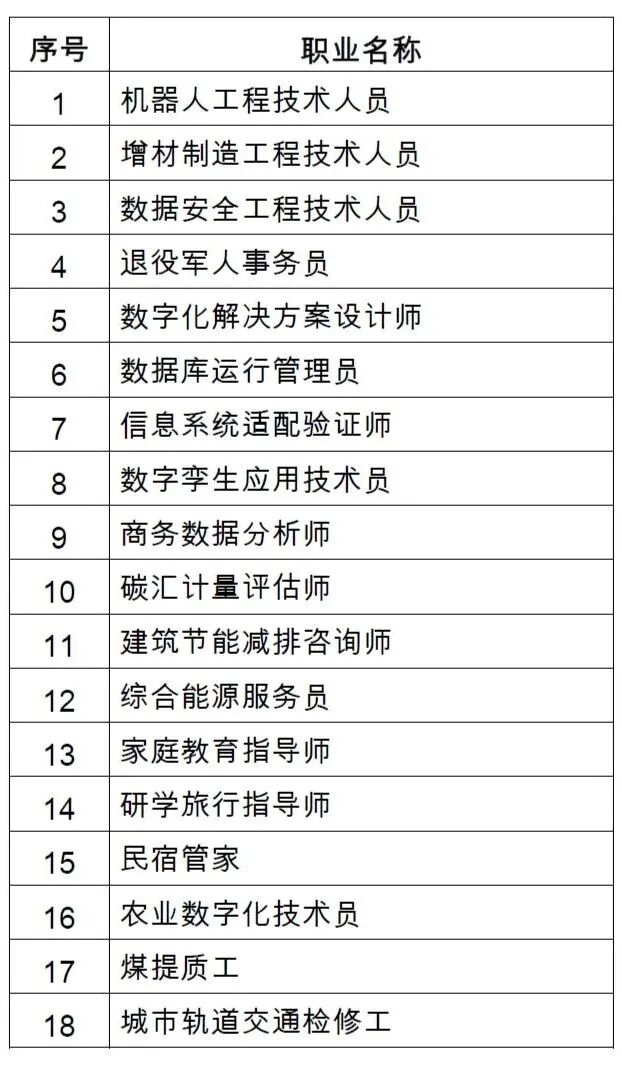
On June 14, the Ministry of Human Resources and Social Security publicly announced information on 18 new professions, including Robotics Engineering Technicians, Data Security Engineering Technicians, and Carbon Sink Measurement and Assessment Engineers, covering various emerging fields such as the digital industry and green industry.
According to a relevant official from the Ministry of Human Resources and Social Security, the new professions announced this time have the following characteristics:
First, they reflect the needs of the digital economy.The newly announced professions such as “Robotics Engineering Technicians,” “Additive Manufacturing Engineering Technicians,” “Data Security Engineering Technicians,” “Digital Solution Designers,” “Database Administrators,” “Information System Adaptation Verifiers,” “Digital Twin Application Technicians,” “Business Data Analysts,” and “Agricultural Digital Technicians” are categorized and labeled based on their distinct digital characteristics.
Second, they align with the trend of carbon peak and carbon neutrality.As the energy and economic structure quietly changes, new professions such as “Carbon Sink Measurement and Assessment Engineers,” “Comprehensive Energy Service Personnel,” “Building Energy Efficiency and Emission Reduction Consultants,” and “Coal Quality Improvement Workers” have emerged.
Third, they meet the needs of people’s better lives.For example, the newly emerged professions such as “Homestay Managers,” “Urban Rail Transit Maintenance Workers,” “Veterans Affairs Officers,” “Family Education Instructors,” and “Study Tour Guides.” Among them, the booming homestay industry has seen the number of “Homestay Managers” grow from zero to over a million in just a few years.
Digital skills are in high demand, with a talent gap of nearly ten million.According to the “New Profession Online Learning Platform Development Report” released by the Ministry of Human Resources and Social Security’s China Employment Training Technical Guidance Center in collaboration with Alibaba DingTalk, in the next five years, the demand for new profession talents will be enormous, with an estimated 1.5 million Cloud Computing Engineers, 5 million IoT Installation and Debugging Technicians, 1 million Drone Pilots, 2 million Esports Players, 1.5 million Esports Operators, 1.5 million Agricultural Managers, 5 million AI Talents, 1.3 million Building Information Modeling Technicians, and 1.25 million Industrial Robot System Operators and Maintenance Workers, with the number of Digital Management Professionals exceeding 2 million, resulting in a talent gap of nearly ten million.
The report points out that the preference for digital skills has become a significant characteristic of the new profession era.Digital Management Professionals, Drone Pilots, AI Engineering Technicians, Agricultural Managers, and IoT Engineering Technicians are the new professions that users most want to learn. Among them, those born in the 1960s prefer Agricultural Managers, while those born in the 2000s prefer Esports Operators.
In terms of regional distribution, Guangdong, Zhejiang, Beijing, Henan, Shandong, Shaanxi, Jiangsu, Shanghai, Hebei, Hubei, and Sichuan have the highest number of learners for new professions, and the popularity of new professions injects new momentum into urban development, giving rise to more and more “new employment cities.”
In terms of age demographics, those born in the 1980s and 1990s are the main force in new professions, accounting for 83%. “Career freedom” has become the work style pursued by young people. Career freedom refers to the ability of professionals to master multiple career skills and choose more than two careers, having the autonomy to select their employment.
In terms of career development, 83% of those born in the 1980s have encountered career crises or bottlenecks, with the proportion for those born in the 1990s being 82%. Compared to other age groups, those born in the 1990s are the most worried about unemployment, with 79% expressing concern. 95% of users believe that learning new professions and enhancing their development potential are key factors in overcoming career crises.
Ministry of Human Resources and Social Security Announces a Total of 56 New ProfessionsAccording to statistics, since 2019, the Ministry of Human Resources and Social Security has officially announced four batches of a total of 56 new professions.
-
First Batch
In April 2019, the Ministry of Human Resources and Social Security, in conjunction with the State Administration for Market Regulation and the National Bureau of Statistics, announced 13 new professions. This was the first batch of new professions released since the promulgation of the “Occupational Classification Standard of the People’s Republic of China (2015 Edition).” The specific professions include: AI Engineering Technicians, IoT Engineering Technicians, Big Data Engineering Technicians, Cloud Computing Engineering Technicians, Digital Management Professionals, Building Information Modeling Technicians, Esports Operators, Esports Players, Drone Pilots, Agricultural Managers, IoT Installation and Debugging Technicians, Industrial Robot System Operators, and Industrial Robot System Maintenance Workers.
· Related Digital Professions in the First Batch of New Professions01Artificial Intelligence Engineering Technicians
Definition: Engineering technicians engaged in the analysis, research, and development of various technologies related to artificial intelligence algorithms, deep learning, etc., and responsible for the design, optimization, operation, management, and application of artificial intelligence systems.
Main Tasks:
1. Analyze and research artificial intelligence algorithms, deep learning, and neural network technologies;
2. Research, develop, and apply artificial intelligence instructions, algorithms, and technologies;
3. Plan, design, and develop chips based on artificial intelligence algorithms;
4. Research, develop, and optimize technologies such as language recognition, semantic recognition, image recognition, and biometric recognition;
5. Design, integrate, manage, and deploy artificial intelligence hardware and software systems;
6. Design and develop artificial intelligence system solutions;
7. Provide technical consulting and services related to artificial intelligence.
02IoT Engineering Technicians
Definition: Engineering technicians engaged in the research and development of IoT architecture, platforms, chips, sensors, smart tags, etc., as well as the design, testing, maintenance, management, and service of IoT engineering.
Main Tasks:
1. Research and apply IoT technologies, architectures, protocols, and standards;
2. Research, design, and develop dedicated IoT chips and hardware and software systems;
3. Plan, research, and design IoT solutions;
4. Plan, design, integrate, deploy IoT systems, and guide engineering implementation;
5. Install, debug, maintain, and ensure the normal operation of IoT systems;
6. Monitor, manage, and ensure the security of IoT systems;
7. Provide technical consulting and support for IoT systems.
03Big Data Engineering Technicians
Definition: Engineering technicians engaged in the research of big data collection, cleaning, analysis, governance, mining, etc., and responsible for utilizing, managing, maintaining, and servicing these technologies.
Main Tasks:
1. Research and develop technologies related to big data collection, cleaning, storage, management, analysis, mining, presentation, and application;
2. Research and apply big data platform architectures, technologies, and standards;
3. Design, develop, integrate, and test big data hardware and software systems;
4. Collect, clean, model, and analyze big data;
5. Manage, maintain, and ensure the stable operation of big data systems;
6. Monitor, manage, and ensure the security of big data;
7. Provide technical consulting and services for big data.
04Cloud Computing Engineering Technicians
Definition: Engineering technicians engaged in the research of cloud computing technologies, cloud system construction, deployment, operation and maintenance, cloud resource management, applications, and services.
Main Tasks:
1. Develop virtualization, cloud platform, cloud resource management, and distribution technologies, as well as large-scale data management and distributed data storage technologies;
2. Research and apply cloud computing technologies, architectures, protocols, and standards;
3. Plan, design, develop, integrate, and deploy cloud computing systems;
4. Manage, maintain, and ensure the stable operation of cloud computing systems;
5. Monitor and ensure the security of cloud computing systems;
6. Provide technical consulting and services for cloud computing systems.
05Digital Management Professionals
Definition: Personnel who use digital intelligent mobile office platforms to build organizational structures, maintain operational processes, facilitate workflow collaboration, conduct big data decision analysis, and connect upstream and downstream operations online, achieving online and digital management of enterprises.
Main Tasks:
1. Develop plans and implementation schemes for promoting digital office software, build organizational structures, and conduct flat, transparent, and visual management;
2. Build digital office modules and maintain operational processes to achieve efficient and secure communication;
3. Establish workflow collaboration mechanisms for enterprises and organizations, facilitating knowledge and experience sharing;
4. Online business processes and behaviors, achieving big data decision analysis for enterprises;
5. Connect information channels between enterprises and organizations, achieving online organization, communication, collaboration, and business, reducing costs and improving production and sales efficiency.
06Building Information Modeling Technicians
Definition: Technicians who use computer software to simulate construction processes in engineering practice to improve the technical processes throughout.
Main Tasks:
1. Responsible for building, reviewing, and managing building information models in projects, including architecture, structure, HVAC, plumbing, and electrical specialties;
2. Collaborate with other specialties for modeling and conduct collision checks;
3. Conduct visual design of building information models through indoor and outdoor rendering, virtual tours, architectural animations, and virtual construction cycles;
4. Construction management and later operation and maintenance.
07Drone Pilots
Definition: Personnel who control drones to complete designated flight tasks through remote control devices.
Main Tasks:
1. Install and debug drone motors, power devices, propellers, and corresponding task equipment;
2. Plan flight routes according to tasks;
3. Adjust flight parameters based on flight environment and weather conditions;
4. Operate drones to complete designated flight tasks;
5. Organize and analyze collected data;
6. Evaluate flight results and work effectiveness;
7. Inspect, maintain, and organize drones and task equipment.
08IoT Installation and Debugging Technicians
Definition: Personnel who use testing instruments and specialized tools to install, configure, and debug IoT products and devices.
Main Tasks:
1. Test the quality of IoT devices, sensing modules, and control modules;
2. Assemble IoT devices and related accessories;
3. Connect IoT device circuits;
4. Establish connections between IoT devices and networks;
5. Adjust installation distances and optimize IoT network layouts;
6. Configure parameters for IoT gateways and short-range transmission modules;
7. Prevent and resolve network paralysis, interruptions, and other incidents in IoT products and network systems, ensuring normal operation.
09Industrial Robot System Operators
Definition: Personnel who use teaching devices, operation panels, and other human-machine interaction devices and related mechanical tools to assemble, program, debug, change process parameters, replace fixtures, and perform other auxiliary tasks on industrial robots, industrial robot workstations, or systems.
Main Tasks:
1. Complete job preparation according to the requirements of process guidance documents and other relevant documents;
2. Assemble industrial robot workstations or systems using tools and instruments according to assembly drawings, electrical diagrams, and process documents;
3. Use teaching devices, computers, configuration software, and other relevant hardware and software tools to program, debug unit functions, and conduct production joint debugging for industrial robots, programmable logic controllers, human-machine interfaces, motors, and sensors;
4. Use teaching devices and operation panels to set and modify production process parameters, select and configure menu functions, and choose and switch programs;
5. Inspect, confirm, replace, and reset industrial robot system fixtures and other devices;
6. Observe changes in the status of industrial robot workstations or systems and take corresponding actions, executing emergency stop operations in case of anomalies;
7. Fill out records of equipment assembly, operation, etc.
10Industrial Robot System Maintenance Workers
Definition: Personnel who use tools, measuring instruments, testing instruments, and equipment to collect data, monitor status, analyze and diagnose faults, and perform maintenance and preventive maintenance on industrial robots, industrial robot workstations, or systems.
Main Tasks:
1. Conduct routine inspections and diagnostics on industrial robots, end effectors, and surrounding devices;
2. Conduct routine inspections and diagnostics on the electrical systems of industrial robots, including control systems, drive systems, power supplies, and wiring;
3. Perform maintenance on industrial robots, industrial robot workstations, or systems according to maintenance manuals, including zero position calibration, dust prevention, battery replacement, and lubrication;
4. Use measuring equipment to collect operational parameters and working status data of industrial robots, industrial robot workstations, or systems for monitoring;
5. Analyze, diagnose, and repair faults in industrial robot workstations or systems;
6. Compile operation and maintenance reports for industrial robot systems.
-
Second Batch
In February 2020, the Ministry of Human Resources and Social Security, in conjunction with the State Administration for Market Regulation and the National Bureau of Statistics, announced 16 new professions. These include: Intelligent Manufacturing Engineering Technicians, Industrial Internet Engineering Technicians, Virtual Reality Engineering Technicians, Chain Operation Managers, Supply Chain Managers, On-Demand Delivery Personnel, AI Trainers, Environmental Testing Personnel for Electrical and Electronic Products, Multimedia Operators, Health Care Workers, Respiratory Therapists, Birth Defect Prevention Consultants, Rehabilitation Technology Consultants, Drone Assembly and Maintenance Workers, Railway Comprehensive Maintenance Workers, and Prefabricated Building Construction Workers.
· Related Digital Professions in the Second Batch of New Professions01Intelligent Manufacturing Engineering Technicians
Definition: Engineering technicians engaged in the research and development of technologies related to intelligent manufacturing, responsible for the design, installation, debugging, management, and application of intelligent manufacturing equipment and production lines.
Main Tasks:
1. Analyze, research, and develop technologies related to intelligent manufacturing;
2. Research, design, and develop intelligent manufacturing equipment and production lines;
3. Research, develop, and apply intelligent manufacturing virtual simulation technologies;
4. Design, operate, and apply intelligent detection systems;
5. Design, develop, and apply intelligent production management systems;
6. Install, debug, and deploy intelligent manufacturing equipment and production lines;
7. Operate, program, and apply intelligent manufacturing equipment and production lines for intelligent processing;
8. Provide technical consulting and services related to intelligent manufacturing.
02Industrial Internet Engineering Technicians
Definition: Engineering technicians engaged in planning, designing, technical research, testing, engineering implementation, operation management, and maintenance services in the fields of industrial internet networks, platforms, and security.
Main Tasks:
1. Research and design solutions for network interconnection and data sharing, guiding engineering implementation;
2. Research, develop, and apply industrial big data collection technologies, industrial mechanism models, and advanced data analysis and mining technologies;
3. Research, design, develop, test, and promote industrial internet application platforms and industrial applications;
4. Plan, design, and deploy industrial internet security systems, monitoring, managing, and ensuring the security of industrial internet networks, platforms, and data;
5. Plan and operate asset data for industrial chains and supply chains, guiding resource allocation, collaborative production, flexible production, equipment health, and energy consumption management;
6. Build, test, and maintain industrial internet networks, monitoring relevant information, dynamically maintaining network links and resources;
7. Provide explanations of industrial internet terminology, technical consulting, and engineering implementation guidance.
03Virtual Reality Engineering Technicians
Definition: Engineering technicians engaged in the planning, design, coding, testing, maintenance, and service of virtual reality products using virtual reality engines and related tools.
Main Tasks:
1. Plan virtual reality software products, design scenes, design interfaces, create models, develop programs, and conduct system testing;
2. Design, develop, integrate, and test virtual reality hardware systems;
3. Research, apply virtual reality architectures, technologies, and standards;
4. Manage, monitor, maintain, and ensure the stable and secure operation of virtual reality products;
5. Provide technical consulting, training, and support services related to virtual reality technologies.
04On-Demand Delivery Personnel
Definition: Personnel who receive and verify customer orders through mobile internet platforms, deliver ordered items to designated locations within a specified time according to platform-intelligent planned routes.
Main Tasks:
1. Receive, verify, and check customer orders through mobile smart terminals, including but not limited to quantity, size, specifications, color, shelf life, price, and address;
2. Classify and organize ordered items, arranging delivery sequences;
3. Deliver ordered items to designated locations within a specified time according to customer requirements and the delivery route planned by the network platform;
4. Handle delivery exceptions such as no reception, refusal, and damage;
5. Address customer complaints and other delivery requests.
05AI Trainers
Definition: Personnel who use intelligent training software to manage databases, set algorithm parameters, design human-computer interaction, track performance testing, and perform other auxiliary tasks during the actual use of AI products.
Main Tasks:
1. Label and process original data such as images, text, and voice;
2. Analyze and extract features from specialized fields, training, and evaluating algorithms, functions, and performance of AI products;
3. Design interaction processes and application solutions for AI products;
4. Monitor, analyze, and manage application data of AI products;
5. Adjust and optimize parameters and configurations of AI products.
This profession includes but is not limited to the following job types:
Data Annotators, AI Algorithm Testers
06Multimedia Operators
Definition: Personnel who utilize various media technologies and channels, employing data analysis and creative planning to process, match, distribute, disseminate, and provide feedback on information.
Main Tasks:
1. Use network information technology and related tools to conduct data analysis on media and audiences, guiding media operations and the matching and precision of information dissemination;
2. Plan and process information content such as text, sound, images, animations, and web pages to make them suitable for dissemination;
3. Precisely distribute, disseminate, and market information carriers to target audiences;
4. Collect relevant data and adjust media distribution channels, strategies, and actions based on real-time data analysis and monitoring;
5. Establish a multimedia communication matrix, creating multidimensional information entry and exit points, and coordinating operations across all ports.
07Drone Assembly and Maintenance Workers
Definition: Personnel who use equipment, tools, and debugging software to select, assemble, debug, repair, and maintain drones.
Main Tasks:
1. Select, produce, and test drone components based on product performance and other relevant requirements;
2. Assemble drones using specialized tools according to assembly drawings and other relevant requirements;
3. Use relevant debugging software and tools to conduct joint debugging and testing of drone systems and functional modules;
4. Use specialized testing instruments and software to test, analyze faults, and diagnose issues in drone systems;
5. Repair drones based on fault diagnosis results using relevant tools;
6. Test the performance of repaired drones using specialized testing tools and software;
7. Maintain various functional modules of drones according to maintenance manuals;
8. Compile reports on drone equipment assembly, testing, and repair.
-
Third Batch
In June 2020, the Ministry of Human Resources and Social Security, in conjunction with the State Administration for Market Regulation and the National Bureau of Statistics, announced 9 new professions. This batch also included five job types such as “Live Sales Personnel” and “Internet Information Review Personnel.” The specific professions include: Blockchain Engineering Technicians, Urban Management Grid Personnel, Internet Marketing Specialists, Information Security Testers, Blockchain Application Operators, Online Learning Service Personnel, Community Health Assistants, Elderly Capability Assessors, and Additive Manufacturing Equipment Operators.
· Related Digital Professions in the Third Batch of New Professions01Blockchain Engineering Technicians
Definition: Engineering technicians engaged in blockchain architecture design, underlying technology, system applications, system testing, system deployment, and operation maintenance.
Main Tasks:
1. Analyze and research distributed ledgers, privacy protection mechanisms, cryptographic algorithms, consensus mechanisms, smart contracts, and other technologies;
2. Design blockchain platform architecture and write blockchain technology reports;
3. Design and develop underlying technical solutions for blockchain system applications;
4. Design and develop performance evaluation indicators and tools for blockchain;
5. Address deployment, debugging, and operational management issues during the application of blockchain systems;
6. Provide blockchain technology consulting and services.
02Urban Management Grid Personnel
Definition: Personnel who use modern urban network management technologies to patrol, verify, report, and address issues related to municipal engineering (public) facilities, urban appearance, and social management affairs, and collect, analyze, and address relevant information.
Main Tasks:
1. Operate information collection devices to patrol and identify issues related to municipal engineering (public) facilities, urban appearance, and social management affairs within the grid, and accept related public reports;
2. Use system platforms to verify, report, and record issues discovered or reported by the public within the grid;
3. Research issues related to municipal engineering (public) facilities, urban appearance, and social management affairs within the grid, proposing solutions;
4. Notify responsible units of existing issues and assist in resolving related problems;
5. Verify issues reported by higher authorities, assist responsible units in addressing them, and provide feedback on the resolution results;
6. Collect, organize, and analyze relevant information and data, proposing optimization suggestions for urban governance within the grid.
03Internet Marketing Specialists
Definition: Personnel who utilize the interactivity and credibility of networks on digital information platforms to market and promote enterprise products.
Main Tasks:
1. Research user positioning and operational methods of digital information platforms;
2. Accept enterprise commissions to verify information regarding enterprise qualifications and product quality;
3. Select relevant products, design marketing plans, and establish commission settlement methods;
4. Build digital marketing scenarios, promoting products across multiple platforms through live broadcasts or short videos;
5. Enhance personal influence and increase user engagement, promoting the conversion rate from attention to purchase;
6. Sign sales orders and settle sales payments;
7. Coordinate after-sales services for sold products;
8. Collect and analyze sales data, providing optimization suggestions for enterprises or products.
This profession includes but is not limited to the following job types:
Live Sales Personnel
04Information Security Testers
Definition: Personnel who conduct penetration testing on the networks and systems of evaluation targets to identify security issues and propose improvements to protect networks and systems from malicious attacks.
Main Tasks:
1. Analyze and research network and information system security attack and defense technologies, tracking their developments;
2. Use information collection tools and techniques to gather and analyze relevant information about evaluation targets;
3. Develop security testing plans and implementation strategies for evaluation targets;
4. Use vulnerability detection tools to locate and identify security vulnerabilities in evaluation targets, conducting technical verification and assessment;
5. Use penetration tools to conduct in-depth testing on evaluation targets, verifying security vulnerabilities that may lead to network and system security risks;
6. Compile security assessment reports and assist professionals in restoring and improving the security of evaluation targets.
05Blockchain Application Operators
Definition: Personnel who use blockchain technology and tools to operate applications in government affairs, finance, healthcare, education, and elderly care.
Main Tasks:
1. Analyze and research user needs in blockchain application scenarios;
2. Design system application plans, processes, and models;
3. Assist in system development using relevant application development frameworks;
4. Test system functionality, security, and stability;
5. Operate system applications on blockchain service platforms;
6. Monitor and maintain system applications;
7. Collect and summarize issues encountered during system application operations.
06Online Learning Service Personnel
Definition: Personnel who use digital learning platforms (tools) to provide learners with personalized, precise, timely, effective learning planning, guidance, support services, and feedback.
Main Tasks:
1. Analyze learners’ learning situations, proposing targeted learning plans and suggestions;
2. Provide comprehensive, full-cycle personalized guidance and course management services to learners, addressing technical, content, and methodological issues during the learning process;
3. Manage online learning classes, establishing and maintaining online interactive communities to stimulate learners’ motivation and interest;
4. Use analysis and evaluation tools to comprehensively evaluate learners’ learning activities and outcomes, providing timely feedback;
5. Propose optimization suggestions for learning platforms, tools, and resources based on learners’ experiences.
- Fourth Batch
In March 2021, the Ministry of Human Resources and Social Security, in conjunction with the State Administration for Market Regulation and the National Bureau of Statistics, announced 18 new professions. These include: Integrated Circuit Engineering Technicians, Corporate Compliance Officers, Corporate Financial Advisors, Barter Specialists, Second-Hand Car Brokers, Automotive Rescue Personnel, Beverage Technicians, Food Safety Managers, Service Robot Application Technicians, Electronic Data Forensics Analysts, Vocational Trainers, Cryptography Technology Application Personnel, Building Curtain Wall Designers, Carbon Emission Managers, Pipeline Operation and Maintenance Personnel, Wine Body Designers, Smart Hardware Assembly Technicians, and Industrial Vision System Maintenance Workers.· Related Digital Professions in the Fourth Batch of New Professions01Integrated Circuit Engineering Technicians
Definition: Engineering technicians engaged in chip demand analysis, chip architecture design, detailed chip design, testing and verification, netlist design, and layout design.
Main Tasks:
1. Define specifications, analyze requirements, compile design manuals, and develop design plans for chip design;
2. Define specifications for chips, write RTL code, verify, conduct logical synthesis, timing analysis, and testability design;
3. Conduct design simulation, logical verification, and related prototype validation and testing for chips;
4. Conduct backend design, overall layout, and analog layout design for chips;
5. Conduct backend simulation, physical verification of layouts, timing/noise/power analysis, and global integrity analysis and verification for chips;
6. Sign off and validate chip production data according to production processes.
02Service Robot Application Technicians
Definition: Personnel who use service robot (including special robots) technologies and tools to integrate, implement, optimize, maintain, and manage service robots in application scenarios such as home services, medical services, and public services.
Main Tasks:
1. Analyze the needs of service robots in personal/home services, medical services, and public services, proposing application solutions;
2. Adapt, install, debug, and troubleshoot systems for service robots, including environmental perception, motion control, and human-computer interaction;
3. Responsible for parameter tuning and deployment of service robot application systems;
4. Monitor, analyze, optimize, and maintain the operational effectiveness of service robots;
5. Provide technical consulting and services related to service robots.
03Electronic Data Forensics Analysts
Definition: Personnel engaged in the collection, extraction, recovery, and forensic analysis of electronic data.
Main Tasks:
1. Conduct on-site and online extraction of various electronic data;
2. Analyze electronic data recovery technologies based on physical repair or data characteristics;
3. Extract and analyze electronic data from different media and smart terminals;
4. Extract and analyze electronic data from servers, databases, and public cloud;
5. Extract and analyze electronic data from IoT and engineering control systems;
6. Design and establish visual analysis models for electronic data forensics;
7. Analyze the functions of applications on computers and other smart terminals.
04Cryptography Technology Application Personnel
Definition: Personnel who use cryptography technology to engage in the architecture design, system integration, testing and evaluation, operation management, and cryptography consulting of information system security.
Main Tasks:
1. Analyze security threats and business application scenarios involving cryptography technology in information and communication systems;
2. Design cryptography application planning and implementation schemes;
3. Engage in the deployment and implementation of cryptography resources in information systems;
4. Conduct security assessments of cryptography applications in information systems according to standards and specifications;
5. Manage cryptographic assets, ensure security, and apply cryptography technology;
6. Respond to emergencies involving cryptography application security incidents;
7. Monitor and maintain the application status of cryptography in information systems;
8. Provide cryptography application technical consulting, vocational skills training, and popular science services.
05Carbon Emission Managers
Definition: Personnel engaged in monitoring, statistical accounting, verification, trading, and consulting related to carbon dioxide and other greenhouse gas emissions from enterprises and institutions.
Main Tasks:
1. Monitor the current carbon emissions of enterprises and institutions;
2. Statistically account for carbon emission data from enterprises and institutions;
3. Verify the carbon emission status of enterprises and institutions;
4. Buy, sell, and mortgage carbon emission rights of enterprises and institutions;
5. Provide consulting services related to carbon emissions for enterprises and institutions.
This profession includes but is not limited to the following job types:
Civil Aviation Carbon Emission Managers, Carbon Emission Monitors, Carbon Emission Accountants, Carbon Emission Verifiers, Carbon Emission Traders, Carbon Emission Consultants.
06Smart Hardware Assembly Technicians
Definition: Technical service personnel who can use oscilloscopes, signal generators, and computers or mobile phones to complete hardware assembly and debugging, software code debugging and testing, system configuration, and joint debugging tasks for smart hardware modules, components, and systems.
Main Tasks:
1. Operate electronic product assembly equipment, oscilloscopes, signal generators, etc., to complete the assembly, debugging, and troubleshooting of smart hardware components, testing and debugging of component function software, and writing assembly reports;
2. Analyze and research the specific needs of smart hardware in application scenarios such as home services, medical services, logistics, and public services, proposing solutions;
3. Responsible for parameter tuning, application of solutions, and deployment of smart hardware application systems, writing maintenance reports;
4. Adapt, install, and debug smart hardware in environmental perception, automatic control, and human-computer interaction applications;
5. Test the functionality of smart hardware application systems, writing application system testing and optimization reports;
6. Provide technical consulting and services related to smart hardware.
07Industrial Vision System Maintenance Workers
Definition: Personnel engaged in the selection, installation, debugging, programming, fault diagnosis and elimination, and daily maintenance and upkeep of intelligent equipment vision systems.
Main Tasks:
1. Select, debug, and maintain vision hardware such as cameras, lenses, and code readers;
2. Conduct object imaging and lighting;
3. Conduct precision calibration of vision systems;
4. Conduct coordinate system calibration of vision systems and third-party systems;
5. Integrate and embed communication between vision application systems and main industrial software;
6. Confirm and capture object features during imaging;
7. Identify and classify the quality of images during system operation, determining and resolving issues;
8. Design small sample programs to verify process accuracy;
9. Reset, debug, and verify systems after replacing vision hardware.
Related Reading
1. How to Define New Professions, What Information is Included in New Professions?
New professions refer to those not included in the “Occupational Classification Standard of the People’s Republic of China” (hereinafter referred to as the Standard), which have a certain scale of practitioners in social and economic development and possess relatively independent and mature professional and skill requirements.
New profession information mainly includes: profession name, profession code, profession definition, and main tasks, which are basically consistent with the profession information in the Standard. Professions with “environmental protection, low carbon, recycling,” and other green characteristics are marked as green professions, uniformly identified by the initial letter “L” of the Chinese pinyin for “green profession.”
2. When was the New Profession Information Release System Established in Our Country, and What is Its Significance?
Establishing a new profession information release system is an internationally accepted practice and an important part of the dynamic adjustment mechanism for occupational classification. In 1999, our country issued the first Standard, which included 1,838 professions. Entering the new century, with the rapid development of our economy and society, industrial structure adjustments, scientific and technological progress, and mass entrepreneurship and innovation, many new business formats have emerged in society that urgently need to be recognized and standardized at the national level, leading to the emergence of the new profession information release system. The first new profession information release work began in 2004, and by 2009, a total of 12 batches of over 120 new professions had been released. After 2010, the country initiated the revision of the Standard. In July 2015, the 2015 edition of the Standard was issued. Nearly four years after the issuance of the 2015 edition of the Standard, with the development of the economy and society, scientific and technological progress, and industrial structure adjustments, new industries, new business formats, and new models have given rise to new professions, necessitating the restart of the new profession information release work.
The significance of the new profession information release system. First, it is conducive to promoting employment and entrepreneurship. By standardizing new professions through the release of new profession information, it accelerates the development of job positions, expands employment capacity, strengthens career guidance and employment services, and promotes laborers’ employment and entrepreneurship. Second, it is conducive to promoting the reform of vocational education and training. It encourages the alignment of professional settings, course content with social needs and actual production, enhancing the quality of vocational education and training, and ensuring that talent cultivation and training closely align with social needs. Third, it is conducive to improving our country’s occupational classification and occupational standards system. By incorporating new professions into the national occupational classification for unified management and accelerating the development of occupational skill standards based on industrial development and talent team construction needs, it helps establish a dynamically updated occupational classification system and improve the occupational standards system.
3. What Impact Does the Release of New Profession Information Have?
The release of new profession information makes the national occupational classification system more scientifically sound and better serves national economic information statistics, human resource development management, vocational education training, and talent evaluation work, providing a scientific basis for the country to formulate relevant industrial development policies, conduct research and analysis on changes in employment population structure and labor supply and demand, and develop human resource market policies. The impact on employers and practitioners mainly lies in standardizing employers’ job settings, personnel recruitment, employee training, etc., making career development planning for practitioners clearer, which is conducive to promoting their professional capabilities and qualities.
Source: Data View