Operating Environment:
MATLAB 2024a
1. Algorithm Description
The Spotted Hyena Optimizer (SHO) is a novel nature-inspired intelligent optimization algorithm, inspired by the social structure, group cooperation, and hunting behaviors of spotted hyenas in the wild. This algorithm demonstrates strong convergence and global search capabilities when solving complex optimization problems, and has potential applications in various fields such as engineering optimization, image processing, path planning, and feature selection.
Before delving into the Spotted Hyena Optimizer, we can start by discussing the behavior of the spotted hyena. Spotted hyenas are social predators living in the African savanna, characterized by strong social organization and group activity. Within a hyena group, there is a clear hierarchy, and individuals collaborate to hunt and forage. Their hunting strategy typically involves multiple members surrounding the prey, gradually closing in, and achieving the goal of capturing the prey through collective cooperation. This cooperative and dynamically adjustable strategy provides significant inspiration for the design of optimization algorithms.
The Spotted Hyena Optimizer draws on the collective intelligence and cooperative hunting mechanisms of hyenas by constructing a simulated population of hyenas, where each individual represents a potential solution. Through dynamic updates of positions and strategies, the algorithm continuously approaches the optimal solution within the search space. This algorithm can be classified as a swarm intelligence algorithm, sharing similarities with ant colony optimization, particle swarm optimization, and gray wolf optimization, but its unique simulation of social structure and cooperation brings novel characteristics.
The core idea of the Spotted Hyena Optimizer can be summarized as a dynamic balance mechanism between exploration and exploitation. In the early stages of group search, the algorithm encourages individuals to explore potential solutions in a broader area, increasing search diversity and preventing convergence to local optima. As the search process progresses, the algorithm gradually guides individuals to concentrate on the currently most promising areas, thus accelerating convergence to the optimal solution.
Specifically, the SHO algorithm typically includes several key steps: initializing the population, evaluating individual fitness, updating positions, selecting dominant hunters, dynamically adjusting strategies, and iterative optimization. These steps are logically interconnected, forming a complete optimization process.
During the initialization phase of the algorithm, the simulated population of hyenas is assigned a set of initial positions, meaning they are randomly distributed in the search space. These positions represent different solutions, and each hyena individual is encoded in a way that allows it to represent a candidate solution to the actual problem. The diversity of the initial population significantly impacts subsequent search results; a good initialization strategy can help the algorithm escape local optima, thereby improving overall performance.
In the fitness evaluation phase, each hyena individual is assessed based on the quality of its position, meaning the algorithm calculates the quality of the solution represented by each individual under the objective function. Fitness evaluation is an indispensable part of the entire optimization process, as it determines which individuals will be considered “excellent” hunters, guiding other individuals to converge towards them.
Next comes the selection of dominant hunters. In the hyena population, there exists a role known as the “dominant hunter,” typically selected from several individuals based on fitness ranking, who play a leadership role in guiding the hunting direction. In the algorithm, dominant hunters guide the remaining members to move towards better areas, a mechanism similar to the guiding role of the global best particle in particle swarm optimization, but SHO allows for multiple dominant individuals, enhancing the robustness and diversity of the algorithm.
In the position update phase, hyena individuals adjust their positions based on the locations of the dominant hunters. This process is not merely about moving closer to the best solutions; it simulates the behavior of hyenas as they close in on prey, constantly approaching, testing, circling, and changing positions. Therefore, in the algorithm, this process typically includes multiple sub-strategies, such as dynamic adjustment of the encirclement radius, distance trade-offs between individuals, and position perturbations. These strategies help the hyena population effectively approach the optimal solution while maintaining a certain level of diversity.
Another important feature is the dynamic weight mechanism of exploration and exploitation in the SHO algorithm. At different stages of iteration, the algorithm automatically adjusts the emphasis individuals place on exploring new areas versus exploiting known high-quality areas. In the initial stages, there is a greater inclination towards exploration, as a wide range of feasible solutions is needed during the global search phase; while in the later stages of iteration, the algorithm focuses more on exploitation, concentrating efforts on refining the search in optimal areas. This mechanism endows SHO with good convergence characteristics and the ability to avoid premature convergence.
It is worth mentioning that the Spotted Hyena Optimizer also incorporates ideas of natural selection and genetic variation in its design. In some variants, the algorithm may introduce information crossover or mutation between individuals to enhance population diversity. This design further improves the algorithm’s ability to escape local optima, making it more advantageous in handling high-dimensional complex problems.
From an application perspective, the SHO algorithm possesses strong generality and flexibility. It can be applied to various continuous optimization, combinatorial optimization, and constrained optimization problems. For instance, in the field of image processing, SHO can be used for image segmentation and image matching tasks; in path planning, it can be applied to robot path optimization and vehicle scheduling; in feature selection and machine learning model training, SHO can also yield significant results. In practical applications, researchers may further improve or hybridize SHO based on the characteristics of the problem, such as integrating it with genetic algorithms, differential evolution, or particle swarm optimization to enhance its performance.
Compared to other swarm intelligence algorithms, SHO has several outstanding advantages. Firstly, its simulated behavioral mechanism is closer to real ecological processes, with a complex and realistic hunting model, making its strategies for approaching optimal solutions more natural and efficient. Secondly, its support for multiple dominant individuals allows the algorithm to perform well in multimodal problems, making it less likely to fall into local optima. Additionally, the parameter settings for SHO are relatively simple, facilitating engineering implementation and problem generalization.
Of course, the SHO algorithm also faces some challenges and shortcomings. For example, when dealing with large-scale high-dimensional data, it may encounter issues such as slower search speeds and increased memory consumption; in terms of convergence accuracy, it may not be as high as some specialized local optimization algorithms. To address these issues, researchers have proposed several improvement measures, such as adaptive adjustment strategies, introducing hybrid mechanisms, and incorporating local search operators, which can mitigate some of the original algorithm’s deficiencies.
In recent years, the SHO has garnered increasing attention from scholars as a relatively new algorithm in intelligent optimization research. Its theoretical foundation is becoming more robust, its application scenarios are continuously expanding, and it forms good complementary relationships with other algorithms. For example, some studies have applied SHO to neural network training to optimize weight parameters, thereby improving classification accuracy and generalization ability; others have combined it with fuzzy systems for modeling and control of complex systems.
In summary, the Spotted Hyena Optimizer is an optimization method based on natural ecosystems, integrating intelligent behavior, dynamic cooperation, and adaptive adjustment. By simulating the collective hunting process of hyenas, it constructs a clearly structured and strategically rich search mechanism, achieving efficient coordination between global search and local exploitation. It demonstrates good performance and application prospects across various optimization problems. With further research into the algorithm’s mechanisms and continuous improvement of technical means, SHO is expected to play a greater role in intelligent computing, engineering optimization, deep learning, and become an important member of the family of intelligent optimization algorithms.
2. Simulation Results Demonstration
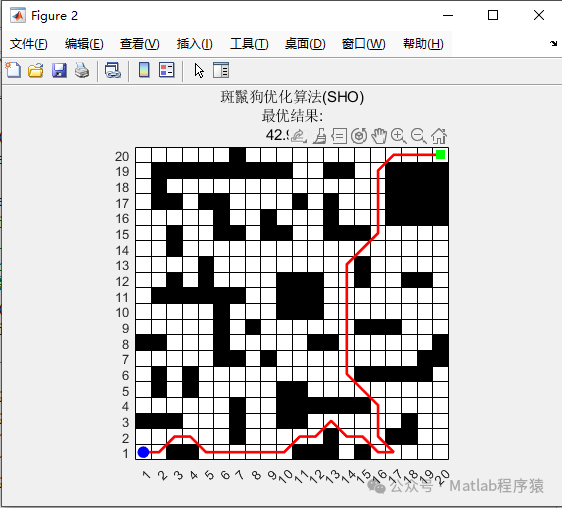
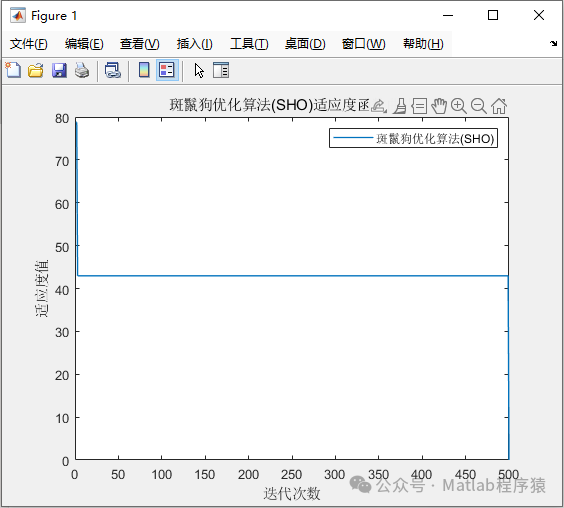
3. Key Code Display
Omitted
Recommended book: Learning about communication-related knowledge
4. Obtaining MATLAB Source Code
Method 1: Click the blue text in the articleRead the original text

Method 2: Copy the following URL and open it in your browserMaiwan Single Product
https://www.maiwan8.com/#/dynamicDetail/0/9938ebf42a20dd92a60cf8014e9776a9/index?yqm=5FCPU
Method 3: Copy the URL to openMaiwan StoreSearch for the title of this article
https://www.maiwan8.com/#/packageA/userDynamicCenter/userDynamicCenter?user_id=1261511
Method 4: If the above methods fail, please contact me viaQQ,Emailor WeChat
(Click the blue text above↑↑↑↑↑to jump)