Linking Soil Ecological Stoichiometry of Nutrients and Microbial Enzyme Activity to Bulk and Aggregate-Associated Organic Carbon in Karst Rocky Desertification
Abstract
Background: Soil microbial nutrient limitation plays a crucial role in nutrient cycling and soil organic carbon (SOC) accumulation, especially in degraded ecosystems. Karst rocky desertification (KRD) is a severe feature of soil degradation in Southwest China, but its impact on SOC and the microbial mechanisms involved are not well studied.
Methods: This study investigated soil nutrients, ecological enzyme stoichiometry, microbial resource limitation, and bulk organic carbon and aggregate-associated organic carbon (OC) in four areas of varying degrees of rocky desertification (Intense Rocky Desertification (IRD), Moderate Rocky Desertification (MRD), Light Rocky Desertification (LRD), and Non-Rocky Desertification (NRD)) in Southwest China.
Results: The results indicated that: (1) although early KRD increased SOC concentration, this effect diminished with further soil layer reinforcement; (2) compared to surface soil, micro-aggregates in subsoil (especially in LRD and IRD areas) had significantly higher OC concentrations than large macro-aggregates, highlighting that the impact of KRD on soil organic carbon stability is influenced by soil layer depth; (3) mediation analysis showed that NRD area soils were primarily nitrogen-limited, while KRD area soils were primarily phosphorus-limited, with the latter becoming more pronounced with increasing KRD intensity at both soil depths; (4) random forest modeling indicated that microbial nutrient limitation had a greater impact on micro-aggregate-associated OC than on macro-aggregates. This may be due to the higher content of nutrient-rich organic matter in micro-aggregates, making them more attractive to microbes, especially in nutrient-deficient ecosystems affected by KRD. This study provides new insights into the accumulation and contribution of aggregate-associated OC to SOC pools, emphasizing the key roles of microbial nutrient limitation, enzyme activity, and mediation characteristics in regulating SOC dynamics in KRD-affected ecosystems.
Conclusion: Understanding these interactions provides the necessary knowledge to enhance SOC sequestration and develop effective soil carbon management strategies in degraded karst environments.
Main Determination Indicators and Analysis Methods
1. Soil Physicochemical Properties and Enzymes
2. Indicators of Microbial Resource Limitation
3. One-way ANOVA followed by Duncan’s multiple range test (α = 0.05)
4. A separate one-way ANOVA with Duncan’s test
5. Redundancy analysis (RDA)
6. Random forest modeling
Main Results
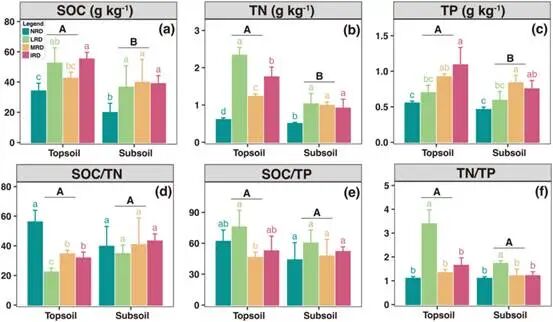
1. Soil organic carbon (SOC), total nitrogen (TN), and total phosphorus (TP) (a–c) and their stoichiometry (d–f).
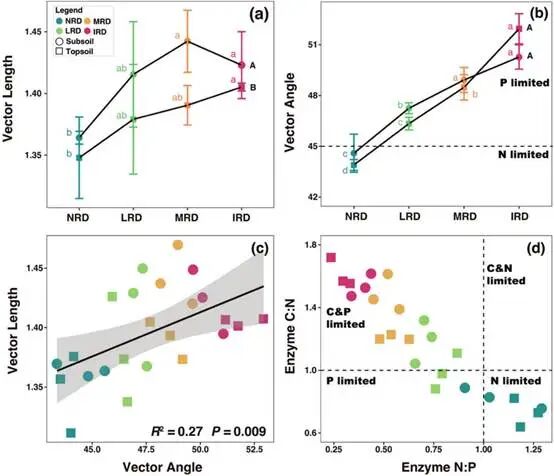
2. Ecoenzymatic vector model quantifies microbial resource limitation along the evolution of rocky desertification.
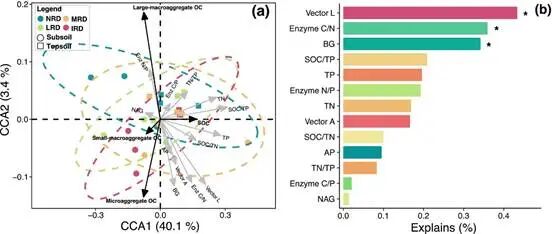
3. Redundancy analysis identifies the relationships between soil C-N-P stoichiometry, ecoenzymatic stoichiometry, and SOC within different soil aggregate fractions.
For more details, please refer to:


Click the “Read Original” button below to view the original text