When children first encounter programming, many parents have questions about which programming language to choose among graphical programming, Python, C++, and others. In today’s technologically advanced era of artificial intelligence, which programming language is the most useful?
Different age groups are suited to learn different programming languages, but regardless of which language is learned, it can effectively enhance children’s logical thinking and application judgment abilities.
“That block-based programming looks like playing a game, but languages like Python and C++ are more advanced for coding.”
“Now is the era of artificial intelligence; starting with Python will provide better prospects for children in the future.”
“Learning C++ will help children in their studies, especially for competitions like the Olympiad in Informatics!”
In fact, there is no distinction between high-level and low-level languages; they simply have different application scenarios. Blindly pursuing the complexity of programming languages is not advisable.
01Graphical Programming
Graphical programming is a tool developed by MIT, characterized by its simplicity and ease of use. Users can program without knowing English words or being familiar with keyboard operations.
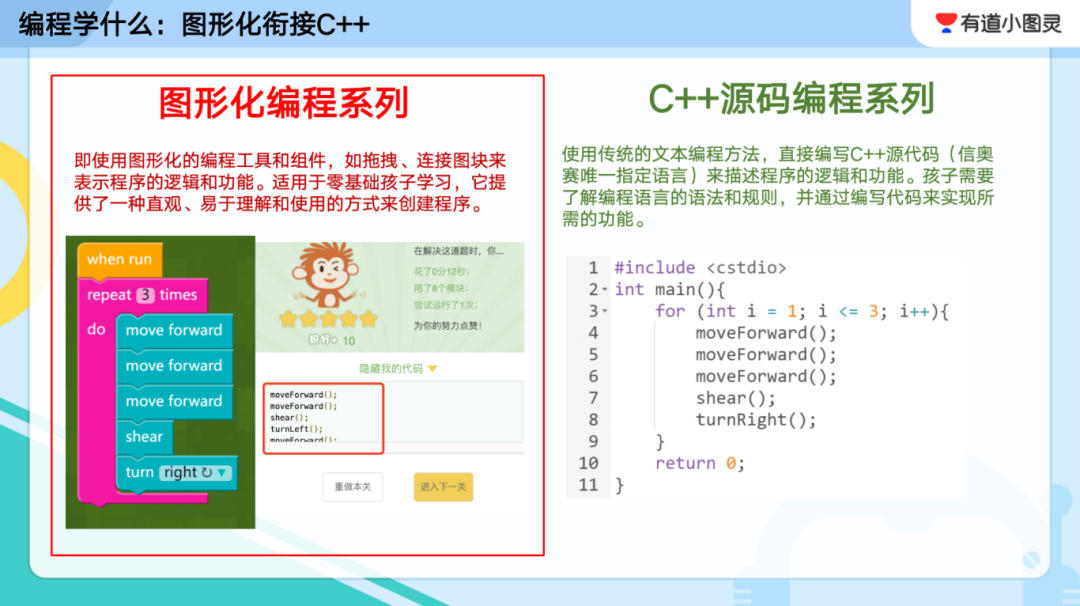
Graphical programming often uses themes like games, music, and animation to stimulate children’s interest in learning, providing various interactive modules that allow children to experience the joy of programming from the start. Through fun block-based programming, children can write programs by simply dragging and dropping, similar to building blocks.
The head of the graphical programming project at MIT Media Lab, Karen Brennan, believes, “Our goal is not to create an army of computer programmers, but to help computer users express themselves. The purpose of graphical programming languages is to help children develop learning skills, creative thinking, and collaborative skills.“
By encapsulating adult programming languages within graphical programming modules, the learning threshold for programming is lowered. Simple and understandable Chinese expressions can help students establish complex programming thinking, enabling them to create project-based programming works.
Learning graphical programming also allows children to gain a deeper understanding of the computer principles behind programming, including variables, loops, method calls, and recursion. Throughout the programming learning process, children’s logical thinking, critical thinking, and concentration abilities will be greatly exercised, while also exposing them to more cultural knowledge and broadening their horizons.
02Python Programming
Python was designed by Guido van Rossum in the early 1990s and is suitable for upper-grade students with some programming foundation or understanding.
Its design philosophy is “elegant, clear, and simple,” making it a “human-readable” language. This means that developers do not need to focus on the underlying details; the syntax is simple and intuitive, and the expression forms are consistent. Professionally speaking, Python is more readable and simpler, making it a good way to learn how to solve problems and establish logical reasoning behind programming.
Python is a code-based programming language, where all code must be input character by character. Since Python’s programming statements and functions are based on English, basic English skills are necessary before learning Python.
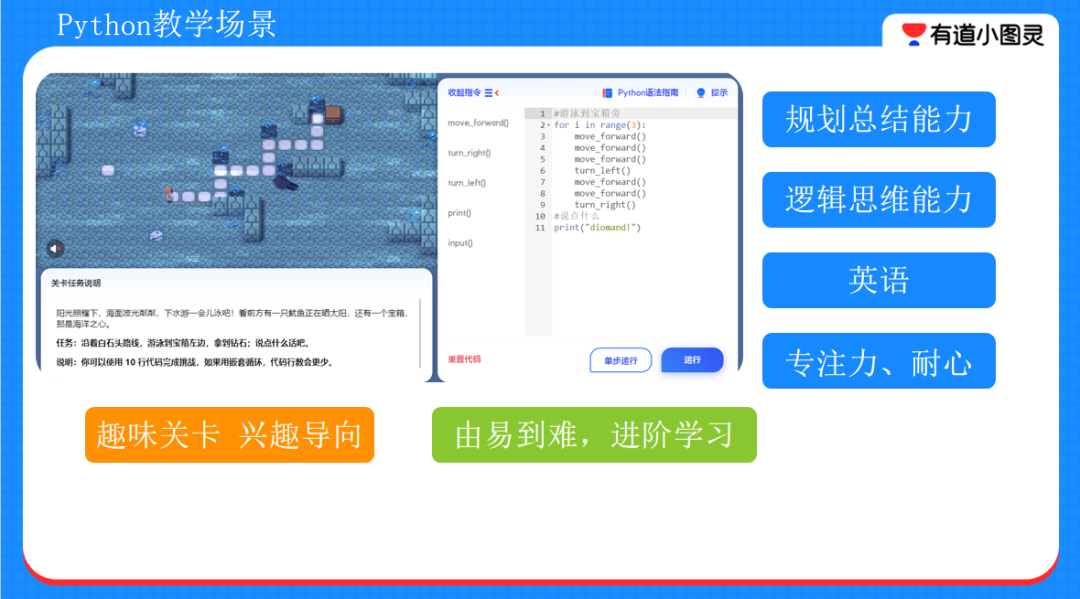
Python supports major operating systems like Windows, Linux, and Mac OS, and is widely used in booming fields like big data analysis and machine learning. Its code typically requires minimal modification to be ported to other platforms. Except for system-level and hardware-level development and high-performance computing, which are dominated by C/C++, Python is almost omnipotent.
For slightly older children or those with a foundation, learning Python is definitely a good choice.
03C++ Programming
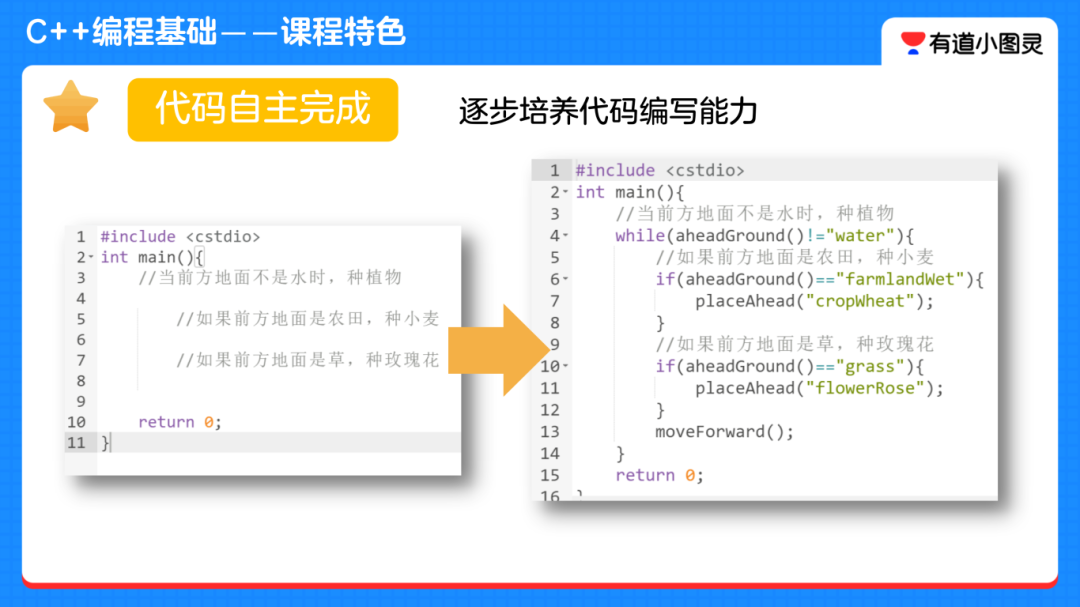
C++ is an evolved language based on C, more refined and powerful. In many game and software productions, C++ plays a much larger role than C, being more stable and easier to operate.
Among various programming languages, if we talk about a technical philosophy that covers the widest range, it would probably be C++. C++ is a culmination of technical philosophies, developed from C language, retaining all the advantages of C while adding object-oriented mechanisms—C++ can be used for both procedural programming and object-oriented programming, making it a powerful hybrid programming language.
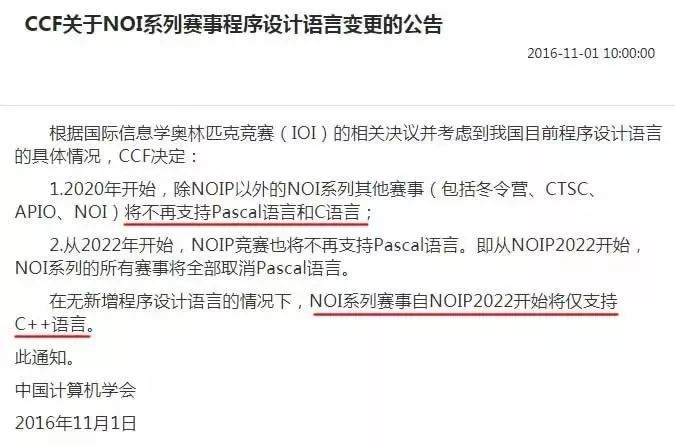
Currently, teenagers learn C++ generally to become “technology specialists” and participate in the Olympiad in Informatics. The Olympiad is one of the five major science competitions and is highly regarded.C++ is the only designated language for the NOI (National Olympiad in Informatics).If planning to pursue the path of a “technology specialist,” C++ is unavoidable.
The languages supported by NOIP currently include PASCAL/C/C++, and starting from 2020, NOIP no longer supports PASCAL language;
From 2022, NOIP competitions no longer support C language, as C and C++ are so similar, and C++ also has a convenient standard template library, so retaining only C++ is sufficient.
Learning programming can also lead to competitions; the Blue Bridge Cup, National Youth Software Programming Level Examination, CSP, NOIP, and NOI series competitions are all authoritative programming contests.
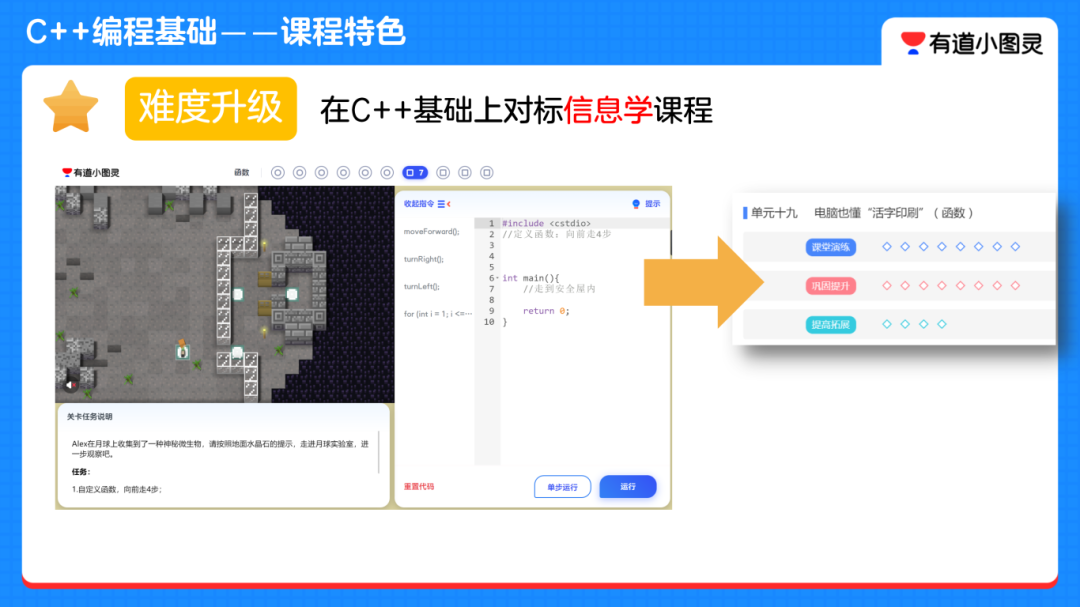
Compared to graphical programming and Python, learning C++ is somewhat more challenging; therefore, for children who are beginners in programming, getting started with C++ may take longer.
Finally, I want to remind all parents that when choosing a programming language for children, there is no question of “should or shouldn’t”; it is only a matter of “is it suitable or not.” The specific situation should be based on the child’s planning, expectations, and foundational knowledge, combined with the characteristics of the programming languages to make a comprehensive decision.
From the birth of the first computer to the current global computerization of offices; from the birth of the first mobile phone to the current mobile internet life; from the birth of the first AI robot to the arrival of fully intelligent life.In the digital technology era, the time it takes for technology to change the world is getting shorter and shorter. With the arrival of the artificial intelligence era, the importance of learning programming is no longer an open question.
Now is the time for children to seize the opportunity to learn programming, so they will have more choices in the future!
END
▼ Scan the code for a free experience ▼