Follow “Electronic Engineering Album” and add the editor’s WeChat
Regional groups are now open, please send messages 【Shenzhen】【Shanghai】【Beijing】【Chengdu】【Xi’an】 to the public account
The European automotive industry has traditionally been characterized by long development cycles, complex ecosystems, and relative closure, but it is now undergoing a profound transformation. In this process, RISC-V is gradually becoming a key technology.
With the rise of Software Defined Vehicles (SDV), electrification, and advanced driver assistance systems, automakers and their suppliers are increasingly demanding higher performance, more customized, and safer processors.
In this context, an open standard instruction set architecture known as RISC-V is gradually becoming a core option of interest in the industry. It is expected not only to reshape the landscape of the European semiconductor industry but also to help address strategic challenges such as technological sovereignty.
This transformation also became a key topic at the recent RISC-V European Summit. Industry leaders gathered to discuss how to accelerate the application of RISC-V in the automotive sector. One roundtable discussion focused on “Accelerating Automotive Innovation with RISC-V.” The session was hosted by Cortus‘s Michael Chapman, with guest representatives from Infineon Technologies, Codasip, Resiltech, Quintauris, and CARIAD.
Additionally, Edward Wilford, Senior Research Director for Automotive at Omdia, also delivered a keynote speech titled “How Automotive and Industrial Designs are Eliminating Boundaries and Creating Opportunities” (汽车与工业设计如何打破界限并创造机遇).
Openness and Control as Strategic Focus
Some attendees pointed out that adopting RISC-V is not difficult; it represents a strategic direction towards openness.
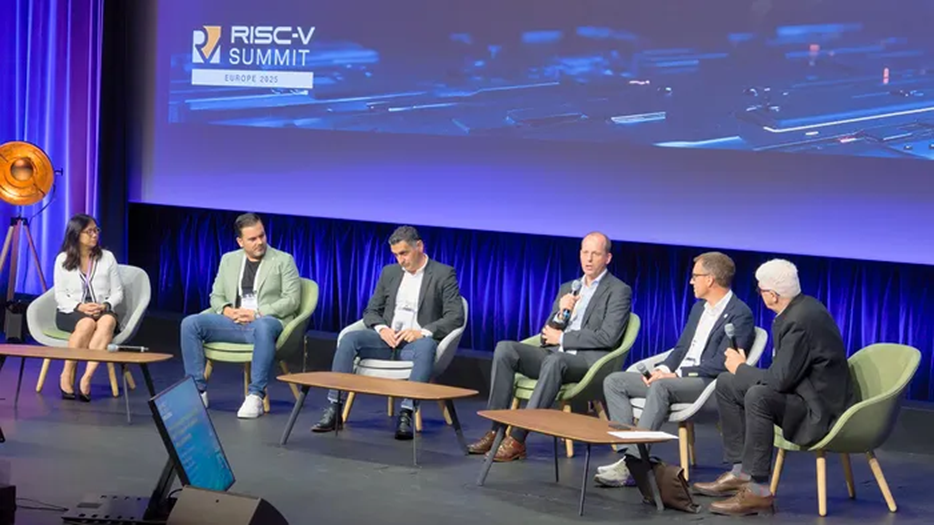
RISC-V European Summit Automotive Roundtable
Infineon’s Senior Director of Software, Partnerships, and Ecosystem Management Thomas Schneid explained the company’s motivation for choosing RISC-V, stating that Infineon began laying out this platform about three years ago, primarily driven by the desire to “create an open standard to stimulate innovation,” while also recognizing the “greater possibilities brought by open standards beyond the technical level.”
Although Infineon has been known for its closed specifications in the past, this move marks the first step towards a “new chapter of open standards.”
For original equipment manufacturers (OEM), this openness means greater control and helps reduce risks. With the development of SDV, “the software part will carry more and more innovation.”
Quintauris (an alliance dedicated to promoting the standardization of RISC-V in the automotive industry) Managing Director Pedro López stated that the ecosystem’s response has been very positive, especially the software community has “opened its arms” to Quintauris. The underlying open standards significantly reduce the potential risk of technological lock-in, which aligns with the industry’s trend towards higher standardization.
OEM manufacturers are increasingly calling for greater flexibility to “independently select components,” avoiding being restricted by a single supplier, thus better controlling their software strategy.
SDV Drives System Integration
The shift towards SDV is fundamentally reshaping vehicle architecture. Previously, a vehicle might contain 30 to 200 distributed electronic control units (ECU), each equipped with dedicated hardware and software architectures, shifting towards a more centralized and integrated architecture that consolidates computing power into fewer core modules.
This decoupling of hardware and software makes adding software packages and resource scheduling more flexible. The software-first philosophy has brought unexpected but positive effects—breaking down barriers between automotive and industrial applications.
Edward Wilford pointed out: “This system does not care whether it is used in a car or an industrial robot.” Key considerations include safety, connectivity, embedded intelligence, and overall reliability. Instead of viewing application scenarios according to industry verticals (such as automotive or industrial), it is better to focus on “functionality and deployment methods.”
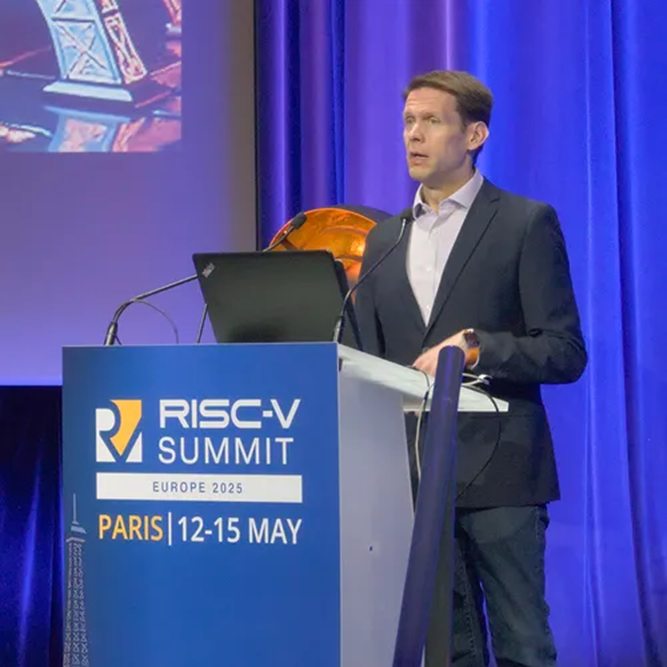
Omdia‘s Wilford attended the RISC-V European Summit
Both fields require “real-time processing, millisecond response times, and deterministic behavior,” and must comply with relevant functional safety standards (such as ISO 26262, IEC 61508) and information security standards (ISO 21434). If a system can achieve “fast, safe, and meet automotive demands,” then it is also applicable to many other scenarios. Artificially dividing into different channels may bring “unnecessary costs.”
The “flexible and scalable” characteristics of RISC-V perfectly meet the needs of “agile computing,” which is essential in “almost all scenarios.” Agile computing is crucial for automotive and industrial applications.
Resiltech‘s Francesco Rossi emphasized that the openness of RISC-V has spawned a “huge ecosystem,” where knowledge is widely disseminated, becoming an “accelerator” that is difficult for individual companies to achieve.
Safety Compliance Cannot Be Ignored
The automotive industry has extremely stringent requirements for functional safety and cybersecurity. Codasip executives with rich automotive electronics experience, Maricel Ventura, stated that although ISO 26262 does not mandate that IP cores must be certified, providing certified products helps establish “good credibility” and enhances customer confidence in “high-quality, high-reliability products.”
She pointed out that the automotive industry is relatively conservative, valuing “state-of-the-art implementations and design standards.” Therefore, the entire ecosystem must “work together” to prove that RISC-V CPU cores can effectively collaborate with a broader range of software and toolchains.
Francesco Rossi added that in an “open environment, especially in cases where multiple software modules interact highly,” knowledge sharing from “developers to certifiers” helps make solutions more “open, transparent, and exploratory.” This open model, including design and verification processes, is often difficult to achieve in a “closed environment.”
Compliance Costs and Sustainable Ecosystem
Despite the enormous technical potential, the strict standards of the automotive industry also bring significant financial challenges.Pedro López mentioned, “There is high cost pressure behind certification, safety, and cybersecurity.” Although the software ecosystem develops alongside other processor manufacturers, IP core suppliers still face “huge investment pressures to complete core certification and continuously follow up on technological innovation.”
They hope to recover their investment within five to seven years during the typical five to ten-year automotive development cycle.López emphasized the need for a business model that allows IP and core suppliers to maintain their safety assurance systems while not “running out of funds.” Without a “healthy industry ecosystem” and a sustainable business model, the market may ultimately be consolidated to just “one or two suppliers,” which would severely restrict future innovation capabilities.
To ensure safety, certain aspects also need to be standardized.Michael Chapman emphasized the importance of “isolated areas” on large chips running multiple operating systems to prevent one operating system from interfering with the rest of the system.
Although there are existing mechanisms, the RISC-V community still has room for further standardization.Thomas Schneid acknowledged that “automotive standards will not disappear,” but the community can “work together to avoid reinventing the wheel, make good use of existing resources, and learn from them.”
Francesco Rossi believes that openness provides opportunities to “reduce costs” through shared methods, software, and verification strategies. However, considering the long development cycles and integration risks in the automotive industry, Pedro López again emphasized the need for a business model that helps IP suppliers maintain their safety assurance systems and achieve profitability faster.
Continued Progress in European Strategic Layout
European companies are actively promoting the implementation of RISC-V solutions tailored to automotive needs. Infineon announced the launch of a new generation of AURIX microcontroller series based on RISC-V architecture, marking an important step in its strategic transformation and indicating that its proprietary TriCore architecture will no longer continue to evolve.
Codasip, as a leading RISC-V IP provider in Europe, offers customizable and functionally safe cores, which are crucial for meeting the high standards of the automotive industry. NXP is also using RISC-V accelerators internally and participating in EU research projects.
Quintauris is dedicated to promoting the standardization of RISC-V in the automotive sector, including RT-Europa specifications. The EU’s “Chips Act” and the “Horizon Europe” program (DARE program allocates 240 million euros, Rigoletto program allocates 80 million euros for RISC-V automotive projects) and other initiatives provide substantial funding support for the development and technological autonomy of RISC-V in Europe.
Challenges and Future Outlook
Despite significant progress in the automotive field, RISC-V still has a relatively immature software ecosystem compared to mature architectures. The conservatism of the industry and competitive landscape require RISC-V to demonstrate reliability and long-term viability at the same level. The fragmentation caused by excessive flexibility also needs to be enhanced through standardization to strengthen the cohesion of the ecosystem.
While China currently leads in SDV and RISC-V chip production, Europe is gradually gaining attention in high-performance industrial automation and SDV investment.Omdia‘s Edward Wilford believes that Europe has “huge development potential” and points out that due to the increasing demand for flexible and agile computing, RISC-V has broad prospects in the fields of automation and SDV in Europe.
The transition to SDV has greatly promoted the progress of ISA architectures in flexibility, scalability, and openness, enabling them to better adapt to the evolving E/E architecture.
Ultimately, the rise of RISC-V in the European automotive sector is not just a technological revolution but a strategic layout concerning innovation, resilience, and technological sovereignty. Its success will depend on the continued collaboration of industry, academia, and policymakers to build a strong, safe, reliable, and sustainable ecosystem, balancing openness and standardization while addressing the real financial issues behind automotive compliance.
(Edited by: Franklin)