Source: Carbon Peak and Neutrality

Article begins
On September 29, the General Office of the State Council forwarded the “Notice on Promoting the Construction of National Parks and Several Fiscal Policy Opinions.” The notice proposed to support the measurement and monitoring of carbon sinks in forests, grasslands, wetlands, etc., encourage the development of eligible carbon sink projects into voluntary greenhouse gas emission reduction projects, and explore the establishment of an ecological protection compensation mechanism that reflects the value of carbon sinks.
What are the domestic and international voluntary greenhouse gas emission reduction projects? Here is a recommended article introducing international voluntary emission reduction standards and CCER! This can give you a preliminary understanding of concepts like CDM, GS, VCS, CCER, etc.!
CCTC®01
Introduction to International Voluntary Emission Reduction Standards
Wang Bowen Gao Yuan
The international voluntary emission reduction market has a wide variety of voluntary emission reduction standards, differing in initiators, methodologies, project scale, transaction methods, and more. For example, in terms of initiators, there are governments, intergovernmental organizations, non-governmental organizations, and private enterprises; in terms of methodologies, some cover broad areas, while others focus on certain key fields; regarding project scale, some are only issued to national and subnational governments and not to project-level activities, while others have no restrictions; and in terms of transaction methods, some are only traded over-the-counter, while others are traded on exchanges.
1. International Voluntary Emission Reduction Standards Registered with CORSIA

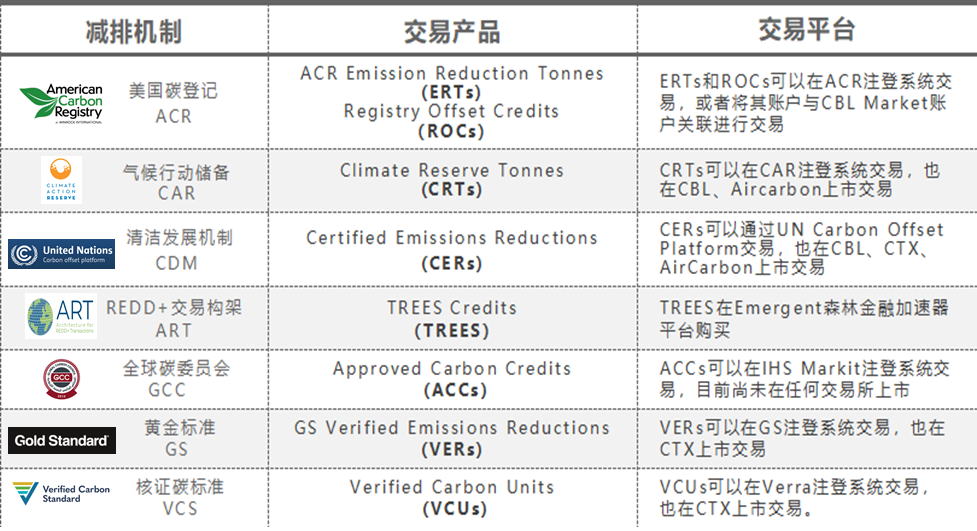
The International Civil Aviation Organization (ICAO), a specialized agency of the United Nations, has registered eight qualified emission units (CORSIA Eligible Emission Units, EUC) for use in the CORSIA compliance period from 2021 to 2023. Under the guidance of the United Nations, CORSIA reviews the voluntary emission reduction standards submitted for application through standardized procedures. The registered standards include: Clean Development Mechanism (CDM), Verified Carbon Standard (VCS), Gold Standard (GS), China Certified Emission Reduction (CCER), American Carbon Registry (ACR), Climate Action Reserve (CAR), Architecture for REDD+ Transaction (ART), and Global Carbon Council (GCC). The following introduces the seven international voluntary emission reduction standards excluding CCER.

1. Clean Development Mechanism (CDM)
In 1997, the third Conference of the Parties (COP) to the United Nations Framework Convention on Climate Change adopted the Kyoto Protocol. The Kyoto Protocol established three flexible cooperation mechanisms aimed at emission reduction: the International Emission Trading Mechanism (I-ET), Joint Implementation (JI), and the Clean Development Mechanism (CDM). Among them, the Clean Development Mechanism is a greenhouse gas emission reduction mechanism based on project cooperation between developed and developing countries. In 2001, at the seventh COP of the United Nations Framework Convention on Climate Change, the Marrakech Accords were adopted, which stipulated the “modalities and procedures of CDM.” The Kyoto Protocol came into effect in February 2005, and the international rules for CDM were adopted at the first COP of the Kyoto Protocol held in November of the same year.
Currently, CDM has registered a total of 117 methodologies, covering fields including: energy – energy industry (renewable, non-renewable resources), energy distribution and demand, manufacturing, chemicals, construction, transportation, mining, mineral production, metal production, fugitive emissions from fuels, fugitive emissions in HFC and SF6 production and consumption, solvent application, waste treatment, afforestation and reforestation, agriculture, etc.
Carbon offset credits (Certified Emissions Reductions, CERs) issued by CDM can be retired through agreements in over-the-counter transactions and canceled on the United Nations carbon offset platform (https://offset.climateneutralnow.org/), or they can be traded on designated exchanges. In 2015, the United Nations carbon offset platform was launched; as of December 2021, approximately 4.5 million tons of CO2 equivalent CERs had been canceled through this platform. The platform does not support the resale of CERs; purchased CERs will be directly retired, with no transfer of ownership. At the same time, the United Nations Climate Change (UNCC) collaborates with AirCarbon Exchange (ACX, https://www.aircarbon.co/exchange), Carbon TradeXchange (CTX, https://ctxglobal.com), and CBL Market (https://xpansiv.com/cbl/) to enable CERs to be traded in the aforementioned exchanges.
2. Verified Carbon Standard (VCS)
VCS was established by the non-profit organization Verra in 2005 and is the most widely used voluntary emission reduction mechanism globally. The methodologies registered under VCS cover areas including energy, manufacturing processes, construction, transportation, waste, mining, agriculture, forestry, grasslands, wetlands, and livestock, totaling 49 projects. All methodologies under the CDM mechanism can be used to register VCS projects. Except for agreements in the AFOLU field under the CAR mechanism, all can also be used to register VCS projects.
The emission reductions issued by VCS are Verified Carbon Units (VCUs). Since April 2020, VCUs can be traded in the Verra Registry system and can also be traded on the CTX exchange. In addition, Xpansiv Data System, Inc. has launched GEO, N-GEO, and C-GEO spot contracts in the ESG spot market, and the Chicago Mercantile Exchange (CME) has launched GEO, N-GEO, and C-GEO futures contracts based on these, all of which include VCUs, with N-GEO and C-GEO having Verra as the sole registry. According to the latest data from Verra’s official website, as of June 30, 2022, more than 1,803 certified VCS projects have collectively reduced or removed over 955 million tons of CO2 and other greenhouse gas emissions.
3. Gold Standard (GS)
The Gold Standard for the Global Goals (GS4GG) is managed by the Gold Standard Foundation, established jointly by the World Wildlife Fund (WWF) and other non-profit organizations, with the Gold Standard Registry as the registration body.
GS has registered 39 methodologies covering eight areas: land use, forestry, and agriculture, energy efficiency, fuel switching, renewable energy, shipping energy efficiency, waste treatment and disposal, water efficiency, and carbon removal.
GS has issued 151 million carbon credits for a total of over 900 projects located in more than 65 different countries. This includes 126.1 million voluntary emission reductions and 24.9 million Gold Standard certified emission reductions. A total of 75.8 million voluntary emission reductions have been retired, accounting for 60% of the total issued voluntary emission reductions.
The carbon offset credits issued by GS are GS Verified Emissions Reductions (VERs). VERs can be traded directly in the Gold Standard Registry, achieving real-time retirement and automatic certificate generation. Large-scale purchases can be made directly with project owners publicly listed on the website or through brokers listed on the International Carbon Reduction Alliance website, with contracts signed over-the-counter and then traded in the Gold Standard Registry. VERs can also be traded on the CTX exchange.
4. American Carbon Registry (ACR)
ACR is a greenhouse gas registry established by the Environmental Resources Trust in 1996 and became a wholly-owned subsidiary of the non-profit organization Winrock International in 2007. In 2012, ACR was approved by the California Air Resources Board as the offset project registry (OPR) for the California cap-and-trade market.
ACR has registered 14 methodologies covering five areas: greenhouse gas reduction projects (fuel combustion), greenhouse gas reduction projects (industrial production), land use, land-use change and forestry, carbon sequestration and storage, and waste treatment and disposal.
The carbon offset credits issued by ACR are divided into ACR Emission Reduction Tonnes (ERTs) and Registry Offset Credits (ROCs). ERTs and ROCs can be traded through agreements in over-the-counter transactions and transferred in the ACR registration system, or their accounts can be linked to CBL accounts for trading on the exchange. Authorized ERTs and ROCs are also listed on CTX. CBL investors can purchase carbon offset credits from specific projects or purchase standardized global carbon offset contracts (GEO) from CBL, with futures contracts based on GEO spot contracts listed on CME.
5. Climate Action Reserve (CAR)
The Climate Action Reserve Offset Registry Program was established in 2001 by the non-profit environmental organization Climate Action Reserve (CAR).
CAR refers to its offset project types as “Protocols” to highlight the complexity of each “Protocol.” CAR has registered 22 protocols in the United States, Mexico, and Canada, with over 400 projects registered in 45 states in the U.S. and 10 states in Mexico. The registered protocols include: adipic acid production, Canadian grasslands, coal mine methane, forestry, grasslands, Mexican boiler efficiency, Mexican forests, Mexican halocarbons, Mexican landfills, Mexican livestock, ozone-depleting substances in Mexico (replaced by the Mexican halocarbon protocol), nitric acid production, nitrogen management, organic waste composting, organic waste digestion, ozone-depleting substances, rice cultivation, soil enrichment, urban forestry management, urban afforestation, U.S. landfills, and U.S. livestock.
The voluntary emission reduction carbon offset credits issued by CAR are Climate Reserve Tonnes (CRTs), which can be traded through over-the-counter transactions and transferred in the CAR registration system, or traded in CBL, ACX, and Intercontinental Exchange (ICE).
6. Architecture for REDD+ Transaction (ART)
ART is a voluntary emission reduction credit mechanism managed by Winrock International. The purpose of ART’s development is to provide long-term funding support for REDD+ emission reduction and removal activities at the national and jurisdictional levels. ART has established the REDD+ Environmental Excellence Standards (TREES) and only issues carbon credits for REDD+ emission reduction activities at the national and subnational levels, not for project-level activities.
The carbon offset credits issued by ART are TREES Credits, which can be traded through agreements in over-the-counter transactions and transferred in the ART registration system. TREES can be traded on the non-profit organization Emergent Forest Finance Accelerator platform, which is also the only product traded on that platform. Emergent is a stable buyer of ART credits, providing certainty of purchase at a base price for carbon offset credits and sharing the excess price revenue. Emergent provides an effective mechanism for TREES buyers to purchase ART credits without having to negotiate and sign directly with national governments.
7. Global Carbon Council (GCC)
The Global Carbon Council (GCC) was established in 2016 by the Gulf Organisation for Research & Development (GORD) and is funded by the Supreme Committee for Delivery and Legacy (SC), making it the first voluntary carbon offset project in the Middle East and North Africa.
The methodologies registered by GCC include all methodologies registered under CDM and three self-registered methodologies. The three self-registered methodologies are: renewable energy generation projects supplying power to the grid or self-users, energy-saving in pumping systems, and energy generation from animal manure and waste management projects.
GCC has currently registered 2 projects, generating 77,249 tons of CO2 equivalent emission reductions per year, with 10 projects still under review. The registration body for GCC is IHS Markit, and the carbon offset credits issued are Approved Carbon Credits (ACCs), which have not yet been listed for trading on any exchange, and the team is evaluating the possibility of this, planning to implement it in the second quarter of 2022 (as of the time of writing, there has been no recent progress).

[1] https://cdm.unfccc.int
[3] https://verra.org/project/vcs-program/
[4] https://globalgoals.goldstandard.org
[5] https://www.goldstandard.org/impact-quantification/carbon-markets
[6] https://americancarbonregistry.org
[7] http://www.climateactionreserve.org
[8] https://www.artredd.org
[9] https://www.emergentclimate.com
[10] https://www.globalcarboncouncil.com
CCTC®02
II. International Voluntary Emission Reduction Standards Applying for CORSIA Registration
From January 26 to February 26, 2022, a total of seven voluntary emission reduction standards submitted applications for qualified emission units to ICAO, including the BioCarbon Fund Initiative for Sustainable Forest Landscapes (ISFL), BioCarbon Registry (BCR), Cercarbono, International Carbon Registry (ICR), Japan’s J-Credit Scheme, the Joint Crediting Mechanism (JCM) between Japan and Mongolia, and the SocialCarbon Standard. In addition, the Forest Carbon Partnership Facility (FCPF) submitted an application for updates on January 10, 2022, which is still under review.

1. BioCarbon Fund Initiative for Sustainable Forest Landscapes (ISFL)
The BioCarbon Fund was established in 2004 and is the world’s first carbon fund, focusing on REDD+ and sustainable agricultural land management (SALM) activities. ISFL was established in 2013, in collaboration with various governments, to reduce emissions from land use through land use planning, policies, and practices. ISFL is managed by the World Bank as trustee and secretariat, with funding from Norway, Germany, Switzerland, the UK, and the US.
ISFL consists of two parts: BioCFplus and BioCF Tranche3, both established at the national or jurisdictional level AFOLU projects. The former provides funding support for national sustainable land use, incentivizing private sector participation and helping countries establish monitoring, reporting, and verification systems for emission reductions, with $13.47 million spent. The latter mainly delivers verified emission reductions, promoting the country’s low-carbon transition and implementing measures with guaranteed long-term benefits for sustainable land use.
ISFL does not provide clear methodological guidance. ISFL emission reduction (ER) projects must meet the definition of “jurisdictional and integrated landscape management” as defined by ISFL. This definition is based on simplified assessments of other mature standards, with each project relying on grassroots organizations fostered during the REDD+ readiness process to evaluate each country’s efforts and capacity in REDD+, as well as the potential to reduce greenhouse gas emissions through similar programs.
ISFL is still in the donation and project development and evaluation phase, and has not yet issued verified emission reductions. ISFL transfers through its registration system, the Carbon Asset Tracking System (CATS), with a special transaction model:
(1) In the climate finance model, ISFL pays the project development country for the purchase of emission reductions (ERs) but does not retain ownership of the ERs. After selling the ERs to the World Bank, the ERs will be returned to the ISFL project country account for use in fulfilling its Nationally Determined Contributions (NDC) under the Paris Agreement.
(2) In the carbon finance model, after ISFL pays for the purchase of ERs, it does not return ownership to the ISFL project country but transfers it to the donor country, which retains ownership of the verified ERs.
2. BioCarbon Registry (BCR)
BCR was established in 2018, originally named ProClima, covering the entire process of designing, developing, approving, verifying, and certifying emission reduction projects and issuing Verified Carbon Credits (VCC). It is registered in Colombia. In 2021, the organization won the runner-up for the “Best GHG Credit Project” in the voluntary carbon market rating by the International Emissions Trading Association (IETA). In 2022, ProClima’s trademark was changed to BioCarbon Registry.
The methodologies registered by BCR include the following five areas: REDD+ activities, greenhouse gas removal activities, energy, transportation (meeting the CDM Part 7 registration requirements), and waste treatment and disposal (meeting the CDM Part 13 registration requirements). The verified voluntary emission reductions issued by BCR are Verified Carbon Credits (VCCs). As of May 20, 2022, BCR has registered 25 projects, with 3 projects under review; issued 3.25 million tons of CO2 equivalent VCCs, and retired 1.83 million VCCs. VCCs can be traded through over-the-counter transactions and transferred through the BCR registration system. At the beginning of 2022, BCR signed a cooperation agreement with CTX, allowing all BCR carbon offset credits to be traded on CTX.
3. Cercarbono
Cercarbono was established in Colombia in 2018 and later expanded its operations to other countries, collaborating with NGOs, governments, and the private sector.
The methodologies registered by Cercarbono come from six areas: energy, transportation, manufacturing, fugitive fuel emissions, waste treatment and disposal, and afforestation. As of the end of 2021, Cercarbono had registered 85 projects and issued nearly 30 million verified emission reductions, retiring nearly 20 million verified emission reductions. The verified voluntary emission reductions it issues are Certified Carbon Credits (Carboncer), which can be traded through over-the-counter transactions and transferred in the Cercarbono registration system EcoRegistr, which utilizes blockchain technology.
4. International Carbon Registry (ICR)
The legal name of ICR is Loftslagsskrá Íslands ehf., registered in Iceland. It is controlled by members of the ICR council and the Program Advisory and Methodology Approval Panel (PAMAP) and managed by the ICR comprehensive management department. The ICR registration platform manages ICR greenhouse gas projects, designed and developed by Global Environmental Markets (GEM).
ICR recognizes all methodologies currently effective under CDM, CER, and ACR mechanisms. All projects that meet ICR requirements and ISO 14062-2 as well as the corresponding methodological requirements can be registered with ICR. The fields registered under ICR methodologies include: energy (energy production, distribution, and demand), manufacturing, chemical manufacturing, construction, transportation, mining and coal mine production, metal manufacturing, fugitive emissions of fuels, fugitive emissions of hydrocarbons and sulfur hexafluoride, solvent use, waste treatment and disposal, afforestation and reforestation, agriculture, carbon capture, sequestration, and removal.
The verified emission reductions issued by ICR are International Carbon Credits (ICCs), which can be traded through over-the-counter transactions and transferred in the ICR registration system. On November 25, 2021, ICR announced direct access to the CTX system, allowing ICCs to be traded on CTX. If retired directly, buyers do not need to register an ICR account; however, if they need to hold them long-term, ICR recommends opening an account. It is claimed that this is the first attempt for a registry and exchange to connect directly. Currently, ICR’s official website lists 8 projects available for trading, issuing 273,711 tons of CO2 equivalent ICCs.
5. Japan’s J-Credit Scheme
The Japan’s J-Credit Scheme is jointly managed by the Ministry of Economy, Trade, and Industry, the Ministry of the Environment, and the Ministry of Agriculture, Forestry and Fisheries, aimed at certifying greenhouse gas reductions and removals within Japan. Under this scheme, the government certifies the greenhouse gas reductions and removals achieved through energy-saving and forest management. This project integrates the Domestic Credit Scheme and the J-VER offset credit scheme. The methodologies registered under the J-Credit Scheme cover six areas: energy saving, renewable energy, manufacturing processes, waste, agriculture, and forest carbon sinks.
As of March 10, 2022, the J-Credit Scheme has cumulatively registered 399 projects, certifying 610,000 tons of CO2 equivalent reductions. J-Credits can be traded through bilateral agreements, intermediary agencies provided on the official website, and official auction trading, and transferred within the J-Credit registration system.
6. Joint Crediting Mechanism (JCM) between Japan and Mongolia
The Joint Crediting Mechanism was established in 2013 through a bilateral agreement and is one of the JCM projects for Japan’s external cooperation. JCM is operated by the Joint Committee (JC), which establishes and amends rules, guidelines, and methodologies based on bilateral agreements, as well as conducts project registration. The Japanese side is jointly supervised by the Ministry of the Environment, the Ministry of Economy, Trade and Industry, the Ministry of Foreign Affairs, the Ministry of Agriculture, Forestry and Fisheries, and the Ministry of Land, Infrastructure, Transport and Tourism; the Mongolian side is supervised by the Ministry of Environment and Tourism (Climate Change Research and Cooperation Center), the Energy Regulatory Commission of Mongolia, the Ministry of Mining and Heavy Industry, the Ministry of Construction and Urban Development, the Ministry of Food, Agriculture and Light Industry, the Ministry of Foreign Affairs, the Ministry of Roads and Transport Development, and the Mayor’s Office of Ulaanbaatar for air pollution reduction.
The Joint Crediting Mechanism has registered 5 projects, issuing 53,730 tons of JCM Credits. JCM Credits can be traded over-the-counter and transferred within its own registration platform, JCM Registry.
7. SocialCarbon Standard (SC)
The SocialCarbon Standard is managed by the Social Carbon Foundation, a non-profit organization based in the UK. This standard was established in 2005 in Tocantins, Brazil, by the Ecologica Institute, a non-profit organization. The standard was designed during the implementation of the first carbon sequestration project on Bananal Island in Brazil, aiming to ensure the participation of 10 communities in the project. Since 2022, the standard has been managed by the Social Carbon Foundation, which aims to mitigate the impacts of climate change through scientific research, environmental protection, and community-based sustainable development activities. At the same time, the Social Carbon Standard has transitioned from a co-benefits standard to a nature-based solutions (NBS) standard.
The Social Carbon Registry uses the Biodiversity and Ecosystem Futures (BEF) as its registration system, and all emission reduction credits are traded on that platform. However, according to official data, as of May 20, 2022, this standard has not certified any projects.
8. Forest Carbon Partnership Facility (FCPF)
The Forest Carbon Partnership Facility (FCPF) is established by the World Bank as trustee and secretariat. The purpose of FCPF is to provide funding for the capacity building of REDD+ in various countries, including the Carbon Fund and the Carbon Fund. The Carbon Fund mainly provides preparation funds for REDD+ projects in various countries. The Carbon Fund is a results-based payment trust fund, where a portion of the verified emission reductions generated under REDD+ projects is purchased by the World Bank, while the remaining is used by REDD+ project developing countries for compliance with other reduction plans (including offset projects like CORSIA). All projects are implemented at the national (or jurisdictional) level and below, with scales several times larger than traditional REDD+ projects.
It is necessary to distinguish between FCPF and the ISFL mentioned above, which is also established by the World Bank as trustee and secretariat. The former is based on REDD+ standards, focusing on forest-related projects; the latter includes all projects meeting AFOLU standards.
The emission reductions issued by FCPF, like those of ISFL, are ERs, transferred in the CATS system. Currently, the FCPF preparation fund has funded 47 projects, the FCPF carbon fund has funded 15 projects, and 14 projects have signed benefit-sharing agreements (EP-PA) with the World Bank, but as of the end of 2021, no project has issued carbon offset credits.
[1] https://www.biocarbonfund-isfl.org
[2] https://biocarbonregistry.com/en/
[3] https://cercarbono.com/en/
[4] https://carbonregistry.com
[5] https://japancredit.go.jp/english/
[6] https://japancredit.go.jp/market/buy/
[7] https://www.jcm.go.jp
[8] https://www.socialcarbon.org
[9] https://bef.earth
[10] https://www.forestcarbonpartnership.org
CCTC®03

01
Understanding CCER
According to the definition by China’s Ministry of Ecology and Environment in the “Interim Measures for the Management of Carbon Emission Trading,” CCER refers to “the greenhouse gas emission reductions quantified and verified from projects such as renewable energy, forestry carbon sinks, and methane utilization within China, registered in the national greenhouse gas voluntary emission reduction trading registration system.”It sounds complicated; simply put, CCER is a type of carbon offset mechanism, where regulated enterprises purchase certified quantities from enterprises implementing “carbon offset” activities that can be used to offset their own carbon emissions.CCER’s Chinese name is “National Certified Voluntary Emission Reductions.” To better understand its meaning, we can break down its complex name into two key terms: “certified” and “voluntary.”“Certified” means that a CCER project must undergo a series of strict quantification examinations and layers of registration before entering the market, while “voluntary” indicates that this trading subject is different from the national mandatory carbon emission quotas, representing a reduction activity voluntarily initiated by environmental projects or enterprises. Combining both, CCER is a “greenhouse gas emission reduction quantity certified and registered by an officially designated institution, actively created by environmental projects or enterprises.” Unlike the national carbon market that only conducts quota trading, the CCER market allows non-key regulated enterprises to enter and provides a trading platform for these enterprises to sell their approved voluntary emission reductions. This brings a compensatory mechanism to China’s total control carbon trading system—regulated enterprises can not only directly purchase emission quotas from other enterprises in the national carbon market but also choose to purchase voluntary emission reductions based on environmental projects in the CCER market to offset their own carbon emissions.Due to the wide variety of CCER projects and the numerous technologies involved, to avoid an excessive influx of CCERs into the local market causing an impact on the carbon quota market, various CCER pilot projects have set limits on the proportion of CCERs that can be used for offsetting, generally between 5%-10%.
 It is worth noting that not only enterprises with insufficient quotas need to purchase CCERs; non-over-quota enterprises can also purchase CCERs to replace their surplus quotas and sell the surplus quotas in the quota market—this depends on which is higher at that time, the CCER or the quota price. However, in general, CCERs tend to be cheaper than carbon quotas, so some key regulated enterprises often purchase CCERs to offset their carbon emission quotas.In summary, the CCER offset mechanism can not only expand the participants in the carbon market but also promote the development of environmentally friendly industries such as forestry and clean energy through market-based compensation methods, while reducing the compliance costs for regulated enterprises.
02
The Past
The CCER system started in March 2012 and was suspended in March 2017, having operated for a total of five years. We refer to this stage as the first phase of CCER, and if CCER restarts in the future, we will call it the second phase of CCER.Before reviewing the operational situation of the first phase, let’s discuss why CCER was suspended. According to the official announcement, during the implementation of the “Interim Measures for the Management of Voluntary Greenhouse Gas Emission Trading” (hereinafter referred to as the interim measures), there were issues such as low trading volume and some projects not being adequately standardized, necessitating revisions to the interim measures.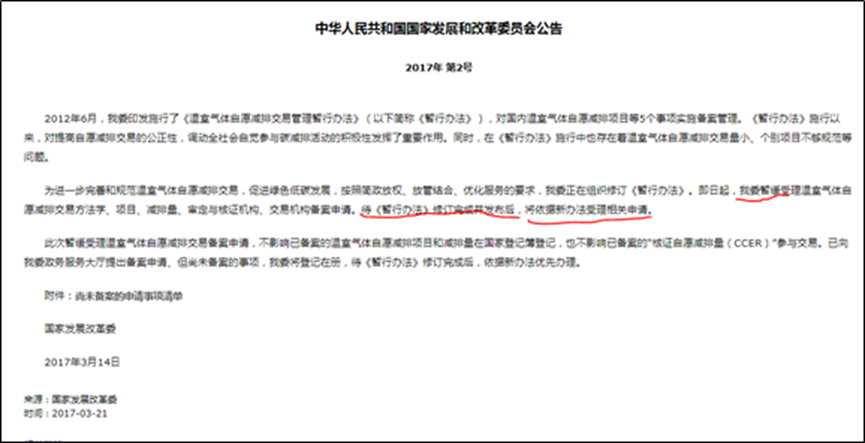 Image source: China Voluntary Emission Trading Information PlatformSince the operation of CCER is based on the interim measures, the revision of the interim measures also means the temporary suspension of the application for five important matters related to CCER. As for when it will restart, it will depend on the completion of the revision of the interim measures, and there is currently no further news.During the first phase of CCER operation, a total of 2,891 CCER projects were developed, of which 1,047 completed project registrations, and 247 completed emission reduction registrations, with a cumulative total of 49.8 million tons of emission reductions registered as CCERs. These are some overall statistics; let’s look at some details.(1) From the perspective of project technology typesAmong the 2,891 developed projects, the top-ranking project types were wind power, photovoltaic power generation, methane utilization, hydropower, waste incineration, biomass power generation, and afforestation and reforestation.
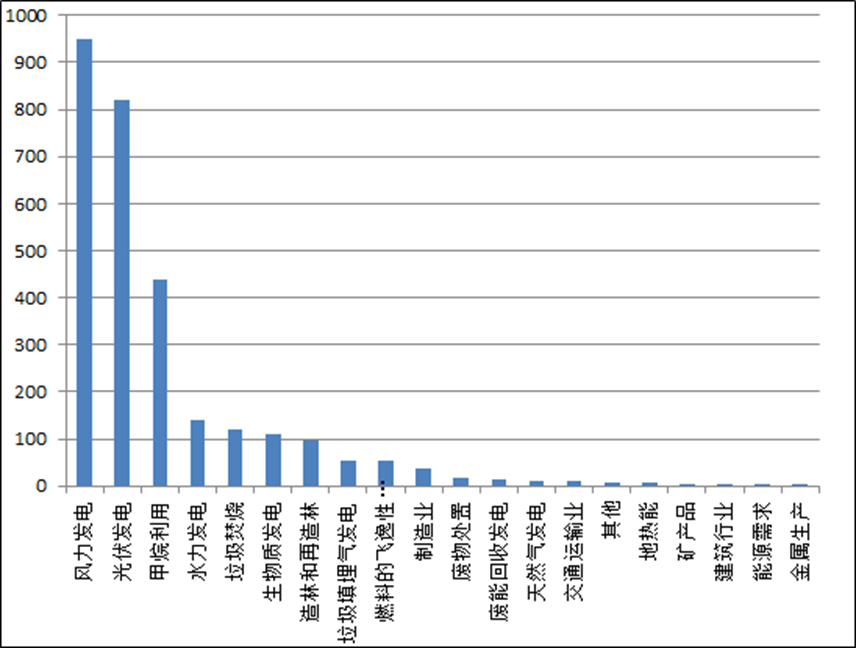 Data source: China Voluntary Emission Trading Information PlatformAmong them, wind power and photovoltaic power projects accounted for more than 60% of the total project proportion, far exceeding other project technology types. This not only indicates a close relationship with the potential project quantity of these two types but also shows that the technologies related to the development of CCER for these projects are very mature.(2) From the perspective of emission reduction distributionAmong the CCER projects that have completed emission reduction registration, the distribution of registered CCER emission reductions is as follows, where hydropower, wind power, and methane utilization are the top three types producing CCER emission reductions. Data source: China Voluntary Emission Trading Information PlatformThis indicates that under the same conditions, hydropower, wind power, and methane utilization are more conducive to producing emission reduction carbon assets. At the same time, seven project types have not obtained emission reduction registrations, which should be the result of a combination of factors such as a lack of projects in related fields, complex emission reduction situations, and immature CCER development technologies.(3) Methodology usageIn the first phase, the national competent authority approved a total of 200 methodologies. Among the approved methodologies, the top ten methodologies used are shown in the following chart.Projects developed using these top ten methodologies exceed 90% of the total project count, contrasting sharply with the fact that over 70% of methodologies lack application examples. This indicates that there is a clustering phenomenon in the use of methodologies, and the application of some methodologies needs to be further deepened.(4) Trading situationAs of the end of 2020, the cumulative trading volume of CCER was 268 million tons (publicly available information). From this information, the trading emission reductions reached five times the registered emission reductions. This means that each registered CCER was traded an average of five times, amazing! Please note that the above data does not consider the impact of three types and hydropower. If we exclude the impact of three types and hydropower, the trading frequency of high-quality CCERs should be even more astonishing.
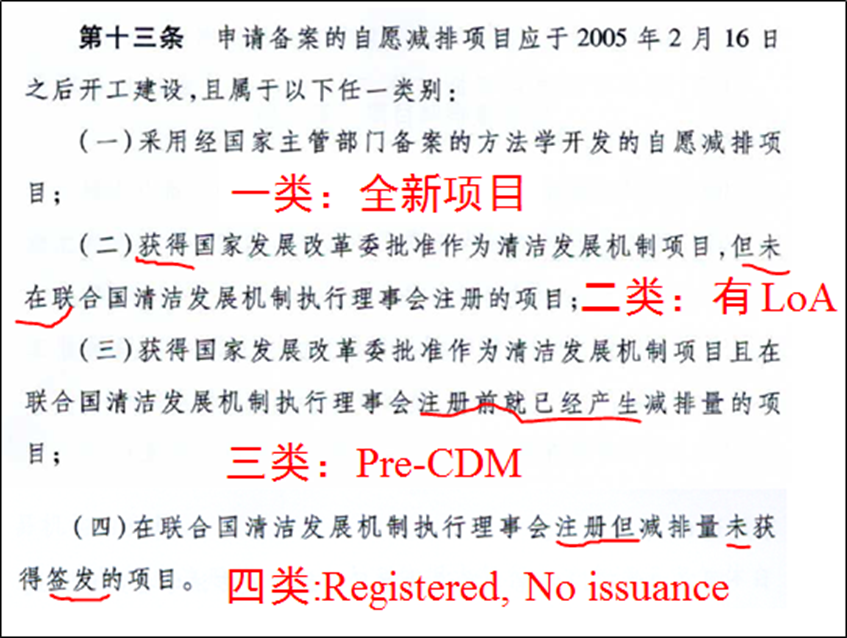 Note: Three types of projects were excluded due to their early generation years, which do not meet the compliance conditions of the pilot carbon market, so their market acceptance is not high; hydropower projects are also excluded.In summary, after the suspension of CCER, the trading of CCER did not stop. On the contrary, as the supply decreased, the trading of CCER continued to rise. The transaction price of high-quality CCERs has also risen to 30 yuan/ton with the continuous increase in trading volume and the decrease in supply.In the first phase, the National Development and Reform Commission was the national competent authority for voluntary greenhouse gas emission trading, responsible for the registration and registration of projects and emission reductions.
03
The Present
As an important supplementary tool for the national carbon emission trading market (hereinafter referred to as the national carbon market), CCER has experienced a suspension, and a series of policies related to CCER have been successively introduced, leading industry insiders to speculate that the CCER primary market may restart this year. In 2021, during the first compliance period of the national carbon market, regulated enterprises could not only directly purchase carbon emission quotas to achieve emission reduction targets but could also purchase certified quantities from enterprises implementing “carbon offset” activities to offset their own carbon emissions. The CCER trading also gradually became active, with multiple local pilot carbon markets reaching new highs in CCER transaction volume and transaction amount.In January 2021, the Ministry of Ecology and Environment announced the “Interim Measures for the Management of National Carbon Emission Trading,” clearly stating that key emission units can use the National Certified Voluntary Emission Reductions to offset carbon emission quota payments each year, with an offset ratio not exceeding 5% of the carbon emission quota that should be paid.In September 2021, the General Office of the CPC Central Committee issued the “Opinions on Deepening the Reform of the Ecological Protection Compensation System,” proposing to accelerate the construction of the national energy rights and carbon emission rights trading market. It aims to improve the carbon emission offset mechanism based on the national greenhouse gas voluntary emission reduction trading mechanism, incorporating greenhouse gas voluntary emission reduction projects in forestry, renewable energy, methane utilization, and other fields with ecological, social, and other multiple benefits into the national carbon emission trading market.
 On October 26, 2021, the Ministry of Ecology and Environment’s website released the “Notice on the Carbon Emission Quota Payment Work for the First Compliance Cycle of the National Carbon Emission Trading Market,” indicating that key emission units willing to use CCER to offset carbon emission quota payments should promptly open general holding accounts in the national voluntary emission reduction registration system and open trading system accounts with the registered greenhouse gas voluntary emission reduction trading institutions, completing CCER purchases and applying for CCER cancellation as soon as possible. This means that CCER has officially been incorporated into the national carbon market for offsetting, and the national carbon market has entered a new phase.In November 2021, the Beijing Municipal Development and Reform Commission proposed in the “Beijing 14th Five-Year Plan for Modern Service Industry Development” to build a high-level Beijing Green Exchange, which will undertake the national voluntary emission reduction (CCER) trading center functions.In December 2021, the State Council’s “Opinions on Supporting the High-Quality Development of Beijing’s Urban Sub-Center” clearly stated that the Beijing Green Exchange would be upgraded to a national-level green exchange facing the world, based on its functions of undertaking national voluntary emission reductions and other carbon trading centers.A series of actions by the Beijing Green Exchange seem to signal the restart of the CCER primary market to the outside world. For example, the release of policy documents such as the Beijing Green Exchange undertaking the national voluntary emission reduction CCER trading center; the public tender for the national greenhouse gas voluntary emission reduction registration system by Beijing Green Exchange Limited, with a budget amount of 9.0873 million yuan; in September 2021, Hang Seng Electronics won the bid for the national greenhouse gas voluntary emission reduction trading system of Beijing Green Exchange.On January 5 of this year, the “Implementation Opinions on Fully and Accurately Implementing the New Development Concept and Doing a Good Job in Carbon Peak and Carbon Neutrality” issued by the Hebei Provincial Party Committee and Provincial Government revealed that Hebei Province will actively establish the China Xiong’an Green Exchange and promote the joint efforts of Beijing and Xiong’an to strive for the establishment of a national-level CCER trading market.
 “Currently, the country is actively preparing to restart the registration and issuance of CCER projects and emission reductions. The national CCER market is expected to restart in 2022,” said a relevant person in charge of the Shanghai Environment and Energy Exchange. After the market restarts, it will not only ease the current tight supply of CCERs, improve market liquidity, and activate carbon assets, maximizing the value of ecological products but also promote more funds to flow into the green low-carbon field.According to Pang Jun, Vice Dean of the School of Environment at Renmin University of China, “Under the ‘dual carbon’ goals, the restart of the CCER trading market is inevitable. CCER serves as a supplementary mechanism to encourage emission reductions and is an effective compliance supplement encouraged by the national carbon market and regional carbon markets. An important goal of the carbon market is to reduce the carbon emissions of regulated enterprises by setting a reasonable total carbon emission quota and internalizing the external environmental costs of carbon emissions through market mechanisms, encouraging enterprises to gradually reduce carbon emissions through technological upgrades and other means.”Pang Jun stated that the effective integration of the national carbon market and the national CCER market can promote the development of renewable energy, methane recovery and utilization, and forestry carbon sinks, more efficiently driving China’s energy conservation and emission reduction, and helping to achieve the “dual carbon” goals.Source: Beijing Green Energy Institute and others
Let the world have a little more love

CCTC®
Follow moreClimate (Narrow/Wide Sense) Information
Please long press identify the QR code below
Follow Huaxia Climate