Audio Guide:
Image Guide:

Article Structure:
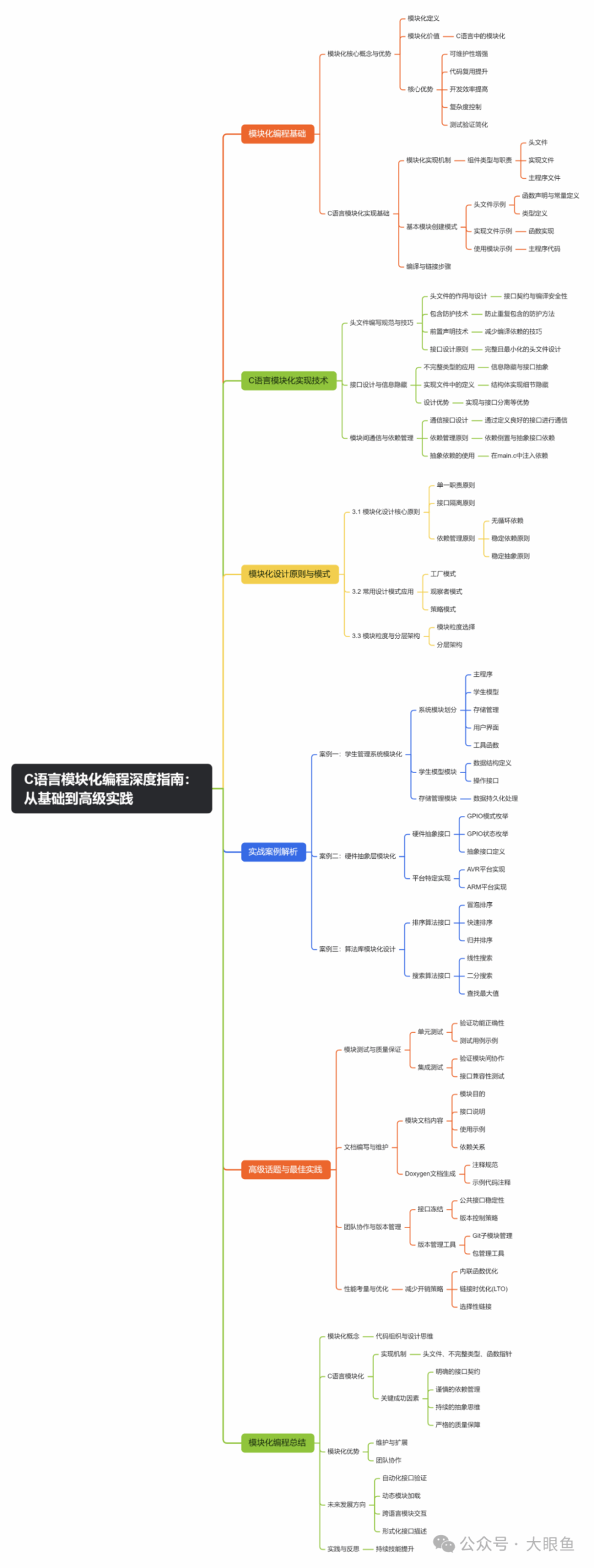
1 Basics of Modular Programming
1.1 Core Concepts and Advantages of Modularity
Modular programming is a software design paradigm that focuses on breaking down large, complex programs into a series of independent and interactive functional modules. Each module is dedicated to solving a specific sub-problem and communicates with other modules through well-defined interfaces. This “divide and conquer” strategy is rooted in the fundamental way humans solve complex problems and has become a cornerstone method in software engineering to address system complexity.
Modular programming is particularly valuable in the C language environment, as it lacks encapsulation mechanisms found in modern object-oriented languages. Modularity provides the foundational means for code organization, interface abstraction, and information hiding, allowing C programs to maintain a clear structure and good maintainability. Modules are not merely code file separations but are logically divided based on functional cohesion and interface simplicity.
The core advantages of modular programming include:
(1) Enhanced maintainability: Module isolation localizes modifications, allowing error fixes and feature adjustments to focus only on specific modules;
(2) Increased code reuse: Well-designed modules can be reused across projects, reducing the workload of duplicate development.
(3) Improved development efficiency: Teams can develop different modules in parallel, shortening project cycles.
(4) Complexity control: By abstracting implementation details, the cognitive load of the system is reduced.
(5) Simplified testing and validation: Modules can be tested independently, facilitating the construction of a comprehensive testing system.
1.2 Basics of Modular Implementation in C
In the C language, modularity is primarily achieved through the separation of header files(.h) and source files(.c) files. Header files serve as the contract for interfaces, declaring externally accessible functions, data types, and constants; source files contain the specific implementations of these declarations, forming the implementation entities. This separation mechanism allows module users to understand the interface without concerning themselves with the internal implementation.
Table:C Language Modular Basic Components
|
Component Type |
File Extension |
Main Responsibilities |
Content Example |
|
Header File |
.h |
Declare Interfaces |
Function prototypes, macro definitions, type definitions |
|
Implementation File |
.c |
Implement Functions |
Function implementations, local data, internal logic |
|
Main Program File |
.c |
Application Entry |
main function, module coordination logic |
Creating a basic module follows this pattern. The header file uses #ifndef–#define–#endif guard mechanism to prevent multiple inclusion issues, which is a foundational technique for C modularity:
// math_operations.h - Header File Example#ifndef MATH_OPERATIONS_H // Include Guard#define MATH_OPERATIONS_H// Function Declarationsint add(int a, int b);int subtract(int a, int b);double divide(double a, double b);// Constant Definitions#define PI 3.1415926// Type Definitionstypedef struct { double real; double imag;} Complex;#endifThe implementation file includes the header file and implements the declared functions:
// math_operations.c - Implementation File Example#include "math_operations.h"// Function Implementationsint add(int a, int b) { return a + b;}int subtract(int a, int b) { return a - b;}double divide(double a, double b) { if (b == 0.0) { // Error Handling return 0.0; } return a / b;}The main program uses the module’s functionality by including the header file:
// main.c - Using Module Example#include <stdio.h>#include "math_operations.h"int main() { int result = add(10, 5); printf("10 + 5 = %d\n", result); double quotient = divide(20.0, 4.0); printf("20.0 / 4.0 = %.2f\n", quotient); return 0;}During compilation, each module should be compiled separately and then linked:
# Compilation Steps Examplegcc -c math_operations.c # Generate math_operations.oggcc -c main.c # Generate main.oggcc -o program main.o math_operations.o # Link to create executable2 C Language Modular Implementation Techniques
2.1 Header File Writing Standards and Techniques
Header files play the role of C modular design as interface contracts, and their quality directly affects the usability and stability of the module. Good header file design should not only provide complete functional interfaces but also ensure compilation safety and minimal dependencies.
Include Guards(Include Guards) are the infrastructure for every header file, preventing multiple inclusions that lead to redefinition issues. Modern compilers support #pragma once as a non-standard directive, but #ifndef traditional method has better cross-compiler compatibility:
// module_interface.h#ifndef MODULE_INTERFACE_H // Unique Identifier, usually related to the file name#define MODULE_INTERFACE_H// Header File Content#endif // MODULE_INTERFACE_HForward Declarations(Forward Declarations) are an important technique for reducing compilation dependencies. When using custom types in module interfaces, it is advisable to use pointer forms and reduce header file dependencies through forward declarations:
// Bad Example: Including full definitions increases dependencies#include "other_module.h" // May include a lot of other dependencies// Good Example: Use forward declarations to reduce dependenciesstruct OtherStruct; // Forward declaration, does not include full definitionvoid process_data(struct OtherStruct* data); // Use pointer parameterInterface design principles require header files to be complete yet minimal, meaning they provide all necessary interfaces for the module without exposing implementation details. Below is an example of a well-designed header file:
// data_storage.h - Good Design Example#ifndef DATA_STORAGE_H#define DATA_STORAGE_H#include <stdint.h> // Only include necessary standard header files// Forward declarations instead of includestypedef struct Record Record;// Module initialization/destroy functionsint storage_init(const char* config);void storage_cleanup();// Core functional interfacesint storage_save(const Record* record);Record* storage_retrieve(int id);int storage_delete(int id);// Auxiliary functionsint storage_count();int storage_backup(const char* path);#endif2.2 Interface Design and Information Hiding
C language lacks native object-oriented support, but information hiding and interface abstraction can be achieved through programming conventions. The key technique is to use incomplete types (Opaque Types) to hide the implementation details of data structures:
// stack.h - Incomplete Type Example#ifndef STACK_H#define STACK_Htypedef struct Stack Stack; // Do not expose struct details// Create/destroy interfacesStack* stack_create(int capacity);void stack_destroy(Stack* stack);// Operation interfacesvoid stack_push(Stack* stack, int value);int stack_pop(Stack* stack);int stack_peek(const Stack* stack);int stack_is_empty(const Stack* stack);#endifProvide complete definitions in the implementation file:
// stack.c - Implementation Hiding#include <stdlib.h>#include "stack.h"// Struct implementation details hiddenstruct Stack { int* data; int capacity; int top;};Stack* stack_create(int capacity) { Stack* stack = malloc(sizeof(Stack)); stack->data = malloc(capacity * sizeof(int)); stack->capacity = capacity; stack->top = -1; return stack;}// Other function implementations...This design provides the following advantages:
(1) Separation of implementation from interface: The implementation can be modified without affecting user code.
(2) Binary compatibility: The implementation can be recompiled without needing to recompile client code as long as the header file remains unchanged.
(3) Error isolation: The internal state of the module is controlled, preventing external erroneous modifications.
2.3 Inter-Module Communication and Dependency Management
Inter-module communication should be conducted through well-defined interfaces, avoiding global variables and implicit coupling. Function parameters should be designed to be self-contained and context-independent, reducing dependencies on external states:
// Bad Design: Depends on global stateextern Database* global_db; // Global dependencyvoid save_user(const User* user);// Good Design: Explicitly pass dependenciesvoid save_user(Database* db, const User* user);Dependency management should follow the Dependency Inversion Principle, where modules should depend on abstract interfaces rather than concrete implementations. In C language, this can be achieved through function pointers and callback mechanisms:
// logger.h - Abstract Interface#ifndef LOGGER_H#define LOGGER_Htypedef enum { LOG_DEBUG, LOG_INFO, LOG_ERROR} LogLevel;// Log function type definitiontypedef void (*LogFunction)(LogLevel level, const char* message);// Set log implementationvoid set_logger(LogFunction func);#endif// main.c - Using Abstract Dependency#include "logger.h"void my_logger(LogLevel level, const char* message) { // Concrete implementation}int main() { set_logger(my_logger); // Inject dependency // ...}3 Modular Design Principles and Patterns
3.1 Core Principles of Modular Design
Efficient modular design requires adherence to a series of validated design principles, which together form the foundation for creating maintainable and scalable software systems.
Single Responsibility Principle(Single Responsibility Principle) requires each module to undertake a single, clear functional responsibility. The criterion is whether the module’s purpose can be described in one sentence without using “ and “ or “ or “ etc. For example:“The logging module is responsible for application logging“ rather than “The logging module is responsible for logging and managing configurations“.
Interface Segregation Principle(Interface Segregation Principle) stipulates that modules should provide small and specialized interfaces rather than large and general-purpose interfaces. Clients should not be forced to depend on interfaces they do not use. In C language, this means breaking down large sets of functions into multiple logically related header files:
// Bad Design: Large Interface// file_operations.hvoid file_read();void file_write();void file_encrypt(); // Not all clients need encryptionvoid file_compress();// Good Design: Interface Separation// file_basic.hvoid file_read();void file_write();// file_advanced.hvoid file_encrypt();void file_compress();Dependency management principles require that inter-module dependencies be clear and controllable. Key guidelines include:
·No Circular Dependencies: Module dependencies should form a directed acyclic graph (DAG).
·Stable Dependency Principle: Modules should depend on more stable modules than themselves.
·Stable Abstraction Principle: Stable modules should provide abstract interfaces.
3.2 Common Design Patterns Applications
Design patterns provide reusable solution templates for common design problems in specific contexts. In C modular programming, the following patterns are particularly useful:
Factory Pattern(Factory Pattern) separates object creation from usage, providing an interface for creating objects while allowing subclasses to decide which class to instantiate. In C language, this is often implemented through function pointers:
// shape_factory.h#ifndef SHAPE_FACTORY_H#define SHAPE_FACTORY_Htypedef struct Shape Shape;// Create function pointer typedeftypedef Shape* (*ShapeCreator)();// Register shape creatorvoid register_shape(const char* type, ShapeCreator creator);// Create shape instanceShape* create_shape(const char* type);#endifObserver Pattern(Observer Pattern) allows modules to subscribe and receive event notifications, achieving decoupling between modules:
// event_system.h#ifndef EVENT_SYSTEM_H#define EVENT_SYSTEM_Htypedef struct Event Event;typedef void (*EventHandler)(const Event*);// Event subscription managementvoid subscribe_event(const char* event_type, EventHandler handler);void unsubscribe_event(const char* event_type, EventHandler handler);void publish_event(const Event* event);#endifStrategy Pattern(Strategy Pattern) defines a family of algorithms, encapsulating each algorithm and making them interchangeable:
// sorter.h#ifndef SORTER_H#define SORTER_Htypedef int CompareFunction(const void*, const void*);void sort_array(void* array, size_t count, size_t size, CompareFunction* compare);#endif3.3 Module Granularity and Layered Architecture
Choosing the granularity (size and complexity) of modules requires balancing multiple factors. Too fine granularity leads to complex interfaces and call overhead, while too coarse granularity reduces reuse opportunities and increases maintenance difficulty. General guiding principles include:
·Functional Cohesion: Related functionalities should be placed in the same module.
·Change Frequency: Functions with different change frequencies should be separated into different modules.
·Reuse Needs: Functions that may be reused should be modularized separately.
Layered architecture is a common organizational method for modular systems, dividing the system into different levels of abstraction, where each layer provides services to the upper layer and uses functionalities from the lower layer. Typical layers include:
// Typical Layer Example// application.c (Application Layer)#include "business_logic.h"#include "data_access.h"// business_logic.h (Business Logic Layer)#include "data_models.h"// data_access.h (Data Access Layer)#include "database.h"// database.h (Infrastructure Layer)#include "file_io.h"Layering should follow the strict layering rules: Layers should only communicate with the directly lower layer, avoiding cross-layer calls and circular dependencies.
4 Practical Case Analysis
4.1 Case 1: Modularization of Student Management System
The student management system is a typical CRUD (Create, Read, Update, Delete) application, suitable for demonstrating modular design practices. We will divide the system into the following modules:
Table: Division of Student Management System Modules
|
Module Name |
Responsibilities |
Interface File |
Implementation File |
|
Main Program |
Program entry and module coordination |
main.c |
main.c |
|
Student Model |
Data structure and validation |
student.h |
student.c |
|
Storage Management |
File read/write operations |
storage.h |
storage.c |
|
User Interface |
Menu and interaction |
ui.h |
ui.c |
|
Utility Functions |
General auxiliary functions |
utils.h |
utils.c |
The Student Model Module defines core data structures and operations:
// student.h#ifndef STUDENT_H#define STUDENT_H#define MAX_NAME_LEN 50#define MAX_STUDENTS 100typedef struct { int id; char name[MAX_NAME_LEN]; int age; float gpa;} Student;// Operation interfacesint validate_student(const Student* s);int compare_students(const Student* a, const Student* b);void print_student(const Student* s);#endifThe Storage Management Module handles data persistence:
// storage.h#ifndef STORAGE_H#define STORAGE_H#include "student.h"int save_students(const char* filename, const Student* students, int count);int load_students(const char* filename, Student* students, int max_count);#endif// storage.c#include <stdio.h>#include "storage.h"int save_students(const char* filename, const Student* students, int count) { FILE* file = fopen(filename, "wb"); if (!file) return -1; int written = fwrite(students, sizeof(Student), count, file); fclose(file); return written;}The main program coordinates the work of the modules:
// main.c#include <stdio.h>#include "student.h"#include "storage.h"#include "ui.h"int main() { Student students[MAX_STUDENTS]; int count = 0; // Load existing data count = load_students("data.bin", students, MAX_STUDENTS); // Display menu while (1) { int choice = show_menu(); switch (choice) { case 1: add_student(students, &count); break; case 2: display_students(students, count); break; // Handle other options } } // Save before exit save_students("data.bin", students, count); return 0;}4.2 Case 2: Modularization of Hardware Abstraction Layer
In embedded systems, the Hardware Abstraction Layer (HAL) is a classic application of modular design. By creating abstract interfaces for hardware devices, it decouples application logic from the hardware platform:
// hal_gpio.h - GPIO Abstract Interface#ifndef HAL_GPIO_H#define HAL_GPIO_Htypedef enum { GPIO_INPUT, GPIO_OUTPUT} GpioMode;typedef enum { GPIO_LOW = 0, GPIO_HIGH = 1} GpioState;// Hardware-independent interfacevoid gpio_set_mode(int pin, GpioMode mode);void gpio_write(int pin, GpioState state);GpioState gpio_read(int pin);#endifPlatform-specific implementations:
// hal_gpio_avr.c - AVR Platform Implementation#include "hal_gpio.h"#include <avr/io.h>void gpio_set_mode(int pin, GpioMode mode) { if (mode == GPIO_OUTPUT) { DDRB |= (1 << pin); // AVR specific code } else { DDRB &= ~(1 << pin); }}// hal_gpio_arm.c - ARM Platform Implementation#include "hal_gpio.h"#include "stm32f4xx.h"void gpio_set_mode(int pin, GpioMode mode) { GPIO_TypeDef* gpio = GPIOA; // ARM specific code if (mode == GPIO_OUTPUT) { gpio->MODER |= (1 << (pin * 2)); } else { gpio->MODER &= ~(1 << (pin * 2)); }}The application code uses the abstract interface without depending on specific hardware:
// application.c#include "hal_gpio.h"void blink_led() { gpio_set_mode(13, GPIO_OUTPUT); while (1) { gpio_write(13, GPIO_HIGH); delay_ms(500); gpio_write(13, GPIO_LOW); delay_ms(500); }}4.3 Case 3: Modular Design of Algorithm Libraries
Algorithm libraries are another typical scenario for modular design, providing reusable algorithm components through separation of concerns:
// sort_algorithm.h#ifndef SORT_ALGORITHM_H#define SORT_ALGORITHM_H// Comparison function pointer typedeftypedef int (*CompareFunction)(const void*, const void*);// Sorting algorithm interfacesvoid bubble_sort(void* array, size_t count, size_t size, CompareFunction compare);void quick_sort(void* array, size_t count, size_t size, CompareFunction compare);void merge_sort(void* array, size_t count, size_t size, CompareFunction compare);// Utility functionsvoid swap_elements(void* a, void* b, size_t size);#endif// search_algorithm.h#ifndef SEARCH_ALGORITHM_H#define SEARCH_ALGORITHM_H// Search algorithm interfacesint linear_search(const void* array, size_t count, size_t size, const void* target);int binary_search(const void* array, size_t count, size_t size, const void* target, int (*compare)(const void*, const void*));void* find_max(void* array, size_t count, size_t size, int (*compare)(const void*, const void*));#endifUsage example:
// main.c#include <stdio.h>#include "sort_algorithm.h"#include "search_algorithm.h"// Custom comparison functionint compare_int(const void* a, const void* b) { return *(int*)a - *(int*)b;}int main() { int numbers[] = {5, 2, 8, 1, 9}; int count = sizeof(numbers) / sizeof(numbers[0]); // Sort bubble_sort(numbers, count, sizeof(int), compare_int); // Search int target = 8; int index = binary_search(numbers, count, sizeof(int), &target, compare_int); printf("Found at index: %d\n", index); return 0;}5 Advanced Topics and Best Practices
5.1 Module Testing and Quality Assurance
Modular design provides a natural foundation for comprehensive testing. Each module should possess testability, meaning it can be tested independently of other modules.
Unit Testing(Unit Testing) verifies the functional correctness of individual modules. In C language, assertions and testing frameworks can be used to create test cases:
// test_student.c - Unit Test Example#include <assert.h>#include "student.h"void test_student_validation() { Student valid = {1, "John", 20, 3.5}; assert(validate_student(&valid) == 1); Student invalid = {2, "", 200, 5.0}; // Invalid data assert(validate_student(&invalid) == 0);}void test_student_comparison() { Student a = {1, "Alice", 20, 3.5}; Student b = {2, "Bob", 21, 3.6}; assert(compare_students(&a, &b) < 0);}Integration Testing (Integration Testing) verifies the collaboration between modules, ensuring interface compatibility and correct data flow:
// test_integration.c - Integration Test Example#include <stdio.h>#include "student.h"#include "storage.h"void test_storage_integration() { Student students[3] = { {1, "Alice", 20, 3.5}, {2, "Bob", 21, 3.6}, {3, "Charlie", 22, 3.7} }; // Test saving int saved = save_students("test.bin", students, 3); assert(saved == 3); // Test loading Student loaded[3]; int loaded_count = load_students("test.bin", loaded, 3); assert(loaded_count == 3); // Verify data consistency for (int i = 0; i < 3; i++) { assert(students[i].id == loaded[i].id); assert(strcmp(students[i].name, loaded[i].name) == 0); }}5.2 Documentation Writing and Maintenance
Module documentation is an important part of the interface contract and should include the following:
·Module Purpose: A concise description of the module’s responsibilities and value.
·Interface Description: The purpose, parameters, and return values of each function.
·Usage Examples: Code examples of typical usage scenarios.
·Dependencies: Other modules that this module depends on.
Doxygen is a commonly used documentation generation tool for C language, which can automatically generate documentation from comments:
/** * @file student.h * @brief Student Data Model Module * * Provides student data structure and related operation functions */#ifndef STUDENT_H#define STUDENT_H/** * @brief Student data structure */typedef struct { int id; ///< Student ID, unique identifier char name[50]; ///< Student name int age; ///< Student age float gpa; ///< Average GPA} Student;/** * @brief Validate student data validity * * @param s Pointer to Student object * @return int 1 for valid, 0 for invalid * * @note Validation rules: Name must not be empty, age between 16-60, GPA between 0.0-4.0 */int validate_student(const Student* s);#endif5.3 Team Collaboration and Version Management
Modular design supports parallel development by teams, requiring clear interface contracts and version management strategies.
Interface Freezing(Interface Freezing) ensures that public interfaces remain stable and should not be easily modified once released. Necessary modifications should be managed through version control:
// module_v1.h - Initial Version#ifndef MODULE_V1_H#define MODULE_V1_Hvoid api_function(int param);#endif// module_v2.h - Backward-compatible Update#ifndef MODULE_V2_H#define MODULE_V2_H#include "module_v1.h"// New features added without affecting existing interfacesvoid new_api_function(int param, int option);#endifGit submodules or package management tools can manage inter-module dependencies:
# Use Git submodules to manage dependenciesgit submodule add https://github.com/example/math_module.gitgit submodule update --init --recursive5.4 Performance Considerations and Optimizations
Modularity may introduce additional overhead, but careful design can minimize the impact:
Inline Functions reduce function call overhead:
# Use LTO compilationgcc -flto -c module1.cgcc -flto -c module2.cgcc -flto -o program module1.o module2.o// Feature selection macros#ifdef ENABLE_ADVANCED_FEATURESvoid advanced_feature();#endifLink Time Optimization (LTO) eliminates inter-module call overhead:
# Use LTO compilationgcc -flto -c module1.cgcc -flto -c module2.cgcc -flto -o program module1.o module2.oSelective Linking only includes necessary features, reducing code size:
// Feature selection macros#ifdef ENABLE_ADVANCED_FEATURESvoid advanced_feature();#endif6 Conclusion
Modular programming is not just a code organization technique, but also a way of thinking in software design. By breaking down complex systems into simple, cooperating modules, we can create more robust, maintainable, and scalable software systems.
Although the C language lacks native support for modularity found in modern languages, high-quality modular design can be fully achieved through header files, incomplete types, function pointers, and good design principles and practices. Key success factors include:
·Clear interface contracts: Strictly distinguish between interfaces and implementations.
·Cautious dependency management: Avoid circular dependencies and control coupling.
·Continuous abstract thinking: Seek conceptual boundaries and separation of concerns.
·Strict quality assurance: Modular testing and comprehensive documentation.
Modular design requires an upfront investment in design effort, but these investments yield substantial returns throughout the project lifecycle, especially in maintenance, expansion, and team collaboration. As system scale increases, the advantages of modularity become more pronounced.
Future development directions include:
·Automated interface validation: Tools to check compliance with interface contracts.
·Dynamic module loading: Runtime module loading and replacement.
·Cross-language module interaction: Interoperability of C modules with components from other languages.
·Formal interface descriptions: Precise interface descriptions using IDL (Interface Definition Language).
Modular programming is a skill that requires continuous practice and should be applied and reflected upon in real projects. By mastering this important technique, C language developers can tackle complex software challenges and build systems that stand the test of time.