🚗🔥In-Depth Analysis of Tesla’s MCU Evolution: From 40nm Tegra to 7nm RDNA2 Performance Leap
Many people say that Tesla’s “in-car system outperforms competitors in seconds,” but few have carefully dissected the evolution of the MCU hardware architecture. Today, we will conduct a technical comparison of Tesla’s three generations of cockpit domain controllers from the perspectives of process technology, CPU/GPU architecture, computing power, and power consumption.
1️⃣ Hardware Evolution Path of the Three Generations of MCU
| Generation | Main Control Platform | CPU | GPU | CPU Process | GPU Process | Memory/Storage | TDP |
|---|---|---|---|---|---|---|---|
| First Generation (2012) | NVIDIA Tegra 3 | ARM Cortex-A9 (4+1 cores) 1.4GHz | GeForce ULP 12 cores 520MHz (~12.4 GFLOPS) | 40nm | 40nm | 1GB + 8GB eMMC | ~20W |
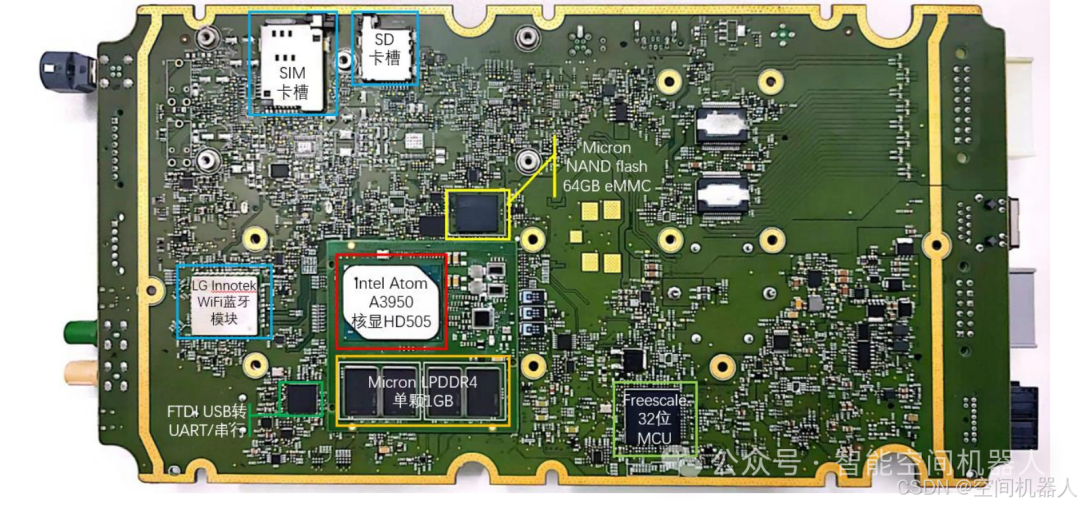
| Second Generation (2018) | Intel Atom A3950 | 4C/4T x86, 1.5GHz | Intel HD 505 (187 GFLOPS) | 14nm | 14nm | 4GB + 64GB eMMC | ~12W |
| Third Generation (2021) | AMD Ryzen + Radeon | 4C/8T Zen+, 3.8GHz | AMD RDNA2 Navi 23, 28 CUs (~10 TFLOPS) | 12nm | 7nm | 16GB + 256GB SSD | 45W + 130W (discrete GPU) |
🔎 Key Changes:
- Process Node Transition: From 40nm → 14nm → 7nm, resulting in reduced power consumption and increased frequency.
- CPU Architecture Transformation: ARM → x86 → Zen architecture, doubling the thread count.
- GPU Performance Surge: From 12.4 GFLOPS → 187 GFLOPS → ~10,000 GFLOPS, an increase of nearly 800 times.
- Memory/Bandwidth: eMMC → SSD, video memory increased from 1GB to 16GB, reaching a host-level standard.
2️⃣ Tesla MCU3 vs. PS5 / Xbox: Horizontal Performance Analysis
| Platform | GPU Architecture | CU Count | GPU Frequency | Single Precision Performance (TFLOPS) | Video Memory Capacity | Video Memory Bandwidth | Power Consumption |
|---|---|---|---|---|---|---|---|
| Tesla MCU3 | RDNA2 Navi 23 | 28 | 2.79 GHz | ~10 | 8GB GDDR6 | 224 GB/s | ~175W (SoC + discrete GPU) |
| PS5 | RDNA2 | 36 | 2.23 GHz | 10.28 | 16GB GDDR6 | 448 GB/s | ~180W |
| Xbox Series X | RDNA2 | 52 | 1.83 GHz | 12.15 | 16GB GDDR6 | 560 GB/s | ~200W |
| Xbox Series S | RDNA2 | 20 | 1.57 GHz | 4 | 10GB GDDR6 | 224 GB/s | ~100W |
📊 Analysis Points:
- Performance Level: Tesla MCU3 ≈ PS5 (essentially on par), fully capable of supporting 4K rendering for mid-to-high quality games.
- Video Memory Bottleneck: 8GB GDDR6 capacity and 224 GB/s bandwidth are relatively low → may encounter loading/caching limitations under extreme conditions.
- Power Consumption Sensitivity: Game console power consumption of about 180W is “socket-friendly,” while MCU3 in a vehicle environment requires consideration of thermal design, EMC, and power redundancy, which is more stringent than home consoles.
- Balance Point: In-car systems do not require long-term extreme rendering; their design focus is on smooth UI, quick application response, and sufficient burst computing power.
3️⃣ Practical Implementation of Performance Experience
- Startup Efficiency: Browser startup reduced to 4 seconds, map dragging approaches smartphone fluidity.
- Application Scenarios: Can smoothly load Bilibili, completing in 9 seconds.
- Game Testing: During the Model S Plaid delivery ceremony, it directly ran “Cyberpunk 2077,” and showcased “The Witcher 3” on the official website.
💡 This means: Tesla has pushed the in-car system to the threshold of AAA game playability.
4️⃣ Engineering Perspective: Challenges in MCU Architecture Design
From a hardware engineer’s perspective, the challenges brought by MCU3 go far beyond just “running games”:
-
Thermal Management
- GPU running at high load for extended periods → cabin temperatures can reach 70°C.
- Requires large-scale liquid cooling/air cooling solutions, even considering independent heat dissipation zones.
Power Architecture
- 45W CPU + 130W GPU means the DC/DC module must support stable output at high currents.
- Ripple and transient response directly affect system stability.
EMC / EMI
- High-speed signals (GDDR6, PCIe Gen4) are prone to electromagnetic interference.
- Must meet ECE R10, ISO 11452 series automotive EMC testing.
Storage Reliability
- Transitioning from eMMC to SSD, write amplification and lifespan issues need to be managed with automotive-grade NAND.
5️⃣ My Perspective: In-Car Systems ≠ Enlarged Smartphones, but a Shrunk Game Console
Many manufacturers approach in-car systems with the mindset of “just enlarging smartphones.” However, Tesla’s approach is closer to “compressing game consoles.”
The future performance formula for in-car systems may be:

👉 Tesla’s choice to “bet big” on the GPU ensures the upper limit of computing power; however, compromises were made on video memory and bandwidth to adapt to automotive environments.
This represents a balance of performance—power consumption—reliability, which is completely different from traditional consumer electronics.
🎯 Summary
- First Generation MCU: Tablet-level, capable of running UI.
- Second Generation MCU: Lightweight PC-level, capable of smooth navigation.
- Third Generation MCU: Console-level, capable of playing AAA games.
From 40nm Tegra to 7nm RDNA2, Tesla has pushed the computing power of in-car systems directly to the industry ceiling. In the future, as autonomous driving matures, in-car systems will not only serve as entertainment terminals but may also undertake tasks such as AI inference and edge computing.
In summary:Tesla has turned the in-car system into a “host on four wheels.”🚗🔥