Click the blue text aboveTalks Lab
Get more information on automotive cybersecurity
01
Concepts
1.1 CPU (Central Processing Unit)
The CPU (Central Processing Unit) is the core of computation and control in a computer. It consists of an arithmetic logic unit, a control unit, and registers, along with buses that connect them for data, control, and status. The well-known three-stage pipeline: fetch, decode, execute pertains to the CPU. The operation of almost all CPUs can be divided into four stages: Fetch, Decode, Execute, and Writeback. The CPU retrieves instructions from memory or cache, places them in the instruction register, decodes the instructions, and executes them. The programmability of a computer primarily refers to programming the CPU.
1.2 MPU (Micro Processor Unit)
The MPU (Micro Processor Unit), also known as a microprocessor (not to be confused with a microcontroller MCU), typically represents a powerful CPU (consider it an enhanced version of a CPU), but it is not designed for any specific computational purpose. This type of chip is often the core CPU of personal computers and high-end workstations. Examples include Intel’s X86 and some ARM Cortex-A chips like Freescale i.MX6, Allwinner A20, and TI AM335X.
1.3 MCU (Micro Control Unit)
The MCU (Micro Control Unit), commonly referred to as a microcontroller, is essentially what we call a single-chip microcontroller. It refers to the integration of a computer’s CPU, RAM, ROM, timers, and various I/O interfaces onto a single chip, forming a chip-level system, such as the 51, STC, AVR, and Cortex-M chips. These chips integrate an entire computer system on one chip, allowing for the direct addition of simple peripheral devices (resistors, capacitors) to run code. It is fundamentally a complete microcontroller with a processor and various interfaces, where all development is based on an existing system architecture, and the user only needs to develop software programs and add external devices. In contrast, ARM (Cortex-A series) cannot run code directly because it is essentially just an enhanced CPU and requires additional RAM and ROM.
1.4 SoC (System on Chip)
The SoC (System on Chip) refers to an integrated circuit system that completes a specific function. It is a system-level chip that, like an MCU, has built-in RAM and ROM, while also being as powerful as an MPU. It can run system-level code, meaning it can operate an operating system (primarily Linux OS), combining the advantages of MCU integration and MPU processing power.
1.5 SoPC (System On a Programmable Chip)
Compared to the above concepts, the occurrence of SoPC is not as frequent, but this does not diminish its importance. SoPC stands for System On a Programmable Chip, which allows for hardware configuration changes, meaning one can construct their own chip.
For example, the hardware configuration of a microcontroller is fixed, and what we can modify through programming is the software configuration. For instance, a serial communication function can be changed to an AD sampling function by modifying the code, meaning the hardware configuration is fixed, and we can only select one or more functions by modifying the software. In contrast, SoPC allows for modifications to the hardware configuration to become the corresponding chip, which can be either an MCU or an SoC.
02
Differences
2.1 Differences Between MCU and MPU
The MCU integrates an entire computer system on a single chip, allowing for the direct addition of simple peripheral devices (resistors, capacitors) to run code. It is fundamentally a complete microcontroller with a processor and various interfaces, where all development is based on an existing system architecture, and the user only needs to develop software programs and add external devices.
In contrast, an MPU, such as the ARM Cortex-A series, cannot run code directly because it is essentially just an enhanced CPU and requires additional RAM and ROM.
2.2 Differences Between CPU and SoC
The SoC can be seen as a combination of the integration of an MCU and the processing power of an MPU, where the MCU integrates various peripherals and the MPU is an enhanced version of a CPU. The differences between CPU and SoC can be visually represented in the diagram below.
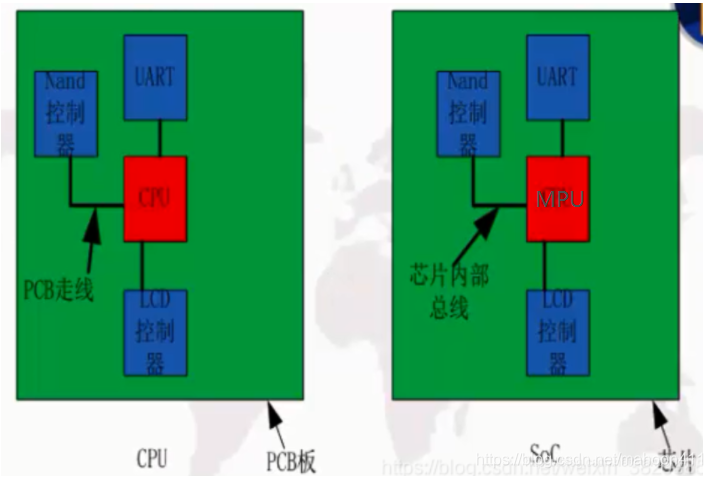
The current direction of chip development is from CPU to SoC; there are no pure CPUs anymore, only SoCs. The cores sold by ARM are essentially CPUs (of course, they also require a bus), and various peripherals are added by semiconductor manufacturers themselves.
2.3 Differences Between SoPC, MCU, MPU, and SoC
The most significant difference between SoPC and MCU, MPU, SoC is the ability to change hardware configurations, meaning one can construct their own chip.
For example, the hardware configuration of a microcontroller is fixed, and what we can modify through programming is the software configuration. For instance, a serial communication function can be changed to an AD sampling function by modifying the code, meaning the hardware configuration is fixed, and we can only select one or more functions by modifying the software. In contrast, SoPC allows for modifications to the hardware configuration to become the corresponding chip, which can be either an MCU or an SoC.
Source:
https://blog.csdn.net/mahoon411/article/details/119374835
end
Recommended Premium Events
AutoSec Series Salon
Professional Community

Some experts in the group come from:
New force car companies:
Tesla, Hozon New Energy – Nezha, Li Auto, Zeekr, Xiaomi, Binnli Auto, Jiyue, Leap Motor, Avita, Zhiji Auto, Xpeng, Lantu Auto, NIO, Geely Auto, Seres……
Foreign traditional mainstream car companies:
Volkswagen China, Volkswagen Coolwing, Audi, BMW, Ford, Daimler-Benz, General Motors, Porsche, Volvo, Hyundai, Nissan, Jaguar Land Rover, Scania……
Domestic traditional mainstream car companies:
Geely Auto, SAIC Passenger Cars, Great Wall Motors, SAIC Volkswagen, Changan Automobile, Beijing Automotive, Dongfeng Motor, GAC, BYD, FAW Group, FAW Liberation, Dongfeng Commercial, SAIC Commercial……
Global leading Tier 1 suppliers:
Bosch, Continental, United Automotive Electronics, Aptiv, ZF, KOSTAL, Schaeffler, Honeywell, DJI, Hitachi, Harman, Huawei, Baidu, Lenovo, MediaTek, Preh, Desay SV, Hubei Chuangxin, XCMG, Yicheng Technology, Weichai Group, Horizon, Unisoc, ByteDance,……
Tier 2 suppliers (500+):
Upstream, ETAS, Synopsys, NXP, TUV, Shanghai Software Center, Deloitte, Qihoo 360, Weichan Xinan, Yunchi Future, Xinda Jiexin, Xinchangcheng, Zelu Safety, Niuchuang Xinan, Fudan Microelectronics, Tianrongxin, Qihoo 360, China Automotive Center, China Automotive Research, Shanghai Automotive Inspection, Ruann Technology, Zhejiang University……
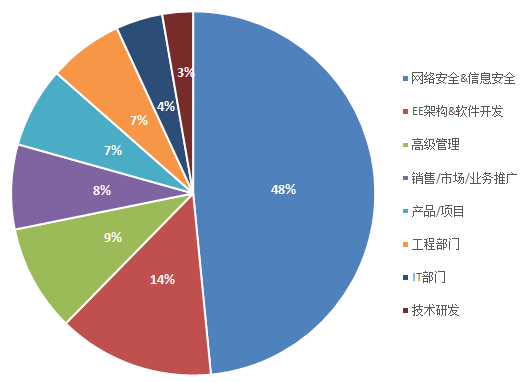
Personnel Proportion
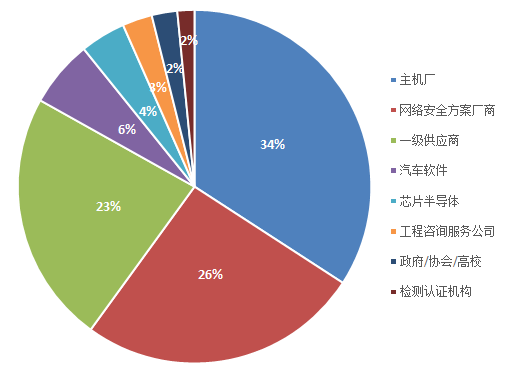
Company Type Proportion
Articles
Don’t miss out, this could be the largest exclusive community in the automotive cybersecurity industry!
About the lawyer’s statement regarding the alleged imitation of the AutoSec conference brand
This article will help you understand the in-vehicle network communication security architecture of smart vehicles
Cybersecurity: TARA methods, tools, and cases
Key analysis of automotive data security compliance
Analysis of automotive chip information security and secure boot
Exploration of automotive in-vehicle communication security solutions in domain centralized architecture
System security architecture of vehicle network security
Privacy protection issues in the Internet of Vehicles
Research on cybersecurity technology for intelligent connected vehicles
AUTOSAR information security framework and key technology analysis
What are the information security mechanisms of AUTOSAR?
Underlying mechanisms of information security
Automotive network security
Use of AUTOSAR hardware security module HSM
First release! Lei Jun from Xiaomi suggested at the two sessions regarding automotive data security: Suggestions for building a complete automotive data security management system