With the increasing popularity of industrial robots, programmable logic controllers (PLCs) are being widely used to control industrial robots. For technical personnel engaged in the industrial robot industry or those wishing to enter this field, mastering the knowledge and skills of communication between PLCs and industrial robots is becoming increasingly important. Therefore, the “Illustrated Guide to Industrial Robot Control and PLC Communication” has emerged.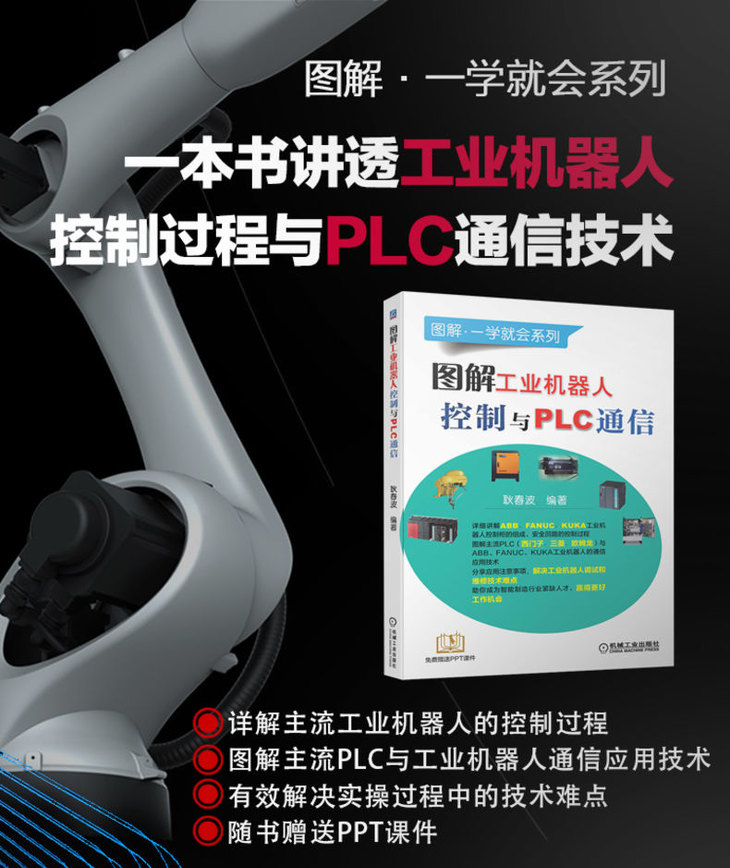 “Illustrated Guide to Industrial Robot Control and PLC Communication” is suitable for engineers and technical personnel engaged in the debugging and maintenance of industrial robots in enterprises, as well as students in colleges and universities studying industrial robot debugging and maintenance, mechatronics, electrical automation, and other related majors.
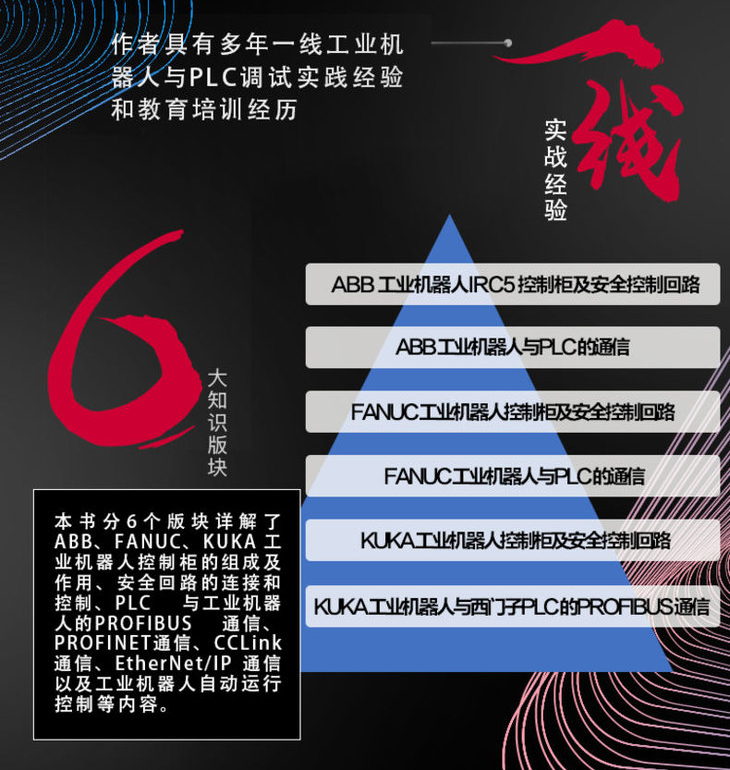 This book is divided into six chapters, explaining the communication technology between ABB, FANUC, KUKA industrial robots and PLCs through illustrations.
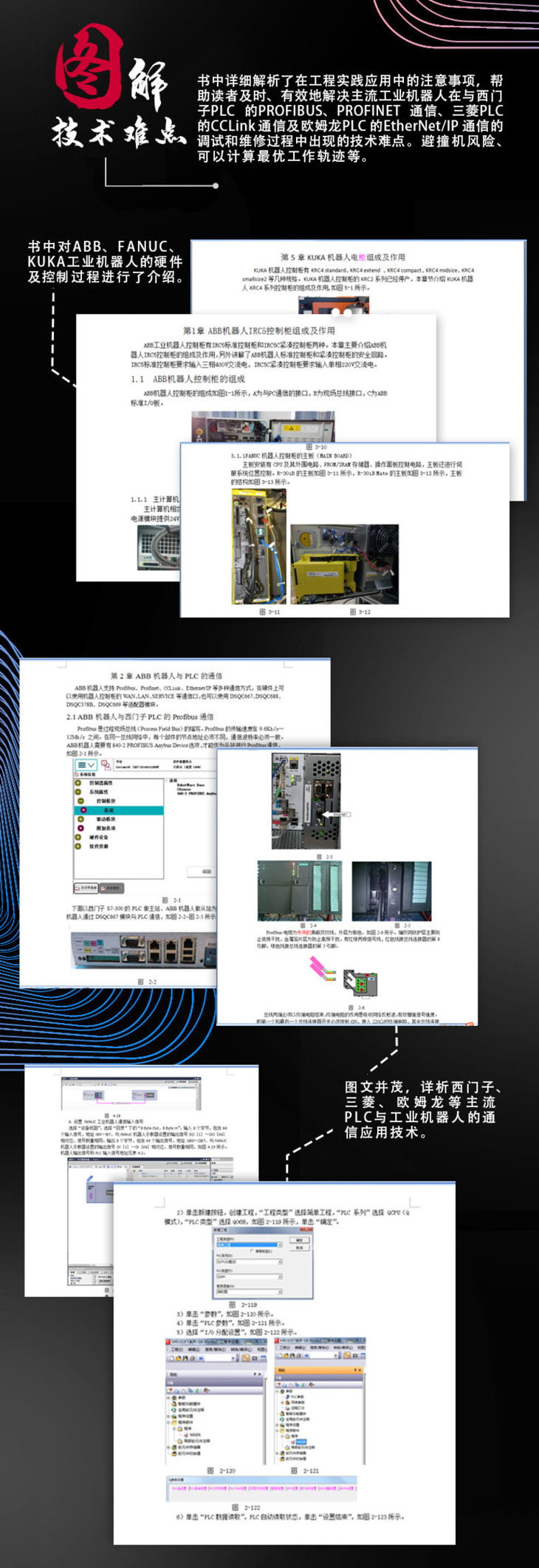
- Chapter 1 introduces the composition and function of the ABB industrial robot control cabinet, as well as the connection and control of safety control circuits.
- Chapter 2 introduces the communication between ABB industrial robots and Siemens PLCs using PROFIBUS and PROFINET, as well as CCLink communication with Mitsubishi PLCs, and EtherNet/IP communication of ABB industrial robots.
- Chapter 3 introduces the composition and function of the FANUC industrial robot control cabinet, as well as the connection and control of safety control circuits.
- Chapter 4 introduces the communication between FANUC industrial robots and Siemens PLCs using PROFIBUS and PROFINET, CCLink communication with Mitsubishi PLCs, EtherNet/IP communication with Omron PLCs, and automatic program running control of FANUC industrial robots.
- Chapter 5 introduces the composition and function of the KUKA industrial robot control cabinet, as well as the connection and control of safety control circuits.
- Chapter 6 introduces the communication between KUKA industrial robots and Siemens PLCs using PROFIBUS and PROFINET, as well as external automatic running control of KUKA industrial robots.
 Click the image to learn moreDrag the scrollbar on the right to view the full directory▼Directory
Preface
Chapter 1 ABB Industrial Robot IRC5 Control Cabinet and Safety Control Circuit …1
1.1 Composition and Function of ABB Industrial Robot IRC5 Control Cabinet …1
1.1.1 Main Computer Unit …1
1.1.2 Axis Computer Board …2
1.1.3 Drive Unit of Six Axes of the Robot …2
1.1.4 Teaching Pendant and Control Cabinet Operating Panel …3
1.1.5 Serial Measurement Board …3
1.1.6 System Power Module …4
1.1.7 Power Distribution Board …4
1.1.8 Capacitor Unit …5
1.1.9 Contactor Board …5
1.1.10 Safety Board …5
1.1.11 Control Cabinet Transformer …6
1.1.12 Bleeder Resistor …6
1.1.13 User Power Supply Module …6
1.1.14 I/O Unit Module …6
1.1.15 Overall Connection Diagram of the Control Cabinet …7
1.2 Safety Control Circuit of ABB Industrial Robot …8
1.2.1 Emergency Stop Control Circuit of ABB Industrial Robot Standard Control Cabinet …8
1.2.2 Automatic Stop, Normal Stop, and Upper-level Stop Control Circuit of ABB Industrial Robot Standard Control Cabinet …11
1.2.3 Emergency Stop Circuit of ABB Industrial Robot Compact Control Cabinet …13
1.2.4 Safety Circuit of ABB Industrial Robot Compact Control Cabinet …15
Chapter 2 Communication between ABB Industrial Robots and PLCs …17
2.1 PROFIBUS Communication between ABB Industrial Robots and Siemens PLCs …17
2.1.1 Configuration of ABB Industrial Robot PROFIBUS …19
2.1.2 Creating I/O Signals for PROFIBUS …24
2.1.3 PLC Configuration …27
2.1.4 Association of System Input/Output with I/O Signals …34
2.1.5 PLC Programming …37
2.2 PROFINET Communication between ABB Industrial Robots and Siemens PLCs …38
2.2.1 ABB Industrial Robot PROFINET Communication via DSQC688 Module …40
2.2.1.1 Configuration of ABB Industrial Robot PROFINET Communication via DSQC688 …40
2.2.1.2 Creating I/O Signals for PROFINET …44
2.2.1.3 PLC Configuration …46
2.2.1.4 Establishing PROFINET Communication between PLC and ABB Industrial Robot …53
2.2.2 ABB Industrial Robot PROFINET Communication via WAN and LAN3 Port …54
2.2.2.1 Configuration of ABB Industrial Robot PROFINET Communication via WAN and LAN3 …54
2.2.2.2 Creating I/O Signals for PROFINET …59
2.2.2.3 PLC Configuration …61
2.2.2.4 Setting Communication Input/Output Signals for ABB Industrial Robot …66
2.2.2.5 Establishing PROFINET Communication between PLC and ABB Industrial Robot …66
2.3 CCLink Communication between ABB Industrial Robots and Mitsubishi Q Series PLCs …67
2.3.1 DSQC378B Module …67
2.3.2 Mitsubishi PLC Settings …68
2.3.3 PLC Programming …69
2.3.4 ABB Industrial Robot Settings …73
2.4 Configuration of ABB Industrial Robot EtherNet/IP Communication …80
2.4.1 Application of ABB Industrial Robot 841-1 EtherNet/IP Scanner/Adapter Option …80
2.4.2 Application of ABB Industrial Robot 840-1 EtherNet/IP Anybus Adapter Option …84
2.5 Socket Communication …88
2.5.1 Socket Communication Settings …88
2.5.2 Creating Socket Communication …90
2.5.3 Example of Socket Communication Application …92
Chapter 3 FANUC Industrial Robot Control Cabinet and Safety Control Circuit …94
3.1 Composition and Function of FANUC Industrial Robot Control Cabinet …94
3.1.1 Mainboard of FANUC Industrial Robot Control Cabinet …97
3.1.2 Mainboard Battery …98
3.1.3 FANUC Input Output Printed Circuit Board …98
3.1.4 Power Supply Unit …99
3.1.5 Teaching Pendant …100
3.1.6 Servo Amplifier …101
3.1.7 Operating Panel …102
3.1.8 Transformer …102
3.1.9 Fan Unit and Heat Exchanger …102
3.1.10 Circuit Breaker …102
3.1.11 Regenerative Resistor …102
3.2 Safety Control Circuit of FANUC Industrial Robot …103
3.3 Emergency Stop Unit 111
Chapter 4 Communication between FANUC Industrial Robots and PLCs
Chapter 5 Composition and Function of KUKA Industrial Robot Control Cabinet and Safety Control Circuit
Chapter 6 Communication between KUKA Industrial Robots and PLCs
Source: Jinfeng MallEditor: Cao Shengyu Reviewer: Han Jingchun