The Internet of Things (IoT) revolution is not just a stepping stone—it is transforming industries, cities, homes, and even our daily lives. At the heart of this digital transformation is a foundational technology: IoT sensors. These small yet powerful devices are enabling a smarter, more interconnected world—according to a recent forecast by Global Market Insights, the global market size for IoT sensors is expected to exceed $381.6 billion by 2034.
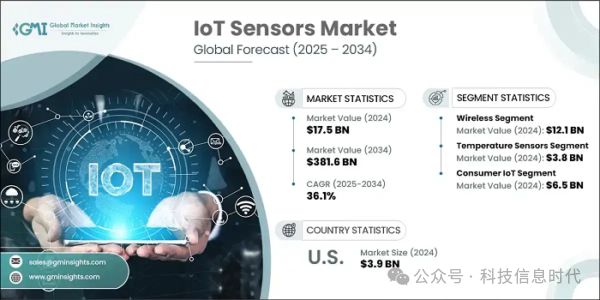
This explosive growth not only signifies a technological transformation but also brings tremendous opportunities across sectors such as automation, robotics, healthcare, agriculture, and manufacturing. For tech innovators, policymakers, and robotics experts (such as those following RoboticsTomorrow.com), the IoT sensor market is a key area for progress and innovation.
What are IoT sensors? Why are they so important?
IoT sensors are devices capable of detecting and measuring physical parameters such as temperature, motion, pressure, humidity, light, and gas, converting these readings into digital signals for analysis or action. Their core function is data collection, acting as the nervous system of any IoT environment, enabling machines and systems to interact intelligently with the physical world.
From smart homes to smart factories, IoT sensors support critical applications in the following areas:
Industrial Automation
Smart Cities
Medical Monitoring
Agriculture
Transportation
Consumer Electronics
As the reliance on real-time data increases, businesses and governments are rapidly investing in sensor technology to enhance efficiency, safety, and sustainability.
Why is the market booming?
By 2034, the IoT market size is expected to surge to over $381.6 billion, driven by several transformative trends:
1. Expansion of the Industrial Internet of Things (IIoT)
Industries such as manufacturing, oil and gas, and logistics are integrating IoT sensors into their infrastructure for real-time monitoring and predictive maintenance. This shift reduces downtime, increases productivity, and minimizes operational costs—an attractive proposition for companies seeking a competitive edge.
2. Investment in Smart Cities and Infrastructure
Urbanization is driving the demand for smarter traffic management, power grids, and public safety solutions. Governments worldwide are embedding IoT sensors into urban infrastructure to monitor air quality, manage streetlights, detect leaks, and optimize energy usage.
3. Innovations in Healthcare
IoT sensors are transforming patient care through wearable devices, remote health monitoring, and smart diagnostics. The demand for continuous health tracking, especially post-COVID-19, has accelerated the application of sensors in medical devices.
4. Agricultural Efficiency
In smart agriculture, IoT sensors can measure soil moisture, monitor crop health, and track livestock conditions. This data enables farmers to make informed decisions, increase yields, and reduce resource consumption—a key factor in feeding the growing global population.
5. Advances in Connectivity Technologies
The widespread deployment of 5G networks, Low Power Wide Area Networks (LPWAN), and edge computing enhances the performance and scalability of IoT systems. These technologies allow millions of sensors to be seamlessly integrated into distributed systems.
Market Segmentation: Key Segments and Insights
► By Sensor Type
Pressure sensors, temperature sensors, and accelerometers are the most widely used sensors in industrial applications.
Image sensors are rapidly developing in fields such as autonomous vehicles and surveillance.
Gas sensors are crucial for environmental monitoring and HVAC systems.
► By Application
Due to the widespread use of smartphones, wearables, and home automation, consumer electronics currently hold a significant market share.
With increased automation and the electrification of vehicles, the industrial and automotive sectors are expected to see the highest growth.
Healthcare is becoming an important application area, especially with the rise of telemedicine and remote patient monitoring.
► By Region
North America leads the market due to early adoption of advanced technologies and a strong industrial infrastructure.
The Asia-Pacific region, particularly China, Japan, and South Korea, is expected to experience exponential growth driven by smart manufacturing and smart city initiatives.
Europe is also experiencing growth, thanks to stringent environmental regulations and innovations in green technologies.
Future Challenges
Despite the optimistic outlook, the IoT sensor market faces several challenges that must be addressed to maintain long-term growth:
Security Risks: The more devices there are, the more potential vulnerabilities arise. Data security and privacy will remain critical issues, especially in healthcare and finance.
Power Consumption: Many sensors are deployed in remote or hard-to-reach locations. Developing ultra-low-power sensors is crucial for scaling IoT applications.
Interoperability Issues: Diverse standards and protocols may hinder sensor integration. Industry standards are essential for the efficient scaling of IoT systems.
The Role of Robotics and Automation
For the robotics industry, IoT sensors are not just accessories; they are enablers. Autonomous robots in manufacturing, delivery, or healthcare heavily rely on sensor data for perception, decision-making, and navigation. As robotic collaboration capabilities (collaborative robots) and mobility improve, the importance of real-time perception significantly increases.
Moreover, the integration of artificial intelligence with IoT sensors is creating intelligent perception platforms, allowing machines to learn from the collected data. This lays the foundation for the next generation of automation in warehouses, farmlands, and hospitals.
Future Outlook: Expectations for 2034
As we move towards 2034, the IoT sensor market will continue to be defined by innovation, miniaturization, intelligence, and integration.
Smaller, smarter sensors with embedded edge AI capabilities will enable more localized decision-making, reducing reliance on cloud computing.
Flexible and printed sensors will become standard in wearable devices and smart textiles.
Sensor fusion—integrating data from multiple sensor types—will enhance accuracy and support advanced applications such as AR/VR and autonomous navigation.
Sustainability will shape sensor design, incorporating more eco-friendly, recyclable, and energy-efficient components.
Conclusion
The IoT sensor market is expected to reach $381.6 billion by 2034, reflecting the growing importance of interconnected intelligence in all aspects of life and industry. Whether you are an innovator in the robotics field, a policymaker, a manufacturer, or a tech enthusiast, understanding the powerful capabilities and potential of IoT sensors is crucial.
As the world increasingly relies on data-driven systems, these unassuming sensors are rapidly becoming one of the most critical cornerstones of our digital future.