Technical Background
In tasks involving high-speed motion tracking and measurement of rigid targets, visual measurement systems based on a single hardware platform typically follow a “capture – return to server – backend processing” model to sequentially complete tasks such as image acquisition, feature extraction, and target tracking. This approach suffers from high data latency and significant bandwidth pressure, making it difficult to meet the millisecond-level real-time processing requirements in high-speed scenarios.
Technical Principles
Qianyan Wolf’s visual measurement engineers have proposed a dual-core collaborative computing technology based on GPU and NPU, achieving technological advancement in hardware architecture, task collaboration mechanisms, and algorithm adaptation optimization:
-
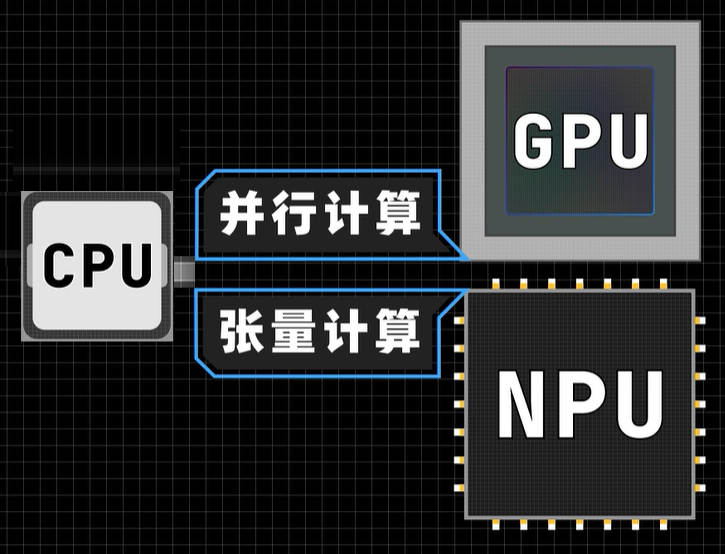
Hardware Architecture Design: The GPU and NPU are connected through a hardware-level collaborative architecture, fully leveraging the parallel floating-point computing capabilities of the GPU and the neural network inference optimization capabilities of the NPU.
-
Task Collaboration Mechanism: The first step involves the Qianyan Wolf high-speed camera (recommended high-resolution high-speed camera G536, 2560×2016 @3600fps) capturing transient images, which are then processed by the GPU’s multi-core architecture for RAW data image stream processing, such as image denoising, image enhancement, and ROI cropping, generating candidate regions. The second step involves real-time transmission of the GPU-processed data to the NPU for AI inference on the tracking target, utilizing distributed small processing units for feature matching and classification, completing target recognition or tracking.
-
Algorithm Adaptation Optimization: Techniques such as pruning, quantization, and knowledge distillation are employed to lightweight the deep learning models on the NPU computing unit, reducing computational complexity and power consumption. Additionally, a mixed-precision strategy is adopted to match different algorithms, such as high-precision algorithms for GPU processing of 3D reconstruction tasks and high-efficiency lightweight algorithms for NPU processing of low-precision inference tasks, balancing accuracy and real-time performance.
Technical Advantages
The tracking and measurement solution based on the GPU and NPU dual-core collaborative computing model exhibits significant differentiated advantages over traditional GPU solutions in terms of real-time performance, energy efficiency, flexibility, and security:
-
Real-Time Performance: Traditional solutions experience delays ranging from seconds to minutes due to server processing, while the dual-core collaborative solution, through algorithm adaptation optimization, can reduce latency to the millisecond level and support real-time output.
-
Energy Efficiency: Traditional solutions see a significant increase in power consumption at high frame rates, whereas the dual-core collaborative solution can dynamically adjust the load distribution between the GPU and NPU, significantly improving energy efficiency.
-
Flexibility: Traditional solutions heavily rely on backend servers and have poor scalability, while the dual-core collaborative solution operates as a complete system on a single device and supports distributed deployment, greatly enhancing flexibility to meet diverse measurement scenario requirements.
-
Security: Traditional solutions pose a risk of data leakage due to server transmission, while the dual-core collaborative solution supports internal information closed-loop processing within the high-speed camera, eliminating the need for external transmission links and ensuring data security.
Typical Case
Qianyan Wolf’s latest developed 6D measurement instrument incorporates dual-core collaborative computing, real-time tracking and measuring the 6Dof data of a conical object at the moment of separation from its mount. The Qianyan Wolf high-speed camera G536_Pro captures target images at a rate of 1000 frames per second, with the GPU performing real-time image enhancement and multi-view matching, while the NPU identifies key points of the conical object and calculates the 6Dof pose in real-time. The entire data processing flow is completed within the high-speed camera, eliminating the need for data return, and providing real-time output of motion trajectories and pose changes.
Conclusion
The high-speed real-time tracking and measurement technology based on the GPU and NPU dual-core collaborative computing model by Qianyan Wolf addresses the bottlenecks of traditional architectures in terms of real-time performance, energy efficiency, flexibility, and security through innovative hardware architecture, task collaboration mechanisms, and algorithm adaptation optimization, providing efficient, precise, and real-time solutions for the high-speed visual measurement field, facilitating the realization of a true “perception-decision-control” closed loop in high-speed visual measurement systems.

Official Website
www.gaosuxiangji.com
National Service Phone
400-859-1866
Official Douyin Account
Qianyan Wolf High-Speed Camera