CoaXPress-over-Fiber (CoF) is a significant extension of the existing CoaXPress specification, designed to support transmission over fiber optics.
CoaXPress (CXP) is the de facto standard for high-bandwidth computer vision applications. CoaXPress 2.0 specifies the CXP-12 speed, which is a 12.5 Gbps (gigabits per second) link achieved over coaxial copper cables. Since link aggregation is common in CoaXPress, achieving 50 Gbps (12.5 x 4) bandwidth is straightforward using four CXP-12 links. The CoaXPress specification is maintained by the Japan Industrial Imaging Association (JIIA).
CoaXPress-over-Fiber is designed as an add-on to the CoaXPress 2.0 specification. It provides a means to run the unmodified CoaXPress protocol over standard Ethernet connections, including fiber optics. Therefore, although CoaXPress-over-Fiber utilizes standard electronic components, connectors, and cables designed for Ethernet, the protocol it employs is CoaXPress, not Ethernet or GigE Vision.
In simple terms, CoaXPress-over-Fiber allows the use of existing Ethernet infrastructure, particularly fiber optic networks, to transmit data using the CoaXPress protocol without any modifications to the protocol itself. This enables CoaXPress technology to be applied in a wider range of scenarios, especially in applications requiring long distances or higher bandwidth.
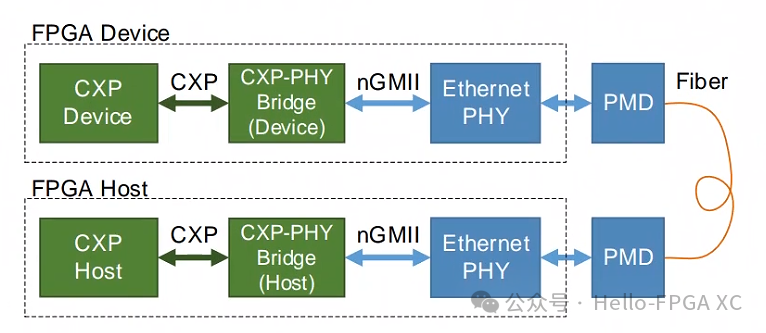
Figure 1 CoaXPress over Fiber link overview
The features of Hello-FPGA’s CoaXPress Over Fiber HOST Bridge FPGA IP Core are as follows:
- Compatible with CoaXPress over Fiber Bridge Protocol V1.0 (released in 2021)
- Supports up to CXP-12 downlink high-speed links, 41.6 Mbps uplink low-speed links, nGMII compliant with IEEE Std 802.3 Clause 46
- nGMII supports 10G/25G options, defaulting to 10G
- Utilizes high-speed transceivers built into the FPGA as PHY chips, making it easy to use
- No complex configuration is required; simply instantiate the IP and make basic connections to use