
Artificial intelligence technology is reshaping the industrial logic and user behavior of the global digital economy. AI chatbots, as a crucial entry point for human-computer interaction, have transitioned from marginal tools to core infrastructure of the digital ecosystem. This report systematically analyzes the global AI chatbot market landscape for 2025 based on traffic data from platforms such as AI Product Rankings and toolify.ai, dissects the growth logic of leading products, and extracts three core insights: ecological synergy, scenario sedimentation, and intelligent capability upgrades, providing strategic decision-making references for industry participants.

Market Landscape
The global AI market in 2025 exhibits significant characteristics of “total explosion and structural concentration.” From August 2024 to July 2025, over 10,500 AI tools generated more than 100 billion web visits, with AI chatbots dominating as the core of traffic—TOP 10 chatbot products accounted for 58.8% of AI web traffic1, forming a market structure dominated by a few leading players.
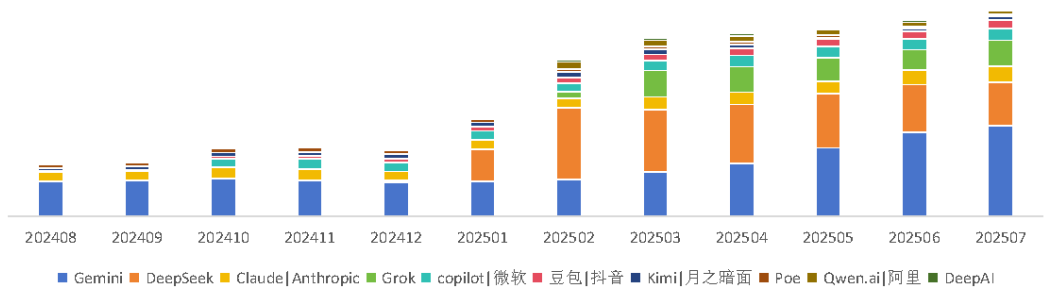
The global AI chatbot market in 2025 presents a pattern of “one strong leader and many strong challengers,” clearly divided into two camps: ChatGPT and non-ChatGPT. Among them, ChatGPT stands out with a market share of 81.5%, achieving an annual visit volume of 52.65 billion, with 5.91 billion visits in July alone, a year-on-year increase of 135%. Its leadership stems from deep technological accumulation and continuous innovation, powerful and widely applicable features, optimized product design, and high-quality user experience, as well as efficient market promotion and word-of-mouth communication. The non-ChatGPT camp is also making strides: Google Gemini leverages Google’s multi-ecosystem to convert traffic, achieving 720 million visits in July, a year-on-year increase of 158%; Anthropic Claude focuses on vertical fields, achieving a steady growth of 72%; Grok, benefiting from exposure on the X platform, Elon Musk’s IP, and a free top-tier model strategy, has entered the top five within six months and has the highest user growth rate in the industry this year; DeepSeek, which once surged, has seen its visit volume drop from a peak of 571 million in February to 345 million in July, a decrease of 39.6%. Additionally, Microsoft Copilot and Douyin Doubao are also enhancing their competitiveness through technology optimization and scenario expansion.
Figure 1: Global Non-ChatGPT TOP 10 AI Chatbot Web Visit Volume2

Growth Logic
1. Traffic Logic: Integration of Entry Points and Ecosystems
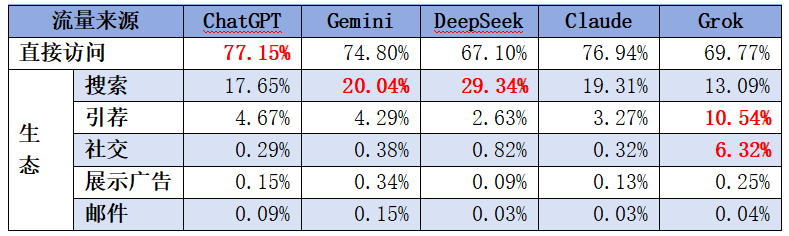
Firstly, integration with social ecosystems enables rapid market expansion. Grok deeply embeds itself in the social DNA of the X platform (formerly Twitter), building a traffic moat through real-time data streams and native interface integration. Users can directly access it via the bottom navigation bar of X, achieving over 100 million daily exposures. The “social + AI” bundling model allows it to gain substantial traffic in a short time. Secondly, system-level ecological penetration builds traffic barriers. Gemini not only deeply integrates with Google Search to provide interactive results for multimodal queries but also achieves underlying integration with the Android operating system and Google Workspace, allowing users to seamlessly access AI features in daily tools like Gmail and Docs. Data shows that traffic obtained through ecological integration accounts for over 25% of Gemini’s total traffic.
Table 1: Global TOP 5 AI Chatbot Desktop Traffic Sources3
2. Value Logic: Differentiation and Scenario Sedimentation
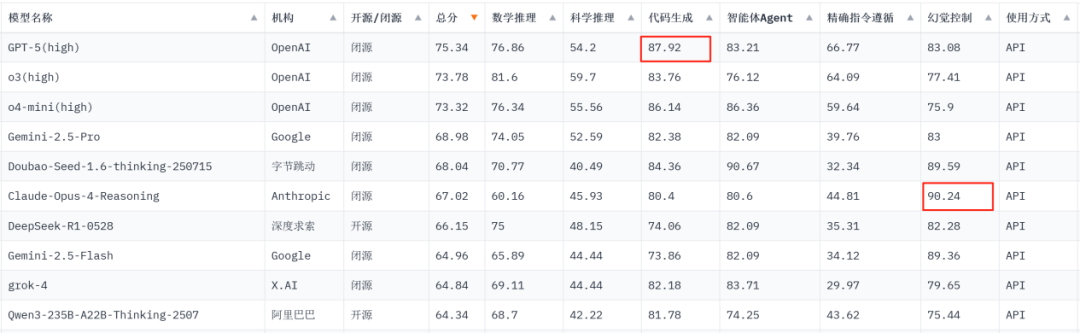
Firstly, continuous breakthroughs in context length. Kimi, with a super long window of 2 million characters, can handle large legal documents, lengthy conversations, and extensive codebases, reinforcing its positioning as a tool for high-risk, data-intensive tasks. Secondly, enterprise-level positioning. Claude builds enterprise-level trust barriers based on deep compliance capabilities and professional technical services in vertical fields: 85% of usage scenarios are concentrated in professional and enterprise environments, with over 60%4 of Fortune 500 companies attempting to introduce Claude into internal tools, and it has been rated as the #1 most trusted LLM in Gartner’s 2025 Magic Quadrant for enterprise applications. For example, in legal scenarios, its query hallucination rate is lower than that of GPT-5, with legal technology applications growing by 61% year-on-year. Thirdly, workflow integration. This is mainly reflected in core indicators such as model capabilities, response speed, and multimodal support. ChatGPT, with the excellent code generation capabilities of the GPT-5 model, deeply integrates programming and office tools, supporting the generation of web applications and schedule management, upgrading from a “Q&A tool” to a “central hub for work.”
Figure 2: Global TOP 10 Models in July 20255
3. Capability Logic: Continuous Evolution Towards Intelligence
Firstly, agentification and routing mechanisms reshape task links. Agentification upgrades models from dialogue tools to automated nodes, capable of proactively calling tools, running code, and achieving multi-agent collaboration. For instance, the ChatGPT Agent can perform web interactions, bridging the gap from Q&A to execution. The routing mechanism dynamically allocates tasks to the optimal sub-model or toolchain, significantly reducing computational costs while ensuring response quality. Secondly, innovation in reasoning mechanisms. At the Google I/O conference in May 2025, Gemini 2.5 Pro introduced the Deep Think advanced reasoning mode, focusing on complex multi-step reasoning scenarios. Its core, Parallel Thinking, draws on human parallel information processing mechanisms, generating multiple reasoning paths simultaneously and dynamically evaluating and integrating them to select the optimal solution, accurately simulating the multi-scenario trade-offs in human complex decision-making. It won a bronze medal with a 60.7% accuracy rate in the IMO 2025 Mathematics Olympiad test, confirming its breakthroughs in high-difficulty tasks. Thirdly, from “text” to “multimodal.” Mainstream AI chatbots break the single text limitation, supporting document, spreadsheet, image, and other multimodal inputs and analyses. For example, GPT-4o and Claude 3.5 Sonnet can analyze uploaded images/PDFs/spreadsheets, allowing users to obtain results without cumbersome descriptions in tasks such as report analysis, contract review, and chart redrawing, directly driving ARPU growth.

Insights
Firstly, ecological synergy builds traffic moats. As the gap in AI foundational technologies narrows, the integrity and synergy of ecosystems become new competitive high grounds. The success cases of Gemini and Grok fully demonstrate that deep integration with existing large platforms can achieve exponential traffic growth.
Secondly, differentiation and scenario sedimentation shape commercial value. By breaking through ultra-long context processing capabilities, delving into vertical industry scenarios, strengthening compliance and professional services, and deeply integrating model capabilities with workflows and multimodal tools, AI is upgrading from a general Q&A tool to an enterprise-level productivity hub. This not only enhances the efficiency of handling complex tasks but also increases user stickiness and trust, becoming a key path to building differentiated competitive barriers and maximizing commercial value.
Thirdly, intelligent capability upgrades drive industry competition. The evolution of AI from “being able to speak” to “being able to do, think, and understand multimodal” indicates that future competition will no longer rely on a single model parameter or algorithm, but on the comprehensive strength of task execution capability, reasoning credibility, multimodal adaptability, and interaction experience, which will directly affect market share, user stickiness, and commercial monetization capabilities.
Notes
1. Digital marketing agency OneLittleWeb “The AI ‘Big Bang’ Study 2025”
2. Data source AI Product Rankings
3. Data source https://www.toolify.ai
4. Bloomberg data
5. Data source https://www.superclueai.com/
Authors

Deng Lihua
Strategic Development Research Institute
Analyst
Employed at China Telecom Research Institute, engaged in value assessment, industry insights, and in recent years focused on research in industrial digitalization and artificial intelligence.

Tian Pan
Strategic Development Research Institute
Chief Analyst
Senior engineer at China Telecom Research Institute, engaged in research on industrial digitalization policies, demands, and trends.

Zhang Yunxia
Strategic Development Research Institute
Analyst
Employed at China Telecom Research Institute, primarily engaged in research in digital cities, smart cities, digital transformation, and the Internet of Things.
Media Operations
Editor: R&D Cloud Digital Experience Design and Development Team
Illustration: Li Yinxin
Editor: Wang Kaiwen
Proofreaders: Dong Zhiming, Liu Xin

