
#Abstract#
This study investigates the application of intelligent sensor networks in smart building electromechanical systems, aiming to enhance monitoring efficiency and energy utilization through optimized sensor layout and data processing strategies. A combination of simulation models and field monitoring methods is employed to analyze the impact of sensor accuracy, layout density, and network latency on system performance. The results indicate that optimizing sensor layout density and data processing capabilities can significantly improve system response speed and data accuracy. This research provides a theoretical basis and technical reference for the design and optimization of smart building electromechanical systems.

0
Introduction
With the development of smart building technology, intelligent sensor networks have become key tools for improving the efficiency and intelligence of electromechanical systems. In recent years, advancements have been made in sensor accuracy, network architecture, and data processing strategies; however, challenges remain regarding sensor layout density, network latency, and processing capabilities. Compared to traditional monitoring methods, intelligent sensor networks offer advantages in response speed, data accuracy, and automation. This article focuses on analyzing the impact of sensor accuracy, layout density, and network latency on system performance, proposing optimization strategies that combine simulation and empirical methods to provide theoretical support and technical assistance for smart building electromechanical systems.
1
Application Conditions of Intelligent Sensor Networks
The application of intelligent sensor networks in smart building electromechanical systems relies on high-precision sensors, stable communication, and robust data processing capabilities. Currently, the accuracy of temperature and humidity sensors has significantly improved, and combined with 5G networks, it enables low-latency, high-bandwidth data transmission, supporting real-time monitoring and control[1]. By collecting environmental data such as temperature, humidity, and air quality, sensor networks can be widely applied in smart air conditioning and ventilation systems. For example, in air conditioning systems, real-time temperature and humidity data can automatically adjust the indoor environment; in air quality monitoring, CO2 concentration can be detected and ventilation dynamically controlled to ensure fresh indoor air[2].
2
Main Influences and Key Measures
2.1
Main Influences
The application of intelligent sensor networks in smart building electromechanical systems is directly influenced by multiple factors. Sensor accuracy is crucial for the accuracy of data collection.
In a certain smart building project, high-precision temperature and humidity sensors reduced the temperature adjustment error of the air conditioning system from 5% to 1%, significantly enhancing the system’s energy efficiency[3]. Network latency has a significant impact on real-time data transmission and system response speed.
Data shows that after optimizing the network architecture, the network latency of a certain building project decreased from 150ms to 90ms, shortening the system response time by 30%. Environmental factors such as temperature changes and humidity can also affect sensor stability and sensitivity, leading to data fluctuations. Therefore, optimizing sensor selection and enhancing network reliability are key to improving the performance of smart building systems[4].
2.2
Key Measures
To ensure the effective application of intelligent sensor networks in smart building electromechanical systems, several key technical measures must be taken.
Among them, optimizing data processing algorithms is crucial for enhancing system performance. For example, introducing data fusion technology can comprehensively process data from multiple sensors, reducing data errors and accelerating system response speed[5]; employing machine learning algorithms for intelligent analysis of sensor data can effectively reduce energy consumption and achieve precise equipment adjustments[6].
In practical applications, a certain smart building successfully reduced the energy consumption of its air conditioning system by 12% through the implementation of data fusion and algorithm optimization, while also accelerating system response speed[7]. By adopting these technical measures, the operational efficiency and stability of the building’s electromechanical systems have been significantly improved.
3
Simulation Analysis of Intelligent Sensor Networks
3.1
Simulation Model
To study the application effects of intelligent sensor networks in smart building electromechanical systems, this research constructs a simulation model based on multi-sensor data fusion, simulating the impact of different sensor layout densities, sensor accuracies, network latencies, and data processing capabilities on overall system performance. The simulation model considers multiple key parameters, including sensor accuracy, layout density, network latency, and data processing capabilities. These parameters significantly affect the system’s accuracy and response time. Sensor accuracy directly relates to the accuracy of data collection, while layout density reflects the comprehensiveness of data collection. Network latency and data processing capabilities affect the timeliness of data transmission and processing speed, which are critical factors for system response speed[8].
To enhance the reliability and accuracy of the model, the article references data from relevant literature and employs a weighted average algorithm for multi-sensor data fusion, reducing the impact of individual sensor errors on the results. The simulation model also simulates transmission delays under different network environments, further examining the performance of various data processing platforms[9].
3.2
Numerical Simulation Parameters
The following numerical simulation parameters and corresponding formulas were used for calculations and analysis during the simulation process.
The sensor accuracy formula is

Where: p is the sensor accuracy, %; xi is the i-th measurement value of the sensor; xtrue,i is the corresponding true value; n is the sample size.
The sensor layout density formula is

Where: N is the number of sensors; A is the area of the monitoring zone.
The network latency formula is

Where: Tend and Tstart are the end and start times of data transmission, respectively; M is the number of transmissions.
The data processing capability formula is

Where: pi is the data processing capability of a single sensor; n is the number of sensors.
To improve the effectiveness of data collection and processing, it is crucial to optimize sensor accuracy, layout density, network latency, and data processing capabilities. Accurate sensors can reduce measurement errors and enhance data quality; a reasonable layout density increases the coverage of data collection, avoiding blind spots; reducing network latency can accelerate data transmission and speed up system response.
3.3
Technical Phase Division
The simulation analysis is divided into four phases:

Phase One
Involves data collection and sensor layout, determining sensor accuracy and quantity, designing a reasonable layout scheme to ensure coverage of key areas[10].
Phase Two
Involves network design and communication optimization, optimizing network structure and communication protocols, utilizing efficient wireless technologies to reduce latency and enhance data real-time performance;
Phase Three
Involves data fusion and processing, employing weighted averaging methods to enhance data accuracy, and achieving real-time analysis and rapid response through intelligent algorithms[11].
Phase Four
Involves performance evaluation and optimization, utilizing evaluation models to identify system bottlenecks and proposing improvement strategies to enhance the overall efficiency and reliability of the sensor network.
4
Key Technologies
4.1
Sensor Selection and Installation
In smart building electromechanical systems, the selection and installation of sensors are crucial for the efficient operation of the system. Sensor selection should be customized based on the functional requirements and environmental characteristics of the building, with high-precision sensors significantly improving data accuracy. In temperature-sensitive areas, high-precision temperature and humidity sensors can be selected.
Installing pressure and CO2 sensors in ventilation or air conditioning systems enables more precise control. The layout of sensors should fully consider the structural characteristics of the building to ensure coverage of key areas and reduce blind spots. Through optimized sensor layout design, the air conditioning system can achieve precise temperature control on each floor, greatly enhancing system response speed and energy efficiency[12].
4.2
Data Collection and Processing Technologies
The data collection and processing technologies in smart buildings are the foundation for the intelligent operation of the system. To ensure that the system can respond quickly and process data efficiently, a robust data collection system needs to be established. This system should have multi-channel parallel collection capabilities while acquiring multi-dimensional environmental information such as temperature, humidity, pressure, and air quality. The advantage of this parallel mechanism lies in its ability to improve the speed and comprehensiveness of data collection, laying a solid foundation for subsequent data processing[13].
During the data processing phase, to ensure the accuracy and stability of the raw data, preprocessing techniques such as filtering and denoising are employed to clean the data. These techniques can remove noise signals and enhance data reliability[13]. Furthermore, intelligent algorithms (such as decision tree-based and neural network models) are used to analyze the sensor data stream, identify equipment operation anomalies, and predict future environmental trends. The formula for the decision tree-based model is

Where: xi is the input data; θ is the parameter of the decision tree. Parameters are adjusted through training data to intelligently analyze sensor data.
By analyzing historical data and real-time environmental parameters, the system can automatically adjust air conditioning operation strategies, achieving on-demand energy supply and dynamic response, maximizing energy-saving effects.
4.3
Wireless Communication Technologies
In smart buildings, where sensors are widely distributed and the environment is complex, the selection and optimization of wireless communication technologies are particularly critical. Wireless communication enables real-time data transmission between sensors and the central control system, avoiding the high costs and complexities associated with traditional wiring solutions. Selecting appropriate wireless communication technologies is crucial for the specific needs of smart buildings.
Technologies such as Wi-Fi, Bluetooth, ZigBee, and Long Range Radio (LoRa) each have their advantages and disadvantages, with ZigBee and LoRa being particularly suitable for large-area, low-power sensor networks due to their low power consumption, high reliability, and long transmission distances. When designing, factors such as transmission distance, data transmission rate, network load, device density, and system stability must be considered[14]. Optimizing communication protocols is also an important means to improve system efficiency. Utilizing multi-hop networks and distributed protocols can effectively reduce the burden on central nodes, enhancing system scalability and reliability. To ensure data security and real-time performance, suitable encryption technologies, anti-interference mechanisms, and redundancy designs should be selected.
4.4
Intelligent Monitoring Platform Technologies
The intelligent monitoring platform is a core component of smart building management. This platform integrates data from various sensors to achieve real-time monitoring and management of building electromechanical systems. The monitoring platform can centrally display various environmental parameters, such as temperature, humidity, and air quality, and issue alarms based on preset thresholds. By using data visualization technologies, real-time data can be clearly presented, assisting managers in effective analysis and decision-making.
The intelligent monitoring platform also possesses certain intelligent decision-making capabilities, automatically adjusting the operation strategies of electromechanical systems based on data changes, optimizing energy consumption, and enhancing the comfort and energy-saving effects of the building. Utilizing machine learning-based algorithms, the platform can learn from historical data and environmental change patterns, predicting and adjusting equipment operation strategies for dynamic responses.
In the context of continuous development of artificial intelligence technologies, intelligent monitoring platforms are gradually acquiring self-learning and intelligent adjustment capabilities, enabling continuous optimization of control strategies, thus providing more intelligent and effective building management solutions. This platform, integrated with other intelligent systems, can not only provide functions such as equipment fault prediction and energy management but also implement security monitoring and other multi-faceted services, greatly enhancing the intelligence level and efficiency of building management[15].
5
Implementation Effects of Control Measures
5.1
Field Monitoring Data
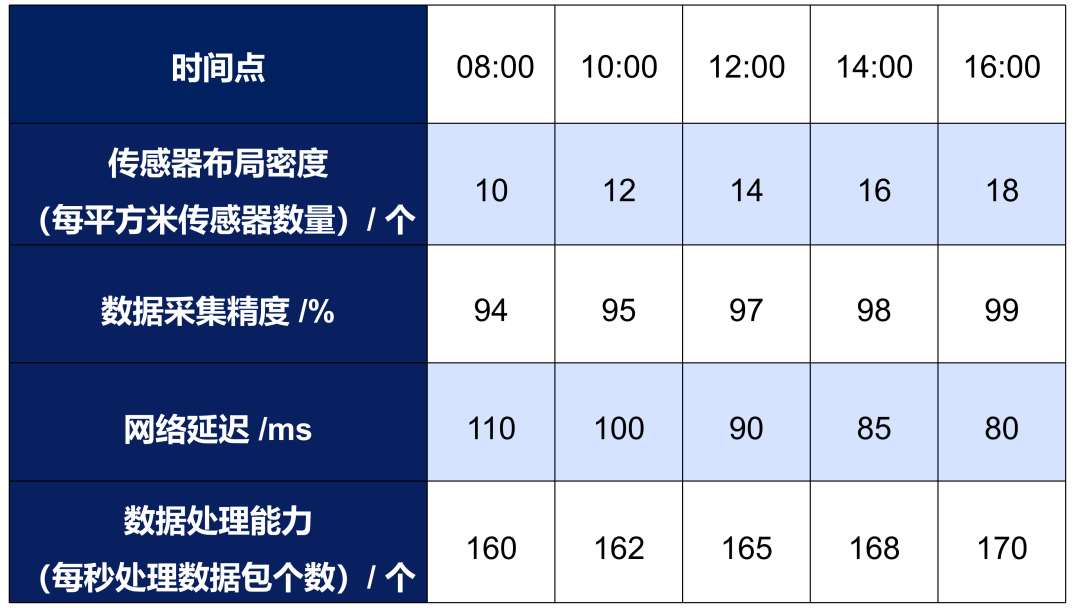
A field monitoring was conducted in a certain smart building to obtain monitoring data under different sensor layout densities. The data includes real-time monitoring data at different time points, including sensor layout density, data collection accuracy, network latency, and data processing capabilities, as shown in Table 1.
Table 1 Changes in Monitoring Data under Different Layout Densities
5.2
Evaluation of Implementation Effects
From the field monitoring data, as the sensor layout density increases, data collection accuracy significantly improves, rising from 94% to 99%, indicating that the density of sensor placement directly affects the accuracy of data collection; the higher the layout density, the more accurate the collected environmental data. Network latency and data processing capabilities also improve with increased layout density, with network latency decreasing from 110ms to 80ms and data processing capabilities increasing from 160 to 170.
Although increasing layout density can optimize network transmission and data processing efficiency, the optimization effect gradually diminishes as the number of sensors increases. A reasonable layout density must find a balance between improving accuracy and controlling load, especially under high-density layouts, to ensure fast system response speed and high data accuracy.
6
Conclusion
This article explores the application of intelligent sensor networks in smart building electromechanical systems through simulation analysis and field monitoring. The research indicates that optimizing sensor layout and data processing strategies can effectively enhance system monitoring efficiency and energy utilization. Although certain achievements have been made in the current research, further consideration of more complex environmental factors and multi-data source integration is still needed. In the future, with the development of technology, intelligent sensor networks will provide more solutions for the intelligent management of building systems.
References
Swipe up to browse
[1] Xiong Hui. Application of Internet of Things Technology in Smart Building Security [J]. UrbanConstruction Theory Research (Electronic Edition), 2024 (11): 223-225.
[2]Yang Xue. Research on Intelligent Lighting System for Building Electrical Engineering Based on Internet of Things Technology [J]. Value Engineering, 2024, 43 (25): 148-151.
[3]Zhang Xueshi. Research on the Installation of Modern Building Intelligent Electromechanical Systems [J]. China Building Decoration, 2023 (18): 120-122.
[4]Zhang Yueming. A Brief Analysis of the Application of Internet of Things Technology in Smart Buildings [J]. Intelligent Buildings and Smart Cities, 2023 (8): 148-150.
[5]Shenzhen Zhongshen Construction Group Co., Ltd. Intelligent Building Energy Consumption Monitoring System Based on Wireless Sensor Networks: 201320299785.8[P]. 2013-10-23.
[6]Yang Xianfeng, Song Fei, Liang Lulu, et al. Design and Implementation of Data Transmission Protocol for Intelligent Building Energy-saving System Based on Wireless Sensor Networks [J]. Modern Electronic Technology, 2011, 34 (21): 37-40.
[7]Guo Yantian. Practical Research on Wireless Sensor Networks in Smart Buildings [J]. Jiangxi Building Materials, 2014 (24): 1-3.
[8]Yan Wenshuang. Design of Building Electrical Systems Based on Intelligent Sensor Networks [J]. Electrical Engineering Technology, 2024 (17): 175-177.
[9]Hu Wen, He Sen, Wang Rulin, et al. Research on Intelligent Building Temperature and Humidity Monitoring System Based on Wireless Sensor Networks [J]. Intelligent Buildings and Urban Information, 2009 (9): 5-9.
[10]Cao Gang. Application of Intelligent Network Monitoring Systems in Building Engineering Safety Management [J]. Building Engineering Technology and Design, 2023 (15): 70-72.
[11]Qu Lei. Application of Internet of Things Technology in Intelligent Building Systems [J]. China Science and Technology Journal Database Industry A, 2021 (1): 54-55.
[12]Ma Yiming. A Data Transmission Protocol Method for Energy-saving Systems in Wireless Sensor Networks: 201710385533.X[P]. 2017-05-26.
[13]Zheng Jungang, Wu Chengdong, Wen Maolong, et al. Application of Wireless Sensor Networks in Smart Homes [J]. Intelligent Buildings, 2005 (8): 3-5.
[14]Zhao Yang. Research on the Application of WSN Technology in Smart Building Monitoring Systems [D]. Shenyang: Northeast University, 2014.
[15]Zhang Li. Design of Intelligent Building Monitoring System Based on Wireless Sensor Networks [D]. Dalian: Dalian University of Technology, 2019.
——Intelligent IoT Technology——
Content Source|”Intelligent IoT Technology” Vol. 57 No. 3 (2025)
Original Author|Gan Yu
Chart Production|”Intelligent IoT Technology”
Original Statement: This article is an exclusive original work of “Intelligent IoT Technology” and may not be reproduced without permission. Feel free to share it with friends to benefit more people. Respect originality and work together to maintain a good online environment! For reprints, please contact us, and kindly indicate the source when quoting.


Follow our public account for more exciting content

[Call for Papers] “Intelligent IoT Technology” Call for Papers on the “AI Large Model” Special Issue
[Original] A Multi-threaded Low-altitude Target Detection and Tracking System
Selected News | Policy Guidance, Industry Dynamics, and Technical Insights in the Fields of Artificial Intelligence and the Internet of Things – Issue 45
[Original] Optimization Strategies for Accessibility Features in Digital News Clients Based on the Kano Model
OpenAI Leads the Construction of One of Europe’s Largest Data Centers
[Original] Research on Dynamic Recommendation Models for Learning Resources – Based on Knowledge Tracing and Multi-modal Knowledge Graph Reasoning Integration

Share, recommend, and like; at least I want to have one!