In our increasingly digital world, the way humans interact with machines is undergoing a profound transformation. From traditional keyboards and mice to touch screens, voice control, and gesture recognition, human-machine interfaces are evolving towards more intuitive and natural interactions. In recent years, a new technology known as “soft human-machine interface” is quietly reshaping the way we interact with computers, robots, and smart devices.
The soft human-machine interface, as the name suggests, is a new type of interactive interface based on flexible electronic technology. It emphasizes usability, accessibility, and learnability, aiming to make interfaces more intuitive and clear.Its uniqueness lies in its ability to achieve bidirectional communication, allowing not only humans to control machines but also machines to perceive the environment through various sensing methods and provide feedback to humans, thus enabling true interaction.
However, despite its promising prospects, this technology still faces many challenges in practical applications. For instance, how to accurately identify and interpret complex physiological signals? How to achieve low-cost, large-scale manufacturing? How to adapt to individual differences among different users? Solving these issues will directly impact the popularization and effectiveness of soft human-machine interface technology.
▍Flexible Electronic Technology Creates “Electronic Skin”
To address the above challenges, a research team from Shanghai University of Science and Technology has proposed a printed human-machine interface. It consists of electronic skin for surface electromyography (sEMG) collection and stimulation feedback, a soft robot with multimodal tactile perception, and machine learning algorithms for gesture classification and material recognition.
This achievement, titled “Printed sensing human-machine interface with individualized adaptive machine learning”, was published in the top journal Science Advances.
The core breakthrough of this technology is electronic skin (e-skin)—a super-thin electronic sensing device that can be directly attached to the human body to monitor various physiological signals in real-time..
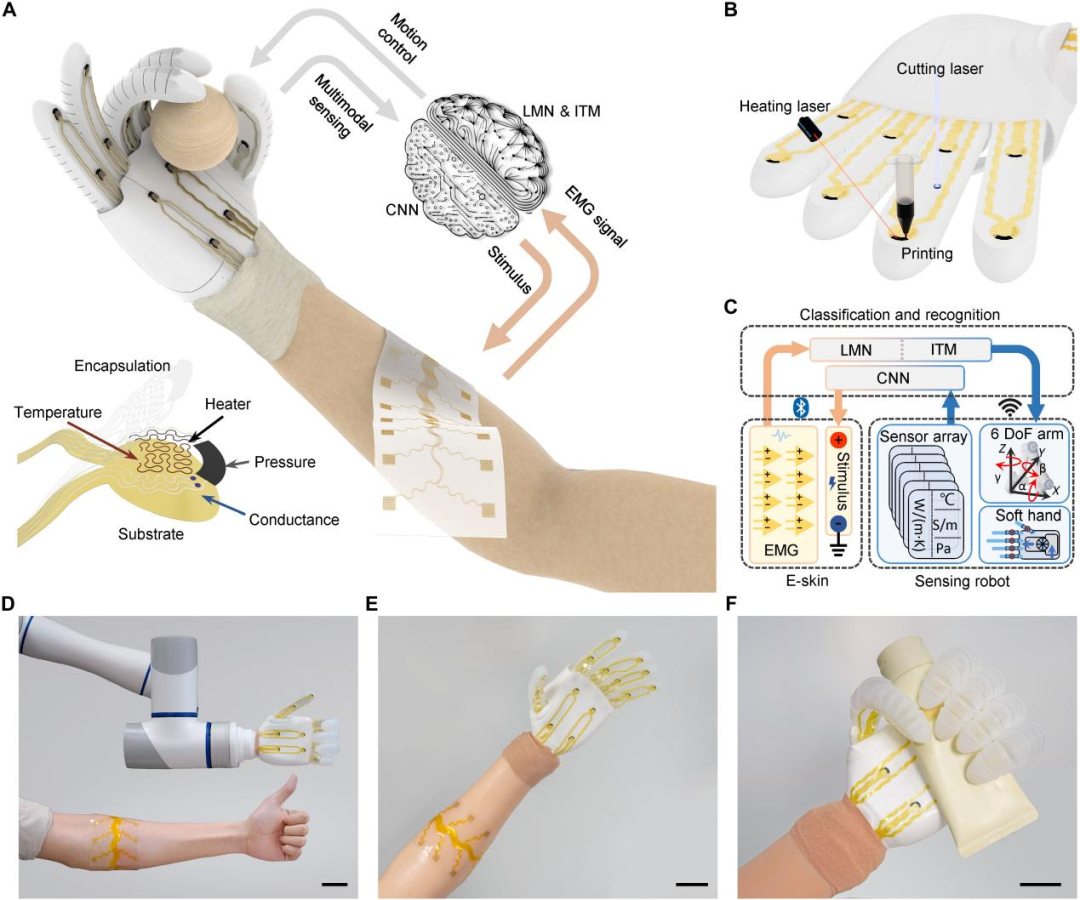
The research team adopted an efficient integrated printing technology, including direct ink writing (DIW), infrared laser engraving, and laser cutting, to achieve large-scale production of multimaterial, high-density sensor arrays. They used various functional inks such as silver ink, carbon ink, and polydimethylsiloxane/carbon (PDMS/C), and through a precise three-axis motion control system, they were able to print electrical circuits with a width of only 40 micrometers on flexible substrates.
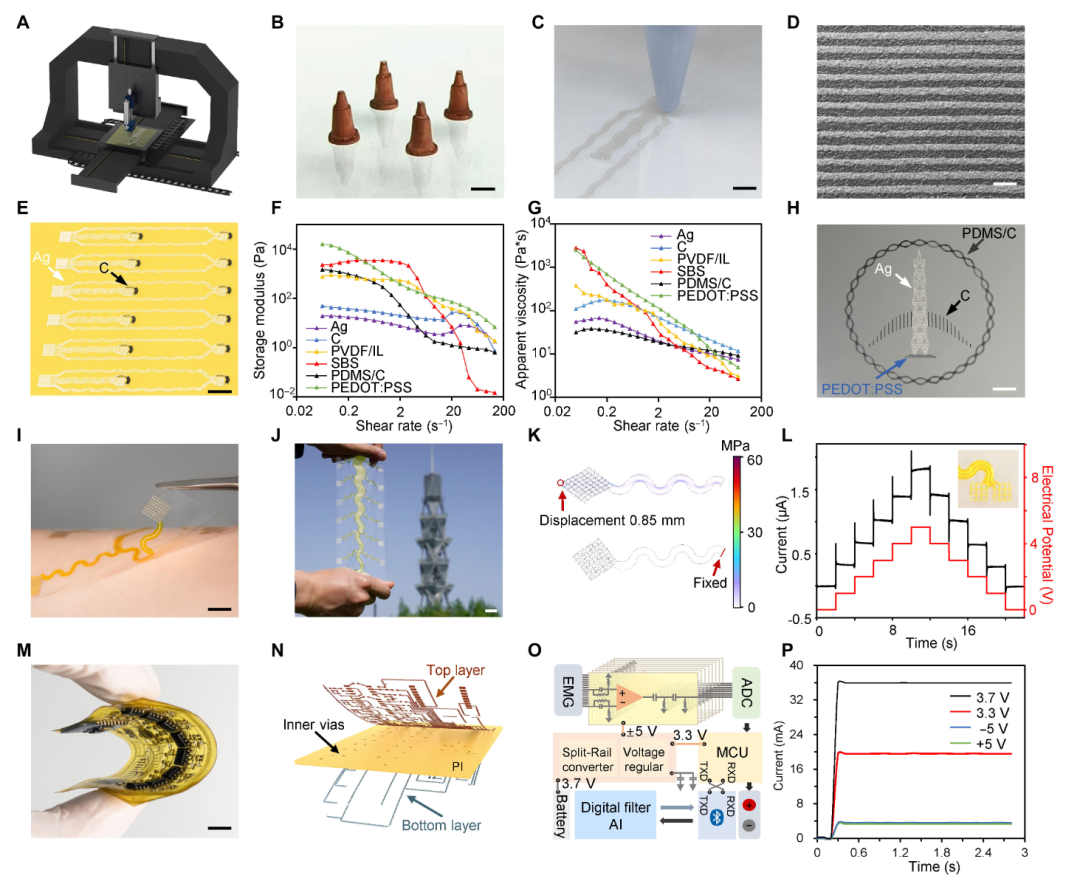
Printing and assembling the soft human-machine interface
This electronic skin exhibits several excellent properties: first, it has high transparency and outstanding mechanical flexibility, allowing it to conform to the curves of the human body like a second layer of skin without affecting natural movements; secondly, the use of serpentine circuit structure design ensures that even during stretching and deformation, it maintains uniform stress distribution, ensuring stable performance of electronic components. More importantly, this electronic skin can not only collect surface electromyographic signals but also achieve various epidermal stimulation effects by applying different characteristic voltages, completing bidirectional communication between humans and machines.
To complement the data collection of the electronic skin, the researchers also developed a dual-layer flexible circuit with wireless transmission capabilities. This circuit consists of two layers of printed silver circuits and an intermediate polyimide layer, interconnected through vias made of silver ink, and encapsulated with PDMS to ensure the reliability of long-term system operation.
▍Intelligent Algorithms: Teaching Machines to Understand Human Intent
However, having high-performance hardware alone is not enough to achieve natural human-machine interaction. The biggest challenge lies in, how to enable machines to accurately understand human intent?
Surface electromyographic signals (sEMG) are electrical signals generated during muscle activity, containing rich information about movement intent. However, these signals exhibit significant individual variability and instability— the same gesture may produce different muscle activity patterns in different individuals; even the same person performing the same gesture at different times may show variations in signal characteristics due to slight changes in electrode placement or muscle state.
To address this challenge, the research team proposed an innovative solution: an adaptive machine learning method that combines linear mapping networks (LMN) and initial time models (ITM).
LMN is responsible for adjusting the weights of signals from different channels, allowing signals from different users to adapt to a unified standard distribution. ITM is a lightweight convolutional neural network (CNN) that excels at capturing local features in time series, characterized by low latency and high accuracy.
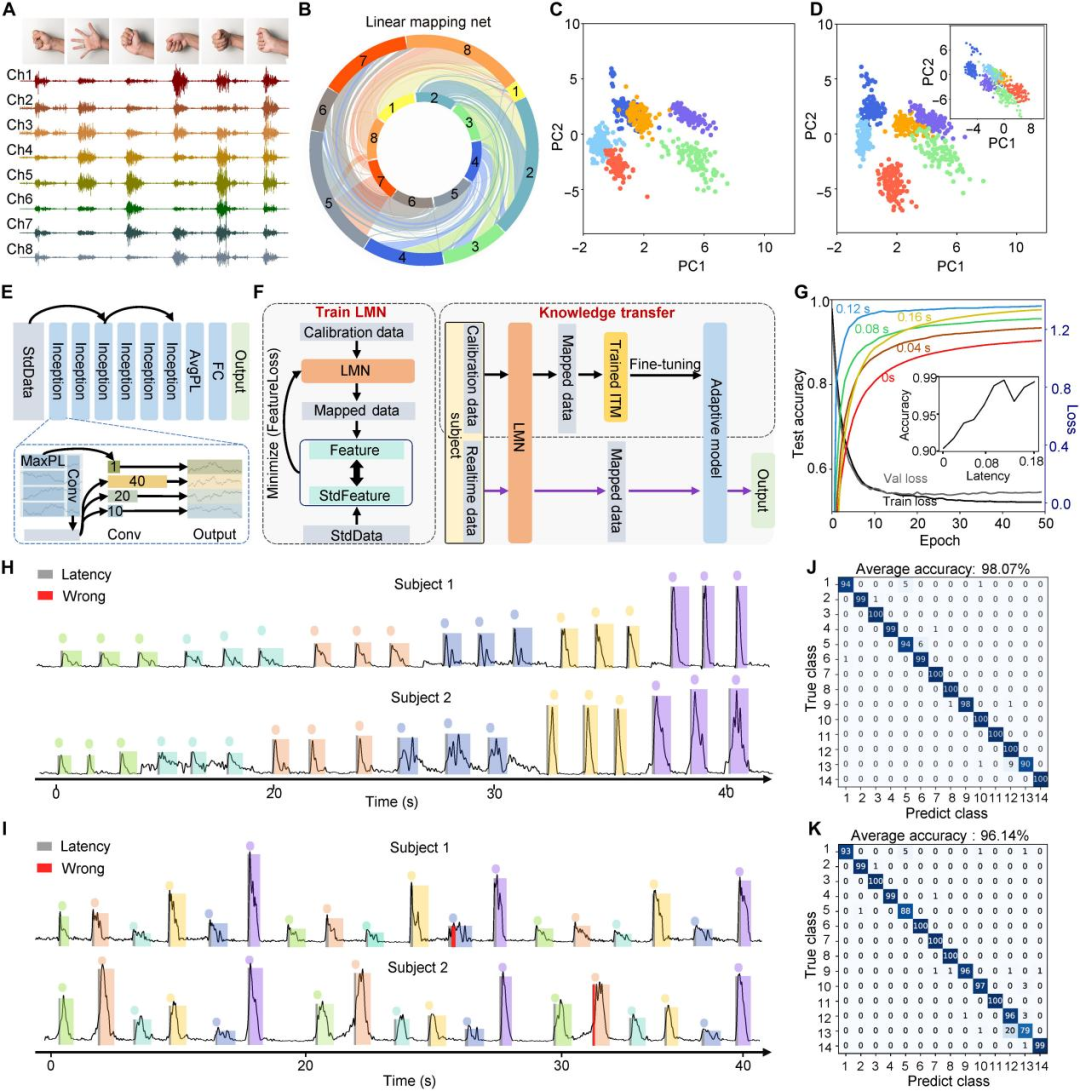
Individual adaptive machine learning model for sEMG data analysis
The most remarkable advantage of this method is its learning capability. A new user only needs to perform three repetitions of a gesture, and the system can adjust the model parameters through a transfer learning strategy to achieve personalized adaptation. This “learn and use immediately” feature greatly enhances the practicality and user experience of the system.
In practical tests, the system achieved a classification accuracy of 98.33% within a latency of 0.1 seconds, which is crucial for real-time interactive applications. Even when the number of gesture categories was expanded from 6 to 14, the system still maintained high-precision recognition.
▍Multimodal Perception: The “Sensory System” of Robots
Another important feature of the soft human-machine interface is that it equips robots with a “sensory system”. By integrating temperature, pressure, thermal conductivity, and electrical conductivity sensors into a multimodal sensor array, robots can now recognize object characteristics through touch, just like humans.
The pressure sensors adopt an innovative capacitive design with a sensitivity of up to 10.5 pF/kPa, maintaining stable performance over 2000 consecutive tests. The combination of thermal conductivity and electrical conductivity sensing enables robots to distinguish between different materials, with recognition accuracy improving from 63.99% when using thermal conductivity alone to 98.03%.
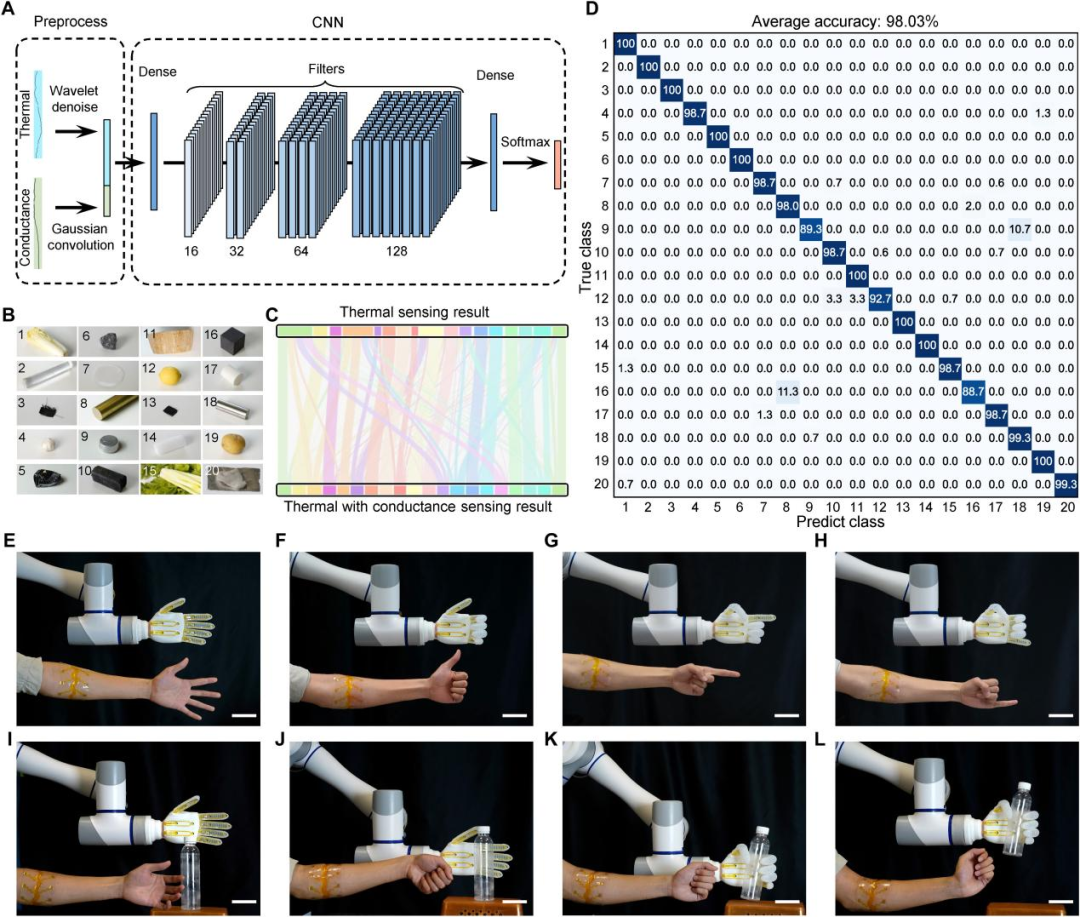
Interactive soft robotic hand object recognition assessment
These sensors are installed on carefully designed soft robotic fingers. The fingers use an elastic airbag structure, with the top made of soft elastomer and the bottom made of relatively hard materials. This design allows the fingers to produce bending movements when inflated while maintaining low stress levels.
▍Transformative Application Prospects
This technology has broad application prospects. It establishes a complete interactive ecosystem: from signal acquisition, intent recognition to action execution and perception feedback, forming a closed-loop human-machine interaction cycle. In the medical field, it brings new hope to upper limb amputees. Experiments show that even when the sEMG signals of amputees exhibit significant time delays and reduced intensity, the system can still achieve an average accuracy of 94.36% in recognizing 11 types of hand and finger gestures through adaptive machine learning algorithms.
This means that amputees can not only control prosthetic hand movements through residual muscle signals but also receive tactile feedback through electronic skin, forming a true closed-loop control.
Beyond the medical field, this technology also shows great potential in industrial and service robots, as well as in virtual and augmented reality (VR/AR) applications. Soft robots with multimodal perception can collaborate with humans more safely and intelligently; while electronic skin combined with electrical stimulation feedback can provide VR/AR users with a highly immersive tactile experience.
Perhaps in the near future, we will be able to wear electronic devices like ordinary clothing, communicating with machines through the most natural actions and sensations, truly realizing the vision of “human-machine integration”.
For inquiries regarding corporate collaboration, please contact the Robot Lecture Hall customer service (19560423866, same number for mobile and WeChat) for connection.
—————-END——————-
Industrial Robot Companies
Estun Automation | Aofei Robot | Feixi Technology | Faao Robot | Yuejiang Robot | Jeka Robot | Songling Robot | Luoshi Robot | Yinglian Technology | Jicui Intelligent Manufacturing | Youbai Robot | CGXi Changguangxi Intelligent Manufacturing | Atom Robot | Jizhi Robot
Service and Special Robot Companies
Yijiahe | Jingpin Special Equipment | Qiteng Robot | Shihe Robot | Ninebot Robot | Pudu Robot | Xiaoben Intelligent | Robot Ji
Medical Robot Companies
Yuanhua Intelligent | Tianzhihang | Sizherui Intelligent Medical | Jingfeng Medical | Tuo Dao Medical | Zhenyida | Shurui® Robot | Luosenbot | Bangkec | Baihui Weikang | Dish Medical | Shuimu Dongfang
Humanoid Robot Companies
UBTECH Technology | Yushu | Yundongchu | Xingdong Jiyuan | Weijing Robot | Zhujidongli | Leju Robot | Elephant Robot | Zhongke Shengu | Magic Atom | Zhongqing Robot | Paxi Ni Perception | Cyborg Robot | Digital Huaxia | Ligong Huahui | Fourier Intelligent | Tianlian Robot | Kepler Humanoid Robot | Lingbao CASBOT | Qingbao Robot | Zhejiang Humanoid Robot Innovation Center | Dongyi Technology | Zhishen Technology | PNDbotics
Embodied Intelligence Companies
Cross Dimension Intelligence | Galaxy General | Qianxun Intelligent | Lingxin Qiaoshou | Ruierman Intelligent | Weiyi Intelligent Manufacturing | Tuihang Technology | Zhongke Silicon Era | Shutu Technology | Lingqiao Intelligent | Xingchen Intelligent | Qiongche Intelligent | Ark Infinite | Keda Xunfei | Beijing Humanoid Robot Innovation Center | National and Local Jointly Built Humanoid Robot Innovation Center | Qinglang Intelligent | Daimeng Robot | Shibite Robot | Xinghai Map
Core Component Companies
Green Harmonics | Yinshi Robot | Kunwei Technology | Maita Intelligent | Qingtong Vision | Benmo Technology | Xinjingcheng Sensors | Blue Dot Touch | BrainCo Strong Brain Technology | Yuli Instruments | Jiya Precision Machinery | Silan Technology | Shenyuan Sheng | Feipu Navigation Technology | Ruichi Intelligent Light | NOKOV Measurement Technology | Yinxike | Fude Robot | Cancer Intelligent Drive | Weihan Power | Lingyun Light Yuan Ke Vision | Xuanji Power | Yiyou Technology | Ruiyuan Precision | Lingzu Times | Xynova Future | HIT Huawai Technology
Educational Robot Companies
Silicon Step Robot | Shihe Educational Robot | Daran Robot
Join the Community
Welcome to join the 【Robot Lecture Hall】 reader discussion group, to discuss topics related to robotics, share cutting-edge technology and industry dynamics, add WeChat “robospeak2018” to join the group!


Feeling tired? Tap “Looking” to support us!