In the intelligent vehicle competition, schools in the three provincial competition areas (Anhui Province, Shandong Province, and Zhejiang Province) are allowed to register multiple teams in the same category. Specific requirements can be found in the announcements made by the provincial organizing committees. For categories where the national organizing committee has not specified a microcontroller, teams from the same school in the same category are required to use different series of microcontrollers from NXP. Recently, many students have inquired about how to determine whether two microcontrollers belong to different series.
NXP provides a wide variety of microcontrollers based on different application fields and solutions. For detailed information, you can visit the company’s website:
www.nxp.com
The homepage of the website categorizes the main semiconductor devices, with the first section being the microcontroller (MCU) section. This section is further divided into three major categories: Processor series, Microcontroller series (MCU), and System on Chips (SoCs).
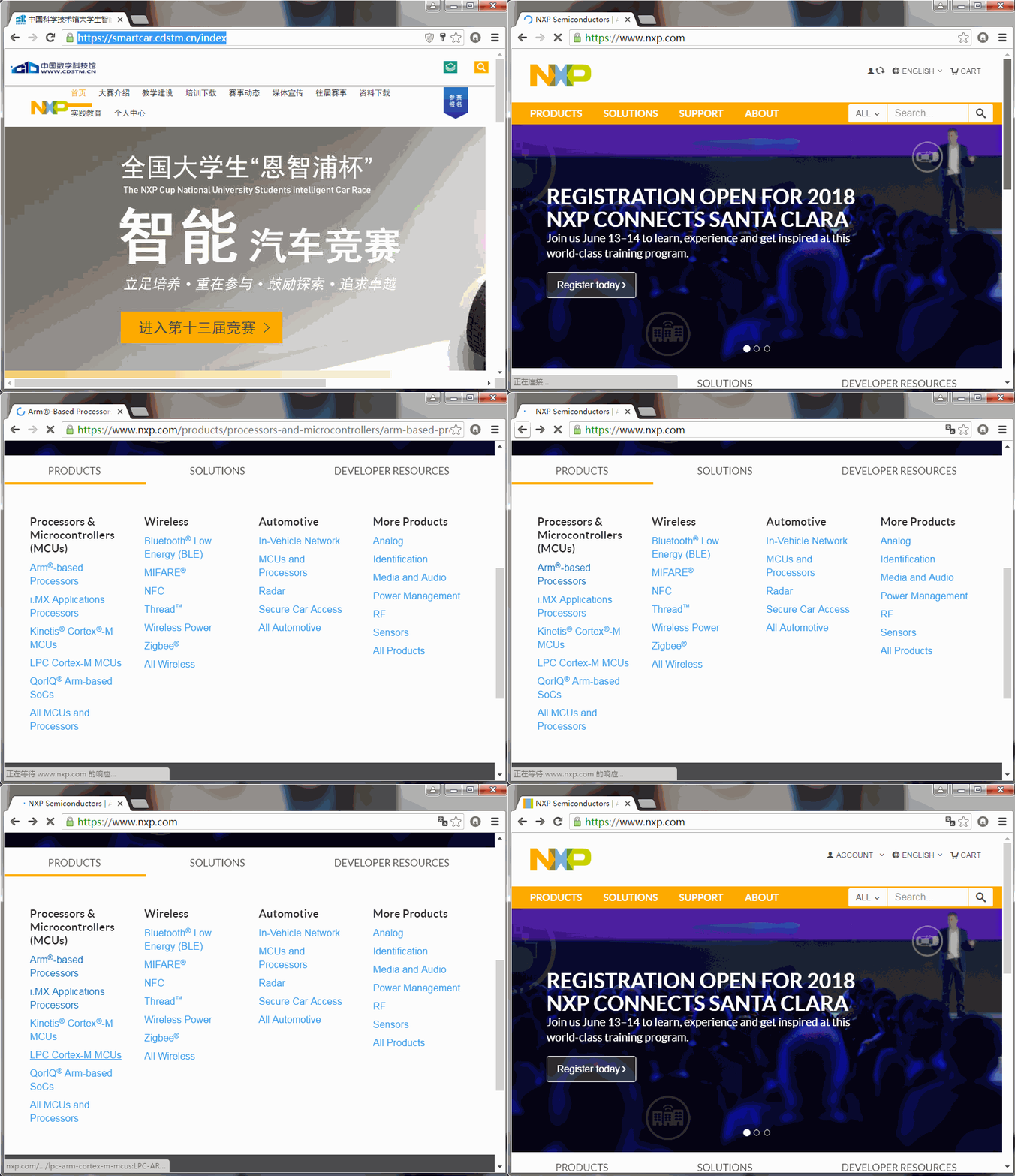
The teams primarily use microcontrollers from the MCU series. This includes two major categories:
1. Kinetis Cortex-M MCUs
2. LPC Cortex-M MCUs
These two categories come from NXP and the microcontroller product line of the former Freescale company.
If the microcontrollers used by the teams come from different major categories mentioned above, they definitely belong to different series. The challenge arises when there are different series within the same major category. So how do we distinguish them?
Within NXP’s Kinetis Cortex-M MCUs, there are several series of microcontrollers:
V Series
This series is mainly used for real-time control, such as motor control (BLDC brushless DC motors; PMSM permanent magnet synchronous motors; ACIM alternating current induction motors) and digital power conversion applications.
E Series
This is a 5V operating power series, featuring high reliability and anti-interference characteristics, suitable for use in harsh electromagnetic interference environments. It is aimed at white goods and industrial fields.
EA Series
This series is used in the automotive industry, providing high-grade chips and long-term supply.
K Series
This series features high-performance chips with rich on-chip resources, including up to 2MB of embedded FLASH and 1MB of SRAM, advanced encryption, and connectivity features (Ethernet, USB, CAN).
L Series
This series focuses on low power consumption and small package applications.
W Series
This series offers RF communication power and low-power wireless communication solutions.
M Series
This series is designed for applications such as electric meters and flow meters, featuring low power consumption and high precision measurement.

The K series is further divided into the following 9 sub-series: K0x, K1x, K2x, K3x, K4x, K5x, K6x, K7x, K8x. The main differences among these sub-series lie in their unique peripherals, such as: LCD, USB, high-precision ADC, Ethernet, Graphic LCD, encryption, etc.
Within the same sub-series, there are different models based on the amount of resources. For example, in the K6x sub-series, there are K60, K61, K63, K64, K65, K66, which have similar functions but differ in MCU clock frequency, memory capacity, and package size.
Finally, returning to the intelligent vehicle competition, how do we define different microcontroller series?
The purpose of requiring different series of microcontrollers is to avoid excessive overlap in hardware and software among teams. In practice, achieving this is not easy. This is mainly because during the programming process of these microcontrollers, the use of different internal modules can be masked by corresponding low-level encapsulated driver programs, allowing the upper-level application programs to have high portability. Nevertheless, to enhance the differentiation among teams, it is still necessary to define standards for distinguishing different series of microcontrollers.
If the only difference in the microcontroller model is the last digit, indicating differences in clock frequency, memory capacity, and package form, then they belong to the same series of microcontrollers, such as K60 and K66. Beyond that, differences in the major sequence, category, and functionality of the microcontrollers are reflected in the differences in the leading letters of the model (E, V, K, L, LPC), the main sequence number differences (K0x, K1x, etc.), and the M-core differences (M0, M3, M4, M7), which all belong to different series of microcontrollers, such as K60, KEA128, KL128, etc.
Since the 11th edition, the intelligent vehicle competition has relaxed the restrictions on the number of microcontrollers used, allowing participants to design and use different types of microcontrollers for different tasks in their vehicle models. How many microcontrollers have you used in your vehicle model?