

Orders are not only lifelines but also entry tickets for reshuffling.
Author: Lu Yongli
Editor: Liu Huan
Currently, the humanoid robot industry is rife with undercurrents, and a “battle for orders” is heating up.
In early September, UBTECH set a new global record for a single order amount with a 250 million yuan procurement contract for embodied intelligent robots; almost simultaneously, Stardust Intelligence announced it secured orders for thousands of units, and Smart Square Technology was reported to have a strategic cooperation worth nearly 500 million yuan; earlier in July, Zhiyuan and Yushu Technology won a 124 million yuan project from China Mobile, and in August, TianTai Robotics shocked the market with a “ten thousand unit order”.
From the breakthrough of tens of millions in July to the explosion of ten thousand unit orders in August, and then to the concentrated disclosure of billion-yuan orders by multiple companies in September, the humanoid robot industry is clearly crossing the technical demonstration phase and fully entering a new cycle of market competition focused on orders. Billion-yuan contracts have not only become a standard action for leading companies in the industry to compete for commercial discourse power and seize market opportunities but also mark a critical turning point from “technical validation” to “market validation”—a game concerning survival rights has begun, filled with competition, suspense, and profound meaning.

1. Significant Differentiation in Billion-Yuan Orders, TianTai’s Ten Thousand Unit Order Faces Controversy
From the publicly available order data, the humanoid robot industry shows a clear characteristic of “prominent large orders at the top, with small and medium orders solidifying the foundation”. Many companies have secured billion-yuan orders, but the differentiation in order value and development trends among companies is significant.
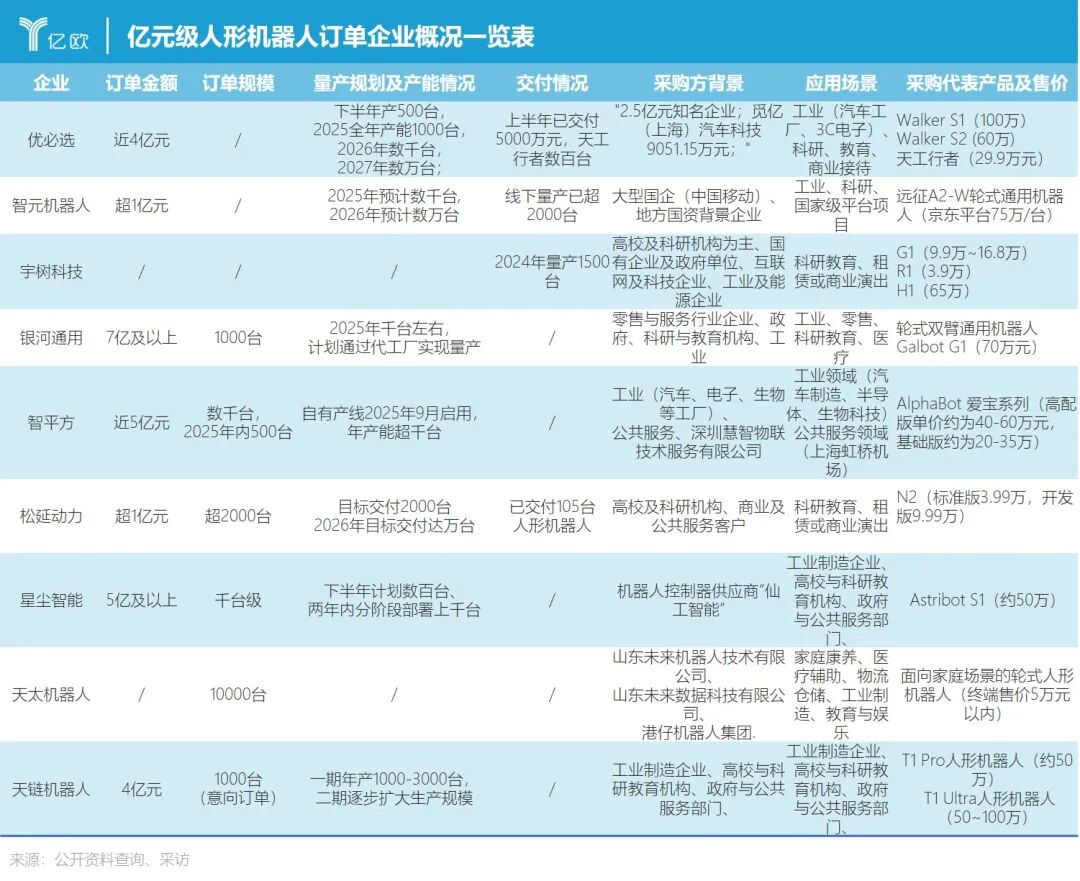
In terms of order amounts, the effect of large orders is prominent. Galaxy General has orders amounting to 700 million yuan and above, Smart Square and Stardust Intelligence both reach over 500 million yuan, UBTECH is close to 400 million yuan, and TianLian Robotics has intention orders also reaching 400 million yuan. Zhiyuan Robotics and Yushu Technology jointly won a 124 million yuan humanoid robot OEM order from China Mobile (contract period 2025-2027), covering multiple scenarios with long-term stable demand such as industrial manufacturing and commercial logistics.
Although Yushu Technology has not disclosed specific order quantities, public information indicates that 2024 revenue will exceed 1 billion yuan, with humanoid robots accounting for about 30%, and a shipment volume of about 1400 units.
These companies, with their large orders, have not only become pioneers in advancing commercialization in the industry but also set a reference standard for “large transactions”.
Order scales vary significantly, ranging from hundreds to tens of thousands of units. TianTai Robotics secured an order for 10,000 units, Zhiyuan Robotics has already produced over 2000 units with clear future capacity planning, Songyan Power has also exceeded 2000 units, and Galaxy General has an order scale of 1000 units. Although UBTECH has a contract amount of 400 million yuan, based on a unit price of about 600,000 yuan per industrial humanoid robot, the scale is insufficient for 700 units.
Capacity planning also varies in pace. UBTECH plans to produce 1000 units by 2025, with subsequent annual growth; Zhiyuan Robotics expects to reach several thousand units by 2025 and break through tens of thousands by 2026; Galaxy General aims for around 1000 units by 2025; Smart Square will have its own production line operational by September 2025, with an annual capacity exceeding 1000 units; Stardust Intelligence plans to produce hundreds of units in the second half of the year, with phased deployment to over a thousand units within two years; Songyan Power has already initiated actual deliveries, targeting 2000 units this year and reaching ten thousand by 2026;
Although TianLian Robotics has intention orders of nearly 1000 units (total value of 400 million yuan), it still needs to complete contract conversion. Its current capacity can only cover existing demand, and if the second phase of expansion does not meet expectations, future growth will be limited.
Moreover, the authenticity of the humanoid robot purchasers directly affects the order value. From the background of billion-yuan order purchasers, they include industrial manufacturing enterprises (such as automotive, electronics, and biological factories), large state-owned enterprises (such as China Mobile), local state-owned platforms, universities and research institutions, technology companies, and retail service providers, reflecting the cross-industry and multi-scenario application potential of humanoid robots. In particular, industrial manufacturing and warehouse logistics scenarios have clear demand and mature budgets, becoming the most grounded fields currently; commercial and household services are still in the early cultivation stage, with a slower commercialization process.
UBTECH, supported by purchasers from the automotive industry chain and state-owned background platforms, has stable orders in core industrial scenarios, while Zhiyuan Robotics has penetrated core areas such as industrial intelligence and national platform construction, deeply participating in scenario implementation. Yushu Technology has a diverse background of purchasers, including large state-owned enterprises, local state-owned platforms, as well as research institutions and commercial service scenarios, and its capacity matches orders, making its order value rank among the top;
Stardust Intelligence’s orders are also concentrated in high-paying scenarios such as industrial and logistics, while Galaxy General’s orders cover multiple fields including industry, retail, research education, and healthcare. These purchasers have mature business systems and financial strength, providing strong support for the implementation and continuous advancement of orders, with high order value.
However, the authenticity of some orders is questionable. Although TianTai Robotics signed a ten thousand unit order, its purchaser, Shandong Future Robotics Technology Co., Ltd., was established shortly (on August 8, 2025, just 12 days before the order was signed), with core personnel overlapping (Shandong Future Data indirectly controls Shandong Future Robotics through subsidiaries), and has not disclosed application scenarios and financial strength. Such related purchases lack commercial logic support, raising industry doubts about the authenticity and sustainability of the orders.
In terms of mass production methods, UBTECH and Zhiyuan mainly rely on self-built capacity; Galaxy General achieves rapid mass production through OEM. Although this method can quickly respond to order demands and save time and capital costs for building production lines, it also increases dependence on the quality control of OEM factories and the stability of the supply chain, facing greater challenges in quality control.
Overall, companies with billion-yuan orders mostly possess the dual attributes of “real demand + capacity matching”, with high order value, but there is differentiation in order conversion potential. UBTECH, Zhiyuan, Yushu Technology, Galaxy General, and Songyan Power have proven their commercialization capabilities, forming a closed loop of “orders-capacity-scenarios”, leading the industry at the order level; Stardust Intelligence and TianLian Robotics have long-term development potential worth looking forward to, while TianTai Robotics requires further observation and verification.

2. Orders of Ten Million and Below Are Mainstream, Clear Layering of Company Orders
Aside from the large top orders, orders of ten million and below still constitute the mainstream of the current humanoid robot industry. Although these orders are not high in single amount, they cover a large number of enterprises and types, with rapidly developing companies achieving order volumes of thousands of units, while more are at hundreds of units or even smaller scales, collectively forming an important foundation for the commercialization of the industry.
Small and medium-sized orders exhibit clear layering characteristics among different companies. Zhongqing Robotics is in a leading position in this tier, with co-founder Yao Qiyuan revealing that its large framework orders are mostly at the tens of millions level, with an expected delivery of about 500 units in 2025, and monthly production capacity has climbed to 100-150 units in the fourth quarter of this year.
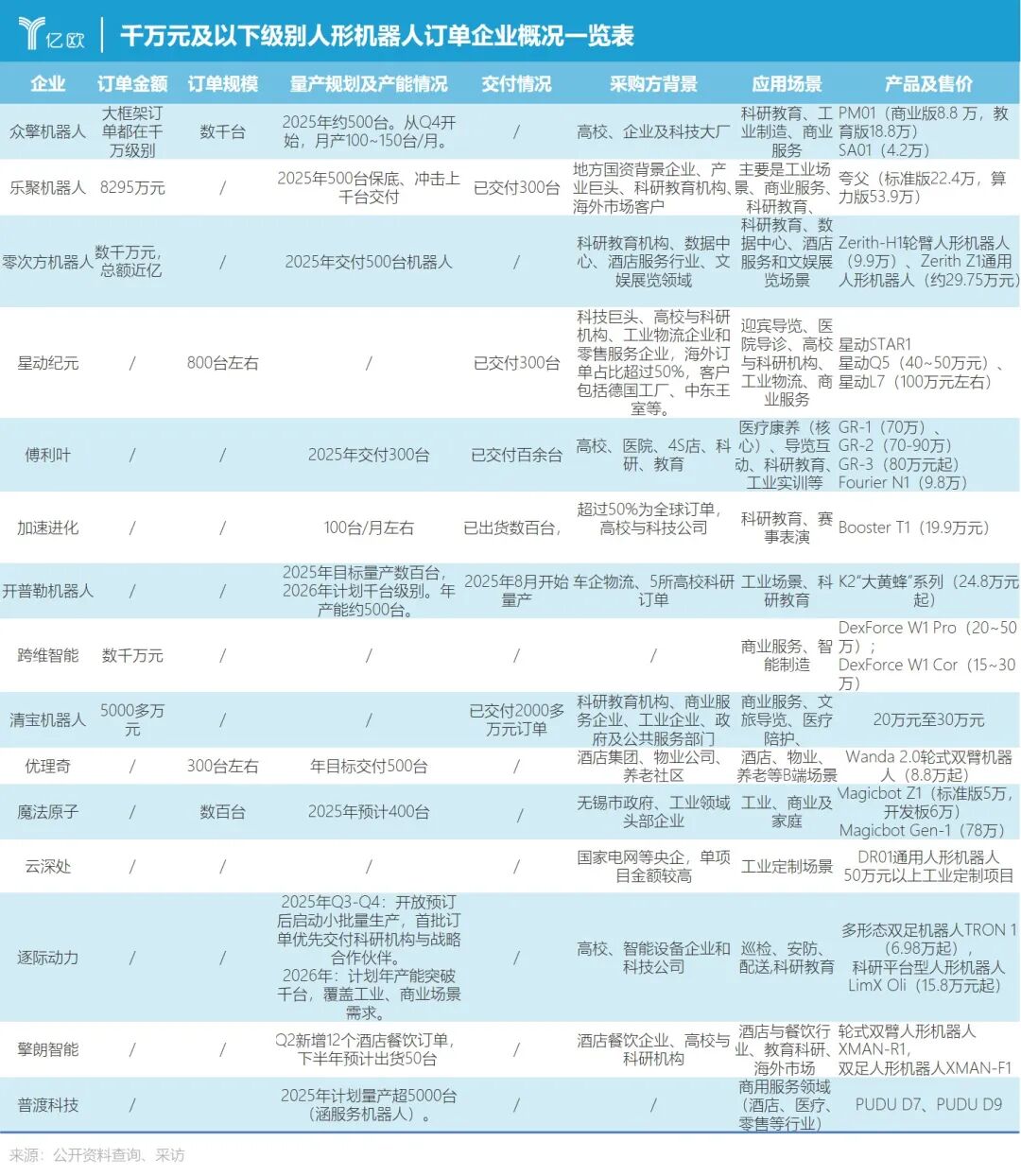
Another major camp consists of enterprises with “orders of tens of millions or with certain scale (hundreds of units)”. The backgrounds of these purchasers vary significantly, further forming three sub-directions:
Leju Robotics and Star Motion Era belong to the “high-end resource type” enterprises, not only holding orders above tens of millions but also reserving orders of hundreds of units, with a customer list of high value—global well-known tech giants, large central enterprises, and high-end overseas clients such as Middle Eastern royal families and German factories, establishing a solid market foundation through a diversified high-end cooperation network;
Zero Degree, Fourier, Accelerated Evolution, and Qingbao Robotics focus on “research and regional demand”, although their order scales meet the standards (hundreds of units), the purchasers are mainly universities, research institutions, and local state-owned enterprises, with demand revolving around technology research and regional industrial support;
Meanwhile, Kepler, Kuawei Intelligence, Magic Atom, and Youliqi lean towards “conventional commercial services”, with order clients concentrated in ordinary industrial enterprises, hotel properties, and commercial service agencies, focusing on daily operational scenarios, closer to market-based basic service needs.
From the delivery and mass production capabilities, there are significant differences among companies. Most have set clear capacity goals: Leju Robotics has delivered 300 units, targeting 500 units by 2025, striving for over a thousand; Kepler aims for mass production of hundreds of units by 2025, planning to scale up to the thousand-unit level by 2026; Zhongqing and Accelerated Evolution have monthly production capacities of around a hundred units; Zero Degree and Youliqi plan to deliver 500 units by the end of 2025; Magic Atom plans to deliver 400 units by 2025; Fourier plans to deliver 300 biped humanoid robots in 2025, having already delivered over a hundred;
Meanwhile, Zhuji Power and Qinglang Intelligence are in the small-scale batch verification stage, with Zhuji Power starting small batch production in the second half of the year, prioritizing delivery of the first batch of orders to research institutions and strategic partners. Qinglang Intelligence expects to produce 50 units in the second half of the year for scenario verification;
Additionally, some companies have not disclosed order amounts and scales, and their delivery and mass production situations remain unclear. Based on their business focus, their humanoid robot order scales may be relatively small. For example, Yunshenchu focuses on quadruped robot development, and humanoid robot-related orders have not formed a clear scale; Purdue Technology has long focused on delivery service robots, with stable and mature orders in that sector, while humanoid robot business is still in the stage of technical accumulation and market exploration, and has not released large-scale orders.

3. Why the Rush for Orders Now?
Why are humanoid robot companies rushing to join the “order battle”?
UBTECH’s Chief Brand Officer Tan Min recently stated, “Strong application landing capability brings orders. We are not worried about not having orders; we are worried about being slower than others and letting them take the lead.” This statement profoundly reflects the anxiety and urgency of companies regarding the pace of market competition.
From survival pressure to long-term strategy, the current order competition emerging in the industry is not a temporary trend but an inevitable result of the intertwining of capital, policy, and the development stage of the industry.
Firstly, dual pressures from the capital side are forcing companies.
On one hand, industry competition is intensifying, and the financing and IPO processes are accelerating. UBTECH recently announced a strategic financing agreement of 1 billion USD with the internationally renowned investment institution Infini Capital, while Yushu, Zhiyuan, TianLian, and other companies are actively preparing for IPOs. Leju Robotics has also recently completed its share reform, signaling its intention to go public. For these companies, real orders are key to supporting financial performance and proving commercial value and profit potential to the capital market.
On the other hand, the primary market financing environment is tightening, with funds increasingly concentrating on companies that already have top customers and the ability to land scenarios, such as Yushu, Zhiyuan, Galaxy General, Fourier, and Parsini. Humanoid robot R&D requires significant investment and has a long profit cycle; orders are not only a source of revenue for companies but also a key bargaining chip to maintain cash flow and support R&D and capacity construction. Companies urgently need real orders to prove their commercial value to secure the next round of funding “blood transfusion” to sustain their operations and development.
Secondly, the policy window has already opened.
Policies such as “new quality productivity” have opened a critical opportunity window for the industry, with the government and state-owned enterprises becoming important forces in current humanoid robot procurement. These purchasers not only focus on the long-term goals of industrial upgrading but also bear the policy mission of promoting the landing of new technologies, making them the most stable “payers” at this stage. For example, the national-level procurement project of the Hubei humanoid robot innovation center and the large orders from China Mobile both carry distinct policy-oriented attributes. Missing this window could cause companies to lose early access to scalable order resources, putting them at a disadvantage in subsequent competition, thus “grabbing orders” is essentially also “grabbing the entry ticket for policy dividends”.
Thirdly, the window for positioning in the race is urgent.
Currently, humanoid robots are at a critical stage of transitioning from laboratory to mass production application. The first company to secure top industry customers can quickly accumulate real scenario data, optimize product stability, and build benchmark case barriers. This “benchmark effect” will create strong brand endorsement, attracting more small and medium B-end customers and supply chain resources, and even influence the discourse power of technological routes.
As Tan Min of UBTECH said, “Being a step slower than others” is the real competitive anxiety—the current competition among companies is not only a battle for orders but also a battle for scenarios and ecosystems.
The order battle is a competition for survival rights and definition rights, a realistic response of companies to the current capital and policy environment, and a preemptive positioning for the future industry landscape. Only those companies that truly run through the business model and stand firm in scenarios can win the qualification to continue participating in this fierce competition.
4. Industry Accelerates Reshuffle, Competing for Orders Also Requires Competing for Delivery
Currently, the rapid growth of humanoid robot order volume marks a critical step for the industry in moving from laboratory to industrial landing, with three major significances for the development of the industry:
Firstly, it breaks the deadlock of the humanoid robot industry of “having technology but no market”, granting opportunities to validate technology and iterate products in real scenarios, accelerating the verification of technology landing;
Secondly, the diversification of purchasers is continuously expanding the application boundaries of humanoid robots, opening up new market growth spaces. From early universities and research institutions to now the “national team” and industrial giants, manufacturing enterprises, and life service providers, covering multiple scenario fields such as research, industry, and commerce. Cooperation cases like Meituan Smart Pharmacy indicate that humanoid robots are penetrating broader markets by addressing actual business pain points;
Thirdly, large-scale orders also help to force capacity upgrades and industrial chain collaboration. Large orders prompt companies to move away from the “small workshop” production model, starting to build automated production lines, optimize supply chain management, and drive the development of the entire chain from upstream core components, midstream body manufacturing, to downstream operation and maintenance services, laying the foundation for the long-term scaled development of the industry.
Despite the growth in total order volume, its internal differentiation is extremely significant, forming a pattern of “concentration at the top, dispersion at the tail”. A few leading companies frequently win large orders, while many small and medium enterprises still have order volumes at the level of millions or even units, facing the dilemma of being squeezed out of survival space.
At the same time, the structure of purchasers also exhibits implicit imbalances. Current orders still heavily rely on strategically motivated “national teams” and industrial capital, whose purchasing behavior is greatly influenced by policies and macro goals, and the market’s endogenous demand has not yet been fully activated. Most enterprise-level orders are still in the pilot and testing stages, with cautious attitudes from purchasers. If the robots do not perform as expected or the return on investment is not better than manual labor, the sustainability of orders will face challenges.
Moreover, the most severe challenge comes from the mismatch between order growth and capacity construction. Currently, the humanoid robot industry exhibits a characteristic of “short-term small batch orders can be covered, long-term large-scale orders await adaptation”: leading companies, with clear capacity planning, can meet short-term order demands but need to break through long-term capacity bottlenecks; companies like TianTai Robotics have taken on large-scale orders, but their short-term mass production capacity needs rapid verification; small and medium enterprises still primarily focus on “pilot delivery”, with scaling capabilities needing enhancement.
The current industry matching degree is still in the “initial balance” stage, with mass production capabilities and smooth delivery becoming key competitive points in the next phase.
“Grabbing orders” is also a self-purification of the industry, forcing companies to face delivery pressures. In the future, only those companies that continuously secure orders and successfully deliver will be able to traverse cycles and enter the next stage of competition.
Recommended Reading
Stone Technology Faces “Expansion Aftermath”: Money Comes In Fast, Leaks Faster
ECOVACS and Stone Technology Deeply Trapped in the Game of Scale and Profit, Is the Sweeping Robot Industry Facing Collective Tribulation?
UBTECH 2024 Financial Report Insight: Revenue Growth of 23.7%, Losses Persist, Long-term Receivables Become a Hidden Worry
After Being Questioned, Yushu Technology Proves Itself: A Fight, Yushu’s “Coming of Age”
Zhongqing and Zhiyuan Create “Dogs”, Is Yushu’s Model the Industry’s “Lifeline”?
From “Not Yet Applied” to Spending 300 Million! Runyang Technology Bets on Humanoid Robots

END