Reading Together: Compilation of Letters from the Twin Fish Collection, Volume One· Morning Assembly · Article Six
With Fan Zhixu
Discussion on the Duty of Advising
Author:[Ming] Yan Jizu
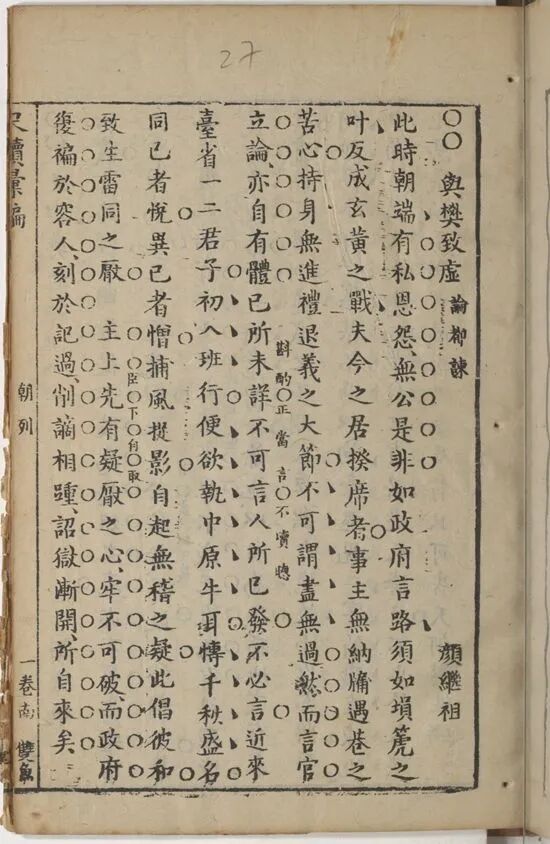 Original Image of Ancient Text
|
Classical Chinese With Fan Zhixu Discussion on the Duty of Advising Yan Jizu At this time, the court is filled with personal grudges, lacking public justice. The government①, and the advisory officials must harmonize like the②leaves of the xun and chi, otherwise it leads to a battle of chaos③.Now, those in high positions④ do not have the good intentions of guiding the monarch⑤ through subtle means, and they lack the great virtue of maintaining propriety and righteousness, thus cannot be said to be without faults. However, the advisory officials also have their own principles. They should not speak on matters they do not fully understand; opinions already expressed by others need not be repeated. Recently, a few gentlemen in the supervisory offices, upon entering the court, wish to seize control of the central authority⑦, seeking eternal fame, delighting in those who agree with them, resenting those who differ, and often creating baseless suspicions. This leads to a culture of blind conformity⑧. The emperor has long harbored doubts and aversions, which are deeply rooted; and the government is narrow-minded in accepting people, fixated on past grievances, leading to continuous demotions and exiles, and the increase of prisons, which is the result of these circumstances. |
Vernacular Chinese With Fan Zhixu Discussion on the Duty of Advising Yan Jizu Nowadays, in the court, people only speak of personal grudges, lacking a standard of public justice. The relationship between the ruling cabinet and the advisory officials should be harmonious, like the xun and chi playing together, but instead, it has turned into a conflict of chaos, with both sides suffering losses. Currently, the ministers in high positions serving the monarch lack the good intentions of “guiding through subtle means” and do not uphold the noble principles of propriety and righteousness, so they cannot be said to be without faults. However, the advisory officials also have their own rules: they should not speak on matters they do not fully understand; opinions already raised by others need not be repeated. Recently, in the supervisory offices, there are one or two officials who, upon entering the court, wish to seize control of the central authority (争夺主导权), seeking eternal fame. They favor those who agree with them and resent those who disagree, often creating baseless suspicions. This leads to a culture of blind conformity and aversion. The emperor has long harbored doubts and aversions, which are deeply rooted; and the ruling cabinet is narrow-minded, unable to accept others, fixated on past grievances, leading to continuous demotions and exiles, and the increase of prisons—this situation has its reasons. |
Notes:
This indicates that the court officials rarely possess public loyalty. They are driven by personal grudges and lack a standard of justice. This leads to excessive recommendations that arouse the emperor’s doubts and aversions, resulting in disgrace and calamity, which is the consequence of our factionalism.
Comment:This is related to the correspondence of Fan Liangshu. Fan Liangshu, courtesy name Shangzhi (also known as Shangmo), styled Zhixu, from Jinxian County, Jiangxi (now part of Nanchang City). He was a scholar in the 25th year of the Wanli era (1597), and in the 32nd year (1604) he became a jinshi, eventually serving as the inspector of Guangxi. He authored works such as the “Poems of Fan Zhixu,” “Doubts of the Book of Changes,” and “Poetic Business,” among which the “Poems of Fan Zhixu” is recorded in the “Complete Catalog of the Four Treasuries”. Initially appointed as the magistrate of Lishui, he was later transferred to Renhe, where he organized relief during a flood, saving many people. He entered the capital as an official in the Ministry of Justice, proposing six reform suggestions for the navy, and was promoted to the position of deputy director in Yunnan. In the 47th year of Wanli (1619), he served as an examiner for the imperial examination, later promoted to deputy commissioner of education in Yunnan. In the fifth year of the Tianqi era (1625), he was transferred to the deputy commissioner of education in Zhejiang, and due to his refusal to write the inscription for Wei Zhongxian’s shrine, he resigned and returned home. During the Chongzhen era, he was reinstated and held various positions, ultimately rising to the inspector of Guangxi. He co-founded the Xiamen Poetry Society with Zhang Xie in Zhangzhou, and his works include “Climbing the Tengwang Pavilion in Late Spring” and “Climbing Mount Lu in Autumn” among others.
① Government: The prime minister oversees the cabinet, which is the ruling body.
② Xun and Chi: They harmonize in music. The phrase “Xun and Chi harmonize” comes from the “Book of Songs, Lesser雅, Who is This?” referring to the xun (a clay wind instrument) and chi (a bamboo wind instrument) playing together, symbolizing brotherly harmony.
③ Chaos: Referring to the bloodshed of mutual harm. This comes from the “Book of Changes, Kun Hexagram,” representing the colors of heaven and earth, where black represents the sky and yellow represents the earth. This term has been extended in classical texts to refer to the heavens and the earth, and can also refer to colors, with ancient people using it to describe the chaotic state before the separation of heaven and earth.
④ Position: Specifically refers to the position of the prime minister or assisting ministers. In ancient texts, it is derived as a term for the prime minister, as recorded in the “Rites of Zhou” with “Kui Bai Shi”. In the Ming and Qing dynasties, the term narrowed to specifically refer to the prime minister or the head of the cabinet.
⑤ Guiding through subtle means: Referring to the subtle guidance of the monarch through a window of understanding. This term comes from the “Book of Changes, Kan Hexagram” meaning to advise through the monarch’s inner understanding.
⑥ Subtle encounter: Referring to a chance meeting, meaning to encounter the monarch, one should be subtle to convey their meaning. This comes from the “Book of Changes, Kui Hexagram,” originally meaning to meet unexpectedly in the street, extended to mean an unexpected encounter.
⑦ Seizing control: Referring to wanting to be in the leading position, as in a coalition of states, where the leader holds the reins and swears an oath over blood and wine.
⑧ Blind conformity: Referring to listeners echoing the same voice.
⑨ Narrow-minded: Referring to being narrow.
⑩ Demotion: Referring to being dismissed and exiled.
⑪ Successive: Referring to following in succession.
Long press to identify and click to follow>>