
In the wave of the Industrial Internet of Things (IIoT), you may often hear terms like “industrial router“, “IoT gateway“, and “edge computing“. They sound similar, yet they play distinctly different roles in your digital transformation blueprint. Confusing them could lead to project selection errors and missed opportunities.
We will use three vivid metaphors to help you thoroughly clarify their essential differences.
-
Industrial Router: A loyal and reliable “Messenger”.
-
Industrial IoT Gateway: A multilingual “Senior Translator”.
-
Industrial Edge Computing Gateway: A “Frontline Commander” capable of making on-the-spot decisions.
This is not just an iteration of products, but a profound evolution from “connection” to “intelligence”.
First Evolution: Industrial Cellular Router
A dedicated “Messenger”
Definition: This is a rugged network device with a single core mission: to provide astable, reliable, and secure cellular network (4G/5G) “connection pipeline” for devices or local area networks in industrial sites. It is essentially a powerful router that can adapt to harsh environments (such as wide temperature ranges, vibrations, and electromagnetic interference).
Core Value:
-
Reliability of Connection: Dual SIM card automatic switching, link detection, and backup mechanisms ensure that services never go offline.
-
Security of Network: Built-in powerful firewalls and various VPN protocols (IPsec, OpenVPN, etc.) establish secure remote access channels.
-
Tolerance to Environment: Industrial-grade hardware design can withstand various harsh physical environments.
Working Scenarios of the “Industrial Router”:
-
Remote Device Monitoring: Provides remote networking capabilities for charging piles, vending machines, weather stations, and distribution boxes located in remote areas.
-
Commercial Network Backup: Provides cellular networks as a backup for wired broadband for chain stores and bank branches, ensuring uninterrupted business operations.
-
Mobile Networking: Provides stable network connections for mobile assets such as buses, logistics trucks, and engineering vehicles.
-
Security Monitoring: Provides data transmission channels for video monitoring systems in areas without wired networks, such as construction sites.
In summary: The router is only responsible for “connection”, faithfully transmitting data without caring about the content of the data.
Second Evolution: Industrial IoT Gateway
A knowledgeable “Translator”
Definition: It serves as a “data bridge” connecting the industrial site “OT world (Operational Technology)” with the “IT world (Information Technology)”. It not only possesses all the networking functions of an industrial router but also adds the ability to “translate” various devices and protocols in the industrial field.
Core Value:
-
Protocol Conversion: This is its core distinction from routers. It can parse various industrial field bus and Ethernet protocols (such as Modbus, Profinet, EtherNet/IP, etc.) and convert these OT data into a unified format that IT systems can understand (such as MQTT, HTTP).
-
Data Aggregation and Filtering: Able to connect multiple downstream devices (PLCs, sensors, instruments), aggregate their data, and perform preliminary cleaning and filtering.
-
Device Management and Control: Able to manage downstream sub-devices.
Working Scenarios of the “Industrial IoT Gateway”:
-
Digital Transformation of Old Factories: Connects PLCs and CNC machines using various outdated protocols in the factory to collect their production data.
-
Building Automation System Integration: Connects HVAC systems based on the BACnet protocol with sensor networks based on LoRaWAN.
-
New Energy Data Collection: Connects photovoltaic inverters, energy storage BMS, and other devices to collect their operational data.
-
Data Source for Predictive Maintenance: Collects operational data (such as current, vibration, temperature) from devices to provide data for cloud-based predictive maintenance algorithms.
In summary: The IoT gateway is not only responsible for connection but also needs to “understand data”. It can translate the language of the OT world, making data usable.
Third Evolution: Industrial Edge Computing Gateway
A decisive “Commander”
Definition: This is the “ultimate evolutionary form” of the industrial IoT gateway. It is no longer just a passive “data bridge” but a “central hub of edge intelligence” with powerful local computing capabilities. It encompasses all the functions of the previous two and adds the ability to perform real-time data processing, analysis, and decision-making close to the data source.
Core Value:
-
Local Intelligence: Equipped with high-performance CPU/NPU, capable of running complex applications directly on the gateway, including AI algorithm models.
-
Reduced Latency and Bandwidth Costs: A large amount of data is processed locally, with only key results uploaded to the cloud, achieving millisecond-level real-time responses.
-
Data Security and Privacy: Sensitive data can be processed locally without uploading, enhancing data security.
-
Enhanced System Reliability: Even if the connection to the cloud network is interrupted, local intelligent applications can continue to operate, ensuring business continuity.
Working Scenarios of the “Industrial Edge Computing Gateway”:
-
Edge AI Quality Inspection: Connects industrial cameras on the production line, running AI visual inspection algorithms on the gateway to eliminate defective products in real-time.
-
Predictive Maintenance of Equipment: Runs equipment fault prediction models directly on the gateway, analyzing data in real-time and providing early warnings.
-
AGV/AMR Fleet Coordination: Runs path planning algorithms on AGVs to achieve local coordinated scheduling of the fleet.
-
Intelligent Security: Conducts localized video analysis in the park, identifying abnormal behaviors in real-time and triggering alarms.
In summary: The edge computing gateway not only needs to understand data but also to “think about data”. It can perform autonomous analysis and decision-making at the front line.
Conclusion: The Value Leap of Three Evolutions
To help you understand more intuitively, we summarize their similarities and differences in a diagram:
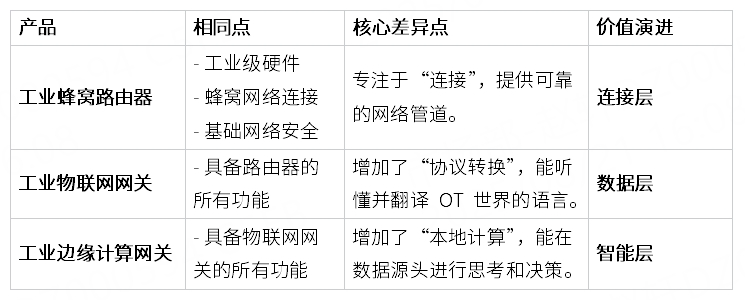
From providing reliable connections as a “Messenger”, to understanding various OT data as a “Translator”, and finally to making intelligent decisions at the data source as a “Commander”, this is the core path of the evolution of industrial IoT terminals.
Understanding this logic will help you accurately find the most suitable starting point for your current needs when embarking on your digital transformation journey.
For high-reliability intelligent IoT solutions for industrial equipment, look for Lubangtong. Welcome to scan the code for consultation. Warm Reminder: Little Lu will continue to provide you with valuable industrial IoT insights. Due to adjustments in WeChat push rules, please click “Look” and “Like” at the end of the article to receive timely content updates from Lubangtong!
Previous Highlights
+


Disclaimer: This WeChat public account cannot verify the copyright of uploaded images, fonts, or text content. If any rights holder is inadvertently infringed, please contact us, and we will delete it immediately. Thank you.