✅ Author Profile: A research enthusiast and MATLAB simulation developer, skilled in data processing, modeling simulation, program design, complete code acquisition, paper reproduction, and research simulation.
🍎 Previous reviews can be found on my personal homepage:MATLAB Research Studio
🍊 Personal motto: Seek knowledge through investigation; complete MATLAB code and simulation consultation available via private message.
🔥 Content Introduction
Fingerprint recognition technology, as a significant breakthrough in the field of biometrics, has been widely applied in modern society. From unlocking smartphones to confirming bank transactions, and even in national security for identity verification, the prevalence and convenience of fingerprint recognition applications have become deeply ingrained in our lives. This article aims to explore the basic principles of fingerprint recognition technology, its specific applications in various fields, the challenges it faces, and future development trends.
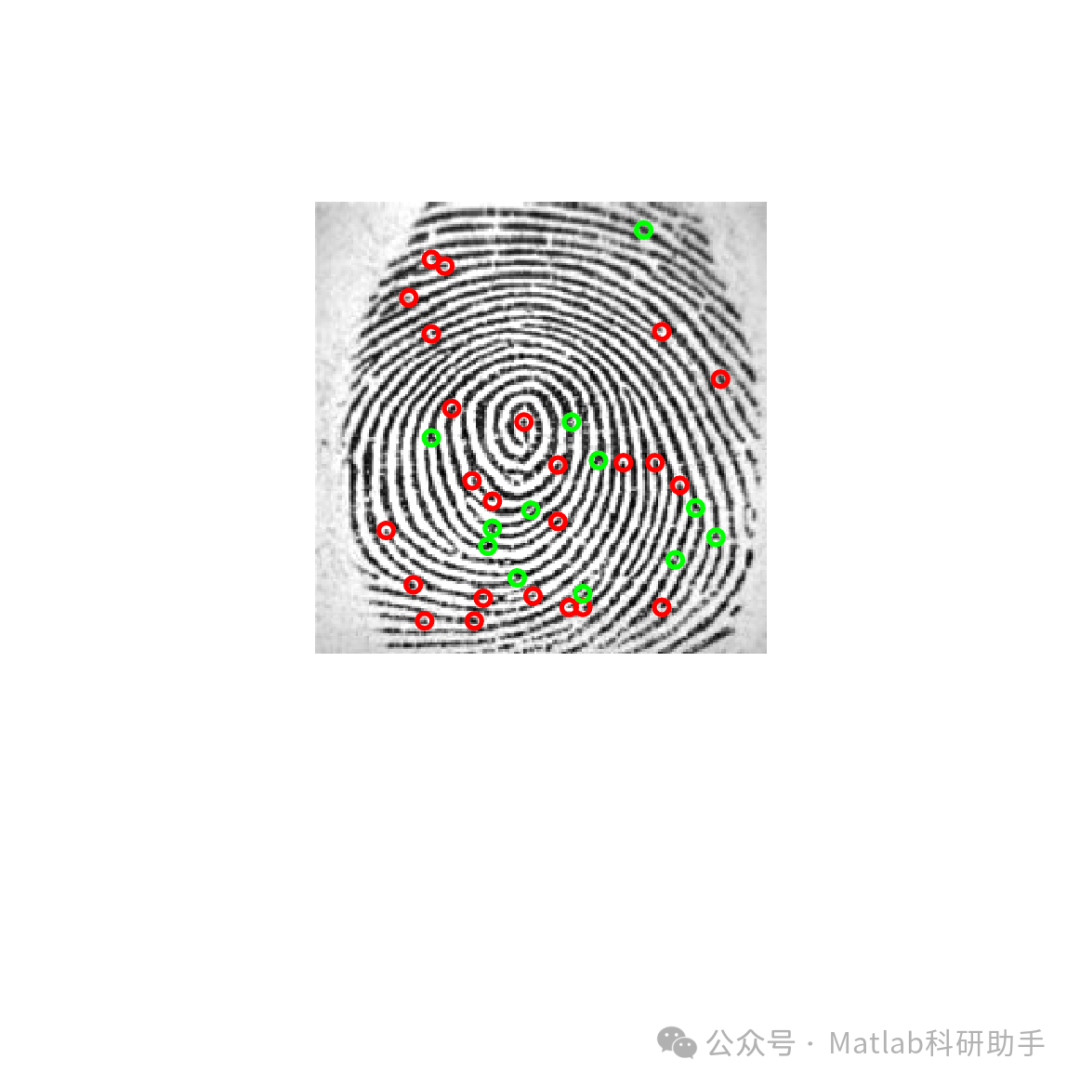
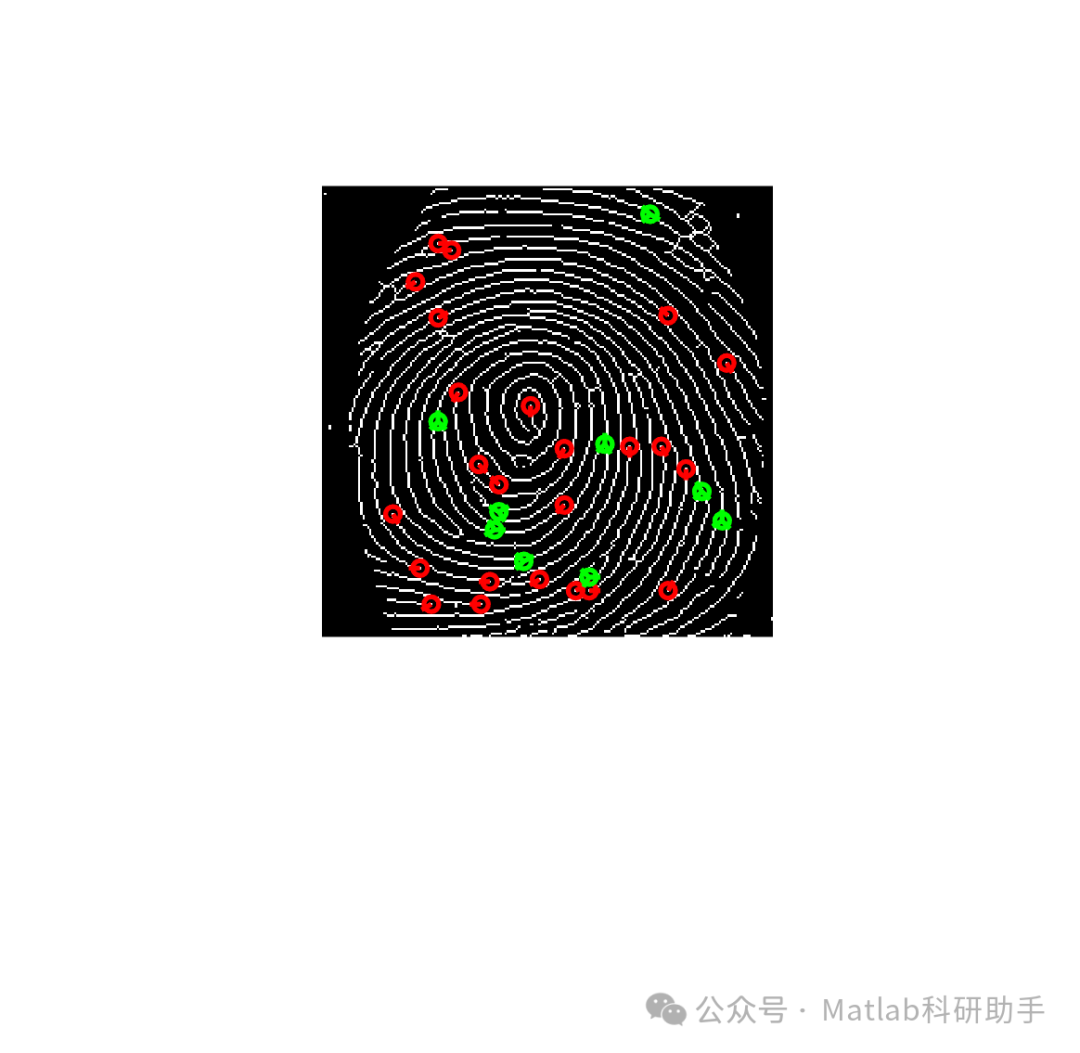
Fingerprints, as unique biological characteristics of humans, consist of distinctive features such as ridge patterns, minutiae, and cross points that form an individual’s unique identity. Fingerprint recognition technology is based on these unique features for identity verification. The basic principles include fingerprint image acquisition, feature point extraction, and comparison. Common technologies for fingerprint acquisition include optical, capacitive, and ultrasonic methods. Optical fingerprint recognition captures fingerprint images using optical sensors; capacitive recognition utilizes the differences in capacitance between the fingerprint’s ridges and the sensor to form an image; ultrasonic recognition detects the deeper structures of fingerprints using ultrasonic waves. The acquired fingerprint images are then processed by algorithms to extract unique feature points, which are converted into digital templates for storage. During identity verification, the system compares the currently acquired fingerprint with the stored template to determine the authenticity of the identity based on the matching degree.
The popularity of fingerprint recognition applications is first reflected in personal consumer electronics. Smartphones and tablets commonly feature fingerprint unlocking, greatly enhancing the convenience and security of devices. Users can quickly unlock their devices and access personal data with a simple touch of the fingerprint sensor, eliminating the need for complex passwords. In the mobile payment sector, fingerprint recognition also plays a crucial role. Major payment platforms such as Alipay and WeChat Pay support fingerprint payments, providing users with a fast and secure payment experience. By verifying fingerprints, users can avoid the risks of password leakage and ensure transaction security.
Beyond personal devices, fingerprint recognition also plays a vital role in finance, healthcare, and security sectors. In finance, banks widely adopt fingerprint recognition technology for customer identity verification, including counter services, ATM withdrawals, and online banking logins. This not only improves the efficiency of business transactions but also effectively prevents financial fraud. In healthcare, fingerprint recognition can be used for patient identity confirmation, ensuring the accuracy of medical records and preventing medical errors. Additionally, fingerprint recognition can be utilized for internal personnel management in hospitals, controlling access to specific areas. In national security and public safety, fingerprint recognition is an indispensable tool. For example, in border management, fingerprint recognition is used for identity verification of individuals entering and exiting the country, effectively combating illegal immigration and terrorist activities. In criminal investigations, fingerprints left at crime scenes serve as crucial evidence, and fingerprint comparison technology provides strong support for solving cases.
However, fingerprint recognition technology also faces several challenges during its application. Firstly, there are privacy and data security issues. Fingerprint information, as personal biometric data, can lead to irreparable losses if leaked. Therefore, how to securely store and process fingerprint data to prevent hacking and misuse is an urgent problem to be solved. Secondly, there are issues related to recognition accuracy and robustness. Although fingerprint recognition technology has matured significantly, certain conditions, such as worn fingerprints, moisture, or contamination, may affect recognition accuracy. Moreover, some criminals may attempt to bypass recognition systems by forging fingerprints, which also poses challenges to the security of fingerprint recognition.
Looking ahead, fingerprint recognition technology is expected to develop towards greater intelligence and multimodal integration. With advancements in artificial intelligence and machine learning technologies, fingerprint recognition algorithms will become more precise, better able to handle various complex situations. Additionally, integrating with other biometric technologies, such as facial recognition and iris recognition, to build multimodal biometric systems will further enhance the security and accuracy of identity verification. For instance, combining fingerprint and facial recognition allows the system to verify identities through other features even if a single biometric characteristic is damaged or forged. Furthermore, with the development of Internet of Things (IoT) technology, fingerprint recognition will be more widely applied in smart homes, smart cities, and other scenarios, bringing more convenience and security to people’s lives.
In summary, fingerprint recognition, as a revolutionary technology, has permeated various aspects of our lives, providing unprecedented convenience and security. Despite facing challenges such as privacy protection and recognition accuracy, with continuous technological advancements, fingerprint recognition is expected to play a greater role in the future, contributing to the establishment of a safer and smarter society.
⛳️ Results
🔗 References
[1] Sun Yuming, Wang Ziting. Research and Implementation of Fingerprint Recognition System Based on MATLAB [J]. Computer Knowledge and Technology: Academic Edition, 2009, 5(12):2. DOI:10.3969/j.issn.1009-3044.2009.34.070.
[2] Sun Yuming, Wang Ziting. Research and Implementation of Fingerprint Recognition System Based on MATLAB [J]. Computer Knowledge and Technology, 2009. DOI:JournalArticle/5af50e08c095d718d820c7c6.
[3] Fu Yali. Application of Genetic Algorithm in Fingerprint Recognition Feature Matching [D]. Beijing University of Posts and Telecommunications [2025-09-13]. DOI:CNKI:CDMD:2.2006.136609.
📣 Sample Code
🎈 Some theoretical references are from online literature; please contact the author for removal if there is any infringement.
👇 Follow me to receive a wealth of MATLAB e-books and mathematical modeling materials.
🏆 Our team specializes in guiding customized MATLAB simulations in various research fields to support your research dreams:
🌈 Various intelligent optimization algorithms improvements and applications
Production scheduling, economic scheduling, assembly line scheduling, charging optimization, workshop scheduling, departure optimization, reservoir scheduling, 3D packing, logistics site selection, cargo location optimization, bus scheduling optimization, charging pile layout optimization, workshop layout optimization, container ship loading optimization, pump combination optimization, medical resource allocation optimization, facility layout optimization, visual domain base station and drone site selection optimization, knapsack problem, wind farm layout, time slot allocation optimization, optimal distributed generation unit allocation, multi-stage pipeline maintenance, factory-center-demand point three-level site selection problem, emergency life material distribution center site selection, base station site selection, road lamp post arrangement, hub node deployment, transmission line typhoon monitoring devices, container scheduling, unit optimization, investment optimization portfolio, cloud server combination optimization, antenna linear array distribution optimization, CVRP problem, VRPPD problem, multi-center VRP problem, multi-layer network VRP problem, multi-center multi-vehicle VRP problem, dynamic VRP problem, two-layer vehicle routing problem (2E-VRP), electric vehicle routing problem (EVRP), hybrid vehicle routing problem, mixed flow shop problem, order splitting scheduling problem, bus scheduling optimization problem, flight shuttle vehicle scheduling problem, site selection routing problem, port scheduling, port bridge scheduling, parking space allocation, airport flight scheduling, leak source localization.
🌈 Machine learning and deep learning time series, regression, classification, clustering, and dimensionality reduction
2.1 BP time series, regression prediction, and classification
2.2 ENS voice neural network time series, regression prediction, and classification
2.3 SVM/CNN-SVM/LSSVM/RVM support vector machine series time series, regression prediction, and classification
2.4 CNN|TCN|GCN convolutional neural network series time series, regression prediction, and classification
2.5 ELM/KELM/RELM/DELM extreme learning machine series time series, regression prediction, and classification
2.6 GRU/Bi-GRU/CNN-GRU/CNN-BiGRU gated neural network time series, regression prediction, and classification
2.7 Elman recurrent neural network time series, regression prediction, and classification
2.8 LSTM/BiLSTM/CNN-LSTM/CNN-BiLSTM long short-term memory neural network series time series, regression prediction, and classification
2.9 RBF radial basis function neural network time series, regression prediction, and classification
2.10 DBN deep belief network time series, regression prediction, and classification
2.11 FNN fuzzy neural network time series, regression prediction
2.12 RF random forest time series, regression prediction, and classification
2.13 BLS broad learning system time series, regression prediction, and classification
2.14 PNN pulse neural network classification
2.15 Fuzzy wavelet neural network prediction and classification
2.16 Time series, regression prediction, and classification
2.17 Time series, regression prediction, and classification
2.18 XGBOOST ensemble learning time series, regression prediction, and classification
2.19 Transform various combinations time series, regression prediction, and classification
Directions cover wind power prediction, photovoltaic prediction, battery life prediction, radiation source identification, traffic flow prediction, load forecasting, stock price prediction, PM2.5 concentration prediction, battery health status prediction, electricity consumption prediction, water body optical parameter inversion, NLOS signal identification, subway parking precision prediction, transformer fault diagnosis.
🌈 Image processing aspects
Image recognition, image segmentation, image detection, image hiding, image registration, image stitching, image fusion, image enhancement, image compressed sensing.
🌈 Path planning aspects
Traveling salesman problem (TSP), vehicle routing problem (VRP, MVRP, CVRP, VRPTW, etc.), drone three-dimensional path planning, drone collaboration, drone formation, robot path planning, grid map path planning, multimodal transport problems, electric vehicle routing problem (EVRP), two-layer vehicle routing problem (2E-VRP), hybrid vehicle routing problem, ship trajectory planning, full path planning, warehouse patrol.
🌈 Drone application aspects
Drone path planning, drone control, drone formation, drone collaboration, drone task allocation, drone secure communication trajectory online optimization, vehicle collaborative drone path planning.
🌈 Communication aspects
Sensor deployment optimization, communication protocol optimization, routing optimization, target localization optimization, Dv-Hop localization optimization, Leach protocol optimization, WSN coverage optimization, multicast optimization, RSSI localization optimization, underwater acoustic communication, communication upload and download allocation.
🌈 Signal processing aspects
Signal recognition, signal encryption, signal denoising, signal enhancement, radar signal processing, signal watermark embedding and extraction, EMG signals, EEG signals, signal timing optimization, ECG signals, DOA estimation, encoding and decoding, variational mode decomposition, pipeline leakage, filters, digital signal processing + transmission + analysis + denoising, digital signal modulation, bit error rate, signal estimation, DTMF, signal detection.
🌈 Power system aspects
Microgrid optimization, reactive power optimization, distribution network reconstruction, energy storage configuration, orderly charging, MPPT optimization, household electricity.
🌈 Cellular automata aspects
Traffic flow, crowd evacuation, virus spread, crystal growth, metal corrosion.
🌈 Radar aspects
Kalman filter tracking, trajectory association, trajectory fusion, SOC estimation, array optimization, NLOS identification.
🌈 Workshop scheduling
Zero-wait flow shop scheduling problem (NWFSP), Permutation flow shop scheduling problem (PFSP), Hybrid flow shop scheduling problem (HFSP), zero idle flow shop scheduling problem (NIFSP), distributed permutation flow shop scheduling problem (DPFSP), blocking flow shop scheduling problem (BFSP).
👇