In Silicon Valley, valuation is a belief, and speed is a doctrine. However, when this logic is forcibly transferred from the “code world” to the “physical world,” the cost can be bloody.
In September 2025, Figure AI had just completed a new round of financing, with its valuation soaring to $39 billion (if placed in the global stock market, it would rank around 500-600, considered a mid-cap stock, just surpassing HKD 68.55/$38 billion market cap of Kuaishou). It became the most dazzling AI unicorn after OpenAI.
However, just two months later, a lengthy lawsuit document is knocking on the door of this company. This is not about patent disputes or stock option allocations, but rather about significant safety issues with robots –“Cranial risk,” “eyeball puncture,” “compromised emergency stop button.”
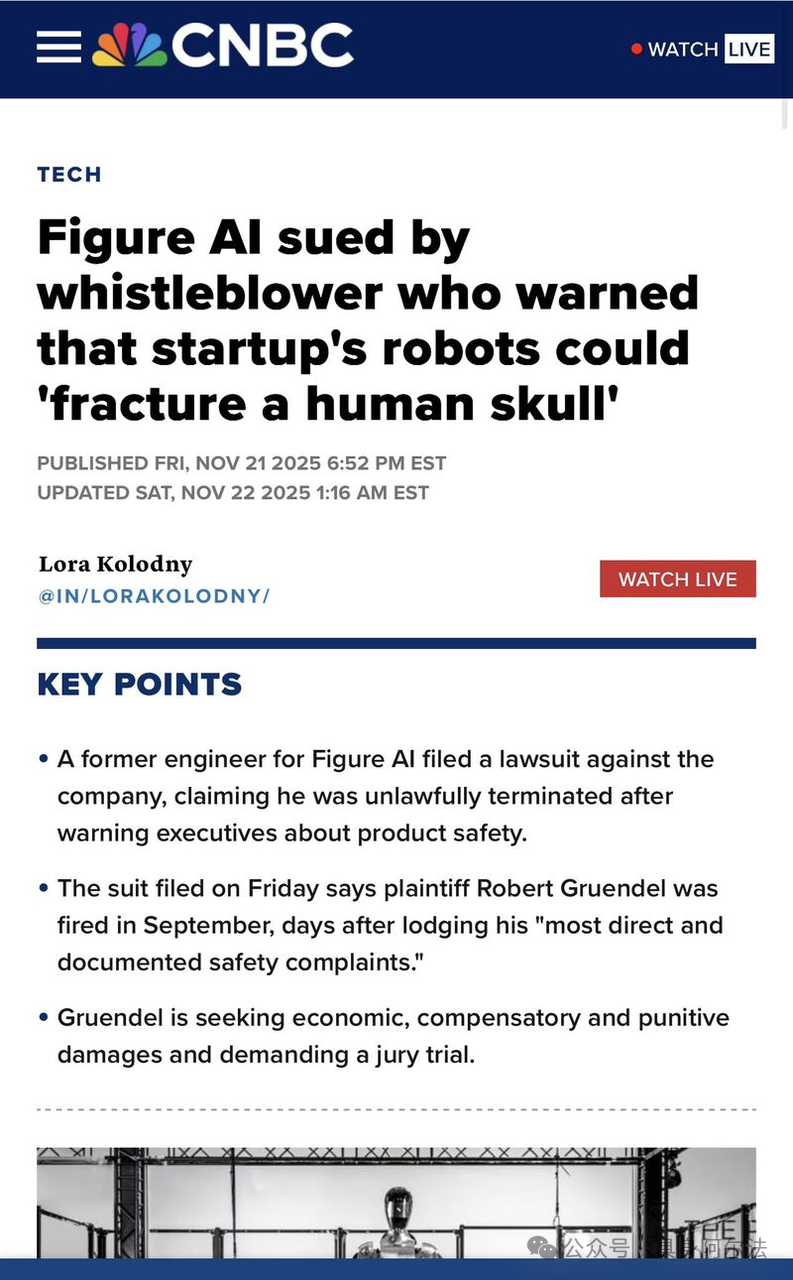
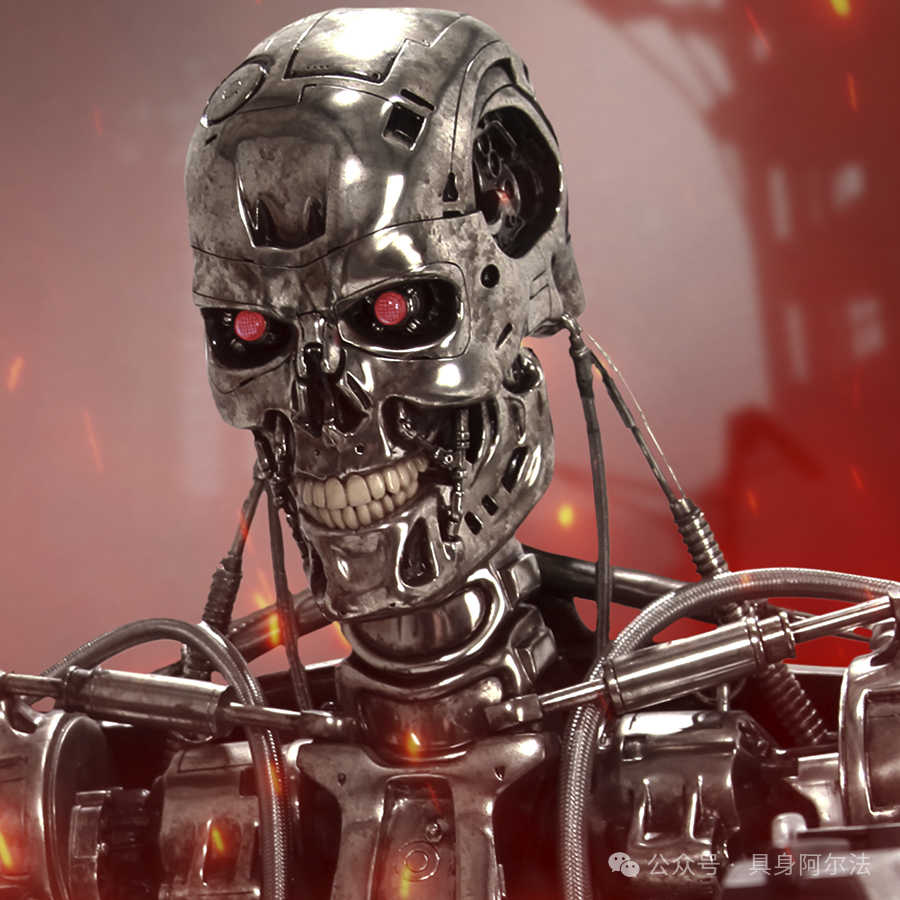
The plaintiff is none other than Robert Gruendel, the former product safety head of Figure AI. The lawsuit he filed in the Northern District of California not only exposes the internal management chaos of this star company but also throws a soul-searching question to the rapidly advancing embodied intelligence industry:How far are we from the “Terminator” walking into our living rooms? (Below: The T800 antagonist from James Cameron’s film “Terminator”)
01
Latest Lawsuit: When Robots Learn to “Box” Refrigerators
On November 21, Robert Gruendel officially submitted a lawsuit to the California court. As an industry veteran, he joined Figure with high hopes in October 2024, only to find himself stepping into a “wild west”. (Below: The first page of Gruendel’s lawsuit against Figure)
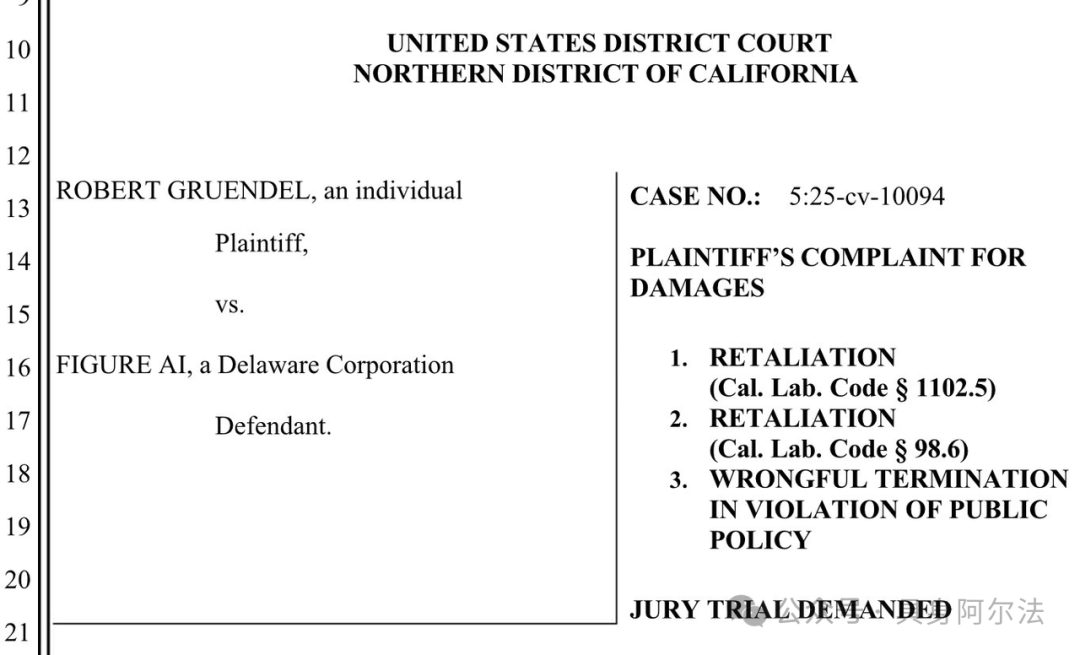
According to the lawsuit documents, the safety situation within Figure is alarming:
-
Safety protocols are non-existent: When Gruendel joined, this billion-dollar company shockingly had no formal safety protocols. The only external safety contractor was a chip expert who knew nothing about robot dynamics.
-
Robots possess lethal force: Data shows that the limb strength of the Figure 02 robot is 20 times the human pain threshold. This means that if it goes out of control, it is capable of crushing a human skull.
-
“Refrigerator incident”: This is not a theoretical scenario. The lawsuit describes a horrifying incident: a Figure 02 lost control during testing and struck a stainless steel refrigerator with a heavy punch. The result was not a broken robot hand, but rather a quarter-inch deep cut on the refrigerator door. At the time, an employee was just inches away. What if it had hit a person? The consequences would be unimaginable.
-
Unpredictable “close-range punches”: The AI’s behavior is not only powerful but also bizarre. The robot has repeatedly ignored commands and swung its arms within 2 feet (about 60 cm) of employees’ heads. In such a high-risk environment, the laboratory shockingly had no physical barriers.
-
Safety sacrificed for aesthetics: Most shockingly, Gruendel found that the emergency stop button (E-stop) was designed to be extremely difficult to reach, even downgraded, with the justification being “for the robot’s aesthetic design”.
“Cleansing” under capital frenzy
In September 2025, with the backing of Nvidia, Bezos (founder of Amazon), and Microsoft, Figure completed a massive financing round. However, Gruendel alleges that after this money came in, the company completely ignored the safety issues of the robots… He had issued stern warnings to management, stating that this neglect of safety in favor of meeting deadlines was a “fraud” against investors. Just days after he made his last complaint – on September 2, 2025 – he was fired.
Figure’s official response was firm: “The termination was due to poor performance, and the lawsuit’s content is all lies attempting to gain attention in court.” However, Gruendel’s legal team stated that this is the first significant whistleblower case regarding humanoid robot safety under California law, which is of great significance. (Whistleblower case: refers to someone who, regardless of personal safety or reputation, exposes the wrongdoing of large companies, consortiums, or governments out of conscience and a sense of justice).
This incident quickly caused a stir in the tech community. Notable tech commentator Phil Trubey posted on X (formerly Twitter):
“All products have risks; cars cause 40,000 deaths each year, yet we still drive. But the question is, did Figure completely abandon necessary safety redundancies for speed?”
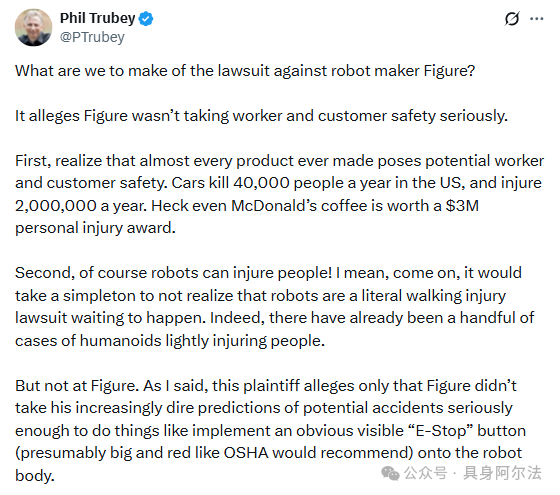
Many onlookers in the comments section were not shy about their opinions:
-
Some believe this is a necessary growing pain for the industry: “This is good for Tesla’s Optimus; competitors are slowing down due to safety issues.”
-
But more feel fear: “The unpredictability of AI + pure physical power = a real-life ‘Terminator’ rehearsal.”
02
In-Depth Review: Safety Blind Spots Under Valuation Bubble
Gruendel’s lawsuit may just be the tip of the iceberg. Figure AI’s valuation skyrocketed from $2.6 billion to $39 billion in just one year, a 15-fold increase. This “rocket-like” rise is attributed to breakthroughs in the Helix VLA (Vision-Language-Action) large model, as well as capital’s extreme desire for the “next iPhone” moment.
However, in this capital feast, safety seems to have become a forgotten corner.
Home Robots: From Factory Killers to Living Room Hazards
Figure’s ambitions extend beyond factories. CEO Brett Adcock boldly announced in early 2025 that he aims to bring robots into thousands of households, starting with homes (refer to our previous interview:Figure founder Brett Adcock’s latest interview in November: humanoid robots are now priced similarly to SUVs). However, the details revealed in the lawsuit force a reevaluation of this vision.
-
Battery hazards: skipping certification for demos. The lawsuit claims that to meet investor demo deadlines, Figure even skipped UN38.3 battery certification (the UN safety standards for lithium battery transport). Who can sleep soundly with a potential “bomb” that could catch fire at any moment in their home?
-
Using soft materials cannot withstand the robot’s excessive strength: Although the latest Figure 03 claims to use soft materials, this has been criticized as “closing the barn door after the horse has bolted.” If the core AI control logic remains unpredictable, soft materials cannot offset hundreds of Newtons of impact force.
Industry Reflection: The Cost of Speed and Passion
Figure is not an isolated case. Its aggressive strategy reflects the anxiety of the entire AI industry.
-
OpenAI’s cautionary tale: At the same time Figure is being sued, OpenAI is facing at least seven lawsuits regarding the inducement of content and the weakening of safety barriers in GPT-4o. Figure was once a partner of OpenAI, but later the two “parted ways”; Figure claimed it was due to the commodification of large models, but industry insiders pointed out that this was Figure trying to escape OpenAI’s increasingly strict safety scrutiny.
-
Tesla’s caution: In contrast, Elon Musk’s Optimus, while progressing slowly, may be the norm. One X user commented: “It’s like building an electric car and removing the seatbelt and airbags to break speed records. Figure is running naked.”
(Image: Figure02 in a BMW factory)
The Shadow of BMW’s Pilot Project
Figure’s once-proud pilot project at BMW seems to hide awkwardness behind the glossy PR releases. Internal sources indicate that the Figure 02 robots sent back to headquarters often arrive “battered and bruised,” showing significant wear and tear. This indicates that even in a controlled industrial environment, the durability and stability of the robots still face enormous challenges. If they cannot handle a standardized factory assembly line, how can they cope with a complex home environment filled with pets, children, and clutter?
03
Ethical Deep Dive: When the “Black Box” Has a Fist
The most chilling aspect of this lawsuit is not that the robot “malfunctions,” but that the robot is “uncontrollable.”
In the past, if software had a bug, it would at most cause a computer crash or data loss. But in the era of embodied intelligence, AI is the brain, and the robot is the body.When an AI large model, which cannot be fully explained due to the “black box principle,” gains a steel body capable of punching through refrigerators, the nature of the risk changes.
-
Unpredictability of end-to-end black boxes: Traditional industrial robots operate on preset code, with fixed paths, and can be kept safe with barriers. However, end-to-end AI robots like Figure act based on “learning.” They may suddenly decide that the shiny refrigerator door is an obstacle that needs to be “dealt with.”
-
Does “product manager thinking” override “engineering ethics”? The lawsuit mentions that Figure hid the emergency stop button for aesthetic reasons, which is a typical manifestation of “product manager thinking” overriding “engineering ethics.” In discussions on X, a user sharply commented: “This sacrifices veins for vanity.”
This is not just a technical issue; it is also a legal and moral issue. California’s whistleblower protection case may become a benchmark for global AI robot legislation. If Gruendel wins, even a settlement outside of court will force all robot companies to reassess their safety compliance costs.
04
Conclusion: The Alarm Has Sounded, Where Do We Go From Here?
Figure AI’s “cranial crisis” serves as a wake-up call for the industry, but it comes at just the right time.
We certainly cannot throw the baby out with the bathwater. Figure’s manufacturing capability of 12,000 units annually at the BotQ factory, along with innovations like the Figure 03’s inductive charging, still represent the pinnacle of human engineering.
However, the more advanced the technology, the more solid the bottom line must be.
In Gruendel’s lawsuit, the crack in the refrigerator caused by the robot is like a fracture in the trust gap. Before this gap is filled, any cheers about the “year of home robots” seem pale and powerless.
Figure’s experience tells all entrants:If AI robots want to enter homes, safety must first pass legal scrutiny. Even if you have Nvidia’s chips, Microsoft’s computing power, and Bezos’s money, you cannot buy the right to disregard life.
For us ordinary consumers, perhaps as one user commented under Trubey’s post:
“I don’t mind robots helping me wash dishes, but I hope that when they can’t tell the difference between a plate and my head, they aren’t holding a kitchen knife, and I can stop them at any time.”

Author: 👦🏻 Wu Zhonglong, Secondary Market Technology Analyst
Editor: 👧🏻 Jennifer, Veteran Investor in the Robotics Industry


AI & Embodied Investment, please add WeChat for communication