🌠This work includes a complete runnableprogram, Chinese comments,and a program operation video
01
—
🔥Software version: matlab2024b
✨Test results are as follows:
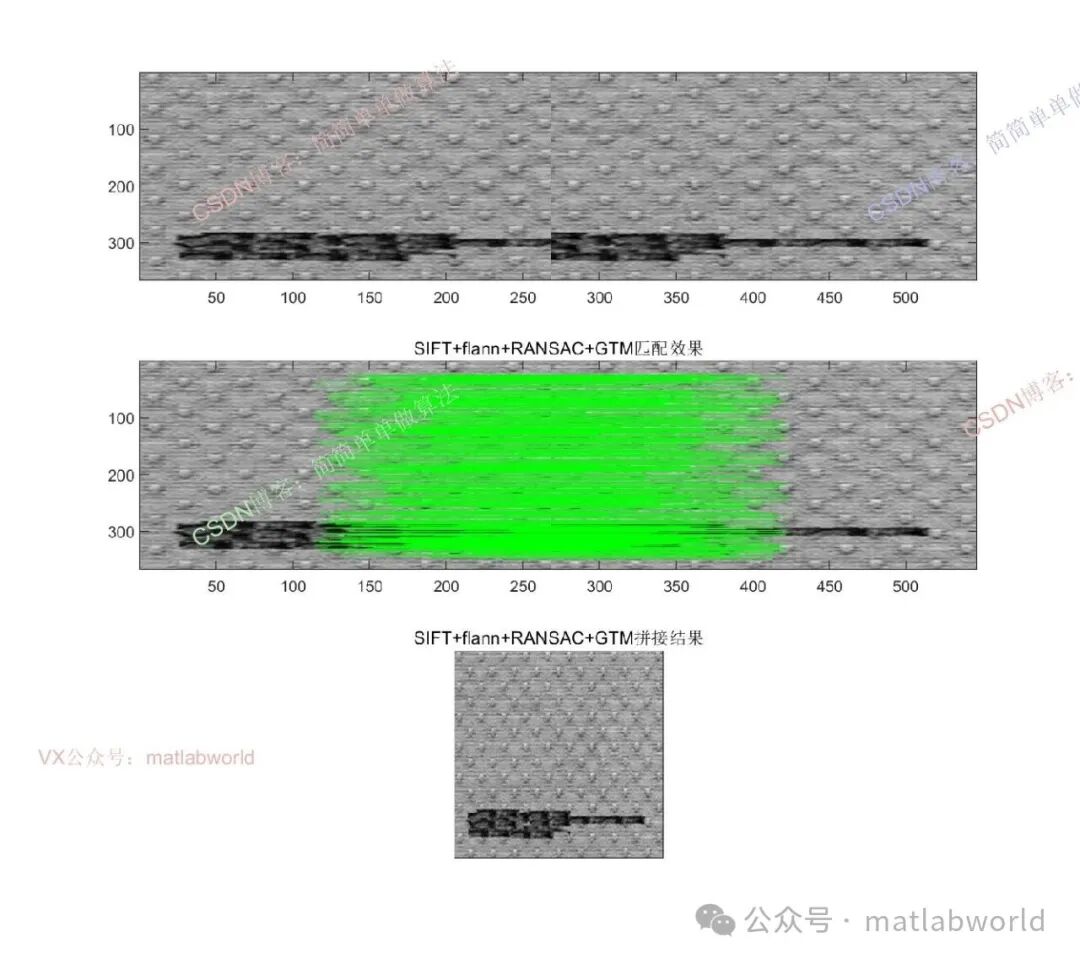
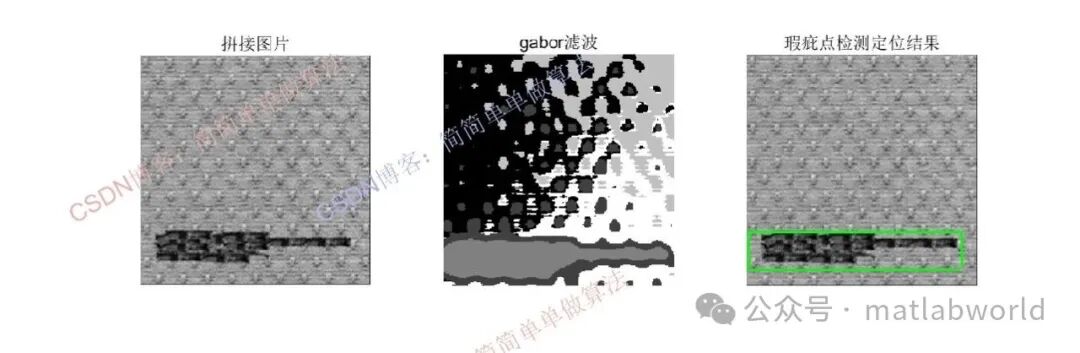
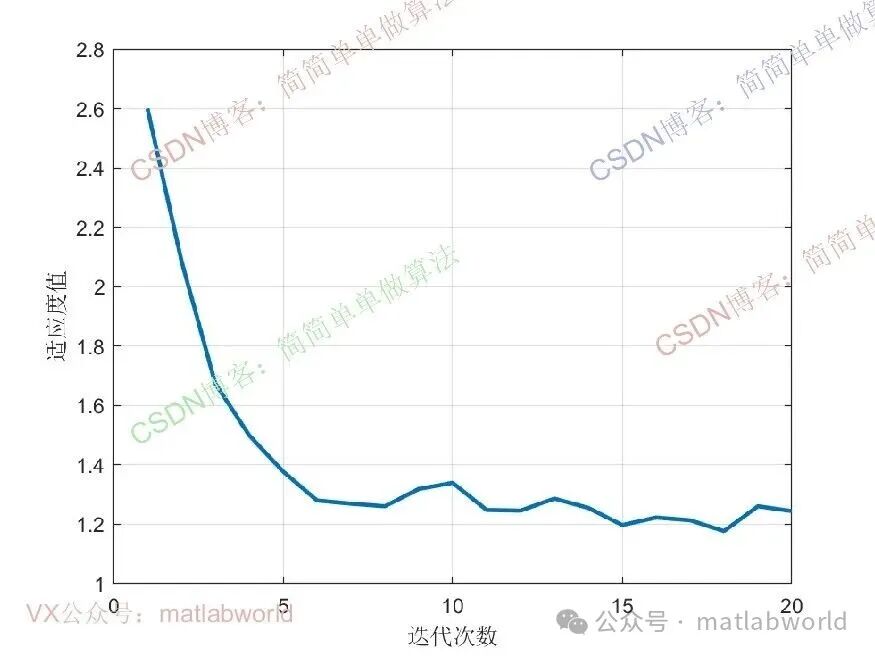
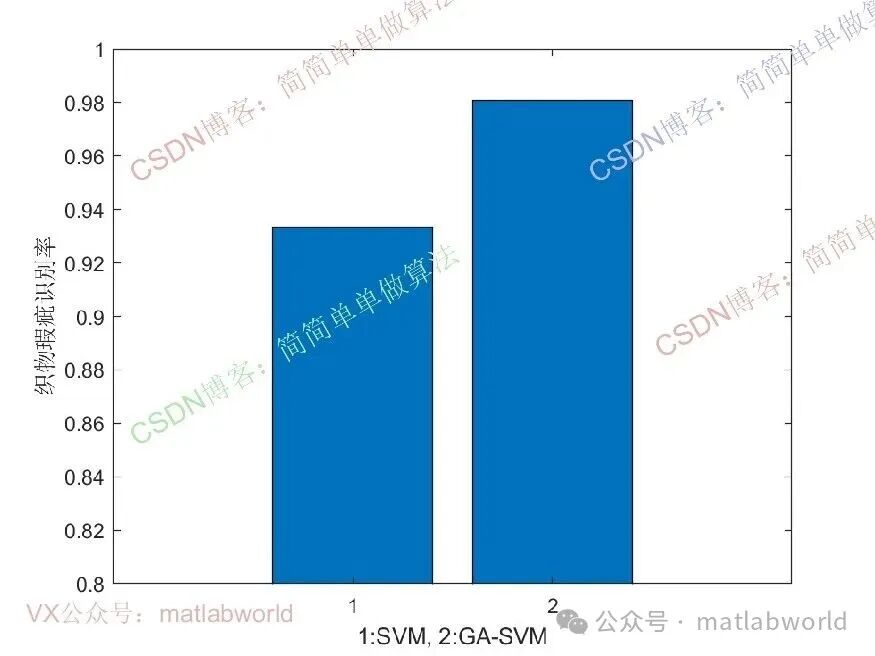
02
—
🌐Source code acquisition method:
🌐Open the “Read the original text” link at the bottom left of the article
 After opening, search for the algorithm name/keyword as prompted.
03
—
🚀Algorithm Theory Overview
The fabric image stitching technology based on SIFT+FLANN+RANSAC+GTM focuses on establishing associations between images through feature extraction and matching, and then fuses them through robust model estimation and global transformation to solve the issues of repeated fabric textures and misalignment during stitching, ultimately achieving seamless stitching. The local features of SIFT can distinguish subtle differences in repeated textures (such as slight shifts in yarn), reducing mismatches. The fast matching of FLANN reduces the stitching time for multiple fabric images, making it suitable for batch processing in industrial scenarios. RANSAC eliminates outliers to avoid misalignment caused by texture mismatches, while GTM’s global transformation eliminates cumulative errors. Weighted average fusion addresses the stitching seams caused by lighting differences in fabrics, ensuring visual consistency in the stitched image.
The essence of genetic optimization SVM is “to optimize the classification performance of SVM using genetic algorithms to find the optimal parameter combination (C*, γ*)”. The specific collaborative process is as follows:
1. The genetic algorithm encodes SVM’s C and γ as chromosomes, generating an initial population;
2. For each chromosome (i.e., a set of (C, γ)), train the SVM and calculate its fitness (e.g., 10-fold cross-validation accuracy);
3. Generate a new generation of populations through selection, crossover, and mutation operations, repeating step 2;
4. Stop evolution when the number of iterations reaches a preset value or fitness no longer improves, outputting the optimal chromosome corresponding to (C*, γ*);
5. Use (C*, γ*) to train the final SVM model for fabric defect type recognition.
04
—
📶SomeCore Code
.....................................................................................................................err=0;
err1=0;err2=0;err3=0;err4=0;for ii=1:15    ii    for j = 1:7        rng(ii*j);        if j == 1;xcc=xc1;end;        if j == 2;xcc=xc2;end;        if j == 3;xcc=xc3;end;        if j == 4;xcc=xc4;end;        if j == 5;xcc=xc5;end;        if j == 6;xcc=xc6;end;        if j == 7;xcc=xc7;end;
        I       = imresize(xcc,[64,64]);
        % Add noise        I       = double(I) + ii*randn(size(I));
        F       = [func_feature1(uint8(I))];        [Predict1,error1] = svmpredict(T(j),F,model);        if Predict1==T(j);           err=err+1;         end        if Predict1==2&T(j)==2;           err1=err1+1;         end                if Predict1==3&T(j)==3;           err2=err2+1;         end          if Predict1==4&T(j)==4;           err3=err3+1;         end                 if Predict1==5&T(j)==5;           err4=err4+1;         end      endend
disp('Accuracy:');rates  = err/105rates2 = rates;
save R1.mat rates
load R0.matrates1 = rates;
figure;bar([rates1,rates2]);xlabel('1:SVM, 2:GA-SVM');ylabel('Fabric Defect Recognition Rate');ylim([0.8,1]);09_054c
Thank you forliking, saving, and sharing, much appreciatedmy friends!