RISC-V (pronounced risk-five) architecture is an open-source instruction set architecture (ISA) that has gained attention in recent years for its flexibility, modularity, and scalability. In this article, we will explore the main aspects of RISC-V architecture, including its design principles, instruction set, register file, memory model, privilege levels, and implementation methods. We will also discuss the RISC-V ecosystem and community, as well as its applications in various fields. By the end of this article, you will have a comprehensive understanding of RISC-V architecture and its potential impact on the future of computing.
History and Evolution of RISC-V
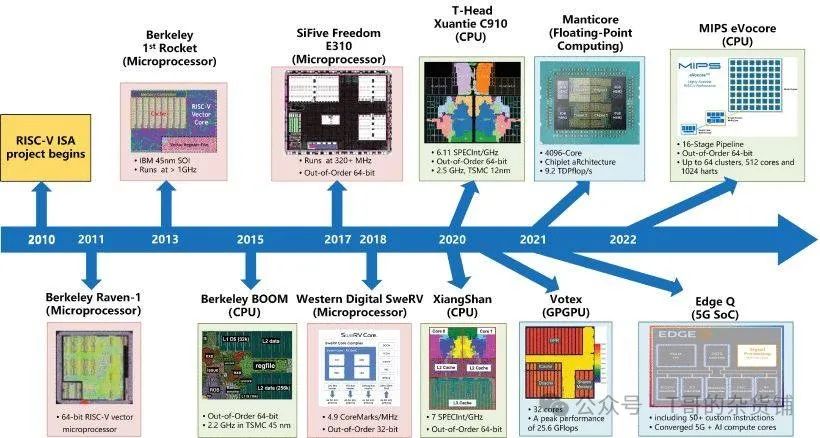
Evolution of RISC-V Processors
Proprietary ISAs (such as ARM) are tightly controlled by specific companies, limiting access to their architectures and imposing licensing fees. This lack of openness stifles innovation, hampers competition, and poses challenges for small companies or academic institutions in experimenting and developing custom processors. This has led to the rise of RISC-V.
Before RISC-V, there were several RISC (Reduced Instruction Set Computer) processors on the market. Notable examples include MIPS, SPARC, and PowerPC. These architectures are considered efficient and have their applications, but they often require licensing fees, and access to their internal workings is also restricted.
The origins of RISC-V can be traced back to the University of California, Berkeley, where it was initially developed as a research project in 2010. The project aimed to create a new open-source ISA to address the limitations of existing proprietary ISAs and lay the foundation for future processor designs. The RISC-V project was led by computer scientists Krste Asanović, Yunsup Lee, and Andrew Waterman, who were inspired by the success of open-source software and sought to bring similar benefits to the hardware domain.
The first version of the RISC-V ISA was released in 2011, known as the “RV32I” basic integer instruction set. The initial version followed the principles of Reduced Instruction Set Computing (RISC), focusing on simplicity and efficiency. Over the years, the RISC-V ISA has undergone multiple iterations, adding new extensions and features to enhance its capabilities and meet broader application needs.
In 2015, the RISC-V Foundation was established to promote the adoption and standardization of the RISC-V ISA. The foundation brings together industry leaders, academic institutions, and individual contributors to collaboratively develop and promote RISC-V technology. Since its establishment, the RISC-V Foundation has grown to over 200 member organizations, and the RISC-V ISA has been adopted by numerous companies, applied in a variety of fields ranging from microcontrollers and embedded systems to high-performance computing and data center processors.
The development of RISC-V is driven by various factors, including the need for greater customization and flexibility in processor design, the desire to reduce dependence on proprietary ISAs, and the growing demand for energy-efficient and cost-effective computing solutions. By providing an open, modular, and scalable ISA, RISC-V has ushered in a new era of innovation in processor design and has the potential to reshape the semiconductor industry landscape.
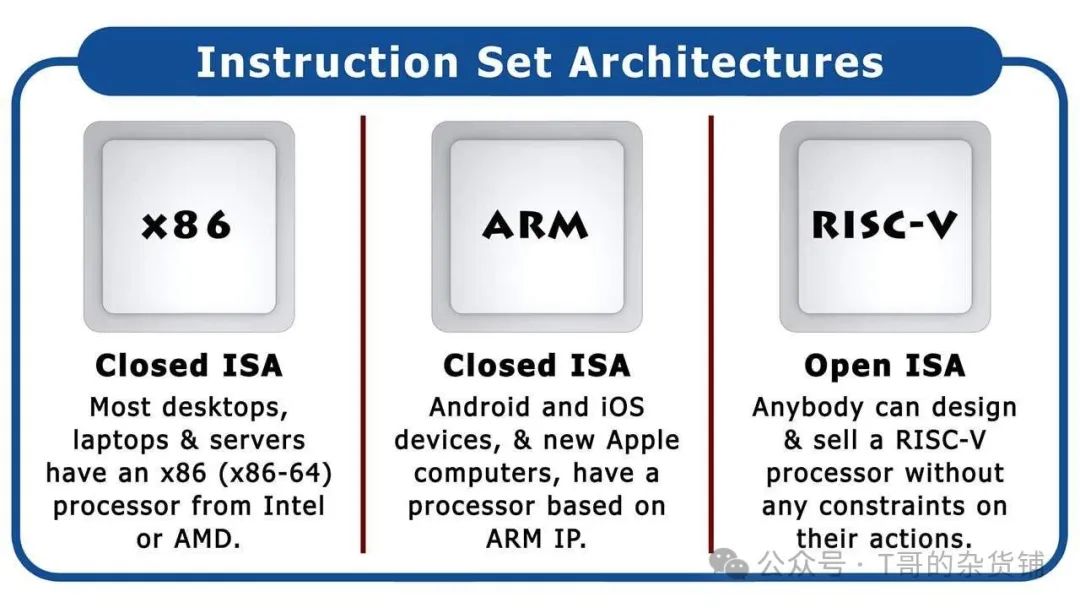
RISC-V Design Principles
The RISC-V architecture is built on a set of key design principles that help improve its performance, efficiency, and adaptability. These principles include the use of a reduced instruction set, modularity, and scalability. By adhering to these principles, RISC-V can develop processors tailored to specific applications and use cases, providing a high degree of customization and optimization.
Reduced Instruction Set Computing (RISC)
At the core of the RISC-V architecture is the concept of Reduced Instruction Set Computing (RISC). RISC is a processor design philosophy that emphasizes simplicity and efficiency by using a small set of simple, general-purpose instructions. This stands in contrast to Complex Instruction Set Computing (CISC), which employs a larger, more complex instruction set capable of performing multiple operations in a single instruction.
RISC architectures prioritize simplicity, executing one instruction per clock cycle, thereby simplifying design and improving decoding efficiency. In contrast, CISC architectures utilize complex instructions that can perform multiple operations but may require multiple clock cycles to execute. Both CPU types aim to enhance CPU performance.
| Aspect | RISC | CISC |
|---|---|---|
| Instructions per Cycle | Small and Fixed Length | Large and Variable Length |
| Instruction Complexity | Simple, Standardized | Complex and Diverse |
| Instruction Execution | Single Clock Cycle | Multiple Clock Cycles |
| Memory Usage | High Memory Usage | More Efficient Memory Usage |
| Memory | Increased Memory Usage for Instruction Storage | Efficient Memory Encoding |
| Cost | Higher Cost | Cheaper than RISC |
Compared to CISC, the RISC approach has several advantages:
-
Simplified Hardware Implementation: It simplifies the hardware implementation of the processor since fewer instructions need to be decoded and executed. This can speed up execution time and reduce power consumption.
-
Higher Instruction-Level Parallelism: RISC processors typically have higher instruction-level parallelism, allowing multiple instructions to be executed simultaneously, further enhancing performance.
-
Simplicity: The simplicity of the RISC instruction set makes it easier to develop compilers and other software tools that can generate efficient code for the processor.
RISC-V follows the RISC philosophy, providing a minimal instruction set that can be composed to execute complex operations. This simplicity allows for more streamlined processor design, thereby enhancing performance and energy efficiency. Moreover, the design of the RISC-V instruction set is easily extensible, enabling the addition of new instructions and features as needed to meet specific application requirements. This combination of simplicity and extensibility makes RISC-V a versatile and powerful foundation for processor design.
Further Reading: The Most Comprehensive Showdown Between RISC-V and ARM
Modularity and Scalability
Another key design principle of the RISC-V architecture is modularity and scalability.
Modularity refers to dividing the ISA into different independent components that can be combined in various ways to create a custom processor. On the other hand, scalability refers to the ability to add new instructions, features, or extensions to the ISA without compromising existing functionality.
The RISC-V ISA is divided into a basic integer instruction set and a series of optional extensions. The basic integer instruction set provides the core functionality required for general-purpose computing, while the extensions add specialized capabilities for specific applications or domains. This modular approach allows designers to select the features needed for specific use cases, thereby optimizing the processor’s performance, power consumption, or other design goals.
The scalability of RISC-V is achieved through a well-defined extension mechanism that allows for the addition of new instructions and features without affecting existing software compatibility. This enables the ISA to evolve over time and adapt to new technologies and application demands. The RISC-V community has developed a range of standard extensions, such as floating-point operations, vector processing, and cryptographic operations, which can be incorporated into processor designs as needed.
For instance, if a company is designing a processor for embedded systems in digital signal processing (DSP) applications. DSP tasks often involve complex mathematical operations, such as vector multiplication. The company can create custom instruction extensions for vector multiplication rather than relying solely on basic RISC-V instructions. These custom extensions act like independent modules designed to enhance the processor’s capability to handle DSP workloads. Scalability refers to RISC-V’s ability to continuously evolve and adapt to new requirements (such as supporting DSP operations) while maintaining its core design principles.
The combination of modularity and scalability in RISC-V provides a high degree of flexibility and customization, making it possible to develop processors tailored to specific applications and use cases. This, in turn, can enhance performance, energy efficiency, and cost-effectiveness, making RISC-V an ideal choice for various computing platforms and devices.
RISC-V Instruction Set
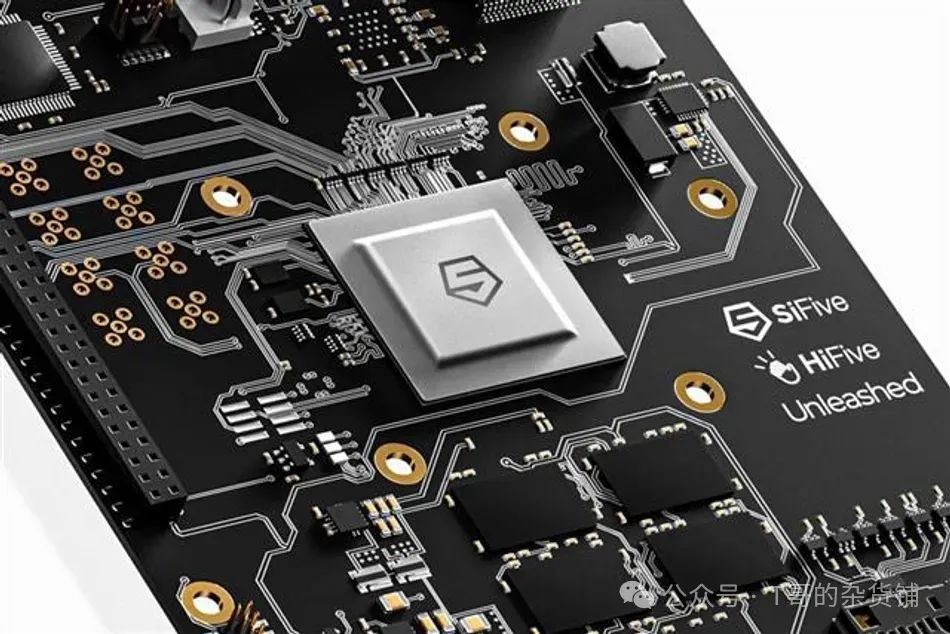
The RISC-V instruction set is a collection of instructions that define the operations that a RISC-V processor can perform. These instructions are designed to be simple, efficient, and easy to extend, allowing for high levels of customization and optimization. The instruction set is divided into a basic integer instruction set and a set of optional extended instruction sets that provide specialized functionality for specific applications or domains.
Basic Integer Instruction Set
The basic integer instruction set is also known as the “RV32I” or “RV64I” instruction set (depending on the address space size) and provides the core functionality required for general-purpose computing. It includes arithmetic, logical, and control operation instructions, as well as memory access and manipulation instructions. The design of the basic integer instruction set follows the principles of Reduced Instruction Set Computing (RISC), characterized by minimization and efficiency.
The RISC-V instructions are encoded in a fixed 32-bit format, simplifying decoding and execution. The instruction formats are divided into six types: R, I, S, B, U, and J: each format has a specific purpose and unique encoding structure:
-
R-Type Instructions: Used for register-to-register operations, such as arithmetic and logical operations. They include three register operands: two source registers and one destination register.Eg:- add (adds two registers and stores the result in another register)
-
I-Type Instructions: Used for immediate operations, such as arithmetic and logical operations with immediate values. They include two register operands and a 12-bit immediate value.Eg:- li (loads an immediate value)
-
S-Type Instructions: Used for store operations, moving data from registers to memory. They include two register operands and a 12-bit immediate value for memory address offset.Eg:- sw (stores a value in a register)
-
B-Type Instructions: Used for conditional branch operations, transferring control to different instructions based on conditions. They include two register operands and a 12-bit immediate value as the branch target address.Eg:- beq (compares and branches)
-
U-Type Instructions: Used for operations with 20-bit immediate values, such as loading a 20-bit constant into a register or setting the upper 20 bits of a register.Eg:- lui (loads a high immediate value)
-
J-Type Instructions: Used for unconditional jump operations, transferring control unconditionally to another instruction. They include one register operand and a 20-bit immediate value as the jump target address.Eg:- J (jump)
Standard Extensions
In addition to the basic integer instruction set, the RISC-V ISA also includes a series of standard extensions that provide specialized functionality for specific applications or domains. These extensions can be added to RISC-V processors as needed, enabling high levels of customization and optimization. Some of the most notable standard extensions include
-
M Extension: The M extension adds support for integer multiplication and division instructions. These instructions can efficiently perform complex arithmetic operations commonly used in applications such as signal processing and cryptography.
-
A Extension: The A extension, also known as the Atomic extension, provides support for atomic memory operations. These operations allow concurrent access to shared memory resources without complex synchronization mechanisms, making them particularly useful in multi-core and multi-threaded systems.
-
F Extension: The F extension adds support for single-precision floating-point operations. Floating-point operations are crucial for many scientific, engineering, and graphics applications requiring high-precision calculations.
-
D Extension: The D extension extends the F extension by adding support for double-precision floating-point operations. Double-precision arithmetic provides higher accuracy and dynamic range, making it suitable for demanding applications such as computational fluid dynamics and numerical simulations.
-
C Extension: The C extension, also known as the Compressed extension, introduces a set of 16-bit compressed instructions that can be used alongside standard 32-bit instructions. These compressed instructions help reduce code size and improve code density, enhancing performance and reducing power consumption, especially in memory-constrained systems.
-
V Extension: The V extension (or Vector extension) adds support for vector processing, enabling efficient execution of data-parallel operations. Vector processing is particularly useful in applications such as machine learning, image processing, and scientific simulations, where the same operations need to be performed on large datasets.
-
B Extension: The B extension, or Bit Manipulation extension, provides a set of efficient bit-level operation instructions, such as bit shifting, bit counting, and bit field extraction. These instructions are useful in various applications, including encryption, compression, and error correction.
Other standard extensions include Q, L, J, T, P, N, etc.
By providing a range of standard extensions, the RISC-V ISA allows designers to create processors tailored to specific applications and use cases, optimizing performance, power consumption, and cost-effectiveness.
Further Reading: The RISC-V Instruction Set Manual
RISC-V Register File
The RISC-V register file is a key component of the RISC-V architecture, providing a set of storage locations for holding data during instruction execution. The register file is divided into integer registers and floating-point registers, depending on the extensions implemented in the processor. Registers play a crucial role in the RISC-V architecture as they allow for fast access to data, contributing to the performance and efficiency of the processor.
Integer Registers
Integer registers in the RISC-V architecture are used to store and manipulate integer values during instruction execution. These registers can perform operations such as addition, subtraction, multiplication, division, bit manipulation, and comparisons. The RV32I basic integer instruction set includes 32 integer registers, while the RV64I basic integer instruction set includes either 32 or 64 integer registers, depending on the address space size. In the RV32I ISA, each register is 32 bits wide, while in the RV64I ISA, each register is 64 bits wide.
Integer registers are general-purpose, meaning they can be used for any purpose. The naming convention is as follows:
-
x0: The value of this register is 0 and cannot be modified.
-
x1-x31: These registers are all general-purpose, with some having specific names to indicate their purposes, such as: “x1-x31”:
-
ra (x1): Return address register, used to store the return address in function calls.
-
sp (x2): Stack pointer register, used to manage the stack.
-
gp (x3): Global pointer register, used to access global data.
-
tp (x4): Thread pointer register, used for thread-local storage.
-
t0-t6 (x5-x11): Temporary registers, used to hold intermediate values during computations.
-
a0-a7 (x10-x17): Argument registers, used to pass function arguments.
-
s0-s11 (x8, x9, x18-x27): Saved registers, used to preserve values across function calls.
-
T3-T6 (X28-X31): Additional temporary registers.
The RISC-V architecture provides a set of integer registers with a clear naming convention, enabling efficient execution of integer operations and simplifying the development of compilers and other software tools that can generate code for processors.
Floating-Point Registers
Floating-point registers in the RISC-V architecture are used to store and manipulate floating-point values during instruction execution. These registers are utilized when the processor implements the F or D extensions. The F extension provides 32 single-precision floating-point registers, while the D extension extends these registers to support double-precision (64-bit) floating-point values.
Each floating-point register for single-precision values is 32 bits wide, while each floating-point register for double-precision values is 64 bits wide. The naming convention for floating-point registers is “f” followed by a number, such as f0, f1, f2, etc., up to f31. Double-precision (64-bit) floating-point values are labeled d0 to d31.
Floating-point registers are categorized based on their intended use:
-
**ft0-ft7 (f0-f7)**: Temporary registers used to hold intermediate values during computations.
-
fs0-fs11 (f8-f9, f18-f27): Saved registers used to preserve values across function calls.
-
**fa0-fa7 (f10-f17)**: Argument registers used to pass function arguments.
-
**ft8-ft11 (f28-f31)**: Additional temporary registers.
RISC-V provides a set of floating-point instructions to operate on these registers. For example, fadd.s adds two single-precision floating-point values, while fmul.d multiplies two double-precision floating-point values. These instructions differ from integer instructions and use different opcodes.
Code Sample:
.data

# Declare and initialize the double-precision floating-point values

.doubles_

_value1:     .double 3.14_

_value2:     .double 2.71_

.text_

.globl main_

_main:_

    # Load the double-precision values into floating-point registers_

    _fld.d   d0, value1    # Load value1 into d0_

    _fld.d   d1, value2    # Load value2 into d1_

    # Perform the addition and store the result in d2_

    _fadd.d  d2, d0, d1    # Add the values in d0 and d1, store the result in d2_
Floating-point registers in the RISC-V architecture can efficiently execute floating-point operations, which are crucial for many scientific, engineering, and graphics applications. The RISC-V architecture provides a set of floating-point registers with a clear naming convention, simplifying the development of compilers and other software tools that can generate code for processors with floating-point capabilities.
RISC-V Memory Model
The RISC-V memory model defines how the processor interacts with memory, including the addressing and access mechanisms used for reading and writing data. The memory model plays a crucial role in the performance and efficiency of the processor, as it determines how data is organized and accessed during instruction execution. In the RISC-V architecture, the memory model supports both virtual memory and physical memory, providing a flexible and efficient framework for managing memory resources.
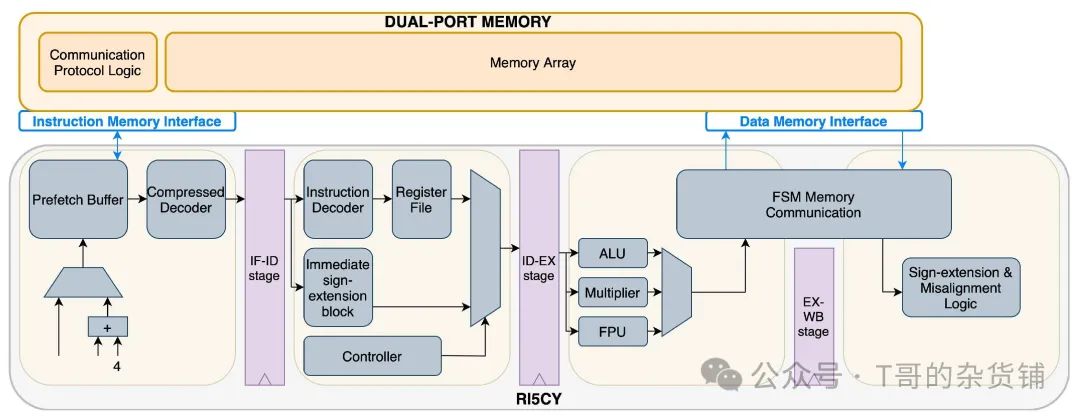
Virtual Memory
Virtual memory is a memory management technique used in the RISC-V architecture that provides an abstraction layer between the processor and physical memory. With virtual memory, the processor operates on virtual addresses, which are translated into physical addresses before accessing actual memory. This abstraction technique has several advantages:
-
Memory Isolation: Virtual memory provides each process with an independent address space, ensuring that one process’s memory cannot be accessed by another process without proper authorization. This isolation prevents unauthorized access and reduces the risk of memory corruption, enhancing security and stability.
-
Memory Management: Virtual memory allows the operating system to allocate and deallocate memory as needed, leading to more efficient memory management. This helps reduce memory fragmentation and improve overall system performance.
-
Address Space Expansion: Virtual memory allows for a larger address space than physical memory, enabling the processor to access more memory than is physically available. This is particularly useful in systems with limited physical memory, as it allows for disk space to be used as auxiliary storage for memory.
In the RISC-V architecture, virtual memory is implemented through a multi-level page table mechanism that translates virtual addresses into physical addresses through a series of lookups. The number of levels in the page table depends on the address space size and page size; the larger the address space and the smaller the pages, the more levels are required. This multi-level page table mechanism provides a flexible and efficient means of managing virtual memory, allowing for fine-grained control over memory access and allocation.
Physical Memory
Physical memory refers to the actual memory resources available in the system, such as RAM and ROM. In the RISC-V architecture, physical memory is organized into a flat address space, where each address corresponds to a unique location in memory. The processor accesses physical memory through the memory model, which translates virtual addresses into physical addresses as needed.
The relationship between virtual memory and physical memory in the RISC-V architecture is managed by the Memory Management Unit (MMU). The MMU is responsible for using the multi-level page table mechanism to translate virtual addresses into physical addresses and handle memory protection and access control. This translation process ensures that the processor can access the correct physical memory location while operating on virtual addresses.
In addition to the flat address space, the RISC-V memory model also supports various memory addressing modes, which determine how addresses are computed and accessed during instruction execution. The most common addressing modes in RISC-V include:
-
Base+Offset Addressing: In this mode, the effective address is computed by adding the value of a base register to a direct offset. This is commonly used to access memory locations relative to a base address, such as accessing elements in an array or accessing local variables in a function stack frame.
-
Immediate Addressing: In this mode, the effective address is directly specified as an immediate value in the instruction. This is useful for accessing fixed memory locations, such as global variables or constants.
-
Register Indirect Addressing: In this mode, the effective address is stored in a register, with the instruction specifying which register to use. This is particularly useful for accessing memory locations determined at runtime, such as pointers or dynamically allocated memory.
By providing a flexible memory model that supports both virtual and physical memory, as well as various addressing modes, the RISC-V architecture achieves efficient, versatile memory management, enabling the processor to effectively handle a wide range of applications and use cases.
RISC-V Privilege Levels
The privilege levels in the RISC-V architecture define the access rights and capabilities of the processor during instruction execution. These levels are designed to provide a secure and controlled environment for running software, ensuring that applications and system components can only access resources and perform operations they are authorized to do. The RISC-V architecture defines three privilege levels: Machine Mode, Supervisor Mode, and User Mode.
-
Machine Mode (M-mode): M-mode is the highest privilege level in the RISC-V architecture, allowing unrestricted access to all processor resources and system functions. This mode is typically used by the lowest-level system software, such as firmware or hypervisors, responsible for managing hardware resources and providing a secure environment for running other software components. In M-mode, the processor can access and modify all registers, memory locations, and control registers, and can execute any instruction.
-
Supervisor Mode (S-mode): S-mode is an intermediate privilege level that provides a more restricted environment for running system software, such as operating systems or virtual machine monitors. In S-mode, the processor’s access to certain resources and functions is limited, controlled by software running in machine mode. This level of access control helps ensure that system software components can only perform authorized operations, preventing unauthorized access or modification of critical system resources.
-
User Mode (U-mode): U-mode is the lowest privilege level in the RISC-V architecture, providing the most restricted environment for running application software. In U-mode, the processor’s access to resources and functions is limited, controlled by software running in supervisor mode. This level of access control helps ensure that application software can only access authorized resources and perform authorized operations, preventing unauthorized access or modification of system resources and other application software.
The privilege levels in the RISC-V architecture provide a powerful and flexible framework for managing access rights and capabilities, ensuring that software components can only perform authorized operations. By providing a secure and controlled environment for running software, the RISC-V architecture helps enhance the overall security, stability, and reliability of computing systems.
RISC-V Implementations
RISC-V implementations refer to the various ways of realizing the RISC-V ISA in hardware. These implementations include soft-core designs that run on programmable logic devices such as FPGAs, as well as hard-core designs integrated into custom silicon chips. Each implementation has its advantages and disadvantages, depending on factors such as performance, power consumption, and development costs.
Soft-Core Implementations
Soft-core RISC-V implementations are designs that can be synthesized and run on programmable logic devices (PLDs) such as Field-Programmable Gate Arrays (FPGAs) or Complex Programmable Logic Devices (CPLDs). These implementations are typically written in hardware description languages (HDLs) such as Verilog or VHDL and can be customized and configured to meet specific design requirements.
The advantages of soft-core RISC-V implementations include:
-
Flexibility: Soft-core implementations can be easily modified and reconfigured to meet specific design requirements, making them ideal for prototyping and experimentation. This flexibility allows designers to optimize processor designs for performance, power consumption, or other design goals.
-
Lower Development Costs: Developing a soft-core RISC-V implementation on an FPGA or CPLD is more cost-effective than creating a custom silicon chip, especially for small-scale projects or proof-of-concept designs. Lower development costs enable more developers and organizations to access RISC-V.
-
Faster Time-to-Market: Compared to hard-core implementations, soft-core implementations can be developed, tested, and deployed more quickly as they do not require the lengthy manufacturing processes associated with custom silicon chips. This faster time-to-market is a significant advantage for companies looking to bring new products to market quickly.
However, there are some disadvantages to using soft-core RISC-V implementations:
Lower Performance: Soft-core implementations running on FPGAs or CPLDs typically have lower performance compared to hard-core implementations on custom silicon chips. This is due to the overhead of programmable logic and the limitations of FPGA or CPLD technology.
Higher Power Consumption: Soft-core implementations on FPGAs or CPLDs may consume more power than hard-core implementations, as the power consumption of programmable logic devices is generally higher than that of custom silicon chips.
Despite these drawbacks, soft-core RISC-V implementations remain an attractive option for many applications, particularly in the early stages of development or for projects with budget and resource constraints.
Hard-Core Implementations
Hard-core RISC-V implementations are designs that are directly integrated into custom silicon chips (such as Application-Specific Integrated Circuits (ASICs) or System-on-Chip (SoC) devices). These implementations are typically developed using a combination of custom logic and standard cell libraries, with the standard cell libraries providing pre-designed building blocks for creating complex digital circuits.
The advantages of hard-core RISC-V implementations include:
-
Higher Performance: Hard-core implementations can provide higher performance compared to soft-core implementations, as they are designed and optimized specifically for the target silicon technology. This can lead to faster clock speeds, lower latency, and higher instruction-level parallelism.
-
Lower Power Consumption: Hard-core implementations are more power-efficient than soft-core implementations, as they can leverage custom silicon optimizations and power management techniques. This is particularly important for battery-powered devices or energy-constrained applications.
-
Higher Integration: Hard-core RISC-V implementations can be directly integrated into larger SoC designs, which may include other components such as memory, peripherals, and accelerators. This high level of integration can improve system performance, reduce power consumption, and simplify board complexity.
However, there are also some disadvantages to using hard-core RISC-V implementations:
- Higher Development Costs: Developing custom silicon chips with hard-core RISC-V implementations may be more expensive than using soft-core implementations on FPGAs or CPLDs, especially for small-scale projects or proof-of-concept designs. The costs of chip manufacturing, testing, and packaging can be high, particularly for cutting-edge silicon technologies.
- Longer Development Time: The design, manufacturing, and testing processes for custom silicon chips are very time-consuming, resulting in longer time-to-market compared to soft-core implementations. This can be a disadvantage for companies looking to quickly bring new products to market.
Despite these challenges, hard-core RISC-V implementations can offer significant advantages in terms of performance, power consumption, and integration, making them an attractive choice for many applications, particularly in high-performance or power-constrained systems.
RISC-V Ecosystem and Community
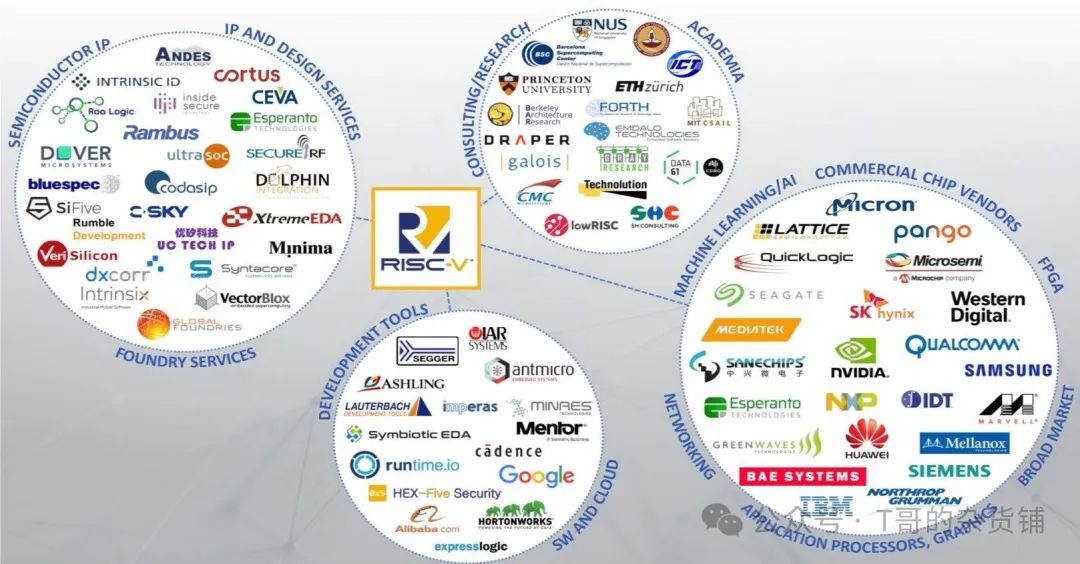
The RISC-V ecosystem is a diverse and evolving collection of organizations, developers, and resources that support the development, adoption, and standardization of the RISC-V ISA. This ecosystem plays a crucial role in the success of RISC-V, as it fosters collaboration, innovation, and the sharing of knowledge and expertise among its members.
The RISC-V community includes a wide range of stakeholders, such as semiconductor companies, hardware and software developers, academic institutions, and individual contributors. These stakeholders work together to develop and promote RISC-V technology, create new products and solutions based on the RISC-V ISA, and contribute to the ongoing evolution of the architecture. GitHub is a popular platform for collaborative software development, where RISC-V development projects (including compilers, simulators, and hardware designs) are frequently hosted. This facilitates community contributions and open-source innovation.
The well-known open-source operating system Linux has become a core component of the RISC-V ecosystem, with developers actively optimizing and tuning its kernel for seamless operation on RISC-V processors. Through the collaborative efforts of the Linux community and RISC-V developers, an increasing number of Linux distributions tailored specifically for the RISC-V architecture have emerged, enhancing the viability of the platform across various applications. Companies actively participating in the RISC-V ecosystem include SiFive, Andes Technology, Alibaba Group, Google, and others.
Some key components of the RISC-V ecosystem include:
-
RISC-V Foundation: The RISC-V Foundation is a non-profit organization aimed at promoting the adoption and standardization of the RISC-V ISA. The foundation provides a collaborative forum, organizes events and workshops, and maintains the official specifications and documentation for RISC-V.
-
RISC-V International: RISC-V International is a global organization aimed at supporting the development and application of RISC-V technology worldwide. It works closely with the RISC-V Foundation and regional RISC-V organizations to promote RISC-V across various markets and industries.
-
Open Source Projects: Numerous open-source projects related to RISC-V exist, including soft-core implementations, compilers, operating systems, and development tools. These projects enable developers to access and contribute to RISC-V technology, fostering innovation and collaboration within the community.
-
Commercial Products: Many companies have developed commercial products based on the RISC-V ISA, ranging from microcontrollers and embedded systems to high-performance computing and data center processors. These products demonstrate the versatility and potential of RISC-V technology across various applications and markets.
-
Research and Education: Academic institutions and research organizations play a crucial role in the RISC-V ecosystem, contributing to the development of new RISC-V technologies, conducting research on RISC-V applications, and providing education and training on RISC-V concepts and designs.
The RISC-V ecosystem and community are vital for the ongoing development and success of the RISC-V architecture. By fostering collaboration, innovation, and the sharing of knowledge and expertise, the RISC-V ecosystem helps ensure that RISC-V remains a viable and competitive option in the rapidly evolving computing landscape.
Advantages and Disadvantages
Compared to other instruction set architectures (ISAs) such as ARM, x86, and MIPS, the RISC-V ecosystem and community have both strengths and weaknesses. Here are some key advantages and disadvantages of RISC-V:
Advantages
-
Open and Royalty-Free: One of the most significant advantages of RISC-V is its openness and royalty-free nature. Unlike many other ISAs, RISC-V is not controlled by a single company, and anyone can implement it without paying licensing fees. This openness fosters innovation and lowers the barriers to entry for startups and small companies.
-
Customizability: RISC-V is highly customizable. It allows designers to create application-specific instruction set extensions (ISA extensions) tailored to specific needs, optimizing performance and energy efficiency for target workloads.
-
Community Collaboration: The RISC-V community is collaborative and diverse, involving numerous companies, universities, and individuals. This fosters innovation, knowledge sharing, and the development of a broad ecosystem.
-
Versatility: The design of RISC-V is versatile, making it suitable for a wide range of applications, from embedded systems and IoT devices to high-performance computing and data centers. Its modular architecture allows for scalability.
-
Transparency: The RISC-V ISA specifications are public and open for public review, making it easier to understand and verify the architecture. This transparency enhances trust and security.
-
Academic and Research Interest: RISC-V is widely used in academia for research and teaching purposes. This fosters a continuous stream of innovation, ideas, and talent for the RISC-V ecosystem.
Disadvantages
-
Market Adoption: As of the last knowledge update in September 2021, RISC-V’s market adoption has not reached the level of established ISAs like ARM and x86. While RISC-V is gaining increasing attention, its applications in consumer devices and mainstream computing are still limited.
-
Software Ecosystem: Although the RISC-V software ecosystem is continuously evolving, it still lags behind established ISAs in terms of the availability of software, compilers, and tools. Porting existing software to RISC-V poses challenges.
-
Hardware Ecosystem: Building a mature hardware ecosystem takes time. While RISC-V cores and development boards are available, the ecosystem may not provide the same diversity and choice as other ISAs.
-
Lack of Standardization: The flexibility of RISC-V may lead to fragmentation, as different implementations and extensions may not be compatible. Efforts are underway to achieve standardization in certain areas, but achieving full compatibility can be challenging.
-
Legacy Compatibility: RISC-V is not natively compatible with legacy software written for other ISAs such as x86. Transitioning to RISC-V may require recompilation or porting of existing software.
-
Intellectual Property Issues: Despite being open and royalty-free, there are concerns about potential patent claims associated with specific RISC-V extensions. Some implementations may require careful legal considerations.
In summary, RISC-V offers advantages such as openness, customizability, and collaboration, attracting a wide range of users, particularly in research, embedded systems, and specialized applications. However, it still faces challenges in market adoption, software and hardware ecosystems, and standardization. Its advantages and disadvantages should be carefully considered based on specific use cases and requirements.
RISC-V Applications
With its flexibility, modularity, and scalability, the RISC-V architecture has found wide applications across various industries. From energy-efficient IoT devices to high-performance server processors, RISC-V architecture has also facilitated the design of various microprocessors. Some notable RISC-V applications include:
-
Embedded Systems: RISC-V is well-suited for embedded systems, such as microcontrollers, IoT devices, and industrial control systems, due to its simple, efficient, and customizable instruction set. Companies like SiFive and Microchip have developed RISC-V-based microcontrollers that are competitive in performance and power consumption compared to traditional proprietary solutions.
-
Automotive: The automotive industry has shown significant interest in RISC-V’s applications in advanced driver-assistance systems (ADAS), infotainment systems, and powertrain control. The open-source nature and customizable instruction set of RISC-V allow automotive manufacturers to optimize their processors for specific requirements such as real-time processing, safety-critical operations, and low power consumption.
-
Artificial Intelligence and Machine Learning: The scalability of RISC-V and its support for vector processing make it an attractive choice for AI and machine learning applications. Companies like Esperanto Technologies and Syntiant have developed RISC-V-based AI accelerators that provide high performance and energy efficiency for tasks such as neural network processing and natural language processing.
-
High-Performance Computing: High-performance computing (HPC) applications, such as supercomputers and data center processors, have also adopted RISC-V. The European Processor Initiative (EPI) has chosen RISC-V for its next-generation HPC processors, which are designed to provide exascale computing capabilities for scientific research and simulations.
-
Networking and Storage: RISC-V’s modularity and support for custom extensions make it well-suited for networking and storage applications, such as network switches, routers, and storage controllers. Companies like Western Digital and Broadcom have utilized RISC-V in their next-generation storage and networking products, citing the advantages of open and customizable computing architectures.
These examples showcase the versatility and potential of RISC-V architecture across various applications and industries. By providing a flexible, modular, and scalable ISA, RISC-V enables the development of processors that meet specific requirements, optimizing performance, power consumption, and cost-effectiveness.
Conclusion
The RISC-V architecture represents a significant shift in the field of processor design, offering a flexible, modular, and scalable open-source ISA that can be customized for specific applications and use cases. RISC-V adheres to key design principles of reduced instruction set computing, modularity, and scalability, enabling the development of processors that deliver optimized performance, power consumption, and cost-effectiveness. As the ecosystem and community supporting the development and adoption of RISC-V continue to grow, RISC-V has the potential to reshape the semiconductor industry landscape and drive innovation across a wide range of applications, from embedded systems and IoT devices to high-performance computing and artificial intelligence.
Frequently Asked Questions (FAQ)
What is RISC-V?
RISC-V is an open-source instruction set architecture (ISA) that provides the foundation for processor design. It is based on the principles of Reduced Instruction Set Computing (RISC) and offers a modular and scalable ISA that can be customized for specific applications and use cases.
What are the advantages of RISC-V compared to other ISAs?
Some advantages of RISC-V include its open-source nature, allowing for greater customizability and flexibility in processor design; adherence to RISC principles, which can improve performance and energy efficiency; and its modular and scalable ISA, enabling the addition of new instructions and features as needed to meet specific application requirements.
What are some applications of RISC-V?
RISC-V has been adopted in various applications, including embedded systems, automotive systems, artificial intelligence and machine learning, high-performance computing, and networking and storage.
What is the difference between soft-core and hard-core RISC-V implementations?
Soft-core RISC-V implementations are designs that can be synthesized and run on programmable logic devices such as FPGAs or CPLDs, while hard-core RISC-V implementations are designs integrated directly into custom silicon chips like ASICs or SoCs. Soft-core implementations offer greater flexibility and lower development costs, while hard-core implementations can provide higher performance and lower power consumption.
How does the RISC-V memory model work?
The RISC-V memory model defines how the processor interacts with memory, including the addressing and access mechanisms used for reading and writing data. The memory model supports both virtual memory and physical memory, providing a flexible and efficient framework for managing memory resources. Virtual memory is implemented through a multi-level page table mechanism that translates virtual addresses into physical addresses.
References
[1] https://riscv.org/
[2] https://id.wikipedia.org/wiki/RISC
[3] https://www.researchgate.net/
[4] https://www.geeksforgeeks.org/computer-organization-risc-and-cisc/
Click to follow, make friends THE END
The content represents the author’s personal views, and reproduction is prohibited without authorization.
The opinions and data in this article are for reference only, and any commercial use based on them is at your own risk.
If there is any violation or infringement, please send a private message for deletion.
Sharing, liking, and showing love are all encouragement!