
ACROVIEW Technology, as a leader in the chip programming field, has announced the expansion of its compatible chip model list alongside the release of its new programming software. The 32-bit microcontroller STM32G474QET from STMicroelectronics is among the newly added models and is now supported by the ACROVIEW universal programming platform AP8000.
The STM32G474QET is based on a high-performance Arm® Cortex®-M4 32-bit RISC core, with a maximum operating frequency of 170MHz. The Cortex-M4 core features a single-precision floating-point unit (FPU) that supports all Arm single-precision data processing instructions and all data types. This core also includes a complete set of DSP (Digital Signal Processing) instructions and a memory protection unit (MPU) for enhanced application security.
The STM32G474QET integrates high-speed memory (up to 512KB of Flash memory and 128KB of SRAM), a flexible external memory controller (FSMC) for static memory (for devices using 100 or more pin packages), a Quad-SPI Flash memory interface, and a large number of enhanced I/O and peripherals connected to 2 APB buses, 2 AHB buses, and 1 32-bit multi-AHB bus matrix. It also incorporates various protection mechanisms for embedded Flash memory and SRAM, including read protection, write protection, secure storage areas, and proprietary code read protection.
The built-in peripherals of the STM32G474QET support mathematical/arithmetic function acceleration (CORDIC for trigonometric functions, FMAC unit for filtering functions). The STM32G474QET provides 5 fast 12-bit ADCs (4MSps), 7 comparators, 6 operational amplifiers, 7 DAC channels (3 external channels and 4 internal channels), 1 internal voltage reference buffer, 1 low-power RTC, 2 general-purpose 32-bit timers, 3 dedicated 16-bit PWM timers for motor control, 7 general-purpose 16-bit timers, 1 16-bit low-power timer, and a high-resolution timer with 184 ps resolution.
The STM32G474QET also features standard and advanced communication interfaces, such as:
– 4 I2C interfaces
– 4 SPI interfaces, with 2 multiplexed with half-duplex I2S interfaces
– 3 USART interfaces, including 2 UART interfaces and 1 low-power UART interface
– 3 FDCAN interfaces
– 1 SAI interface
– USB device
– UCPD
The operating temperature range of the STM32G474QET is -40 to +85°C (+105°C junction temperature) and -40 to +125°C (+130°C junction temperature), with a power supply voltage range of 1.71 to 3.6V. These devices provide a complete set of energy-saving modes to support users in designing low-power applications. They also support the use of some independent power supplies, including analog independent power supply inputs for ADC, DAC, OPAMP, and comparators. The VBAT input supports backup RTC and registers.
The STM32G474QET is available in 9 package options ranging from 48 pins to 128 pins.
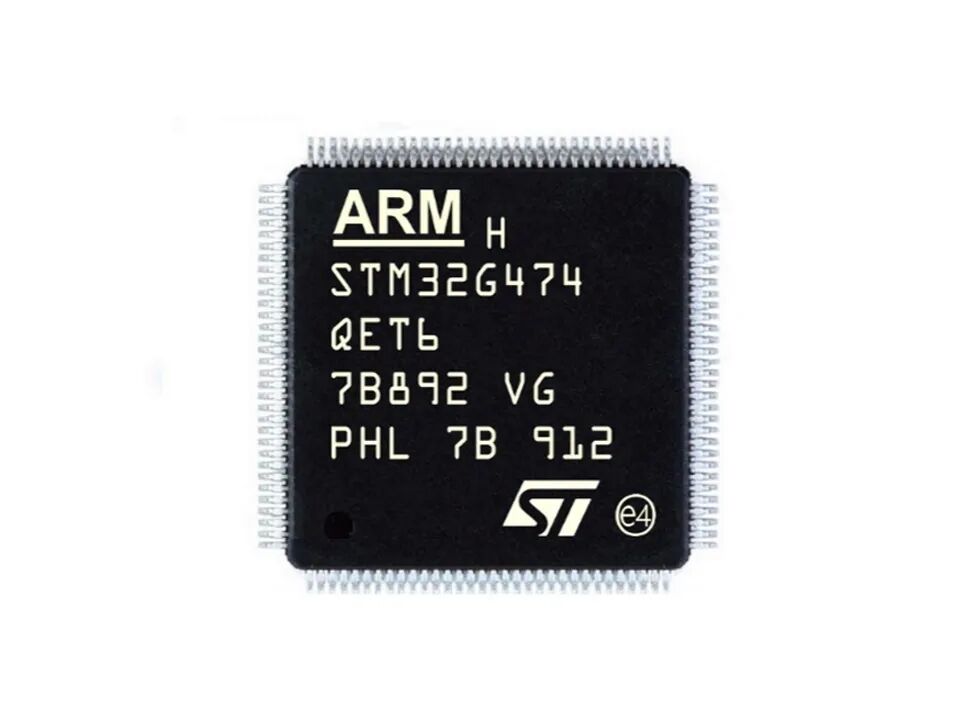
All Features
• Core: Arm® 32-bit Cortex®-M4 CPU with FPU, Adaptive Real-Time Accelerator (ART Accelerator) for zero-wait execution from Flash memory, achieving 213 DMIPS performance at 170MHz, MPU, supports DSP instructions
• Operating Conditions
– VDD, VDDA voltage range: 1.71V to 3.6V
• Mathematical Hardware Accelerator
– CORDIC for trigonometric function acceleration
– FMAC: Filtering algorithm accelerator
• Memory
– 512KB Flash memory, supports ECC, 2 memory areas with simultaneous read/write capability, proprietary code read protection (PCROP), secure storage area, and 1KB OTP
– 96KB SRAM, with the first 32KB implementing hardware parity
– Execution accelerator: 32KB SRAM on instruction and data buses, supports hardware parity (CCM SRAM)
– External memory interface for supporting SRAM, PSRAM, NOR, and NAND memory static memory FSMC
– Quad-SPI memory interface
• Reset and Power Management
– Power-on/Power-down Reset (POR/PDR/BOR)
– Programmable Voltage Detector (PVD)
– Low-power modes: Sleep, Stop, Standby, and Shutdown
– VBAT mode power supply for RTC and backup registers
• Clock Management
– 4MHz to 48MHz crystal oscillator
– 32kHz oscillator with calibration function
– Internal 16MHz RC oscillator with PLL option (±1%)
– Internal 32kHz RC oscillator (±5%)
• High-speed I/O ports up to 107
– All ports can be mapped to external interrupt vectors
– Multiple I/O tolerant to 5V voltage
• Interconnect Matrix
• 16-channel DMA controller
• 5 fast 12-bit ADCs, with up to 42 channels and hardware oversampling resolution up to 16 bits, conversion range from 0 to 3.6V
• 7 12-bit DAC channels
– 3 buffered external channels at 1MSPS
– 4 unbuffered internal channels at 15 MSPS
• 7 ultra-fast rail-to-rail analog comparators
• 6 operational amplifiers available in PGA mode, all terminals accessible
• Internal voltage reference buffer (VREFBUF), supporting three output voltages (2.048V, 2.5V, and 2.9V)
• 17 timers
– HRTIM (High-Resolution and Complex Waveform Generator): 6 16-bit counters, 184 ps resolution, 12 PWM
– 2 32-bit timers and 2 16-bit timers, allowing for up to 4 IC/OC/PWM or pulse counter and quadrature (incremental) encoder inputs
– 3 16-bit 8-channel advanced motor control timers, with up to 8 PWM channels, dead-time generation, and emergency stop functions
– 1 16-bit timer with 2 IC/OC, 1 OCN/PWM, with dead-time generation and emergency stop functions
– 2 16-bit timers with IC/OC/OCN/PWM, with dead-time generation and emergency stop functions
– 2 watchdog timers (independent watchdog and window watchdog)
– 1 SysTick timer: 24-bit decrementing counter
– 2 16-bit basic timers
– 1 low-power timer
• Calendar RTC, supporting alarm and wake-up from stop/standby mode
• Communication Interfaces
– 3 FDCAN controllers, supporting flexible data rates
– 4 I2C enhanced fast mode (1Mbit/s), supporting 20 mA sink current, SMBus/PMBus, and wake-up from stop mode
– 5 USART/UART (ISO 7816 interface, LIN, IrDA, modem control)
– 1 LPUART
– 4 SPI, supporting 4 to 16-bit programmable frame, with 2 multiplexed with half-duplex I2S interfaces
– 1 SAI (Serial Audio Interface)
– USB 2.0 full-speed interface supporting LPM and BCD
– IRTIM (Infrared Interface)
– USB Type-C®/USB Power Delivery Controller (UCPD)
• True Random Number Generator (RNG)
• CRC calculation unit, 96-bit unique ID
• Development Support: Serial Wire Debug (SWD), JTAG, Embedded Trace Macrocell™
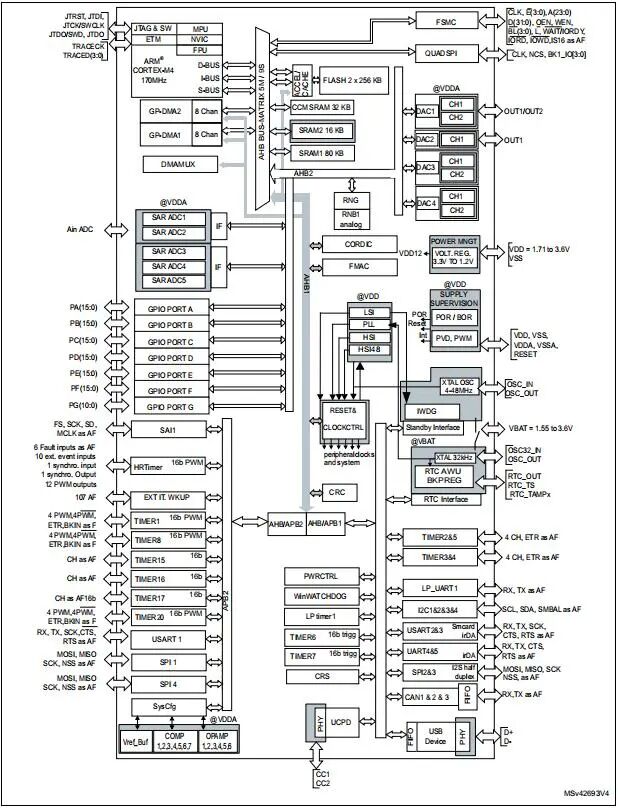
Internal Block Diagram
With a strong technical foundation, ACROVIEW Technology’s self-developed AP8000 universal programmer is regarded as a benchmark-level programming solution in the industry. This device supports flexible one-to-one and one-to-eight configurations, while providing both online and offline operating modes. It has also developed dedicated programming solutions for eMMC and UFS storage chips, fully meeting the bare chip offline programming and on-board programming needs for the entire series of STMicroelectronics chips. The AP8000 consists of three core modules: host, baseboard, and adapter, and this modular design grants it excellent compatibility and expandability. As a universal programming platform, the AP8000 not only adapts to various programmable chips on the market but also, due to its stable and efficient performance, has become the core component of the ACROVIEW automated IPS5800S programming system, efficiently handling large-scale chip programming tasks to meet mass production needs.The AP8000 host features flexible connectivity options, equipped with USB and NET interfaces, allowing for easy networking of multiple programmers. Through the networking function, users can easily achieve synchronized control of multiple programmers, efficiently conducting parallel programming operations. In terms of safety, the host is equipped with an intelligent safety protection circuit that can monitor the chip placement status and circuit connection in real-time. If it detects abnormal conditions such as chip reverse insertion or short circuits, it will immediately trigger a power-off protection mechanism, fully safeguarding the safe operation of the chip and programmer. The host is internally equipped with a high-speed FPGA chip, significantly enhancing data transmission and processing efficiency, ensuring a smooth and efficient programming process. To enhance user convenience, the back of the host is equipped with an SD card slot, allowing users to store project files generated on the PC to the SD card and insert it into the slot. They can then complete file selection and loading for programming operations through the physical buttons on the programmer, achieving independent operation without a PC. This design not only reduces dependence on computer hardware configurations but also simplifies the setup process of the working environment, significantly enhancing operational flexibility.In terms of expandability and compatibility, the AP8000 adopts a modular design of baseboard and adapter board, effectively extending the functional boundaries of the host. Currently, this device has achieved support for products from all major semiconductor manufacturers, covering well-known brands such as ESPRESSIF, ALLWINNER, ALLEGRO, TI, RENESAS. It supports a wide range of device types, including NAND, NOR, MCU, CPLD, FPGA, EMMC, etc., and is fully compatible with various industry-standard file formats such as Intel Hex, Motorola S, Binary, POF, providing users with a one-stop, all-scenario chip programming solution.
Company Introduction
About STMicroelectronics: STMicroelectronics (ST) was established in 1987, formed by the merger of Italy’s SGS Microelectronics and France’s Thomson Semiconductors. In May 1998, it was renamed STMicroelectronics Ltd. STMicroelectronics is one of the largest semiconductor companies in the world and a leading provider of semiconductor solutions, offering innovative solutions for electronic device manufacturers across various application fields. With a wealth of technology, design capabilities, and intellectual property portfolio, strategic partnerships, and manufacturing strength, STMicroelectronics aims to be the undisputed industry leader in multimedia convergence and power applications.
About ACROVIEW Technology: ACROVIEW Technology is a national-level specialized and innovative “little giant” enterprise engaged in the research, production, and sales of semiconductor chip testing and programming equipment. The company is committed to empowering the entire industry chain customers, including Fabless, IDM, OSAT, wafer fabs, and end-device companies, through innovative semiconductor testing technologies and solutions. ACROVIEW’s pioneering fully automated aging testing ABI (Auto Burn-In) system greatly enhances the aging testing efficiency of customer chips and reduces the Per DUT testing cost. Additionally, it provides customers with equipment products and solutions for various stages from PSV, CP, FT, BI, SLT, to programming. We perfectly integrate the leading advantages of product technology, system-level expertise, and a globally laid-out R&D and sales service network to create value for customers to gain a competitive edge in the market.
Scan to follow us

ACROVIEW Technology Service Account

ACROVIEW Technology Subscription Account