Samsung Exynos 1080 Performance Compared to Kirin 9000
Click the above Computer Enthusiasts to follow us
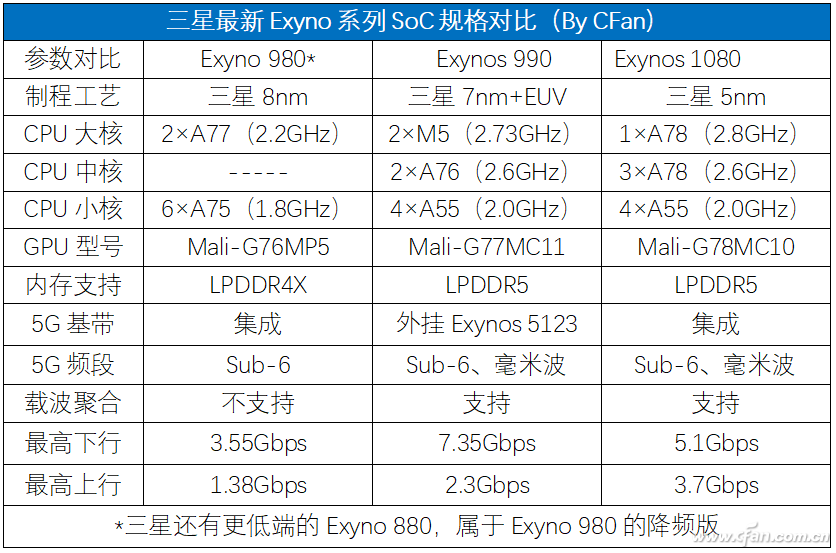
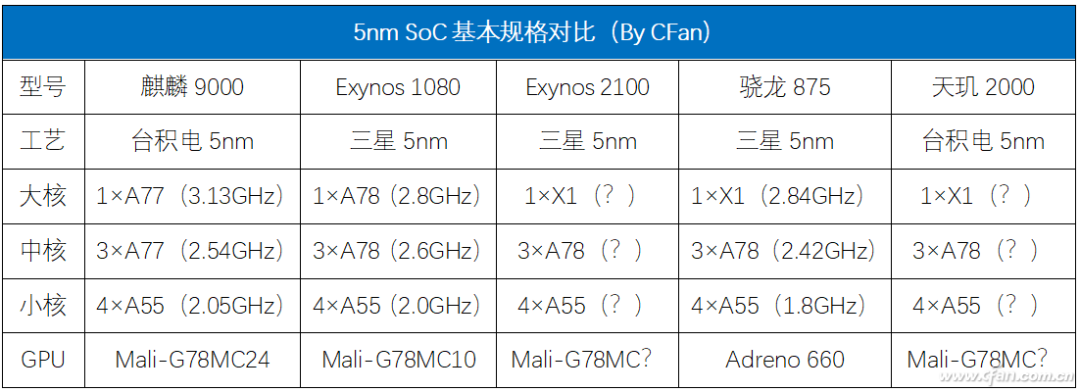
Yesterday, Samsung officially launched its first 5nm SoC, the Exynos 1080. Compared to the already mass-produced 5nm Kirin 9000, the Exynos 1080 is the world’s first smartphone chip designed using ARM’s latest Cortex-A78 architecture. This chip is customized in collaboration with vivo and is expected to debut in the vivo X60 series.Compared to the Exynos 980 (8nm) launched by Samsung last year, the Exynos 1080 benefits from the latest 5nm process, offering a 14% performance boost and a 30% reduction in power consumption, with a smaller packaging size. Even compared to the mature 7nm EUV process, it shows a 7% performance increase and an 18% decrease in power consumption.In other words, if a SoC in 2021 does not utilize 5nm technology, it cannot be considered high-end.The biggest feature of the Exynos 1080 is that it is the first to commercially use ARM’s latest Cortex-A78 public architecture, adopting a 1+3+4 tri-cluster configuration, with the big core clocked at 2.8GHz, and the mid-core and small core at 2.6GHz and 2.0GHz, respectively. According to Samsung, the Exynos 1080’s single-core performance has improved by 50%, while multi-core performance has roughly doubled.It is important to note that earlier leaks showed the Exynos 1080 achieving a score of 3.0GHz in AnTuTu benchmarks, but the official version’s maximum clock frequency is limited to 2.8GHz, possibly due to power consumption considerations.Earlier leaked AnTuTu benchmark scoresIn theory, the performance of a 2.8GHz Cortex-A78 big core should not be inferior to a 3.13GHz Cortex-A77 (Kirin 9000), but the former certainly has the advantage of relatively lower power consumption.The Exynos 1080’s GPU has jumped two generations, directly upgrading from the Mali-G76MP5 in the Exynos 980 to the Mali-G78MC10, and the computing cores have doubled from MP5 to MC10, theoretically offering better 3D performance. It is worth noting that Samsung’s flagship Exynos 990 only integrates an 11-core Mali-G77MC11, so the 10-core Mali-G78 is definitely stronger than the 11-core Mali-G77, right?However, the Kirin 9000, also using the Mali-G78 GPU, integrates up to 24 computing units, while the Kirin 9000E has 20. It remains to be seen whether the Exynos 1080 can compensate for the lower number of computing cores by achieving higher core frequencies, thereby narrowing the gap with the Kirin 9000.As an SoC, the Exynos 1080 also integrates a new generation of DSP, ISP, and NPU (with computing power up to 5.7TOPS), as well as a baseband that supports 5G NR Sub-6 and millimeter wave (mmWave), supporting download speeds of up to 5.1Gbps, and also supporting Wi-Fi 6 and Bluetooth 5.2 functionalities.It is important to note that, similar to the Snapdragon 865, which integrates the Snapdragon X55 that natively supports mmWave, smartphones sold in China almost all do not support this frequency band. This is because mmWave requires the installation of more complex antenna arrays in smartphones, and until domestic operators officially deploy mmWave base stations, smartphone manufacturers lack the motivation to improve antenna array capabilities.Therefore, while the Exynos 1080 supports mmWave, it does not mean that smartphones equipped with this chip will also support mmWave.To keep up with the times, the Exynos 1080 has also enhanced the synergy between NPU, DSP, and ISP, such as the NPU + DSP AI solution, which can accurately and quickly identify objects or detect scenes in applications like immersive VR/XR, smart voice assistant recognition, and AI-enhanced photography.The NPU + ISP AI solution can intelligently adjust parameters to optimal values through machine learning in the raw RAW domain, allowing the ISP to better adjust white balance, exposure, chroma, saturation, clarity, and more.The Exynos 1080 supports cameras up to 200 million pixels and can activate up to six cameras simultaneously for 1080P HD video recording. Its ISP can receive up to three input signals simultaneously, providing support for full three-camera operation, leading to a more intelligent photography experience, and it can also support shooting 10-bit color space videos.In summary, based on 2020 standards, the Exynos 1080 is undoubtedly a flagship-level SoC, equipped with high-frequency Cortex-A78 and Mali-G78MC10, making the previous flagship Exynos 990 envious.However, looking further ahead, in 2021 we will see more 5nm SoCs incorporating the Cortex-X1 super core, such as Samsung’s own Exynos 2100, Qualcomm Snapdragon 875, and MediaTek Dimensity 2000 series. As for which is stronger among them? We’ll have to wait for time to reveal that.After reading this article, you might also click:
Click “Read the original text” for more exciting content