Process optimization, predictive maintenance, manufacturing services, adaptive systems, resource savings, smart factories, and cost reduction—there are limitless benefits to adopting control network data at higher-level systems. The Internet of Things (IoT), Industry 4.0, and China Manufacturing 2025 all mention that seamless, continuous, and standardized communication is universally required across various levels. Sensor data is uploaded to the cloud, while recipes and parameters are downloaded from ERP systems to distributed devices, akin to a feeding system shared by two machines: there is a data flow requirement in both vertical and horizontal directions.
EtherCAT fundamentally meets the needs of digital transmission through its high performance, flexibility, and open interfaces. Exceptional system performance provides the prerequisites for realizing big data functionalities in control networks.
EtherCAT offers flexibility for connecting existing systems to the cloud without needing to touch controllers or update slave devices: boundary gateways can access any data in any EtherCAT slave device through the mailbox gateway function of the EtherCAT master. Boundary gateways can be remote devices communicating with the master via TCP or UDP/IP, or they can be software entities on the hardware of the EtherCAT master.
Moreover, the open interfaces allow for the integration of any IT-based protocol—including OPC UA, MQTT, AMQP, or any other protocol that directly interfaces with the slave devices—thereby providing a direct link for IoT, ensuring that there are no protocol interruptions between sensors and the cloud.
These features have always been part of the EtherCAT protocol, demonstrating the foresight of the EtherCAT protocol architecture. As technology evolves, EtherCAT has also added more networking features. Of course, looking to the future while reflecting on the past, we can clearly see the developmental philosophy of this technology: since the EtherCAT protocol was introduced in 2003, this stable technology has had only one version. As networks continue to evolve, new features introduced into the EtherCAT protocol will ensure consistency and continuity with previous versions of the EtherCAT protocol.
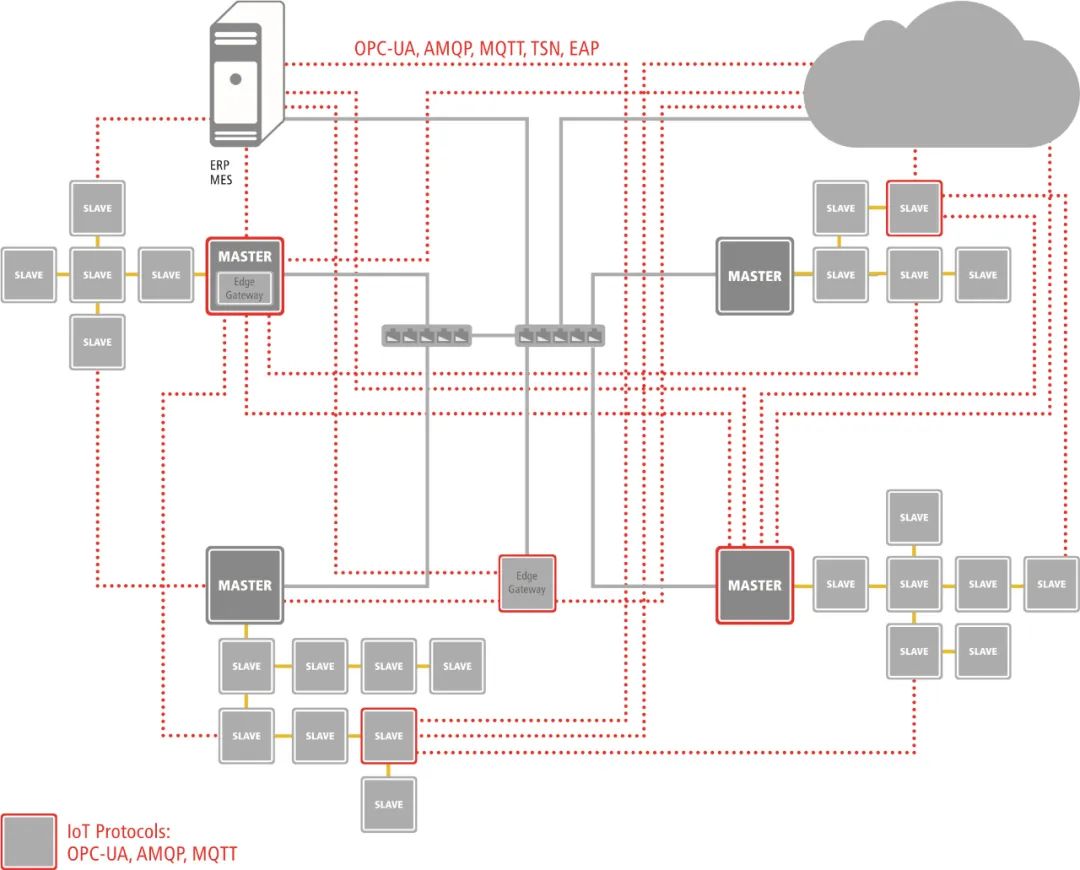
Recent developments in Time-Sensitive Networking (TSN) will further enhance the real-time communication between controllers. Through TSN, control systems (even cloud-based control systems) can access slaves within the EtherCAT network across the factory network. Since EtherCAT typically requires only one frame to scan the entire network, this access is more streamlined and efficient than any other fieldbus or industrial Ethernet technology. In fact, experts from the EtherCAT Technology Group have contributed to the IEEE802.1 TSN working group since the very first day of TSN development (when TSN was still known as AVB).
The EtherCAT Technology Group (ETG) is also one of the earliest fieldbus organizations to collaborate with the OPC Foundation. OPC UA complements the EtherCAT protocol as a scalable TCP/IP-based client/server communication technology with integrated information security features, enabling encrypted data transmission to MES/ERP systems. After adopting the Pub/Sub mechanism, OPC UA improves the availability of machine-to-machine (M2M) applications and vertical communication in cloud services. ETG actively participates in related R&D to ensure its seamless application within the EtherCAT environment.
Therefore, EtherCAT is not just ready for the Internet of Things; EtherCAT is the Internet of Things!
-END-