In recent years, with the continuous expansion of drone applications, various types of drones have gradually entered different fields, becoming important photographic equipment for commercial use and recreation, as well as a new trend in consumer entertainment.
However, the number of illegal aerial photography and surveying activities using drones has been increasing, especially the “black flying” activities that ignore no-fly regulations, posing a series of safety risks.
In order to further regulate the flight of unmanned aerial vehicles and related activities, the State Council and the Central Military Commission have issued the “Interim Regulations on the Flight Management of Unmanned Aerial Vehicles” (hereinafter referred to as the “Regulations”), which will take effect on January 1, 2024. The Regulations clearly stipulate the real-name registration, flight airspace, and flight declaration for unmanned aerial vehicles.
How Are Drones Classified?
According to the “Regulations”, unmanned aerial vehicles are classified into five categories: micro, light, small, medium, and large based on weight, flight altitude, and flight speed.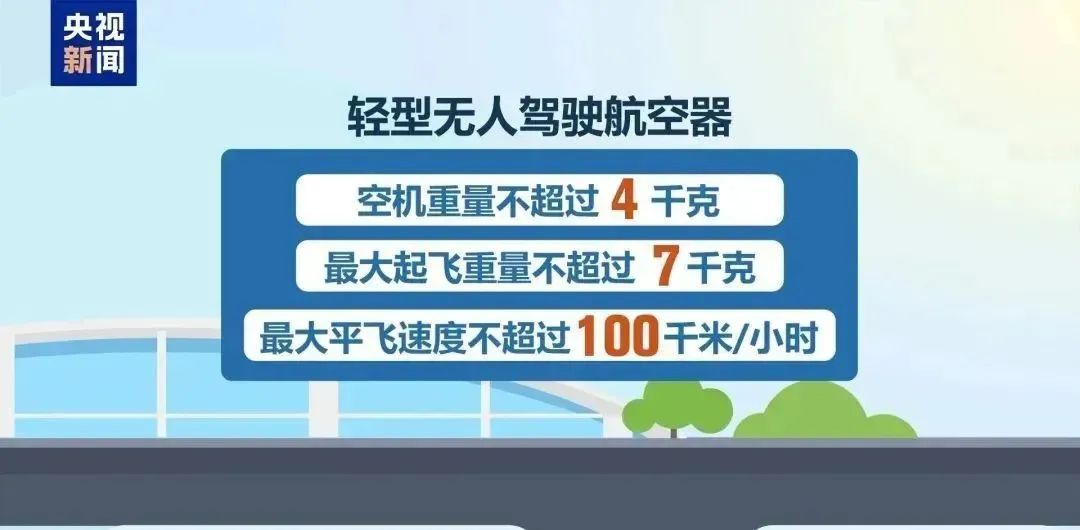
For example, a micro unmanned aerial vehicle has an empty weight of less than 0.25 kilograms, a maximum flight altitude not exceeding 50 meters, and a maximum horizontal flight speed not exceeding 40 kilometers/hour; a light unmanned aerial vehicle has an empty weight not exceeding 4 kilograms and a maximum takeoff weight not exceeding 7 kilograms, with a maximum horizontal flight speed not exceeding 100 kilometers/hour.
 Generally speaking, the drones purchased by households for travel, tourism, and aerial photography are mainly micro and light types.
Do Drone Operators Need a License?
Operators of micro and light civil unmanned aerial vehicles do not need to obtain an operator’s license but should be proficient in the operation methods of the relevant aircraft models, understand risk warning information, and related management systems. Moreover, minors operating unmanned aerial vehicles need to be guided on-site by an adult who is proficient in drone operations.
What Actions Constitute “Black Flying”?
“Black flying” refers to flying without approval from relevant authorities in controlled airspace or flying without real-name registration, among other violations of relevant laws and regulations.
How to Register a Drone?
According to the “Regulations”, owners of civil unmanned aerial vehicles must conduct real-name registration in accordance with the law, regardless of type or importance, and must register their unmanned aerial vehicles before flying. Those who violate these regulations and fly without real-name registration may be ordered to correct their actions by the public security authorities and may be fined up to 200 yuan; for serious violations, fines of 2,000 yuan to 20,000 yuan may apply.
Real-Name Registration Process
① Enter the Comprehensive Management Platform for Civil Unmanned Aerial Vehicles (UOM) https://uom.caac.gov.cn; ② Real-name register the drone. Log in to the homepage — Registration Management — Real-name Registration — Register Brand Drone — Verify Owner Information — Scan Code and Face Verification — Select Manufacturer Name — Select Model and Other Relevant Information (serial number must be entered manually) — Upload Photos as Required — Complete Registration.
Special Reminder: Drone operators must remember to report the registration information to the local police station after registering in the Civil Aviation Administration’s real-name registration system!
Does Drone Flying Require Prior Application?
If flight activities fall under any of the following circumstances, a flight activity application must be submitted: Article 19 of the Regulations states: Airspace above 120 meters, no-fly zones, restricted airspace, and surrounding airspace, military aviation low-altitude flight airspace, airports and surrounding areas, military restricted areas, and important revolutionary memorial sites are designated as controlled airspace. If you need to fly within controlled airspace, you must apply for flight permission from the air traffic control agency of the corresponding flight control district in advance. Controlled airspace includes but is not limited to: power plants, substations, refueling (gas) stations, water supply plants, public transportation hubs, aviation hubs, major water conservancy facilities, ports, highways, electrified railway lines, and surrounding areas of public infrastructure, as well as drinking water source protection zones. In addition, flying during major gatherings also requires prior application. Airspace outside of controlled airspace is suitable for micro and light drones without the need to apply for flight permission. Article 51 of the Regulations states: Those who operate micro, light, or small civil unmanned aerial vehicles in controlled airspace without approval, or operate model aircraft in airspace designated by air traffic management agencies outside the controlled airspace, may be ordered by public security authorities to stop flying and may be fined up to 500 yuan; for serious violations, the unmanned aerial vehicle used for illegal flying may be confiscated, and fines between 1,000 yuan and 10,000 yuan may apply.
Warm Reminder from Jinyun Police:
Citizens are urged to strictly adhere to flight control regulations, register in the unmanned aerial vehicle real-name registration system as per the Civil Aviation Administration’s regulations, report to the local police station, and declare flights as required. Additionally, do not release drones or other “low, slow, small” aircraft in controlled areas and times, and do not fly illegally; those suspected of violating the law will be held legally accountable.

Supervision | Ma Weihua
Editing | Fan Yifei
Editor | Tong Siyu
Proofreading | Ma Shufei
Correspondent | Xu Jie
Recommended Reading
200 Yuan for a “Golden Express” Delivery: Is It Profitable? Is It “Criminal”!
In 10 Seconds! Jinyun Police Officer Xie Binjian Saved Him Using the “Heimlich Maneuver”!