According to recent news from The Paper, Shandong Province has included Python content in its latest sixth-grade information technology textbook. Prior to this, there were rumors in the programming community that Zhejiang Province would modify its secondary school information technology textbooks, replacing VB (Visual Basic 6.0) with Python.
Will things develop as programmers hope? Why has the Python language suddenly received such attention?
What did VB do wrong to be abandoned?
In fact, VB is not at fault; it is just that the users have changed.
Both languages emerged in 1991, yet their current standings are drastically different: according to the latest TIOBE programming language rankings, Python firmly holds the 4th position, while VB has dropped to 20th place, with a significant downward trend.
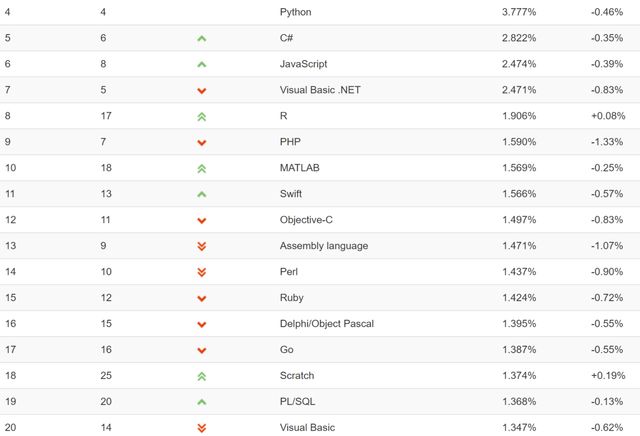
From 2016 to 2017, Python maintained its 4th place, while VB fell from 14th to 20th. Image source: tiobe.com
There are many reasons for VB’s decline. The main reason is Microsoft’s withdrawal. In April 2008, Microsoft announced it would stop supporting VB, shifting focus to C# and VB.net, leading to a lack of community support. In the domestic education market, competitions like NOIP removed BASIC from the list of usable languages in 2005, and people’s stereotypical impression of VB remains stuck on basic applications like drawing geometric shapes and writing multiplication tables, making it rare for job seekers to list it as a programming language on their resumes. The demand for a more vibrant programming language is urgent.
VB is dead; Python should rise.
C/C++, Java, and Python have long been eyeing the opportunity, but why has Python received special attention?
Although C has a simple and clear syntax, managing memory can be quite troublesome; Java’s syntax is overly complicated, causing beginners to focus too much on syntax rather than grasping the key points of computer science. Python is the best introductory programming language among the three. As a beginner, you may not appreciate the power of C and Java, but you can certainly appreciate Python’s simplicity.
This language is very easy to learn, with a style close to natural language, allowing one to quickly become proficient with a little familiarity. Reading Python code is like reading an English article, making it easier to understand the logical structure without overly focusing on the language itself. This has attracted many professionals from other fields to use Python for specialized projects; you might easily encounter doctors who know Python, accountants who use Python, or even winemakers analyzing grape varieties with Python.
The Python developer community has also thrived due to the introduction of diverse elements; whether you are a novice coder or an experienced developer, you can find the answers you need in ample documentation and tutorials. Many star internet companies, such as YouTube, Dropbox, Quora, Instagram, and Reddit, have their core businesses based on Python development.
Who are the “behind-the-scenes supporters” of Python?
After VB dominated secondary school information technology textbooks for so many years, educational reform must keep pace with the times. Of course, several major events are the “behind-the-scenes supporters” of this change.
1. The push from the U.S. government. In the last year of his presidency, Obama proposed a significant investment in basic education, totaling $4 billion, to ensure that every K-12 student has access to computer education.
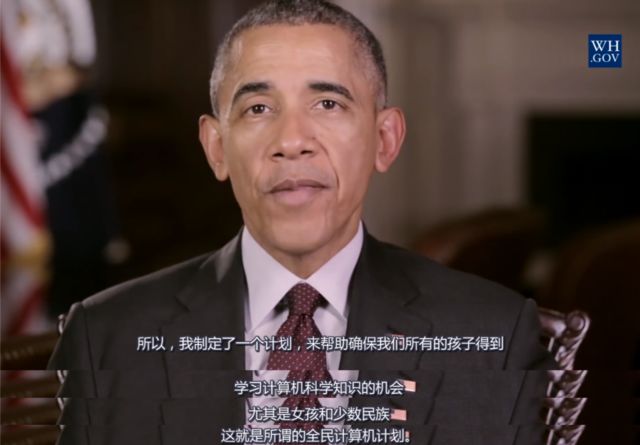
Obama announced “CS For All” during his weekly television address on January 30, 2016. Image source: video screenshot
His successor, Trump, has a clearer plan, expecting to invest $200 million annually in the Department of Education to increase the emphasis on computer education in K-12 schools, while requiring the department to submit annual reports on effectiveness. Regardless of support or opposition to Trump, people are pleased to see the government’s emphasis on education.
2. The emphasis from universities. At top universities in the U.S., Python has become the most popular language for teaching introductory computer science courses.
Among the top 10 CS departments, 8 use Python as the primary teaching language; MIT and UC Berkeley’s computer science departments have even changed their introductory course programming language to Python.
3. Support from MOOCs. The three largest MOOC (Massive Open Online Courses) platforms, Coursera, edX, and Udacity, all offer introductory courses in Python.
Is Python suitable for teenagers?
For most people, programming is considered an “adult’s business.” Is Python really suitable for teenagers to learn from a young age?
In a sense, this may be Python’s advantage. In fact, many talented young individuals have achieved remarkable results using Python. As early as 2013, a 13-year-old Python developer, Julian Meyer, published an article online teaching his peers how to create simple games with Python.
In this tutorial, he guided readers through a tower defense game he designed called “Rabbits and Badgers.” From installing Python to adding the rabbit’s image and actions, designing interactions with the antagonist badger, and finally adding sound effects and background music, a beginner-level program was thus formed.
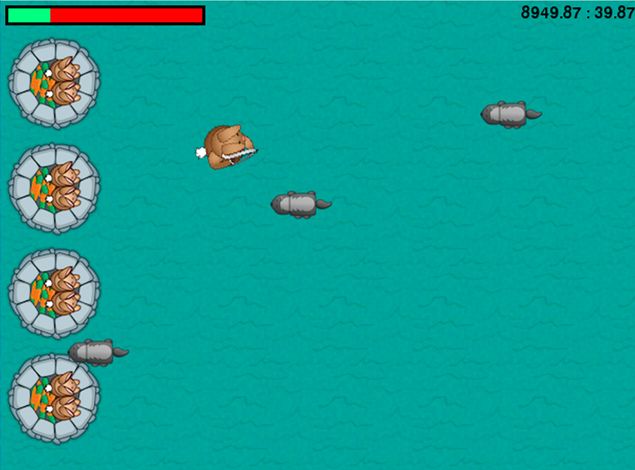
Screenshot of the tower defense game “Rabbits and Badgers” made by Meyer. Image source: winduino.co.kr
Another Python developer, 17-year-old Kevin Frans, has achieved even more astonishing results: he published a paper titled “Meta Learning Shared Hierarchies” as the first author, submitted to the top machine learning conference ICLR 2018.
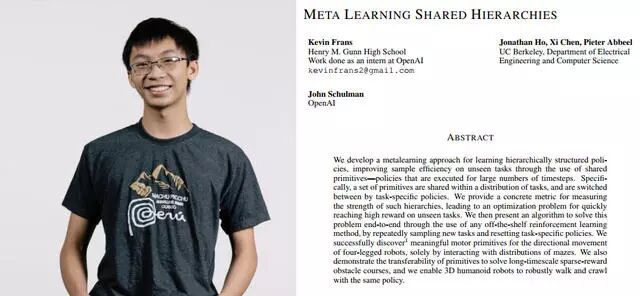
Frans with his published paper. Image source: twitter
By the age of 15, Frans was already training neural networks using Python. Influenced by reports on AI playing Atari games and AlphaGo, he read numerous papers and replicated some functionalities. After absorbing a wealth of knowledge, he created an interactive webpage that could automatically color sketches in a comic style.
The process of discovering Frans’s talent is also quite interesting. Once, while trying to solve an open problem from OpenAI, he made significant progress and wrote to OpenAI researcher John Schulman for advice. After several discussions about algorithms, Schulman checked Frans’s personal blog and was surprised to learn he was a high school student. Later, Frans applied for an internship at OpenAI, and the interviewer was Schulman, who praised the paper submitted by Frans: “He provided a new perspective on this problem, and some results have already surpassed previous work.”
Conclusion
Whether it is Python, JAVA, C, or any other programming language, the most important factor is the teaching method.
If programming is merely added to the college entrance examination or included in compulsory education, but the teaching model remains the old VB style, where teachers follow the textbook and lecture, or engage in rote learning around exam points, allowing students to randomly explore in the computer lab, the results will certainly be unsatisfactory.
Learning under the guidance of interest leads to better results, and Frans is a great example. As a beginner, if you learn with purpose and need, progress will be rapid. Computer programming is inherently a hands-on practice project; the more you practice, the faster and better you learn. Regardless of whether Python becomes a college entrance examination subject, this language can bring endless joy to learners.
Feel free to share this in your circle of friends.
This article is from Guokr.
For reprints, please contact for authorization: [email protected]
For submissions, please contact [email protected]

Guokr
Science People
From Papers to Popular Science, Only One Step

Starting from a young age may alleviate future pressures.
【Further Reading】 Is it useful to let children learn programming early?