As excitement and anxiety intertwine in the global tech community over the arrival of “super intelligence,” and as the smoke of China’s “Hundred Models War” gradually dissipates, Dr. Dai Weimin, founder, chairman, and president of Chipone Technology, calmly and foresightedly points out another path to the future for the industry: edge AI.
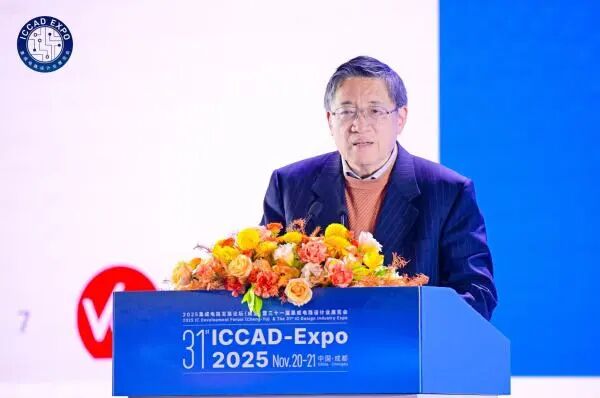
Dr. Dai Weimin, founder, chairman, and president of Chipone Technology
Recently at the ICCAD Expo 2025 held in Chengdu, Dai Weimin deeply analyzed the current state and future of AI development, systematically elaborating on Chipone’s differentiated strategy surrounding AI, Chiplet, and RISC-V, while sharing its unique “going global” philosophy amidst the tide of de-globalization. He pointed out that the truly profitable AI is likely hidden in seemingly unremarkable smart glasses, children’s toys, and affordable cars.
Beyond Transformer: The Next Stop for AI is “Traveling Thousands of Miles” and “Meeting Countless People”
Dai Weimin first offered a calm reflection on the current blind pursuit of large models. He quoted the ancient saying, “Reading thousands of books is not as good as traveling thousands of miles; traveling thousands of miles is not as good as meeting countless people,” cleverly metaphorizing the limitations of current AI models.
“Do not always blindly trust Transformer; it has its limitations,” Dai Weimin pointed out. The Transformer essentially represents “reading thousands of books,” processing knowledge that has already been documented by humans. True intelligence needs to venture into the real world—”traveling thousands of miles,” which emphasizes the physical intelligence and spatial intelligence highlighted by Fei-Fei Li. This requires AI to handle real-time, multi-modal physical world data from devices like smart glasses and autonomous vehicles.
Further, “meeting countless people” refers to understanding the complex emotions and scene interactions of humans, which remains a shortcoming of current AI. Based on this, Dai Weimin believes that the arrival of “super intelligence” still requires time, and the industry need not panic excessively. He reminds practitioners that the essence of current competition is “competing with those who master AI,” and future engineers will polarize: those who can only write code and those who can effectively use AI tools to write code.
Edge Inference and Fine-tuning Will Become Important Markets
Based on profound insights into technological pathways, Dai Weimin predicts that although current AI investments are concentrated in the cloud, in the future, “inference cards and fine-tuning cards on the edge will far exceed training cards in the cloud.” In other words, while cloud-side AI will continue to grow, the growth rate of edge AI will surpass that of cloud-side AI.
“Ultimately, profits will be made on the edge,” Dai Weimin stated. This judgment is based on the inevitable trend of AI technology moving from “model training” to “scene implementation.” The cloud acts like a trunk, responsible for basic training; however, what truly allows AI to flourish and generate value are the countless vertical domain fine-tuning and inference processes occurring on terminal devices, which will bring significant incremental markets in the future. Additionally, due to the concentration of suppliers on the cloud side, while edge applications are more diverse, most players will find profit opportunities on the edge.
He listed several explosive points for edge AI:
Smart Glasses. Dai Weimin proposed three key indicators for market ignition—”30 grams in weight, 8 hours of battery life without charging, and under 2000 RMB.” He believes that the core competitiveness of glasses is ranked as AI first, photography second, and display third. The key lies in embedding small models that allow the glasses to directly output video and audio “tokens” (semantic symbols) instead of raw data streams, thereby significantly reducing transmission power consumption.
AI Toys. He envisioned a scenario for children’s toys that can spontaneously create stories based on a parent’s single sentence, operating offline. “It makes no sense for a child to need a hotspot and a phone to use a toy.” This specific scene application of offline running small models holds enormous commercial potential.
Smart Cars. While luxury cars pursue computing power above 500 TOPS, Dai Weimin sees the demand for “fair autonomous driving.” “The government says it wants fairness and equality; even cars costing 100,000 or 70,000 RMB should have autonomous driving capabilities.” This requires Chiplet technology to provide different levels of computing power in a more flexible and cost-effective manner.
Technological Foundations: Chiplet, RISC-V, and Open Ecosystem
To support its AI strategy, Chipone has made deep layouts in underlying technologies.
1. Chiplet: Achieving the Art of Balancing Performance and Cost
Chiplet modularizes chips with different functions and processes, integrating them at the packaging level, allowing for rapid assembly of solutions that meet various performance and cost requirements, akin to building blocks. This is the technological pathway that enables both luxury and economical vehicles to be equipped with autonomous driving capabilities. Dai Weimin also admitted, “Chiplet is primarily aimed at high-performance chips; Chipone’s Chiplet platform is more targeted at cloud-side AI and smart driving. For smaller, relatively low-power chips, using Chiplet may not be cost-effective, as it could lead to larger overall area and increased costs, which may not be compact enough (as edge devices have extreme requirements for cost and space).”
2. RISC-V and Open-source NPU: Building an Open Foundation for Edge AI
In terms of processor architecture, Chipone demonstrates a high degree of openness and flexibility. Dai Weimin revealed that although Chipone has invested in RISC-V CPUs, it will still comprehensively evaluate and select the most suitable IP for actual projects, including those from Alibaba’s Damo Academy.
He particularly emphasized the collaboration with Google on the open-source Coral NPU. In terms of division of labor, Google opens many technologies and tools, while Chipone provides commercial-grade IP and one-stop customization services, promoting the widespread commercialization of this technology and its implementation in numerous edge AI applications.
In response to a reporter’s question about IP localization and open-source strategies, Dai Weimin precisely distinguished between the concepts of “open-source” and “open.” “It should be accurately stated that it is an open hardware platform to build an open-source software ecosystem.” He pointed out that RISC-V refers to the openness of the instruction set architecture, rather than simply open-sourcing processor core designs. This rigorous distinction reflects Chipone’s pragmatic attitude of embracing openness while respecting commercial laws in building ecosystems.
Scan to reply“AI” to join the industry community
Globalization Amidst De-globalization: Chipone’s “Going Global” Philosophy
In the current environment filled with geopolitical challenges, Chipone’s globalization strategy stands out. When asked about its globalization plans, Dai Weimin clearly stated, “If we don’t go global, we will be eliminated.”
He introduced that Chipone has consistently derived 30% to 40% of its sales revenue from overseas. He summarized the company’s strategy as “globalization amidst de-globalization”—that is, adhering to global market and resource allocation while complying with all laws and regulations.
Talent and Culture: The Soft Power of a Best Employer
Finally, Dai Weimin shared Chipone’s “hardcore” data on talent development and its “soft” core. In the context of industry recruitment contraction, Chipone has maintained a strategy of selecting top talent: in 2024, it will select 200 from 10,000 written test candidates, and in 2025, 100 from 8,000 candidates, with 97% of the selected candidates being master’s degree holders from 985/211 universities, placing great importance on their first degree.
Remarkably, while the industry average voluntary turnover rate is as high as 16.5%, Chipone has kept it at 2.8%, and has been recognized as a “Best Employer” for five consecutive years. This is attributed to the company’s culture of “fairness, care, sharing, and happiness.” Dai Weimin emphasized, “The soft power of corporate culture is very important,” and it is this soft power that enables these top talents to stay and unleash incredible creativity—having applied for over 70 patents in just a few years.
In Conclusion
As the AI industry faces warnings of potentially falling into a “smart computing center abandonment” due to blind pursuit of grand narratives, Dr. Dai Weimin and Chipone Technology have chosen a seemingly low-key yet solid path. They do not overly indulge in the arms race of computing power “in the cloud,” but instead focus on the more universal and commercially valuable “edge”; they use Chiplet and an open hardware ecosystem as their oars, with a rigorous talent strategy and corporate culture as their boat, navigating steadily through the storms of de-globalization.
This path may very well be the wise choice for the sustainable development of China’s semiconductor and AI industries, truly rooting themselves in the global market after the clamor.
END
Note: The cover image of this article is sourced from Freepik, self-made by the author, and publicly available media, all authorized.
Industry Community


Tap “Looking“↘ to share your world with friends

Please click “Read Original” for more information