The association between memory and data types is the core logic of the underlying design of the C language, and their relationship can be summarized as: Memory provides physical storage space, while data types are the logical abstraction and access rules for that storage space. The following analysis will unfold from three dimensions: memory characteristics, the essence of data types, and the implementation of the C language.
🧠1. Memory: The Physical Foundation of Data Storage
The essence of memory (RAM) is a continuous sequence of binary bits (bits), with each storage unit having a unique address. Its characteristics include:
1. Typelessness: Memory only stores 0/1 sequences, without distinguishing data types (such as integers or characters).
2. Addressing: Accessing specific storage units via addresses (e.g., 0x1000 points to a specific byte).
3. Space Limitation: The size of storage units is fixed (usually measured in bytes).
For example: A 32 bit system’s memory can be viewed as a linear byte array from 0x00000000 to 0xFFFFFFFF.
🔢2. Data Types: The Logical Abstraction of Memory
Data types are the compiler’s structured interpretation rules for memory, addressing two core issues:
1. Space Allocation: Determines the memory size occupied by a variable (e.g., int occupies 4 bytes).
2. Operation Semantics: Defines how data is interpreted (e.g., float is decoded according to IEEE 754 for binary bits).
⚙️ The Mapping Relationship Between C Language Data Types and Memory
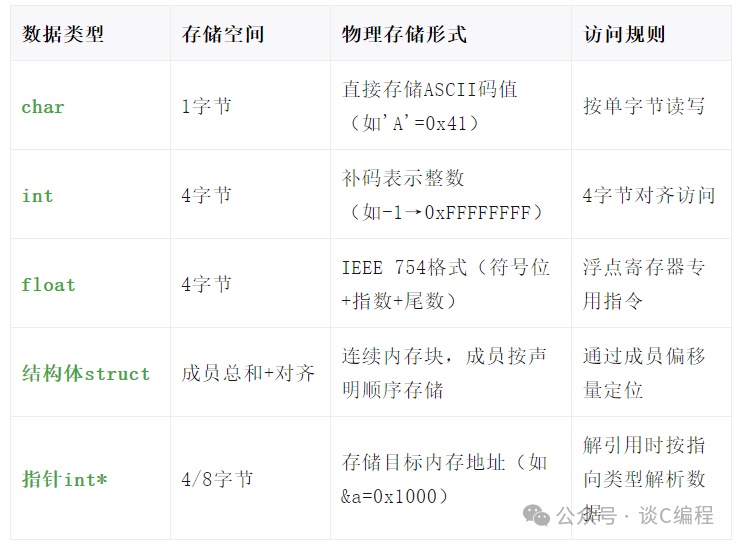
Note: The size of space is influenced by the compiler and platform (e.g., in a 64 bit system, long may be 8 bytes).
🔧3. How C Language Establishes the Connection Between the Two
1.Variable Declaration: Binding Type to Storage Space
· When declaring int a;:
o The compiler allocates 4 bytes of continuous memory (assuming addresses 0x1000-0x1003).
o The symbol a is associated with that address range.
o Subsequent operations are agreed to interpret the data in this range according to integer rules.
2.Pointers: Tools for Direct Memory Manipulation
· Pointers store addresses and determine access methods through types: int b = 10; // Integer variable (address 0x2000). int* p = & b; // p stores address 0x2000.
* p = 20;; // Modifies the 4 bytes starting from 0x2000 according to int decoding.
·Type Casting forcibly changes interpretation rules:
float* fp = ( float*) p;
* fp = 3.14; // Writes to the same address in floating-point format, overwriting the original integer value.
3.Structures: Custom Storage Layouts
· Structures define the internal division of memory blocks:
struct Point {
int x; // Offset 0, occupies 4 bytes.
char y; // Offset 4, occupies 1 byte.
}; // Total size may be 8 bytes (memory alignment padding).
· Member access translates to address calculation: p.y → base address +4 byte offset.
4.Dynamic Memory: Runtime Storage Allocation
· malloc requests space based on type size:
int* arr = ( int*) malloc( 10* sizeof( int));// Allocates 40 bytes of space.
· Memory blocks have no preset type information and rely entirely on the programmer to operate according to the agreed type.
⚠️4. Key Issues and Pitfalls
1. Type Punning: Interpreting the same memory as different types (e.g., int and float sharing addresses) leads to undefined behavior, requiring explicit declaration using union.
2. Memory Alignment Optimization: Compilers insert padding bytes to improve access efficiency (e.g., struct { char c; int i; } occupies 8 bytes instead of 5 bytes).
3. Endianness: The storage order of multi-byte types affects binary compatibility:
· Big-endian: High-order bytes at low addresses (network transmission standard).
· Little-endian: Low-order bytes at low addresses ( common in x86).
💎Summary: The Collaborative Logic of Memory and Data Types
Physical Layer: Memory provides a “blank canvas” ( bit sequence + address) →Logical Layer: Data types define “painting rules” (space division + decoding methods) →Language Layer: The C compiler generates “drawing instructions” (machine code operating on specific addresses).
Understanding this relationship is the cornerstone of mastering pointers, memory management, and cross-platform development. Recommended practices include:
1. Using sizeof and & to print variable addresses and sizes;
2. Using GDB to view binary content in memory;
3. Writing a structure alignment test program to verify padding rules.
Discussing C Programming: Edge Detection Appreciation