
When AI Meets the ‘Air Vacuum Cleaner’: Why DAC Technology Has Become the New Favorite of Tech and Petrochemical Giants?
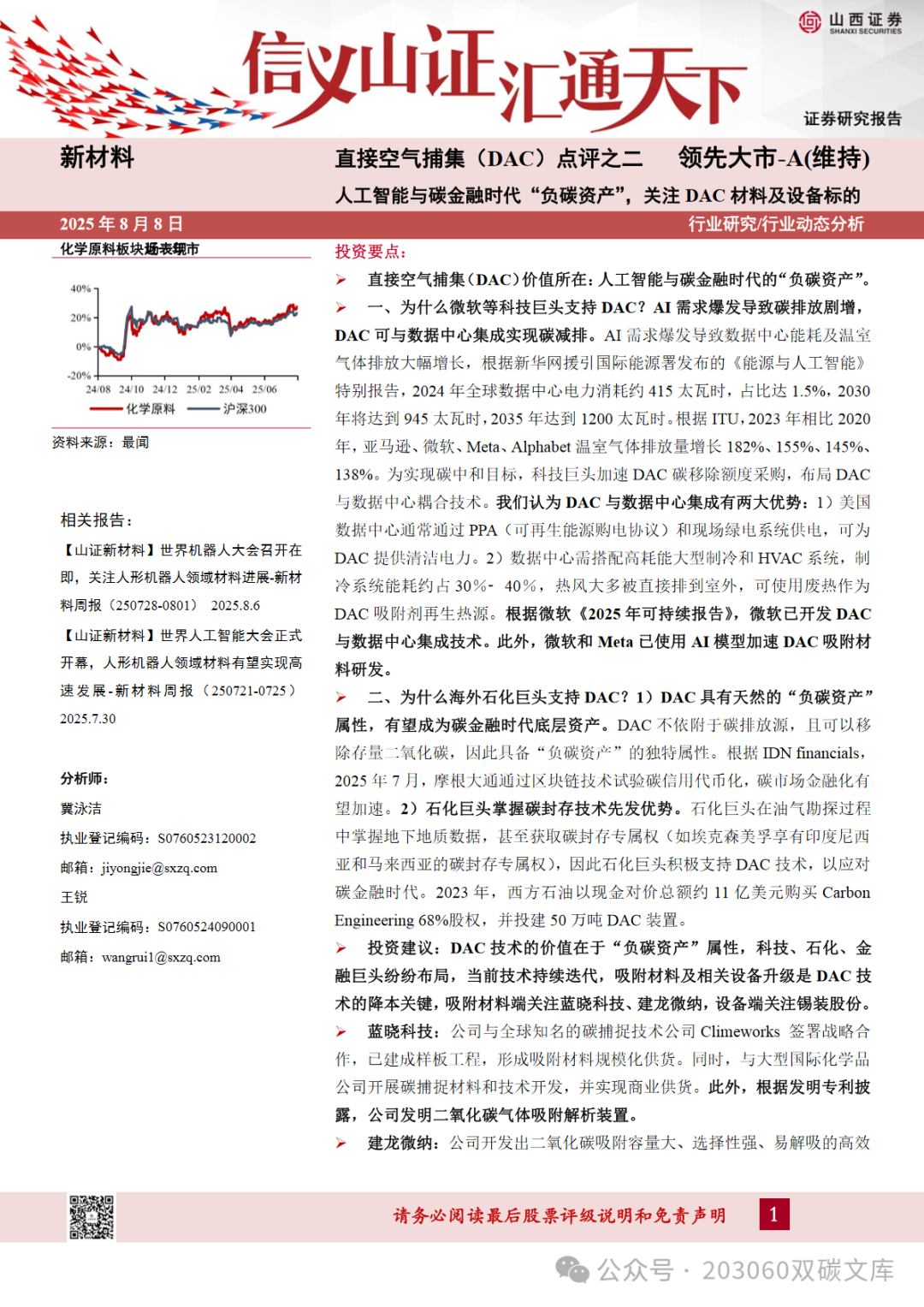
You may not have heard of “Direct Air Capture (DAC)”, but it is quietly becoming a coveted technology for tech, petrochemical, and financial giants. Why has this technology, which can “capture” carbon dioxide from the air, suddenly gained popularity? The answer lies in the dual waves of the explosion of artificial intelligence and the rise of carbon finance.
First, let’s look at the “urgency” of tech giants. The training of large AI models and the operation of data centers rely on massive amounts of electricity, leading to soaring carbon emissions. According to the International Energy Agency, global data center electricity consumption will reach 415 terawatt-hours in 2024, accounting for 1.5% of total global electricity consumption, and will exceed 1200 terawatt-hours by 2035. Even more astonishing is the ITU’s statistics: in 2023, the greenhouse gas emissions of Amazon, Microsoft, Meta, and Alphabet surged by 182%, 155%, 145%, and 138% respectively compared to 2020. To achieve carbon neutrality commitments, DAC has become a key solution.
What’s smarter is that DAC can “seamlessly collaborate” with data centers. On one hand, U.S. data centers often use Power Purchase Agreements (PPAs) for renewable energy and on-site green power systems, which can provide zero-carbon electricity for DAC; on the other hand, the cooling system of data centers accounts for 30%-40% of energy consumption, and the hot air discharged can directly serve as the regeneration heat source for DAC adsorbents, achieving a win-win situation. Microsoft has disclosed related integrated technologies in its “2025 Sustainability Report” and has collaborated with Meta to accelerate the research and development of DAC adsorbent materials using AI, enabling faster technological iteration.
Next, let’s examine the “strategic layout” of petrochemical giants. The core attraction of DAC lies in its status as “hard currency” in the carbon finance era—it is not dependent on specific emission sources and can remove existing carbon dioxide from the air, making it a tangible “negative carbon asset”. In July 2025, JPMorgan’s blockchain experiment in carbon credit tokenization signifies the acceleration of financialization in the carbon market, while petrochemical giants hold an inherent advantage: the underground geological data accumulated from oil and gas exploration gives them a head start in carbon sequestration. For instance, ExxonMobil has secured exclusive rights for carbon sequestration in Indonesia and Malaysia, while Occidental Petroleum has acquired a 68% stake in Carbon Engineering for $1.1 billion and is investing in a 500,000-ton DAC facility, betting on the future carbon economy.
For the average person, the implementation of DAC relies on the support of the industrial chain, where adsorbent materials and equipment are key to cost reduction. Domestic companies have already emerged in this field: Blue Sky Technology has partnered with global DAC leader Climeworks to establish a model project and achieve large-scale supply of adsorbent materials; Jianlong Micro-Nano has developed efficient molecular sieve adsorbents that can significantly reduce carbon capture energy consumption; and Xizhuang Co., through a joint venture, is participating in the world’s first DAC project for sustainable aviation fuel (SAF), which is expected to produce demonstration oil by the end of 2025.
Of course, DAC development still faces challenges, such as adjustments in overseas subsidy policies and technological iterations not meeting expectations, which may affect progress. However, it is undeniable that as AI needs to “reduce carbon” and carbon assets need to “monetize”, DAC has moved from the laboratory to the industrial stage, and it may become an important force in achieving our “dual carbon” goals in the future.