Follow+Star Public Account, don’t miss exciting content

Source | Jishu Community
There are many types of LCD screens we commonly use, with various interfaces. For example, some LCDs are directly driven by the processor, while others are modules with built-in driver ICs. Previously, I shared the differences between 8080 and 6800 interfaces in LCDs. Now, let’s briefly summarize the differences between MCU screens and RGB screens, as well as the characteristics of other types of screens.
The main difference between MCU-LCD and RGB-LCD screens lies in the location of the video memory:
The video memory of RGB-LCD is served by the system memory, so its size is only limited by the size of the system memory. This allows RGB-LCD to create larger sizes; for instance, 4.3 inches can only be considered entry-level, while 7 and 10 inches are widely used in MID.
Initially, the design of MCU-LCD considered that the microcontroller’s memory is relatively small, hence the video memory is built inside the LCD module. The software updates the video memory through dedicated display commands, which is why MCU screens often cannot be made very large. Additionally, the display update speed is slower than RGB-LCD.
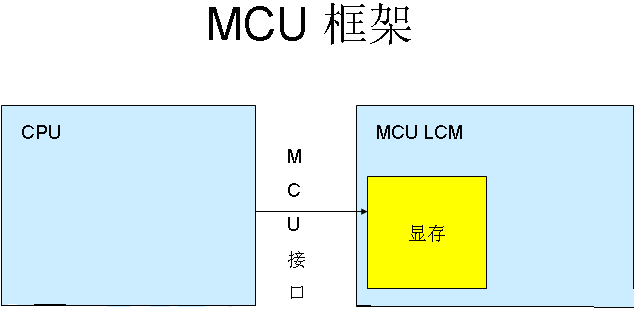
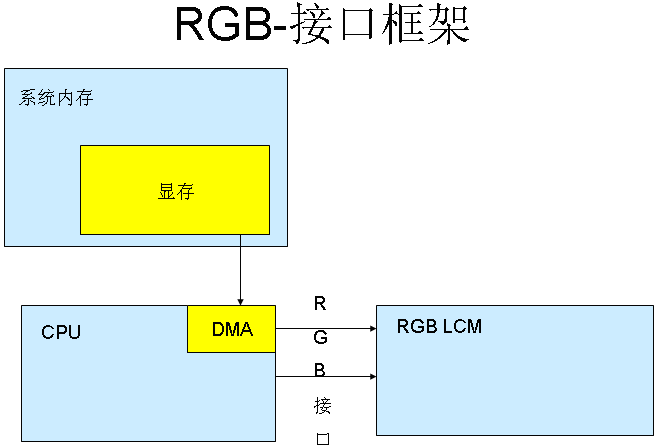
MCU-LCD and RGB-LCD also differ in data transmission modes:
For RGB screens, data must be organized in video memory. After the display is started, LCD-DMA automatically sends the video memory through the RGB interface to the LCM.
MCU screens require sending commands to modify the internal RAM of the MCU (i.e., cannot directly access the MCU screen RAM). Therefore, the RGB display speed is significantly faster than that of the MCU, and when it comes to video playback, MCU-LCD is also relatively slow.
For RGB interface LCMs, the host directly outputs the RGB data for each pixel without needing conversion (except for GAMMA correction, etc.). For this type of interface, an LCD controller must be present in the host part to generate RGB data and synchronize point, line, and frame signals.
This means that traditional MCU screen display data is written into DDRAM, while RGB screen data is not written into DDRAM but directly written to the screen, resulting in faster read and write speeds.
Statement: This article’s materials are sourced from the internet; copyright belongs to the original author. If there are any copyright issues, please contact me for removal.
———— END ————

● Column “Embedded Tools”
● Column “Embedded Development”
● Column “Keil Tutorial”
● Selected Tutorials from the Embedded Column
Follow the public account reply “Join Group” to join the technical exchange group according to the rules, reply “1024” to see more content.


Click “Read Original” to see more shares.