Abstract:This article presents a development plan for a mobile robot. The robot is based on the Arduino Mega 2560 R3 and uses a single-layer robot platform as its chassis, along with a 400-point unallocated MB-102 breadboard. The robot is equipped with the following sensors: ultrasonic sensor HC-SR04, KY-033 line sensor, flame sensor KY-026, infrared thermal module, and Wi-Fi module ESP8266 version ESP-01. The remainder of this article suggests programming the flame sensor.
Original Authors: Vladyslav Shcherbyna, Svitlana Maksymova, Vladyslav Yevsieiev
Editor: AutoGo

01
Introduction
In today’s world, automation is largely achieved through robotics, with robots taking on a significant amount of work in various fields of human life. Initially, robots were programmed to perform monotonous and repetitive tasks. However, in the current context, especially in war environments and various situations caused by human-made disasters, the use of robots becomes essential. In such cases, they can also be manually controlled, including remote control to perform complex tasks. Many articles today discuss the design and control of robots.
Mobile robots are increasingly applied in various life domains, including industry, home life, ecology, and military applications. This drives the need to develop new technologies that enable robots to perform a wide range of tasks, ensuring safety and optimizing workflows.
This article proposes the development of a mobile robot prototype based on the Arduino board and its interactive control system, utilizing sensors to enable the mobile robot to perform specified tasks. The concept is to create a robot capable of autonomous movement and recognizing hazardous situations (especially fire outbreaks and temperature increases).
The developed mobile robot prototype is expected to reduce fire risks and the need for human intervention, responding instantly to dangerous situations. Furthermore, mobile robots equipped with autonomous navigation and hazard recognition capabilities will ensure the optimization of workflows in various enterprises, or be used to inspect hazardous areas, enhancing the safety of workers or surrounding personnel while reducing material costs.
02
Related Work
Currently, numerous researchers are dedicated to the development of robots. Each robot developed must be controlled in some manner. Therefore, various robot control systems are being developed. Many scientific works focus on addressing these issues. The diversity of these problems is such that there are even dedicated books addressing them.
Let us look at some recent research on robot control. Varlamov, O. proposed the creation of a dynamic algorithm for robot actions that can be used in decision-making modules. This utilizes the next-generation Mivar expert system for advanced control.
Research has explored soft robots and their characteristics, such as control systems, materials and structures, modeling, and sensors.
Some researchers have pointed out that traditional feedback control methods can efficiently solve various types of robot control problems. They studied how to decompose difficult control problems in the real world into parts that can be efficiently solved by traditional feedback control methods and the remaining parts that require reinforcement learning.
Scientists have reviewed human-robot collaboration, introducing relevant standards and operational modes. This work ultimately analyzes the future trends of human-robot collaboration identified by the authors.
Attar, H. and his collaborators described the development of animal-like robots in their paper.
Some researchers proposed a reliable intelligent path-following control method for robotic airships suffering from sensor failures. A detection and isolation mechanism was developed, allowing the airship control system to function well even in the presence of sensor failures.
Other research introduced typical products and prototypes of lower limb exoskeleton rehabilitation robots, analyzing and summarizing the state-of-the-art technologies.
Researchers studied the non-singular adaptive fuzzy fixed-time control problem of uncertain n-link robotic systems with position tracking error constraints.
Researchers proposed their own control scheme for robotic manipulators’ trajectory tracking tasks, considering output error constraints and control input saturation.
Thus, we can see that robot control tasks are extremely diverse and differ from one another. It is important to note that to solve robot control problems, scientists have employed various methods and approaches. Therefore, it is first necessary to narrow down the scope of the problem to the specific issue being addressed and then select the method to solve it. In the subsequent sections of this article, we will introduce the development of a mobile robot capable of detecting fires and high-temperature areas, along with its control system.
03
Development of the Mobile Robot
Let us start with the circuit board, which is the core component of the system. Choosing the right circuit board, such as the Arduino Mega 2560 R3, provides sufficient computational power and control over various aspects of the robot.
An example of the circuit board is shown in Figure 1.
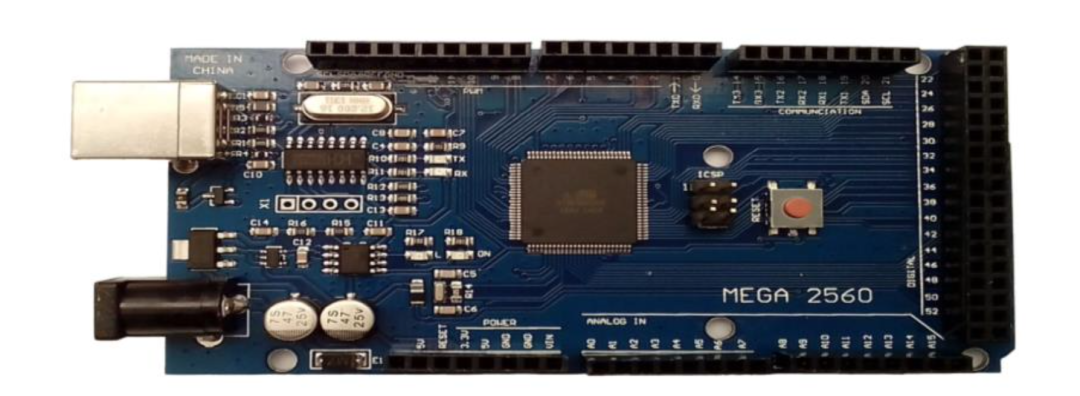
Figure 1. Arduino Mega 2560 R
It is equipped with a powerful Atmega2560 microcontroller, which provides sufficient computational resources to implement complex algorithms and control various devices. The board also has a large number of digital and analog input/output ports, allowing for the connection of various sensors, actuators, and other peripheral devices. The Arduino Mega 2560 supports various software libraries and the Arduino IDE development environment, simplifying the programming and development process. It is also compatible with a wide range of extensions and modules, allowing for the expansion of the system’s functionality and capabilities. The combination of low cost, easy availability, versatility, and support makes this board an attractive choice for projects, including the development of mobile robots with interactive control.
The next important component of the mobile robot is a platform on which all components will be mounted. In our case, it is a mobile three-wheeled transparent robot platform. It offers many advantages and features that make it suitable for developing mobile robots with interactive control. The appearance of the robot platform is shown in Figure 2.
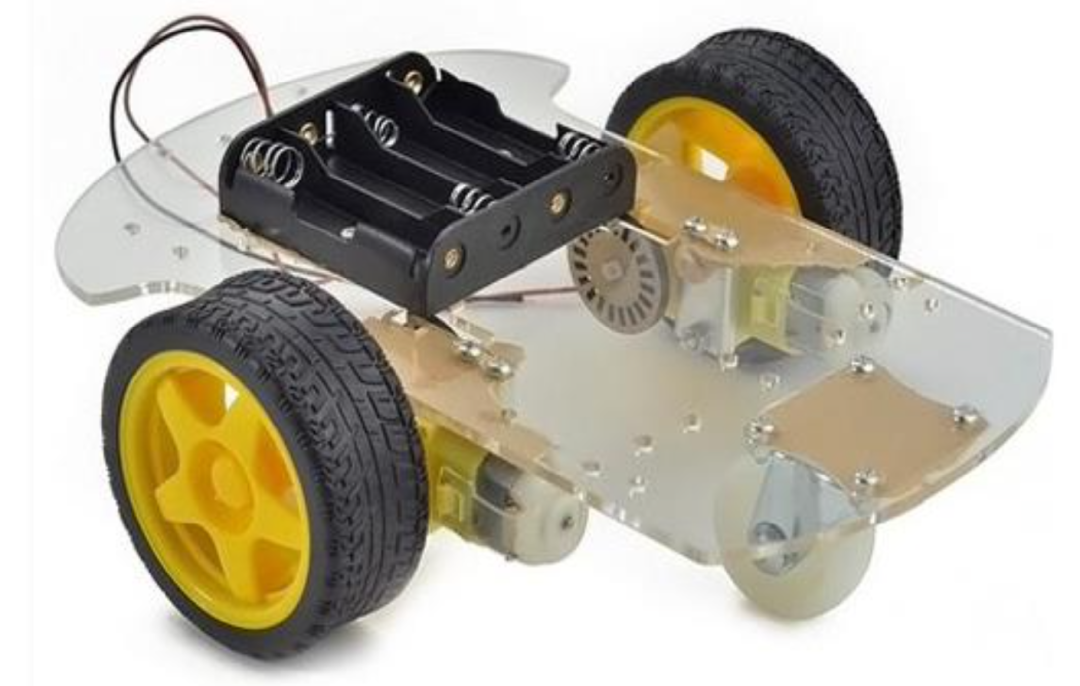
Figure 2. Single-layer robot platform
This platform is equipped with two motors with a gear ratio of 48:1. These motors provide sufficient power and torque to move the robot. They operate at a voltage of 3-6 volts and have low current consumption, making it an energy-efficient solution. The three wheels, two of which are drive wheels and the third provides stability, ensure the robot’s stability and maneuverability. This allows it to move and turn effectively in different directions. The platform also features a battery compartment, simplifying the integration of the power system into the robot’s structure. This provides a convenient and compact placement for the battery, which is especially important for mobile robots.
The next item will be the 400-point unallocated MB-102 breadboard. The selected L293D motor driver is designed to control two DC motors. To connect all components to the circuit board, we will also need a set of female-to-female and male-to-female jumper wires.
The first sensor we will consider is the ultrasonic sensor. This is a component that measures the distance to an object based on the principle of ultrasonic wave reflection. The HC-SR04 we selected is one of the most popular distance sensors, widely used in various robotics projects. The HC-SR04 can measure distances from a few centimeters to several meters. This makes it versatile for various scenarios. Additionally, this sensor has a simple connection and communication interface with microcontrollers. It operates based on the echo-location protocol, simplifying programming and project integration.
In the mobile robot project, the Wi-Fi module ESP8266 version ESP-01 is chosen for communication and connection to wireless networks.
The KY-033 line sensor is a device specifically designed to detect and follow lines on surfaces.
The flame sensor KY-026 is a module based on a light-sensitive element used to detect the presence of flames, responding to changes in light intensity produced by the flame.
The last module to be installed on our mobile robot is the infrared thermal module. The infrared thermometer is designed to measure the temperature of an object based on the infrared radiation emitted by the object.
The connections to the circuit board are shown in Figures 3 and 4.
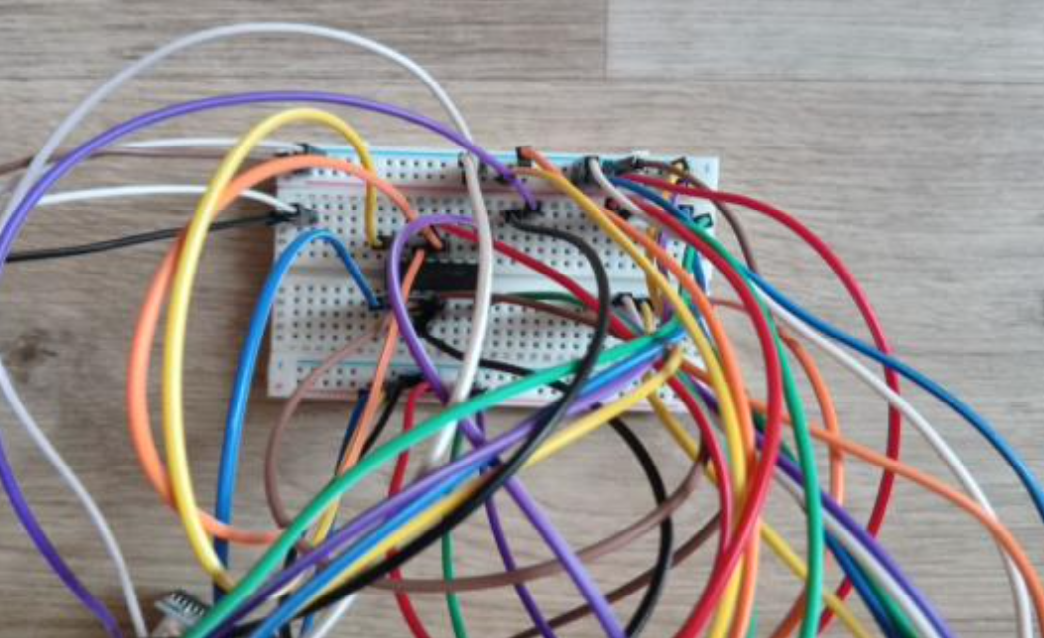
Figure 3. Connection to the circuit board
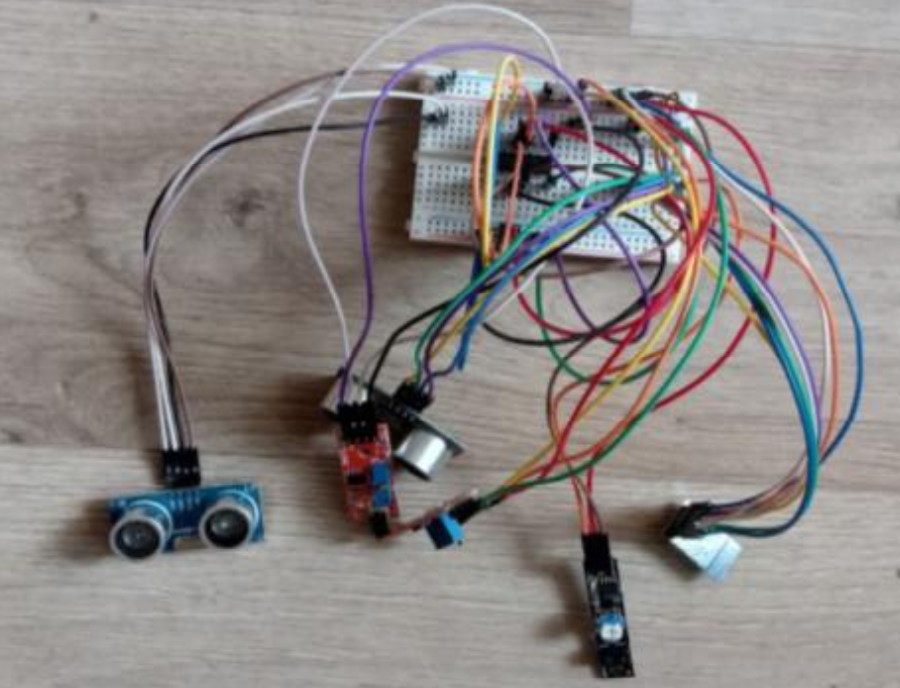
Figure 4. Connection to the sensors
With the Wi-Fi module ESP8266, we can control the mobile robot through a browser. When the user is on a local Wi-Fi network, they open a browser on their device. The mobile robot equipped with the ESP8266 module creates a web server on that module to listen for incoming HTTP requests. A webpage with a robot control interface is displayed in the user’s browser. The user clicks buttons on the webpage to control the robot. The browser sends the corresponding HTTP requests to the robot’s IP address and port. The ESP8266 module receives the requests and interprets them as commands to control the robot’s motors. The module transmits signals to the L293D driver, which controls the robot’s motors. The robot moves according to the commands received from the user through the browser. Thus, the user can control the mobile robot by pressing buttons on the webpage, while the ESP8266 module transmits the commands to the robot’s motors through the driver.
04
Programming the Flame Sensor KY-026
Below is an example code to test the operation of the KY-026 flame sensor. When a flame is detected, this code will output a message to the serial monitor:
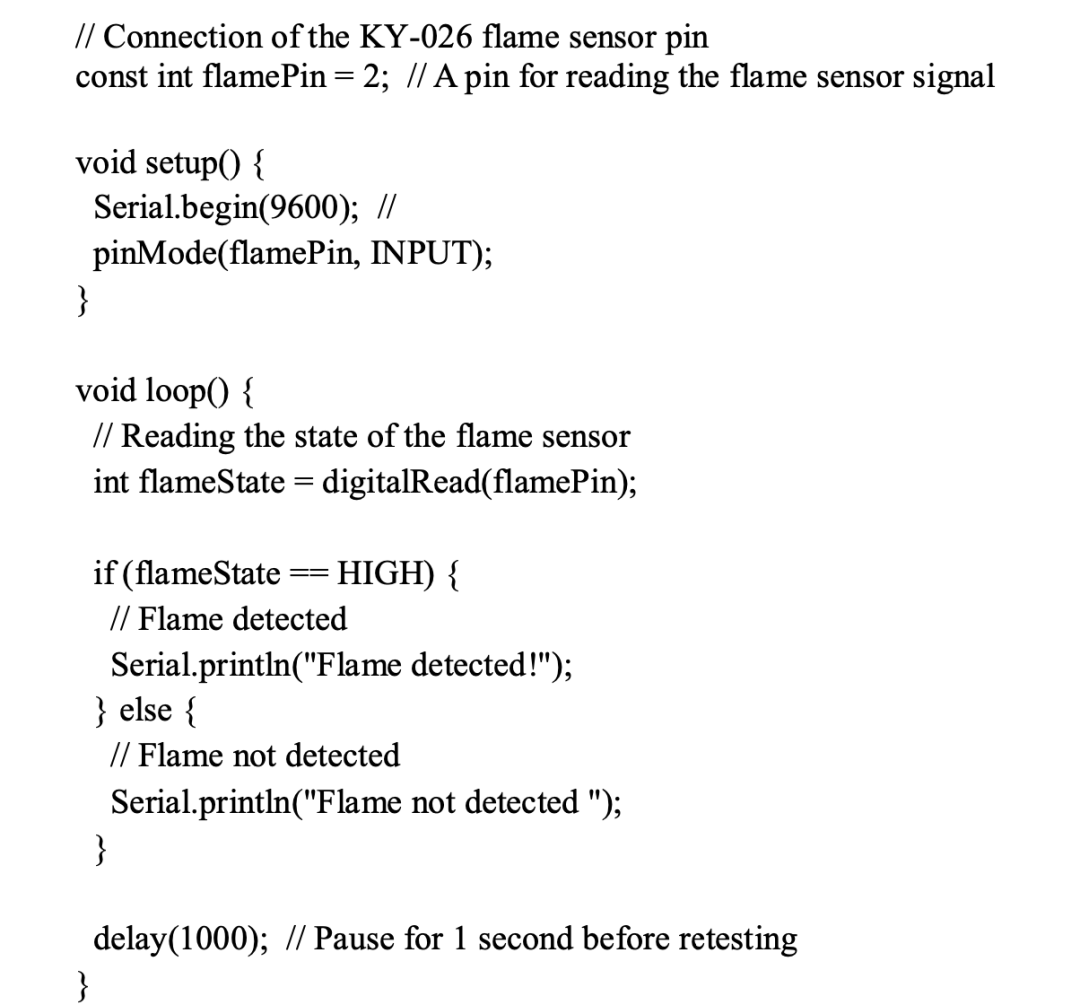
In this code, the flamePin pin (the pin used to read the flame sensor signal) is set as an input. Then, in an infinite loop, the digitalRead() function is used to read the state of that pin. If the state of the flamePin pin is HIGH, the Serial.println() function displays the message “Flame detected!” on the serial monitor. If the state of the flamePin is LOW, it displays the message “Flame not detected”. It then pauses for 1 second before retesting.
Our mobile robot has a 1:48 DC 3V-6V motor responsible for its movement. We have developed and implemented the corresponding code for efficient control of the robot. It includes motor control functions such as turning left, turning right, moving forward, moving backward, and stopping. Each function sets specific values on the pins connected to the motors to achieve the desired movement direction. This code will allow us to easily control the motors and achieve the desired movement of the robot. Next, we can integrate motor control with information from the ultrasonic sensor, flame sensor, or line sensor so that our mobile robot can move reliably and flexibly in the environment. Moving forward, we can create a basic program loop in which we will combine motor control functions and sensor data processing. This will enable us to create intelligent behaviors for the robot, including obstacle avoidance, line following, etc.
05
Conclusion
This article presents the development of a mobile two-wheeled robot. A single-layer robot platform was chosen as the chassis. In this case, two wheels are the drive wheels, while the third wheel serves a stabilizing function.
Consideration was given to the selection of sensors to address two issues: first, ensuring the robot moves while considering obstacle avoidance; second, a set of sensors to ensure the detection of fire hazards. The second set of sensors should include flame detection sensors and high-temperature (i.e., fire hazard) temperature sensors. Suitable sensors have been selected.
This article also describes the development of programs to respond to signals from fire detection sensors.
In the future, there are plans to test the developed robot under real conditions and adjust the software based on the test results.
Disclaimer: The views expressed in this article are for sharing and communication purposes only. The copyright and interpretation rights belong to the original authors and publishing units. If there are any copyright issues, please contact [email protected], and we will address it promptly.
Related Articles ·
▷ Magnetically Controlled Soft Robot Technology
▷ Electronic Skin (E-Skin) — From Humanoid Robots to Humans
▷ A Mass-Produced Social Humanoid Robot – Pepper
▷ The Development History of Quadrupedal Walking Robots and Various Design and Development Methods
▷ Infineon Vice President: Three Key Features to Bring Edge AI Mainstream by 2025
▷ The Robustness of Multimodal Fusion in Robotics
▷ Honda’s ASIMO and Humanoid Robot Research
▷ The World’s First Bidirectional Adaptive Brain-Computer Interface Developed Successfully by a Chinese Team!
▷ Hardware Design of Bipedal Humanoid Robots: A Technical Review
▷ The Mechanical Principles of Humanoid Robots
▷ Methods of Interaction Between Robots and Humans and Multimodal Interface Architecture
▷ AI-Based Human-Robot Collaborative Unit Task and Action Planning Methods
▷ The Humanoid Robot Market Size Will Reach $76.97 Billion by 2032, with a Compound Annual Growth Rate of 48.36%