Fire Hazard Pre-Detection: Detection of Odorous Gases Emitted from Circuit Boards
In recent years, the proliferation of IoT has led to the high performance and miniaturization of electrical products, resulting in circuit boards developing towards higher density.
This high-density circuit board is at risk of quality degradation due to long-term use and thermal accumulation, which could potentially lead to fire hazards.
To prevent such situations, various types of fuse-based protections are generally implemented, but this is not a foolproof solution, especially in fields such as databases and automotive applications that require higher safety measures, where it is necessary to adopt two or even three layers of safety precautions.
This study applies overcurrent to the circuit board and uses our semiconductor gas sensor to detect the odors emitted from the circuit board,
thereby aiming to detect the early abnormal stages before the circuit board starts to smoke or catch fire as early as possible.
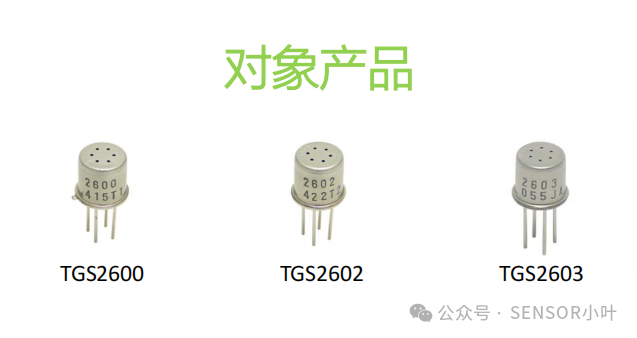
1. Analysis of Volatile Gases Emitted from Circuit Boards
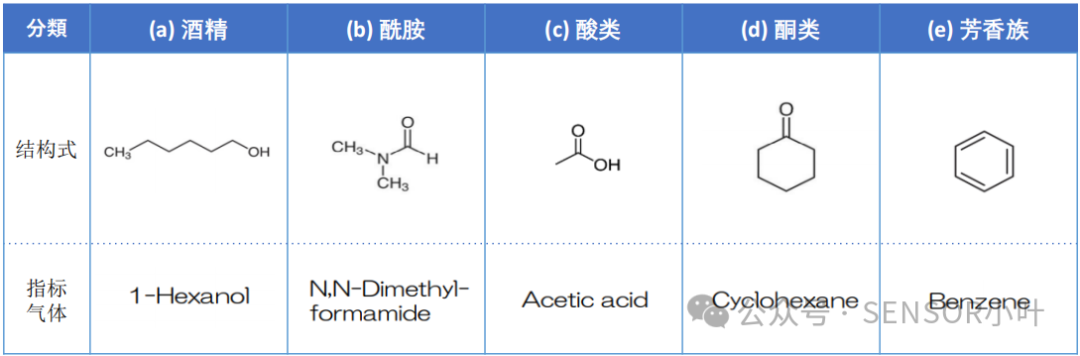
Five different types of circuit boards were heated to 250℃, and the volatile gases emitted were analyzed using gas chromatography and mass spectrometry. The results showed that various types of gases were detected from each circuit board.
The detected gases included the following five major categories.*Reference 3)
2. Discussion on Sensor Selection and Optimization of Operating Voltage
To identify the sensitivity characteristics of each sensor corresponding to the five detected gases, as well as the most suitable operating voltage (heater applied voltage), an investigation was conducted. The concentration of each target gas was based on 10ppm. The sensitivity characteristics of each sensor model are as follows:
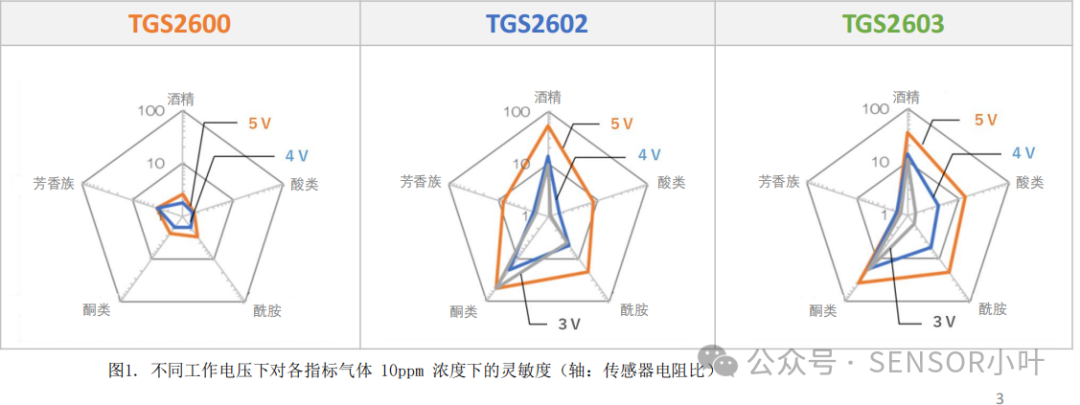
The main sensitivity characteristics of each sensor are as follows:
·TGS2600
Regardless of the operating voltage, although the sensitivity to various gases is relatively low, the balance of sensitivity is acceptable.
·TGS2602
In comparison, it shows a sensitivity state very close to TGS2603, but increasing the operating voltage enhances sensitivity to aromatic gases, and the balance of sensitivity across all gases is very good.
·TGS2603
It has almost no sensitivity to aromatic gases, but increasing the operating voltage significantly enhances sensitivity to alcohol and ketone gases.
For the sensor characteristics sought for this application, rather than requiring particularly high sensitivity, it is more suitable to have good balance across various gases. From this perspective, the TGS2602 driven at 5V should have more appropriate sensitivity characteristics.
3. Mechanism of Volatile Gas Generation and Sensor Response Confirmation
In a sealed container, an overcurrent of 12A was applied to the wiring template on the PCB (wire width 1mm, wire length 50mm, copper thickness 35μm), while observing the change in resistance of the TGS2602 sensor and the state changes of the wiring template.
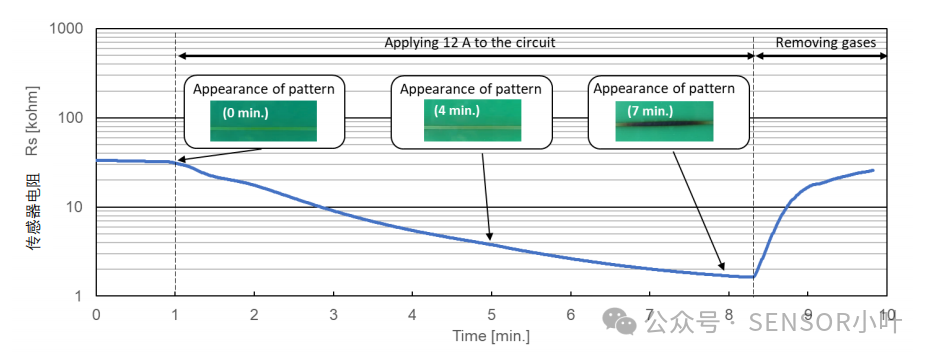
After applying the overcurrent, it was found that the resistance value of the sensor immediately decreased, and certain gases were confirmed to be generated from the wiring template. After 7 minutes, a strong odor was still detectable, and the middle part of the wiring template had turned black.
Research Results
The research results indicate that by placing gas sensors in a sealed space or near the source of odorous gas generation, it is possible to detect abnormal heating of the circuit board in the early stages before smoke and fire occur.
Compared to the currently popular wide-area (indoor) monitoring fire detection systems, this method can significantly advance the time point of abnormal condition detection. For example, by installing gas sensors on the circuit board and using the sensor signals to drive a circuit that cuts off the power supply, the system is expected to prevent incidents or minimize damage.