Click [Your AI Application Collection] to follow
Comprehensive Analysis of the AIAgent Technology Stack
AI agents, as a cutting-edge development direction in the field of artificial intelligence, are gradually reshaping the operational models of various industries. They are software entities capable of perceiving the environment, making autonomous decisions, and executing tasks to achieve goals. Their origins can be traced back to early explorations of autonomy and interactivity in the field of artificial intelligence, evolving from simple rule-based agents to complex intelligent systems relying on advanced technologies such as deep learning and reinforcement learning. With the enhancement of computing power and algorithm optimization, AI agents have transitioned from theoretical research to practical applications, emerging in various fields such as intelligent customer service, autonomous driving, and financial risk prediction, becoming a key force driving the intelligent transformation of various industries.

1. Evolution from Large Language Models to Intelligent Agents
1. Limitations of Traditional LLMs
- Static Responses: Only generate text, unable to perform tasks.
- No Memory: Each interaction is independent, unable to accumulate experience.
- Lack of Tool Integration: Unable to call external APIs or databases.
2. Core Enhancements of AI Agents
| Capability | Technical Solution | Example |
|---|---|---|
| Memory | Vector Databases, SQL | FAISS, Pinecone |
| Tool Invocation | Function Calling | OpenAI Tools, LangChain Tools |
| Task Planning | Chain-of-Thought (CoT) | ReAct, Tree-of-Thoughts |
| Multi-Agent Collaboration | Agent Swarms | AutoGen, CrewAI |
Evolution Path:<span><span>LLM → LLM + Memory → LLM + Tools → LLM + Planning → Multi-Agent Systems</span></span>
2. AIAgent Technical Architecture
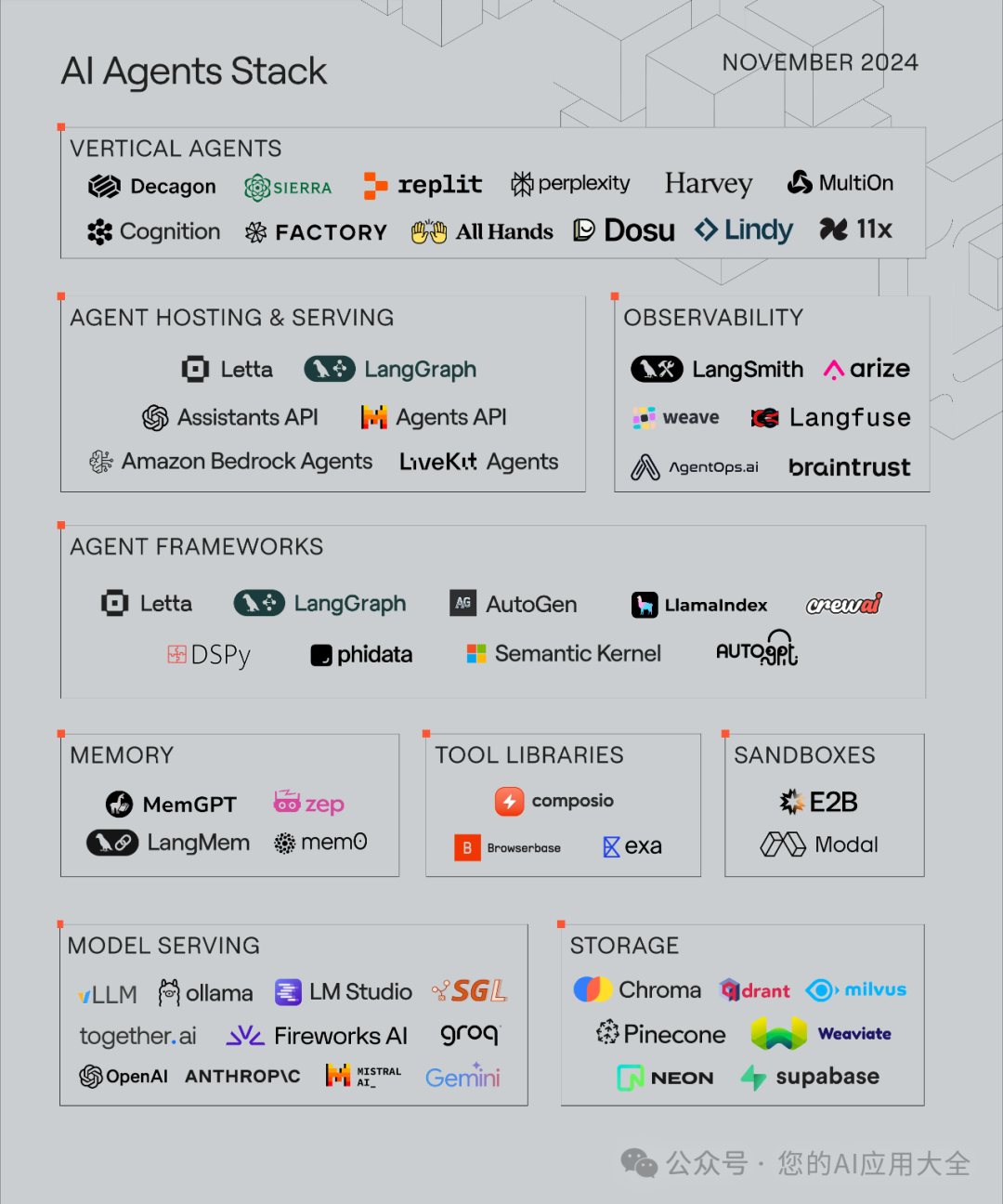
(1) Layered Architecture of the Technology Stack
-
Model Service Layer: This layer is primarily responsible for providing AI capabilities, including but not limited to Natural Language Understanding (NLU), Natural Language Generation (NLG), and decision-making. It typically includes pre-trained deep learning models or models adapted to specific application scenarios through fine-tuning. These models can be deployed in the cloud or on edge devices to support real-time responses and service scalability.
-
Storage Layer: The storage layer serves as the information repository for the entire system, storing important information such as model parameters, user data, and conversation history. In addition to traditional database solutions, it also includes storage solutions specifically designed for large-scale unstructured data processing, such as distributed file systems and NoSQL databases. Security and privacy protection are also key considerations for this layer.
-
Tools and Libraries Layer: This layer provides developers with various tools and libraries needed to build AIAgents. For example, machine learning frameworks like TensorFlow and PyTorch; NLP libraries like spaCy and Transformers; and implementations of dialogue management systems like Rasa. These tools and libraries greatly simplify the process from algorithm research to practical application.
-
Memory Management Module: Unlike the traditional storage layer, the memory management module focuses on the memory functions of the agent, specifically how to effectively manage and utilize long-term and short-term memory to enhance the interaction experience. This involves the design of memory encoding, storage, retrieval, and forgetting mechanisms. A well-designed memory management system enables the agent to better understand and respond to the contextual needs of users.
-
Execution Engine and Orchestration Framework: The execution engine is responsible for converting high-level instructions into specific action steps and monitoring the execution of these steps. The orchestration framework focuses on coordinating workflows between different components, ensuring that the entire system operates efficiently. Together, they ensure that the agent can respond quickly and accurately to changes in the environment.
(2) Core Components and Capability Support
-
Core Components: These mainly include the key elements from the previously mentioned layers, such as model services, storage facilities, toolsets, memory management systems, and execution and orchestration frameworks. Each component plays an important role in its specific domain while collaborating to form a complete system.
-
Capability Support: To enable AIAgents to possess powerful functionalities, various capability supports must be provided. This includes but is not limited to language processing capabilities, learning and adaptive capabilities, environmental perception and interaction capabilities, and problem-solving capabilities. With technological advancements, these capabilities are continuously evolving and improving, driving AIAgents towards a more intelligent and human-like direction.

3. Industry Application Scenarios
1. Personal Productivity
Intelligent Writing Assistant:Jasper.ai A commercial copy generation tool developed based on GPT-3.
Automated Research Assistant:Elicit.org An automatic literature review system for academic papers.
Personal Knowledge Management:Mem.ai An intelligent note management platform.
2. Enterprise Applications
Intelligent Customer Service System:Alibaba’s “Xiao Mi”, multimodal interaction (mixed understanding of text and images), real-time ticket generation, and emotion recognition based on voice analysis.
Automated Data Analysis:Pandas AI can perform natural language queries on data, automatically generate visual charts, and generate visual charts.
Intelligent Process Automation (IPA):UiPath AI Center can receive purchase requests via email, automatically verify supplier qualifications through OCR, and batch generate approval tickets.
3. Professional Fields
Medical Diagnosis Assistance:Babylon Health can provide symptom self-check AI assistants, automatically generate electronic medical records, and medication reminders.
Legal Document Analysis:LawGeex can identify over 30 types of contract risks, reviewing speed is 80% faster than lawyers.
Financial Investment Advice:Betterment can provide personalized asset allocation and tax optimization strategies.
4. Future Trends of Intelligent Agents
Looking ahead, AI agents will continue to develop towards being more powerful, intelligent, and widespread. On the technical level, multimodal integration will become a mainstream trend. Intelligent agents will be able to naturally integrate various types of information such as text, images, audio, and video, achieving more comprehensive and accurate environmental perception and task understanding. On the application level, AI agents will increasingly penetrate various industries such as healthcare, education, finance, and industrial manufacturing, deeply promoting the intelligent upgrade of industries. At the same time, as technology matures and costs gradually decrease, AI agents will gradually enter ordinary households, becoming effective intelligent assistants in people’s lives, fundamentally changing people’s lifestyles.