
In the current digital economy, modern enterprise organizations should integrate processes and IT as two sides of the same coin, achieving mutual fusion to build strong organizational capabilities.
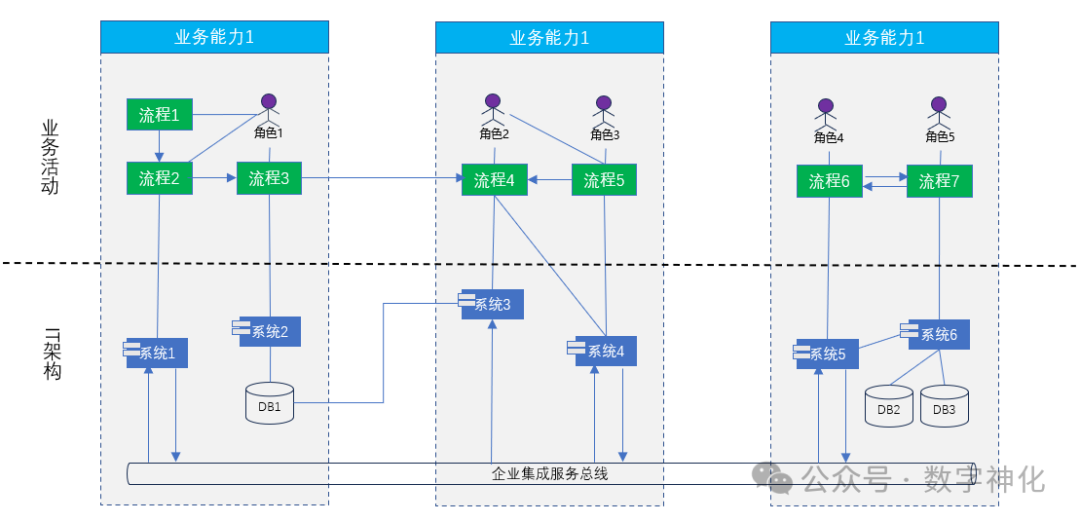
Firstly, from the perspective of definitions and roles, processes carry the business and are the core operational activities of the organization. The positions within the organization must align with the roles in the processes, assuming responsibilities and powers within the processes; the system permissions in IT must be consistent with the responsibilities and powers of the process roles to solidify the processes. Both play the roles of “front-end” and “back-end”, interdependent and indispensable. For example, Huawei’s BET team model integrates technical personnel into business departments to ensure that technical implementations closely align with business needs.
The BET team, as a “business enabling team,” primarily serves as a bridge between business needs and technical implementations. Its core responsibilities include:
Requirement Transformation: Deeply understanding business pain points and converting non-technical language into actionable technical solutions
Agile Response: Shortening the lengthy processes of cross-departmental collaboration in traditional siloed organizations, enhancing the speed of requirement delivery
Capability Accumulation: Solidifying technical capabilities as long-term assets of business departments through mixed teams
Secondly, from the perspective of organizational forms, there are two models of interdependence between business departments and IT departments: supportive and integrated.
In the supportive model, the IT department passively responds to the needs of the business department, which may lead to departmental silos and inefficiencies;
while in the integrated model, IT deeply integrates into business processes, providing user experience, data analysis, and other values, sharing KPIs, and forming closely collaborative teams.
For example, BSM (Business Service Management) quantifies IT services through SLAs, promoting win-win outcomes for both sides, while Huawei’s mixed team model achieves enterprise-level capability accumulation through shared platforms and globally unified operations.
In the integrated model, there are three main types: traditional, project-based, and embedded.
In the traditional model, business and IT departments operate independently, leading to high communication costs;
the project-based model uses temporary teams to address specific needs but lacks long-term capability solidification;
the embedded model disperses technical personnel into business departments for deep integration.
For instance, Huawei’s BET team ensures that technical implementations closely align with business needs through a mixed model, while a dedicated team at China Construction Bank generates standardized models through enterprise architecture methods to ensure that technical implementations meet business objectives.
Again, taking Huawei as an example, Huawei employs mixed teams and a globally unified platform to ensure both departmental innovation and enterprise-level capability accumulation; through dedicated teams for requirement analysis, they ensure that technical implementations align with business strategies; and through self-developed teams, they facilitate joint work between business and IT personnel to enhance response speed.
Traditional hierarchical organizations face severe challenges such as departmental silos, poor communication, and slow response times. However, through a hybrid model (e.g., primarily traditional, supplemented by project-based and embedded), establishing common KPIs, and utilizing enterprise architecture and middle platforms, these issues can be effectively alleviated. For example, Huawei’s BET team uses shared platforms and a mixed model to maintain technical response speed while avoiding redundant construction; the team ensures that technical implementations align with business objectives through standardized models.
Based on the above analysis, it is clear that processes and IT are two sides of the same coin in modern organizations and are core to an efficient management system. They are interdependent and mutually reinforcing in terms of definitions, roles, relational models, and integration strategies. Through reasonable organizational design and strategies, the advantages of both can be fully leveraged to meet challenges, achieving efficient operations and continuous innovation within the organization.
The success of Huawei’s organizational transformation is essentially a reconstruction and enhancement of organizational cognition. We see that most enterprises today are still struggling with conflicts between processes and systems, while Huawei has formed a culture of “process as law,” integrating rule awareness into the genetic makeup of employees. In the current push for digital transformation, only by completing cognitive upgrades and cultural reshaping can enterprises build a management system that adapts to digital transformation. This system is not a digital version of traditional management, nor is it merely transferring offline methods online; rather, it requires establishing three new orders: customer-centric end-to-end process networks, process-driven organizational structures, and data-driven intelligent decision-making centers.
This point has been repeatedly mentioned in my previous articles; those interested can read>>
Reconstructing Organizational DNA? This is the Key to Achieving True Digital Transformation?
What Can We Learn from Huawei? Decoding the Soul of Huawei’s Management System: True Process Transformation is Not an Iteration of Management Techniques, but a Reconstruction and Elevation of Organizational Cognition
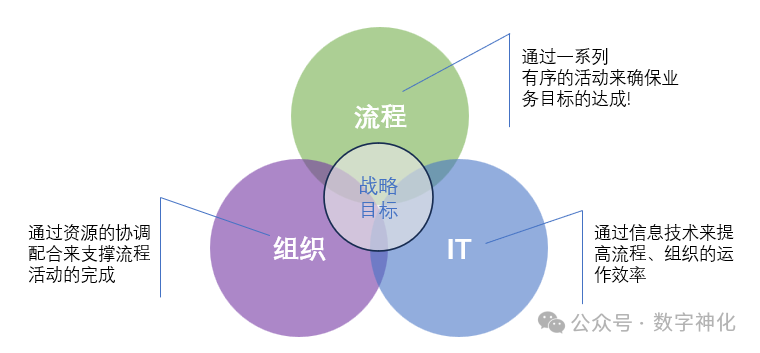
Process reconstruction requires breaking down departmental barriers, building process-oriented organizations, and establishing end-to-end value streams. Consider a successful automotive parts company that, by digitizing R&D, production, and supply chain processes, compressed the new product launch cycle from 18 months to 6 months. This transformation is not merely about speeding up; it establishes a real-time collaboration mechanism across functional teams. Organizational change needs to shift from a pyramid (vertically controlled organization) to a networked (process-oriented organization), building organizational-level capabilities,organizational-level capabilities refer to the processes, organizations, andIT capabilities that support business development.By building capabilities on platforms rather than relying on individuals, business success becomes replicable, and business outcomes manageable.
This also addresses Huawei’s assertion that “the essence of the management system is to build organizational-level capabilities“; welcome to read>>Huawei: The Essence of the Management System is to Build Organizational-Level Capabilities (with 108-page PPT download: Huawei Process System and Implementation)The three key elements in the management system—processes, organizations, andIT (including data) will cover all business areas, and every business will involve processes, organizations, andIT. Thus, it is evident that effectively combining processes and IT can form a strong organizational capability for enterprises, thereby establishing an efficient management system for modern organizations.
Recommended Reading>>AI Restructuring Organizations: Breaking Down Departmental Walls to Return Collaboration to Its Essence100 Selected Knowledge Articles on Enterprise Architecture – The Underlying Methods of DigitalizationLTC from Leads to Payments – A Customer-Centric, End-to-End Integrated Enterprise Sales Process System (with Case Study)Methodology for Building Business Process Architecture: Practical Advancement from Top-Level Design to Implementation