Urban renewal serves as a core engine for promoting new urbanization and optimizing urban functional layouts. Its development process has formed a systematic and multidimensional policy framework. Recently, the Central Committee of the Communist Party of China and the State Council issued the “Opinions on Promoting High-Quality Urban Development” (hereinafter referred to as the “Opinions”), which is a programmatic document guiding urban development in the new era, marking the transition of China’s urbanization process from a “large-scale, rapid” phase to a “medium-low speed, micro-growth” phase. This article is adapted from “JianTou GuanJia” and systematically analyzes the core links of urban renewal project development and innovative financing models based on policy guidance related to urban renewal and typical cases, aiming to provide a reference for advancing urban renewal work in various regions.。
Compilation of Policies Related to Urban Renewal
1. Relevant Document Notifications
In August 2020, the Ministry of Housing and Urban-Rural Development issued the “Notice on Effectively Strengthening Historical and Cultural Protection in Urban Renewal and Resolutely Stopping Destructive Behaviors” (JianBanKe [2020] No. 46), which for the first time clearly placed historical and cultural protection at the core of urban renewal. The “Notice on Preventing Large-Scale Demolition and Construction Issues in Implementing Urban Renewal Actions” (JianKe [2021] No. 63), released in August 2021, became a landmark document. This notice delineated the bottom line for urban renewal, strictly controlling large-scale demolition, expansion, and relocation, effectively curbing the erroneous tendency to equate urban renewal with real estate development.
In July 2023, the Ministry of Housing and Urban-Rural Development issued the “Notice on Solidly and Orderly Promoting Urban Renewal Work” (JianKe [2023] No. 30), marking the entry of policies into a new stage of systematic planning. This document clarified the implementation model, bottom line requirements, and working methods for urban renewal, emphasizing a combination of “retention, modification, and demolition,” and required localities to conduct urban health checks as a basis for planning renewal projects. In May 2025, the General Office of the Central Committee of the Communist Party of China and the General Office of the State Council jointly issued the “Opinions on Continuously Promoting Urban Renewal Actions.” This high-level document positions urban renewal as a long-term, systematic national task, coordinating the direction of future development from a strategic height. In July 2025, the Ministry of Housing and Urban-Rural Development organized the compilation of the “Guidelines for Urban Renewal Planning,” establishing and improving the planning implementation system of “special planning – area planning – project implementation plan.”
2. Coordinated Policies in Related Fields
In November 2023, the Ministry of Natural Resources issued the “Planning and Land Policy Guidelines Supporting Urban Renewal (2023 Edition)” (Natural Resources Office [2023] No. 47), providing important policy basis and convenience for urban renewal in planning approval, land supply, and use conversion.
In October 2024, the Ministry of Housing and Urban-Rural Development released the “Overall Layout Planning for Digital Construction” (JianBan [2024] No. 12), clearly listing urban renewal as one of the main tasks of digital construction, indicating that future urban renewal will be deeply integrated with technologies such as smart cities and digital twins. These documents collectively form a multi-departmental collaborative policy support network.
3. Financial Support and Incentive Mechanisms
To leverage the massive funding needs for renewal, the central government has begun to play a guiding and incentivizing role. On May 6, 2024, the Ministry of Finance and the Ministry of Housing and Urban-Rural Development jointly issued the “Notice on Carrying Out Urban Renewal Demonstration Work,” officially launching central government-supported urban renewal demonstration projects.
In 2025, this work continued, with the two ministries jointly issuing the “Notice on Carrying Out the 2025 Annual Central Government Financial Support for Urban Renewal Actions” (CaiBanJian [2025] No. 11) on April 3, continuing to provide subsidy funds to demonstration cities through competitive selection. This reward-based approach not only directly provides financial support but also, more importantly, guides local governments to allocate funds to key areas that address shortcomings, benefit people’s livelihoods, and promote innovation through a performance evaluation system.
4. Pilot Projects and Cases Issued by the Ministry
In November 2021, the General Office of the Ministry of Housing and Urban-Rural Development issued the “Notice on Carrying Out the First Batch of Urban Renewal Pilot Work” (JianBanKe [2021] No. 443), launching the first batch of pilots in 21 cities (districts) including Beijing and Chongqing, exploring different urban renewal models and policy mechanisms in different regions and development stages.
In March 2025, to implement the decisions and deployments of the Central Committee of the Communist Party of China and the State Council on urban renewal actions, effectively and orderly implementing key tasks of urban renewal, and summarizing and promoting good experiences, practices, and cases in urban renewal, the Ministry of Housing and Urban-Rural Development organized the selection of the second batch of typical urban renewal cases and compiled the “Collection of Typical Urban Renewal Cases (Second Batch).”
Key Links in the Full Process of Development
1. Preliminary Planning and Project Generation
Project initiation must rely on the results of urban health checks, focusing on identifying issues such as aging infrastructure and shortcomings in public services. By 2025, all renewal projects must complete the “Urban Lifeline Safety Engineering” assessment, establishing a risk list that includes 12 categories of elements such as gas pipelines and drainage flood prevention. In the renovation of the Lujiazui North District in Shanghai’s Pudong New Area, a three-dimensional pipeline model was constructed using BIM technology, accurately locating 37 hidden danger points to avoid renovation conflicts in advance. At the policy level, the Ministry of Finance has clarified that projects that complete urban health checks and are included in the renewal plan will receive a 10% subsidy fund tilt.
2. Plan Preparation and Compliance Review
The renewal plan must include core contents such as functional positioning, economic calculations, and implementation paths. Chaoyang District in Beijing implements a “dual review and dual control” mechanism, requiring the plan to pass initial review by the district planning and resources department and re-examination by the municipal expert committee, focusing on mandatory indicators such as historical style protection and sunlight distance. For plans involving regulatory adjustments, opinions from the municipal planning and resources department must be obtained before being recognized by the district government. Guangming District in Shenzhen has innovatively adopted a “plan-based land transfer” model, merging land transfer with renewal plan approval, shortening the project cycle by 40%.
3. Fundraising and Policy Coordination
Current funding channels exhibit a “four-three-two-one” structure: 40% from special bonds (with a central government allocation of 290 billion yuan by 2025), 30% from policy loans (with interest rates of 3.0%-3.5% from the China Development Bank), 20% from social capital (including REITs, PPPs, etc.), and 10% from fiscal subsidies. Special attention must be paid to policy coordination, such as ensuring that applications for central budget investments do not overlap with long-term government bonds or vehicle purchase tax funds; applications for PSL loans must meet conditions such as being within the “three zones and three lines” range and having a public welfare ratio exceeding 60%. The Jianguo East Road project in Huangpu District, Shanghai, achieved asset securitization by issuing 5.6 billion yuan in CMBS, reducing financing costs by 1.2 percentage points compared to traditional loans.
4. Land Preparation and Property Rights Consolidation
Land procedures follow the principle of “classified disposal”: for reserved land parcels, a “conditional transfer” method is used to clarify construction requirements; existing land price compensation applies to parcels with clear ownership, with Shanghai stipulating a 30% discount on the benchmark land price; sporadic renewal projects allow original rights holders to carry out renovations independently, with Beijing stipulating that no land procedures are required for projects not exceeding the original building area. In the renovation of the Ailian area in Longgang District, Shenzhen, a combination model of “property rights exchange + monetary compensation” was used to complete the integration of 12 historical legacy parcels, achieving an average signing rate of 92%.
5. Construction and Quality Control
The construction phase must strengthen the application of green and low-carbon technologies, with a requirement that by 2025, the proportion of prefabricated buildings in new projects must not be less than 40%, and the assembly rate must not be less than 60%. In the renovation of the Republic of China architectural complex on Yihe Road in Nanjing, a “micro-renewal + smart operation and maintenance” model was adopted, incorporating an energy consumption monitoring system that reduced energy consumption by 28%. In terms of quality supervision, Beijing has implemented a “smart construction site” management system that monitors dust, noise, and other data in real-time, with a quality issue rectification rate increasing to 98%.
6. Operation Management and Long-Term Development
Establishing an integrated mechanism of “investment, construction, and operation” is key. The Yulin area in Chengdu piloted a “community partner” system, where merchant cooperatives raised 12 million yuan for renovations, achieving sustainable operation through rent sharing. In terms of asset securitization, the Shenzhen Talent Housing Group issued the first national REITs for affordable housing, raising 1.28 billion yuan with a yield of 4.5%. By 2025, policies will clarify that renewal projects meeting operational standards can apply for operational subsidies, with subsidy standards ranging from 5% to 8% of renovation investments.
Five Innovative Financing Models
Franchise Model (Public-Private Partnership)
Under the old PPP model, the government introduced social capital through public bidding, prematurely locking in future government expenditure responsibilities, while also creating hidden government debt alongside fiscal investments. On November 8, 2023, the “Notice on Standardizing the Implementation of the New Mechanism for Government and Social Capital Cooperation” (GuoBanHan [2023] No. 115) was released, characterized by: all adopting a franchise model, focusing on user-paid projects, where project operating income can cover construction investment, operating costs, and achieve a certain return on investment, without adding new future expenditure responsibilities for local finances, and the government cannot use fiscal funds to cover project construction costs.
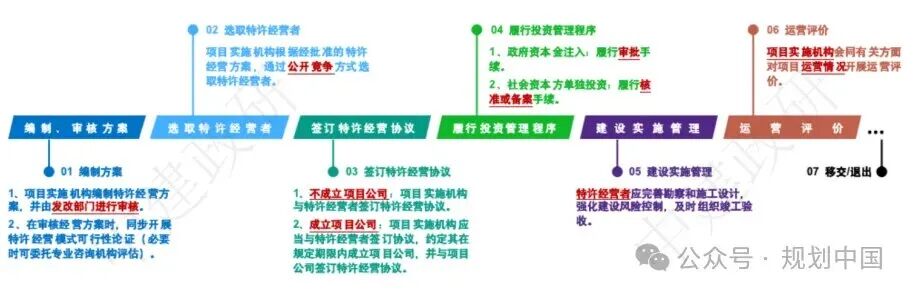
The specific implementation methods mainly include “Build-Operate-Transfer (BOT)”, “Transfer-Operate-Transfer (TOT)”, “Rebuild-Operate-Transfer (ROT)”, “Build-Own-Operate-Transfer (BOOT)”, and “Design-Build-Finance-Operate-Transfer (DBFOT)”.
“Government + Enterprises + Property Owners” Model
In the model combining local governments, real estate enterprises, and property owners, local governments are responsible for public facility investments, real estate enterprises are responsible for project renovation and operation, and property owners coordinate and share profits. The advantage of this model is the integration of resources from all parties, allowing for quicker resolution of property issues in renewal areas and promoting effective project operation; the downside is the involvement of multiple parties, leading to higher coordination difficulties.
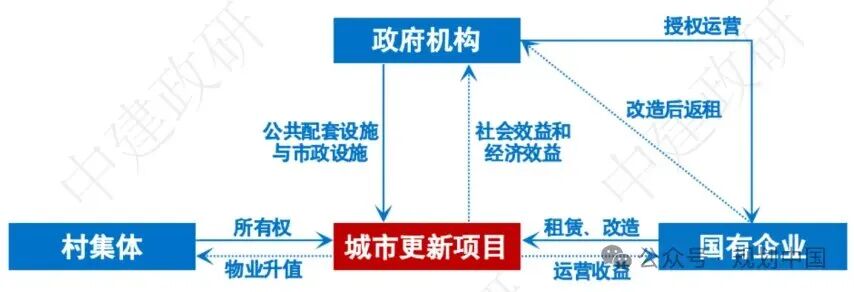
“EPC + O” Model (Engineering General Contracting + Financing + Operation)
In October 2022, the government investment projects introduced the EPC + O (Engineering General Contracting + Operation) model, which is a derivative of the traditional EPC model, meaning that the project construction unit entrusts the general contractor to be responsible for project design, construction, and procurement tasks, while integrating resources to leverage social capital injection beyond government investment and undertake operation and maintenance work.
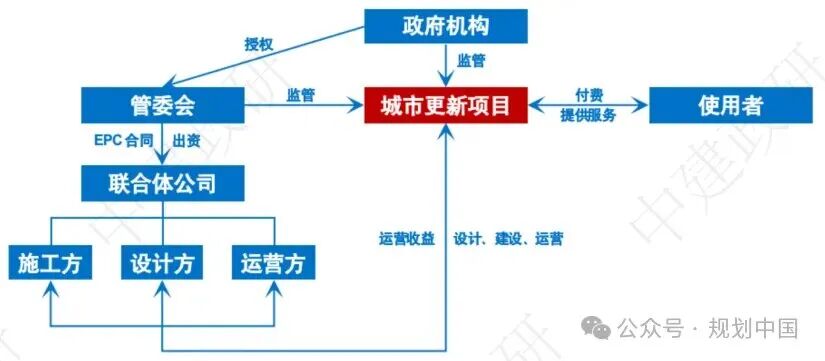
The advantage of this model lies in the overall outsourcing of engineering projects, coordinating construction and operation costs, and comprehensively balancing the relationship between construction period, quality, and cost, thereby reducing overall project costs and improving investment efficiency from the source.
Local Enterprises or Property Owners (Village Collectives) Self-Financed Renovation Model
In this model, local enterprises or residents (village collectives) autonomously carry out renewal and renovation to meet the reasonable interests of demanders and share the benefits of renewal. The advantage of this model is its flexibility in urban renewal, which can meet different needs, thereby alleviating the financial pressure on the government; the downside is the increased difficulty of government supervision, making it hard to control project progress and potentially neglecting improvements in public areas.
“Social Investors + EPC” Model
In this model, the government entrusts its subordinate state-owned enterprises and engineering construction companies to jointly invest in a joint venture company, which is responsible for the investment, construction, and operation management of the involved urban renewal projects, with the project company bearing its own profits and losses. The advantage of this model is that it can attract large engineering construction units and professional operators, integrating funding advantages to promote the implementation of large-scale projects; the downside is the potential debt risk, high financing difficulty, and overall cost.
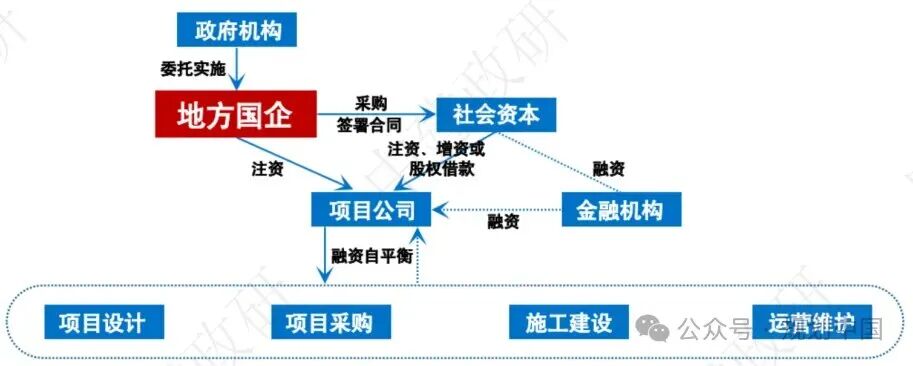
After redesign, the “Investor + EPC + O” (“Investor + Design, Procurement, Construction General Contracting + Operation”) model was explored, mainly applicable to local state-owned enterprises’ public welfare and commercial bundled area development projects or purely market-oriented and commercial projects. Similar models include social security funds/industrial funds + “Investor + EPC” model, using social security funds/industrial funds as the funding source for the project company.
Discussion and Summary of Urban Renewal Models in Major Cities Nationwide
Urban Renewal in Beijing
Beijing’s Urban Renewal Policy System: 1 + N + X
“1” refers to the policy system of relevant regulations and management measures such as the “Beijing Urban Renewal Regulations,” which serves as the programmatic guiding document for urban renewal work in Beijing.
“N” refers to differentiated control policies for various renewal objects such as courtyard houses, old communities, old buildings, and old factories, which supplement and improve the existing policies.
“X” revolves around legislative improvement, supporting regulations, administrative management, technical management, and other content at different levels, providing a solid guarantee and principled guidance for the systematic and sustainable advancement of urban renewal work, including policies and standards related to land management, planning and construction, financial taxation, and health assessments.
Main Characteristics Summary:
Government-led, state-owned enterprises driving; relying on grassroots governance, building a multi-party co-governance platform, and coordinating collaborative effects.
Government investment is mainly borne by district-level finances, with municipal finances providing support according to relevant policies.
For eligible renewal projects such as municipal pipeline renovations in old communities and old factory renovations, the municipal government can provide fixed asset investment support according to corresponding proportions.
Encouraging market entities to invest funds in renewal, property rights holders to self-finance for renovation, and financial institutions to innovate financial products to support urban renewal.
Urban Renewal in Shanghai
Development History:
Major events and urban renewal led by historical and cultural protection (2000-2010)
From historical and cultural protection zones, protected streets to excellent historical buildings, a comprehensive framework for historical protection has been established, under which a large number of old factory protective renovations have been carried out, transforming them into “creative industrial parks.” The Expo effect drove the renovation of large areas of secondary old neighborhoods and old residential areas in Shanghai’s central urban area, with the government actively exploring market-oriented operations and monetary resettlement.
Subsequent urban function improvement-oriented renewal phase after the Expo (2010-2020)
In 2015, the “Urban Renewal Area Assessment – Full Lifecycle Management of Urban Renewal Implementation Plans” was established. The update management system shifted from a parallel approach of “demolition and modification” to a combination of “retention, modification, and demolition,” focusing on preservation and protection, with organic renewal initiated in the central urban area.
Government-led state-owned enterprise renewal phase (2021 to present)
For the remaining sporadic secondary old houses, small-scale, gradual organic urban renewal is primarily implemented in the form of “retaining houses and people.” The “fifteen-minute community living circle” platform promotes five major actions of “livable, business-friendly, tourism-friendly, education-friendly, and care-friendly” and the “six co-mechanisms,” creating a new model of urban space and promoting the construction of a people-oriented city through spatial art seasons.
Main Characteristics Summary:
The government deeply leads, intervening in the distribution of benefits from land redevelopment through mechanisms for selecting subjects, property rights creation, and development rights allocation.
Government projects: Most redevelopment projects are led by the government, management committees, and platform state-owned enterprises. These projects consider political, social, and economic benefits. Government leadership emphasizes systematic approaches, advancing overall progress through land reserve (e.g., both sides of the Pujiang River). State-owned enterprise-led projects are mostly driven by enterprise development needs, revolving around the results of land development rights negotiations.
Market projects: Strictly control urban renewal interference in the existing real estate market, avoiding excessive sporadic renewal land inflow affecting the primary land market. The conditions for market entities to lead sporadic renewal are stringent (reflected in renovation functions, planning controls, self-holding ratios, public element contributions, etc.), and the incentive mechanism for benefits is weak.
Urban Renewal in Guangzhou
Development History:
Eliminating decay-oriented urban renewal phase (2000-2008)
Eliminating residential space decay: In 2000, 138 urban villages were designated for renovation, and pilot work for land and property conversion in urban villages was conducted in mature conditions; in 2007, new community construction was initiated to provide nearby resettlement for demolition households and families with dangerous houses.
Promoting industrial space replacement: In 2006, Guangzhou determined the urban “mid-adjustment” strategy, gradually relocating environmentally harmful enterprises and hazardous chemical enterprises from within the urban ring road to the outskirts, promoting the replacement of industrial space in the main urban area with modern service industries.
Real estate development-oriented renewal phase under old renovation (2009-2015)
In 2009, the “Three Old Renovation” was implemented, achieving policy breakthroughs in self-renovation land agreements, resettlement procedures, and collective construction land conversion to state-owned land. Real estate development drove the three old renovations, with about 80% being demolition and reconstruction, and about 80% being real estate development, with about 80% being old factory renovations.
Large-scale renewal and micro-renovation-oriented urban renewal phase (2016 to present)
In 2016, the “Urban Renewal Measures” were implemented, establishing a spatial governance system with comprehensive renovation and micro-renovation as the core, characterized by large-scale renovation and micro-renewal.
Main Characteristics Summary:
1. Breaking the policy classification of the three old renovations, strengthening the integration of urban renewal and land preparation; emphasizing spatial governance through comprehensive land remediation to promote large-scale contiguous renovations and advance the integration of industry and city.
2. Housing exclusion for migrants in urban village renovations, with stubborn households leading to a “reverse public land dilemma.”
3. Clear real estate development orientation, with post-renovation functions primarily residential and commercial, failing to support the real economy; high-intensity development poses significant challenges to urban traffic, public service facilities, and infrastructure capacity; large-scale contiguous renewal implementation is difficult and costly, still based on land ownership lines as the basic unit, with a lack of spatial integration.
Urban Renewal in Shenzhen
Development History:
Early renewal exploration driven by market emergence (2000-2008)
In 2005, Shenzhen first proposed the strategic judgment of “land, population, resources, and environment” as unsustainable, and by 2008, Shenzhen’s urban renewal had basically formed an overall policy framework for urban village and old industrial area renovations, but a systematic renewal policy had not yet been established.
Real estate development-oriented renewal phase under three old renovations (2009-2015)
In 2009, the “Shenzhen Urban Renewal Measures” were promulgated, achieving a transition from focusing on urban village and old industrial area renovations to comprehensive urban renewal, establishing a management model centered on urban renewal units.
In 2012, the urban renewal implementation details were introduced, focusing on safeguarding public interests, simplifying and expediting administrative approvals, strengthening public participation, and enhancing government guidance; achieving management decentralization; forming two major models of urban renewal and land preparation for existing land.
Government-enhanced renewal coordination phase (2016 to present)
In 2019, Shenzhen’s government reformed its institutions, establishing the Shenzhen Urban Renewal and Land Preparation Bureau, integrating the two existing models of urban renewal and land preparation, and coordinating the top-level framework for the annual plan of urban renewal and land preparation.
Main Characteristics Summary:
Under the premise of government coordination, urban renewal is promoted through market-oriented operation models. Before 2015: active non-intervention. The government relaxed regulations on land use changes, increased capacity, and non-legal land access for updates, delegating some planning authority to market entities; after 2016: active regulation and limited intervention. Strengthening control over market entities’ behaviors and interest coordination from dimensions such as land use, renewal thresholds, and land transfer rates.
Summary of Similarities and Differences in Urban Renewal Planning and Implementation in Beijing, Shanghai, Guangzhou, and Shenzhen
Differences in the Logic of Urban Renewal Planning and Implementation in Beijing, Shanghai, Guangzhou, and Shenzhen:
The constraints of human-land relationships and the degree of dependence on land finance determine the differences in the allocation of land development rights in urban renewal; based on more than a decade of practice, Guangzhou and Shenzhen have formed relatively mature urban renewal planning systems, but they are prone to falling into the “reverse public land dilemma,” exacerbating social injustice and reducing housing inclusivity for migrants; while Beijing and Shanghai are still in the exploratory stage, limited market participation leads to slow progress in renewal. The strength of planning control reflects the relationship between “government-market-society.” The stronger the government intervention, the more rigid the control, the weaker the renewal motivation. The relationships among government, market, and society in Beijing, Shanghai, Guangzhou, and Shenzhen are as follows:
Beijing: omnipotent government, weak market relying on state-owned enterprises, weak society
Shanghai: strong government, state-owned enterprise platform + market, weak society
Guangzhou: leading government, strong market, weak society
Shenzhen: delegating government, strong market, weak society
Commonality in the Logic of Urban Renewal Planning and Implementation in Beijing, Shanghai, Guangzhou, and Shenzhen:
1. Government intentions determine implementation strategies; urban renewal planning is essentially a technical tool for the government’s leading renewal strategic intentions, with the core content being the allocation of development rights for existing land.
2. Strengthening central intervention in local affairs, gradually narrowing the discretionary space of local governments in renewal. National land spatial planning is one of the important tools for strengthening central authority.
3. The renewal strategies in Beijing and Shanghai, under conditions of reduction and strict planning control, have significantly compressed the space for market participation. In Guangzhou and Shenzhen, the trend of weakening market dominance under upper-level intervention is becoming increasingly evident.
4. “Strong government – weak society” is a common portrayal of urban renewal in Beijing, Shanghai, Guangzhou, and Shenzhen.
Main Types of Existing Projects and Operational Models in Urban Renewal
Existing project types typically include the following categories:
1. Industrial heritage and old factory areas: such as abandoned factories, warehouses, and industrial parks.
2. Idle commercial properties: including shopping malls, hotels, office buildings, etc.
3. Old community residences: involving improvements to facilities and environments in residential buildings and communities.
4. Historical districts and cultural heritage buildings: old streets, historical buildings, and cultural landmarks.
5. Public facilities and urban infrastructure: such as idle hospitals, schools, sports venues, and public transportation facilities.
For the above existing projects, urban renewal typically adopts the following five operational models:
Micro-renewal model (value-added renovation)
Micro-renewal is the lowest-cost and quickest model. It usually targets old communities and commercial streets, making partial, refined adjustments through improving building quality, enhancing landscape environments, adjusting storefronts, and upgrading public spaces to re-attract target customer groups and enhance property value. For example, Shanghai’s Yuyuan Road and Guangzhou’s Yongqingfang.
Functional replacement type (value reshaping)
Functional replacement refers to completely changing the function of existing properties or spaces to meet new market demands. For example, converting industrial factories into creative parks, commercial spaces into offices, and residences into elderly care services. This model requires higher investment but offers the most significant value enhancement. The most typical examples include converting industrial factories into cultural and creative parks and offices into long-term rental apartments.
Mixed operation model (business type combination upgrade)
The mixed operation model integrates and upgrades multiple business types and functions, cross-industry integration, and multi-functional combinations, such as the combination of residential and commercial spaces, and the integration of cultural and tourism functions. For example, the re-combination of multi-dimensional business types such as offices, commerce, hotels, and cultural facilities forms a complementary industrial ecosystem, enhancing overall profitability. Examples include Shenzhen’s MixC and Beijing’s Fang.
Public welfare-driven type (supporting value enhancement)
Led by the government, this model introduces public welfare facilities or activities, such as cultural and sports facilities and community support, to enhance regional vitality and drive surrounding value enhancement.
Demolition and reconstruction model (value recreation)
For existing projects that are well-located but severely outdated and have no restoration value, a complete update is carried out through demolition and reconstruction. This model requires significant investment and has a long cycle but offers high expected returns. For example, the Gangksha River Garden old renovation project in Shenzhen.
Urban renewal is a complex project involving a wide range of fields, requiring not only substantial financial support but also policy guidance and active participation from social capital. From the government establishing special funds and issuing relevant policies to the innovation of market-oriented financing models, various regions are actively exploring paths suitable for their own development. The effective implementation of these measures provides strong guarantees for urban renewal projects, improving funding efficiency and project sustainability. However, urban renewal is not just a matter of funding and policy; it also needs to consider the historical culture of the city and the living needs of residents. In promoting urban renewal, how to balance the interests of all parties and ensure the transparency and fairness of projects remains an important issue. In the future, various regions need to continue summarizing experiences, exploring new financing models, and promoting urban renewal in a localized manner to achieve high-quality urban development.
Source: Planning China