Click 【Industrial Automation Insights】 to follow us!
This article delves into the analysis and discussion of two key PLC technologies in current industrial automation: traditional hard PLCs and software-based soft PLCs.
Source: Xiaoyu Discovery
Basic Concepts and Essential Differences between Hard and Soft PLCs
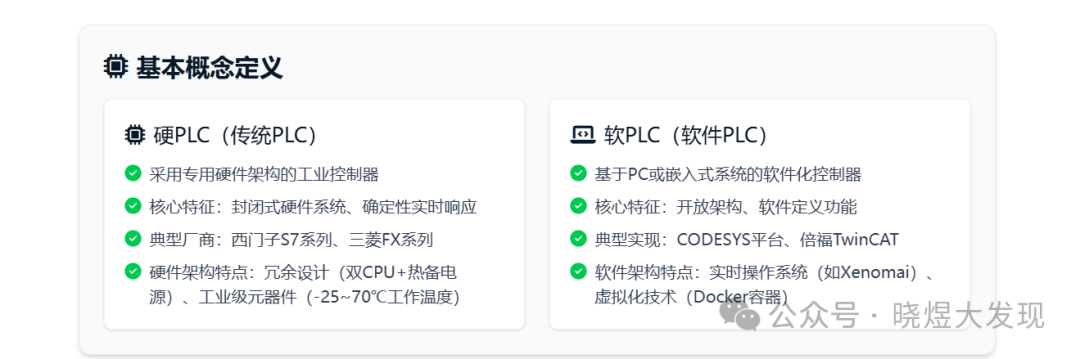
Comparison of Operating Principles
| Feature | Hard PLC | Soft PLC |
|---|---|---|
| Processing Core | Dedicated ASIC Chip | General CPU + RTOS |
| Program Execution | Fixed Scan Cycle | Event-Driven + Task Scheduling |
| I/O Connection | Dedicated Backplane Bus | Standard Industrial Ethernet |
| Development Environment | Vendor-Specific IDE | IEC 61131-3 Standard Environment |
| Response Time | Microsecond Level (1~10ms) | Millisecond Level (Dependent on System) |
Essential Differences
Hard PLC: Prioritizes reliability, emphasizing determinism and stability.
Soft PLC: Prioritizes flexibility, emphasizing scalability and integration capabilities.
Hard PLC: Functionality is fixed in dedicated hardware, with a high degree of customization.
Soft PLC: Functionality is software-defined, running on general hardware platforms.
Common Analogies
A hard PLC is like a “mechanical watch”—precise and reliable but with fixed functions, suitable for standardized scenarios. Like a mechanical watch, it has a precise structure and stable operation, but its functions are relatively singular and not easily expandable.
A soft PLC is like a “smartphone”—functionally expandable but reliant on system stability, suitable for innovative applications. Like a smartphone, it has rich functionalities and can install various applications, but its performance depends on the operating system and hardware platform.
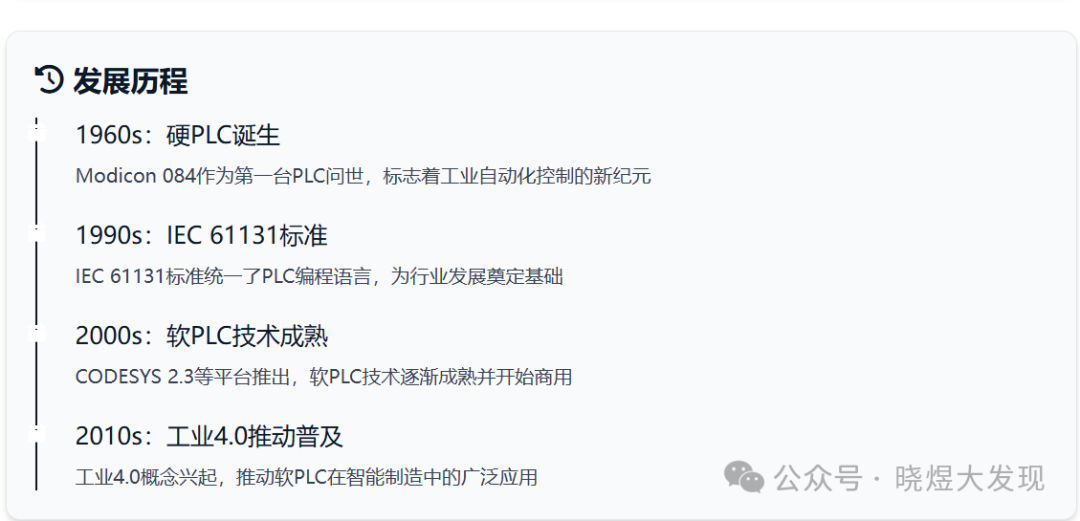
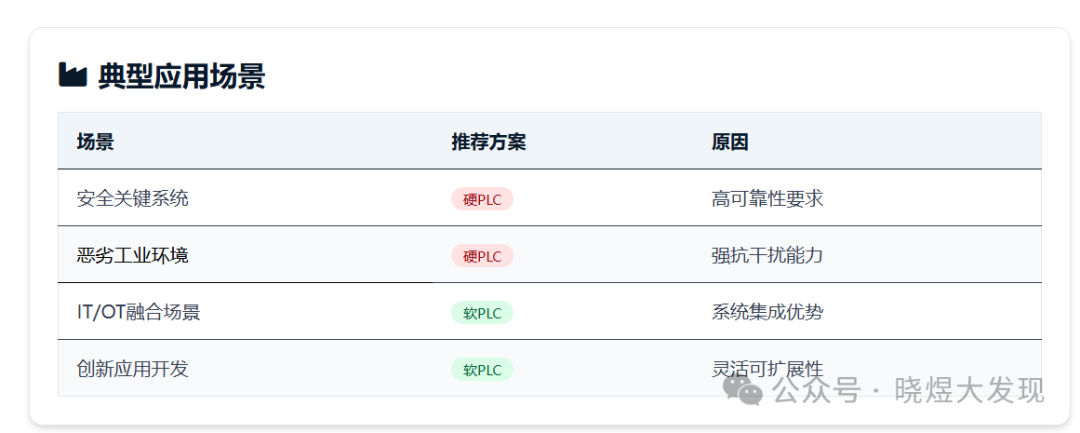
Detailed Comparison of Technical Architecture Features
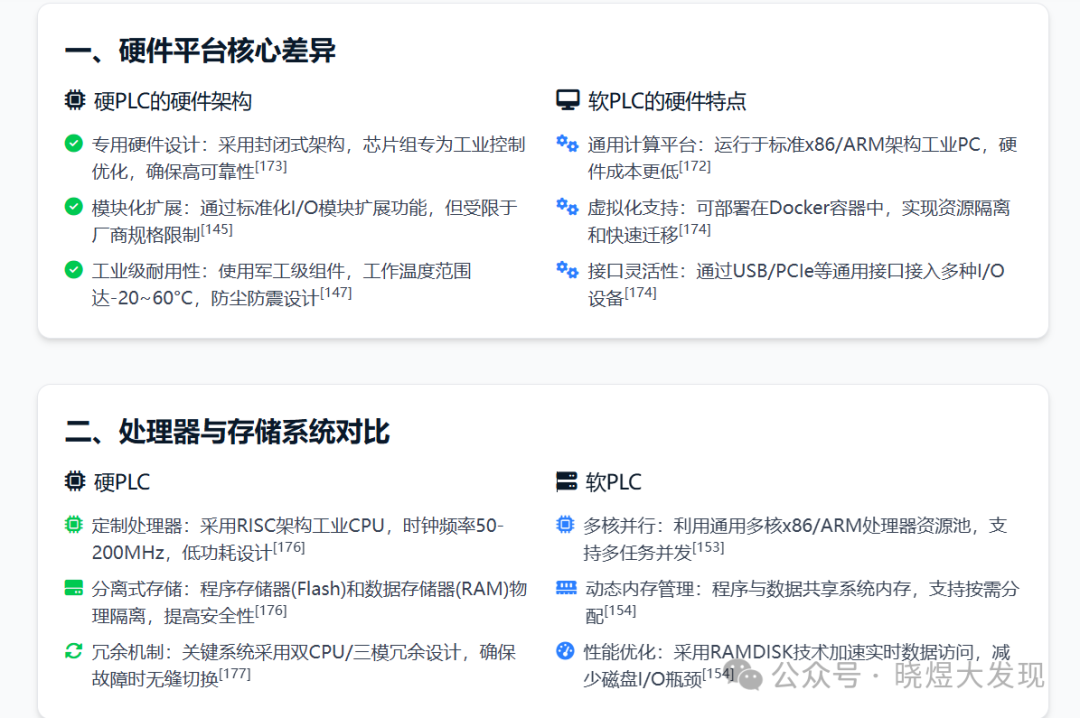
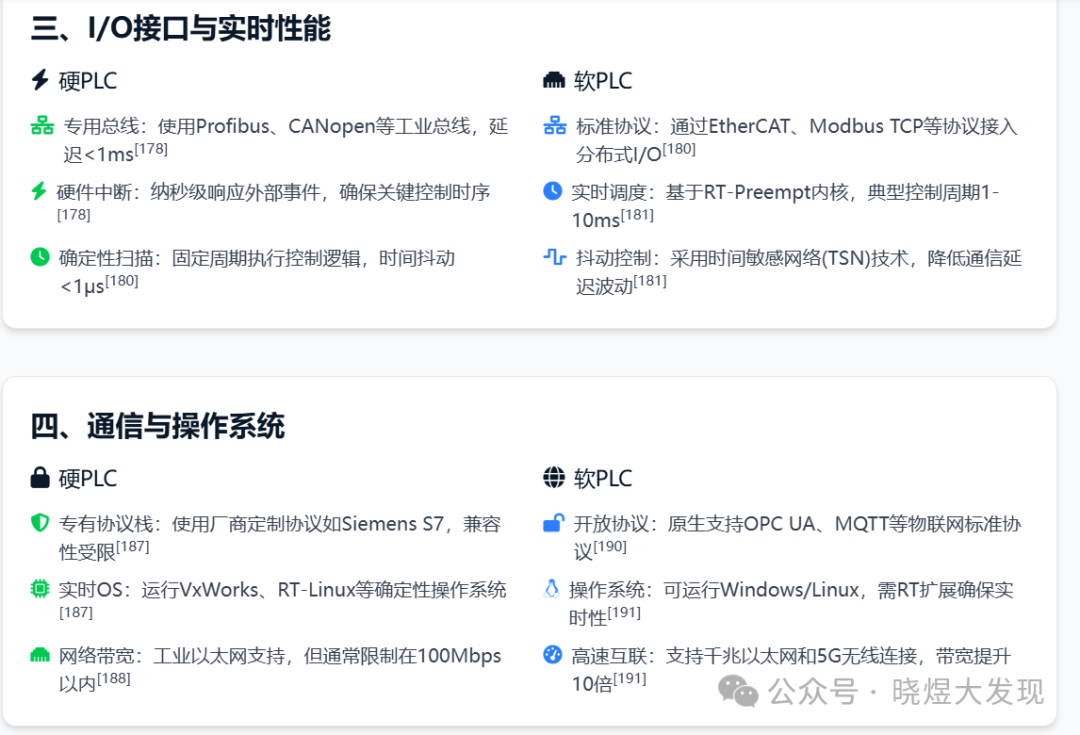
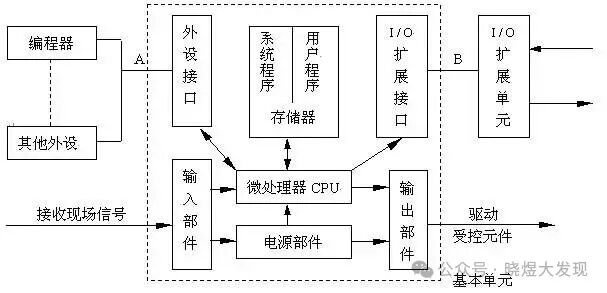
Architecture Diagram Comparison
Hard PLC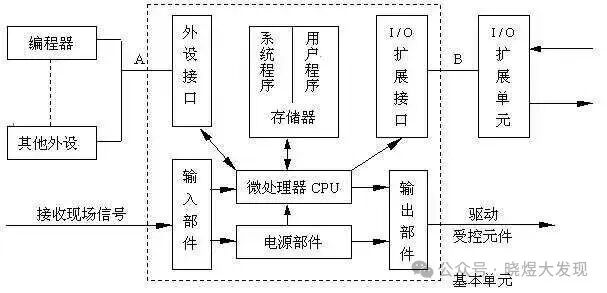
Soft PLC
Core Advantages of Hard PLC
Exceptional Reliability
Redundant Design: Dual CPU hot standby architecture, fault switch time less than 10ms.
Signal Isolation: Optical isolation voltage exceeds 2500V AC.
Durability Indicators: Mean time between failures ≥ 100,000 hours, operating temperature range -20℃ to 60℃.
Outstanding Real-Time Performance
Fast Response: Cycle period 0.1-1ms, critical task delay ≤ 1μs.
Application Scenarios: High-speed stamping machines (cycle ≤ 5ms), safety interlock systems (SIL3 certified).
Strong Anti-Interference Capability
Passed EN 61326-3-1 Class A electromagnetic interference tests.
Complies with IEC 60068-2-6 vibration standards (5-500Hz).
Hardware Design
Industrial-grade dedicated processor (PowerPC architecture).
Fixed real-time operating system (RTOS).
Core Advantages of Soft PLC
System Flexibility and Architectural Innovation
Hardware Independence: Based on x86/ARM and other general processor architectures, enabling cross-platform migration capabilities.
Dynamic Reconfiguration Technology: Supports online logic modification, reducing engineering debugging cycles by over 60%.
Virtualization Support: Multiple PLC instances can run in parallel on a single machine, improving resource utilization by 3-5 times.
Elastic Scalability
Dynamic Allocation of Computing Resources: The number of CPU cores can be adjusted in real-time based on control tasks.
Distributed I/O Architecture: Supports expansion of over 1000 points through industrial Ethernet like EtherCAT.
Functional Modularity: Integrates AI inference, machine vision, and other intelligent algorithm packages.
Significant Cost Advantages
Lower Initial Investment: Hardware costs reduced by 40-60% compared to traditional PLCs.
Lifecycle Cost Optimization: 35% reduction in 5-year TCO (measured data from manufacturing).
Maintenance Innovation: Software updates replace hardware replacements, reducing downtime by 80%.
Intelligent Integration Capability
Deep IT/OT Integration: Natively supports SQL databases, REST APIs, and other enterprise system interfaces.
Cloud-Edge Collaborative Architecture: Seamless integration with cloud platforms like Azure IoT and AWS IoT Core.
Multi-Protocol Compatibility: Simultaneously supports over 20 industrial protocols including PROFINET and Modbus TCP.
Hard PLC Case Study
Automotive Welding Production Line (Siemens S7-1500 Hard PLC)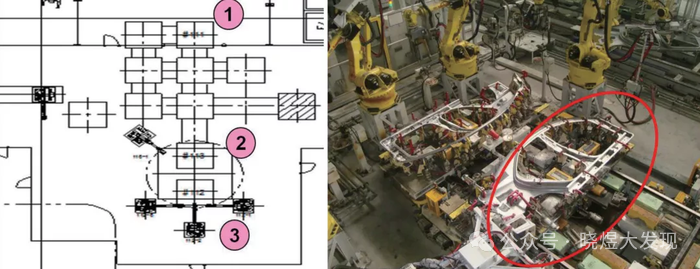 Implementation ResultsAchieved 99.98% equipment availability.Electromagnetic interference level EN 61000-6-2.Millisecond-level response ensures welding accuracy.Meets high reliability for continuous production.Withstands harsh industrial environments.Ensures long-term stable operation (10+ years lifecycle).
Soft PLC Case Study
Dairy Packaging Workshop (Codesys Soft PLC)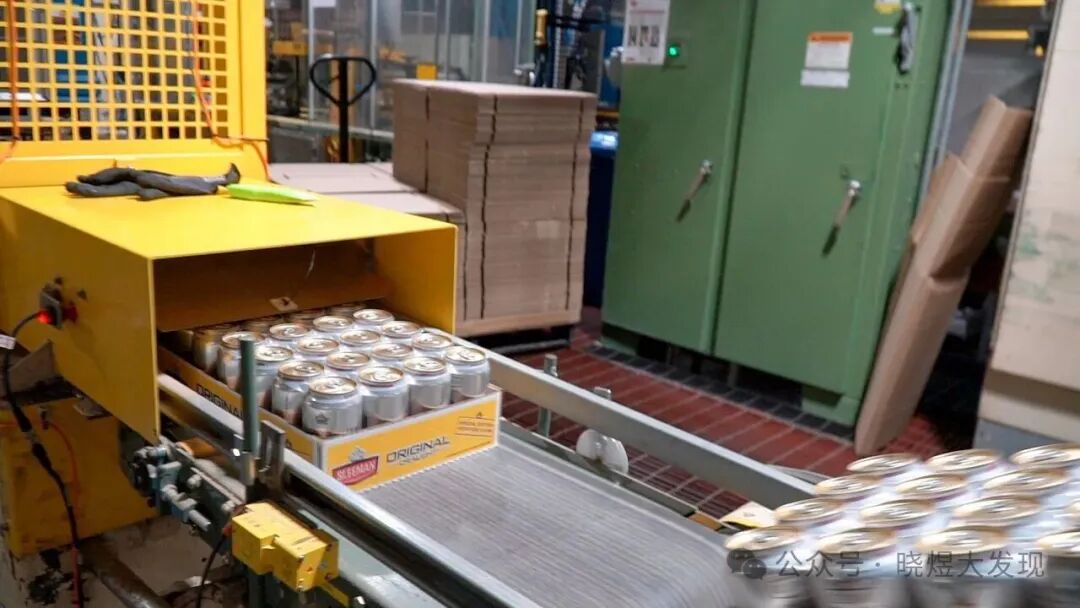 Implementation Results
Production changeover time reduced by 30%.
Achieved deep integration with MES systems.
Dynamic adjustment of packaging parameters (AI algorithm support).
Meets the need for frequent adjustments to production recipes.
Meets big data analysis needs (real-time monitoring of equipment OEE).
Achieved deep integration with ERP/MES systems.
Advantages Comparison
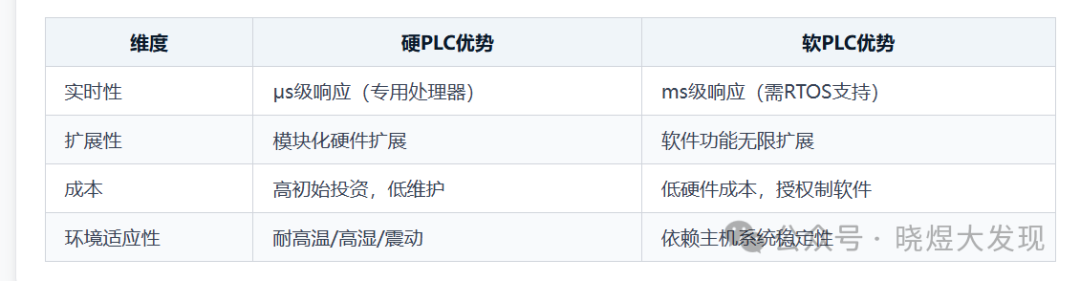

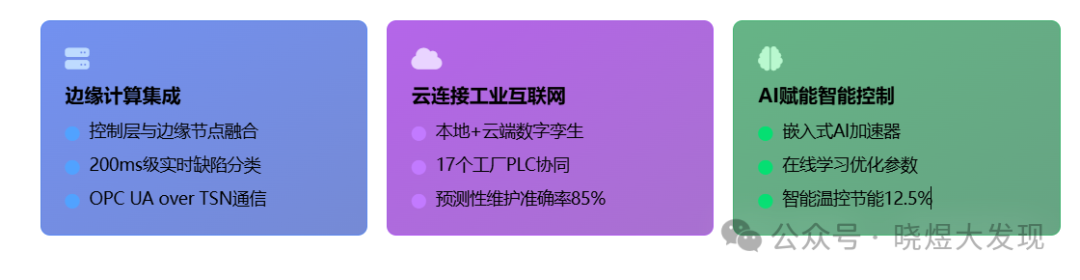
From the current technological evolution perspective, PLC technology is developing in three main directions.
 How to choose in projects?1. Choose hard PLC for high real-time requirements.2. Choose hard PLC for harsh environments.3. Choose hard PLC if long-term updates are not needed.As long as none of the above three points are met, soft PLC can be used.
In Summary
There is no one-size-fits-all solution in the field of industrial automation. Both hard PLCs and soft PLCs have their irreplaceable value, and the future is likely to move towards a path of integrated development. With advancements in edge computing, cloud computing, and AI technologies, the next generation of PLC systems will feature real-time performance, flexibility, and intelligence.

↓
Long press the QR code to register online