Recently, I compiled a list of commonly used words for Python learners, listing 198 high-frequency words that are often encountered in Python learning, for beginners to study and use.These words are relatively simple and easy to understand. Mastering these words will make learning Python much more efficient.When compiling the list of 198 commonly used words for Python beginners, I mainly considered the following:1. In addition to the literal meanings of the words, I supplemented some meanings and usages of the words in Python to make them easier to understand.2. I reduced the inclusion of some uncommon and difficult-to-understand low-frequency words, compressing the original list of over 240 words down to 198, focusing on high-frequency and practical words.3. I added some usage guidelines for commands, such as distinguishing between sort and sorted.4. I provided comments for frequently used statements like: try…except.
| Index | Word | Meaning |
| 1 | Python | Large Python Snake |
| 2 | path | Path |
| 3 | next | Next Step |
| 4 | install | Install |
| 5 | File | File |
| 6 | New File | Create New File |
| 7 | Run | Run |
| 8 | Run Module | Run Program |
| 9 | settings | Settings |
| 10 | key | Key |
| 11 | Create New Project | Create New Project |
| 12 | close | Close |
| 13 | help | Help |
| 14 | dream | Dream |
| 15 | Debug | Debug |
| 16 | Editor | Editor |
| 17 | variable | Variable |
| 18 | date | Date |
| 19 | time | Time |
| 20 | font | Font |
| 21 | PyCharm | A Python Integrated Development Tool |
| 22 | height | Height |
| 23 | weight | Weight |
| 24 | keyword | Keyword |
| 25 | width | Width |
| 26 | Print, Output Function | |
| 27 | datetime | DateTime Module, can be imported with import |
| 28 | URL | Uniform Resource Locator, essentially a web address |
| 29 | FALSE | Logical False |
| 30 | TRUE | Logical True |
| 31 | title | Title |
| 32 | as | As |
| 33 | type | Type |
| 34 | input | Input |
| 35 | type error | Type Error |
| 36 | float | Float Data |
| 37 | add | Add Element to Set |
| 38 | None | Represents “None” or “Does Not Exist”, data type is NoneType |
| 39 | average | Calculate Average |
| 40 | if | If, used for conditional statements if…else |
| 41 | or | Or |
| 42 | and | And |
| 43 | return | Return Function Value |
| 44 | yield | Return a Generator Object |
| 45 | keyword | Keyword |
| 46 | value | Value, used in dictionaries and JSON files |
| 47 | else | Else, often used in if…else conditional statements |
| 48 | while | While Loop |
| 49 | for | For Loop |
| 50 | break | Break Program |
| 51 | class | Class |
| 52 | continue | Continue |
| 53 | except | Except, usually for exception handling try…except |
| 54 | finally | Finally |
| 55 | type | Type, determine data type |
| 56 | from | From..to, used in range…from |
| 57 | pass | Pass |
| 58 | sort | List Sort, directly modifies the original list |
| 59 | reversed | Reverse List |
| 60 | enumerate | Enumerate |
| 61 | import | Import |
| 62 | append | Append, Add |
| 63 | extend | Extend, Increase |
| 64 | sale | Sale |
| 65 | in | In |
| 66 | is | Is |
| 67 | not | Not |
| 68 | set | Set |
| 69 | del | Delete |
| 70 | remove | Remove |
| 71 | clear | Clear, such as clearing a list |
| 72 | string | String |
| 73 | split | Split String |
| 74 | join | Join Characters |
| 75 | count | Count |
| 76 | find | Find |
| 77 | index | Index |
| 78 | lower | Lowercase Letters |
| 79 | upper | Uppercase Letters |
| 80 | strip | Remove Leading and Trailing Whitespaces or Specific Characters |
| 81 | lstrip | Remove Only Leading Whitespaces or Specific Characters |
| 82 | rstrip | Remove Only Trailing Whitespaces or Specific Characters |
| 83 | format | Format |
| 84 | encode | Encode |
| 85 | decode | Decode |
| 86 | match | Match |
| 87 | search | Search |
| 88 | parameter | Parameter |
| 89 | global | Define Global Variable |
| 90 | start | Start |
| 91 | end | End, Terminate |
| 92 | step | Step |
| 93 | empty | Empty |
| 94 | sequence | Sequence |
| 95 | max | Maximum Value |
| 96 | min | Minimum Value |
| 97 | list | List |
| 98 | sum | Sum |
| 99 | sorted | Sort, does not change the original sequence, generates a new sequence |
| 100 | enumerate | Enumerate |
| 101 | element | Element |
| 102 | data | Data |
| 103 | range | Define Number Sequence, used in range…from |
| 104 | item | Item, generally key-value pairs in a dictionary |
| 105 | index | Index |
| 106 | iterable | Iterable |
| 107 | total | Total |
| 108 | random | Random |
| 109 | condition | Condition |
| 110 | language | Language |
| 111 | tuple | Tuple – a type of data |
| 112 | string | String – a type of data |
| 113 | length | Length |
| 114 | sep | Separator, used in print() statement |
| 115 | find | Find |
| 116 | char | Character |
| 117 | args | Arguments |
| 118 | fill | Fill |
| 119 | align | Align |
| 120 | sign | Sign |
| 121 | dir | Directory |
| 122 | enter | Enter |
| 123 | pattern | Pattern |
| 124 | flags | Flags |
| 125 | object | Object |
| 126 | span | Span |
| 127 | group | Group |
| 128 | int | Integer Data |
| 129 | number | Number |
| 130 | map | Map |
| 131 | hash | Hash |
| 132 | dictionary | Dictionary |
| 133 | zip | Zip, program compression format |
| 134 | sign | Signature |
| 135 | get | Get |
| 136 | default | Default |
| 137 | set | Set – a type of data |
| 138 | def | Define Function Keyword |
| 139 | function | Function |
| 140 | name | Name |
| 141 | return | Return |
| 142 | pass | Pass/Empty Statement |
| 143 | filter | Filter |
| 144 | about | About |
| 145 | demo | Demo, Example |
| 146 | TypeError | Type Error |
| 147 | bug | Bug, Error |
| 148 | param | Parameter |
| 149 | dict | Dictionary Data Type |
| 150 | message | Message |
| 151 | expression | Expression |
| 152 | math | Math Module |
| 153 | circle | Circle |
| 154 | area | Area, used in turtle graphics module |
| 155 | hex | Hexadecimal |
| 156 | id | Unique Identifier of an Object in Memory, equivalent to an ID card |
| 157 | oct | Octal |
| 158 | bin | Binary |
| 159 | open | Open File |
| 160 | sum | Sum |
| 161 | round | Round Floating Point Numbers |
| 162 | programming | Programming |
| 163 | statement | Statement, Declaration |
| 164 | self | Self, refers to the instance itself |
| 165 | instance | Instance |
| 166 | from | From, used with range |
| 167 | module | Module, can be imported |
| 168 | property | Property |
| 169 | tree | Tree Structure |
| 170 | model | Model |
| 171 | package | Package, consists of many modules and submodules |
| 172 | show | Show |
| 173 | program | Program |
| 174 | code | Code |
| 175 | main | Define Main Function |
| 176 | home | Original Position |
| 177 | init | Initialize |
| 178 | size | Size, Dimension, such as font size |
| 179 | sys | System, abbreviation for system |
| 180 | os | File Operation Module |
| 181 | calendar | Calendar |
| 182 | re | Regular Expression, abbreviation for regex |
| 183 | log | Log |
| 184 | command | Command, Instruction |
| 185 | uninstall | Uninstall Module |
| 186 | write | Write to File or Data |
| 187 | close | Close File |
| 188 | mode | Mode, refers to how to open, such as binary, utf-8 mode |
| 189 | picture | Picture, more specific and everyday |
| 190 | image | Image, more broad, abstract, and technical |
| 191 | encoding | Encoding, more specific and everyday |
| 192 | with | Context Management, usually used in with…open()…as |
| 193 | read | Read, usually used for reading text and other data |
| 194 | seek | Seek, Find |
| 195 | line | Line |
| 196 | join | Join, Connect |
| 197 | rename | Rename |
| 198 | reverse | Reverse List Order |
Creating this word list is not easy, and I hope everyone will support it.
There may still be many shortcomings, and I welcome everyone to provide valuable feedback.
For a more detailed Excel sheet, please follow the public account and reply with the number: 【005】 to obtain it: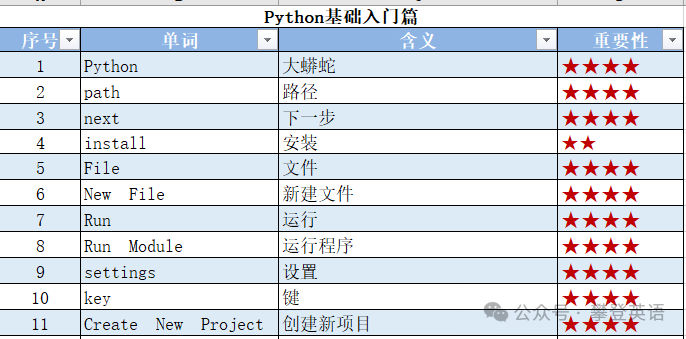 Recommended Reading:Is archiving undergraduate thesis materials too cumbersome? Python can help you solve it with one click!AI-generated images: Making English learning less tediousApplication of Python in corpus construction: text collection, data cleaning, and file name managementPreparing for the CET-4, don’t start with abandon! An efficient vocabulary brushing strategy based on vocabulary comparisonPython calls Doubao API to batch extract image information