Reprinted from: Moore Chip Ball
What Is Wi-Fi 6?Wi-Fi 6 is the alias given by the Wi-Fi Alliance to IEEE Std. P802.11ax.As we all know, our previous Wi-Fi standards were named things like 802.11a/b/n/g/ac/ax, which can be quite confusing and makes it hard to see the chronological order. Therefore, starting from 802.11ax, a numerical naming convention was adopted.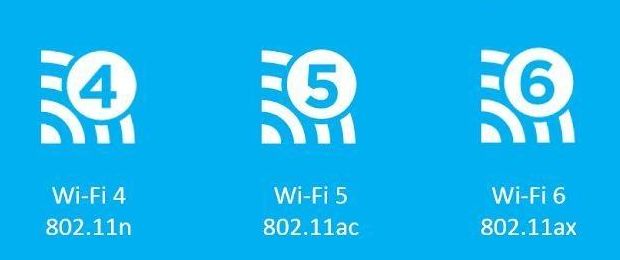 Currently, the Wi-Fi 6 standard is being developed by the IEEE Standards Association’s TGax Working Group. The current version is Draft 4.20 (D1 and D2 were submitted but did not pass the vote, while D3 passed the group vote and was reworked).As of now, the 802.11ax standard has not been formally completed, but the general framework has been established and is currently in the sponsor voting phase.
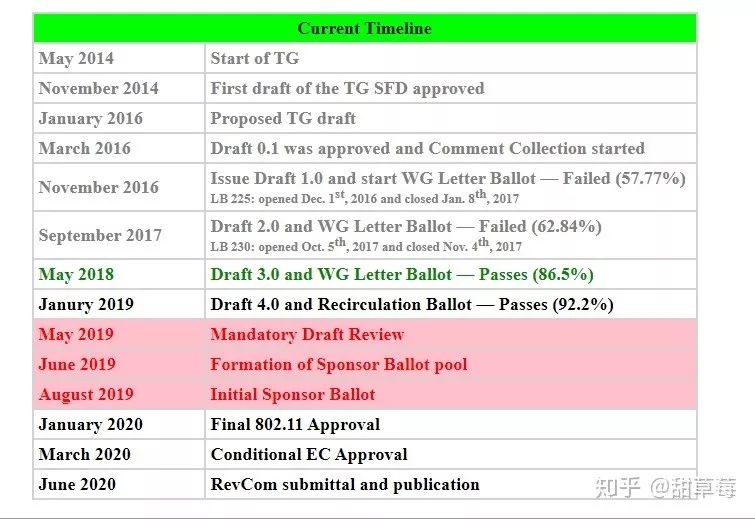 Wi-Fi 6 Standard TimelineIt is expected that the TGax project group will submit the official version in January 2020 for validation by the 802.11 group.The Wi-Fi Alliance is a non-profit industry organization that owns the Wi-Fi trademark, mainly responsible for Wi-Fi certification and authorization, and also participates in the development of the 802.11 series standards. Devices that pass Wi-Fi 6 product validation can display the Wi-Fi 6 certification label, which looks something like this:
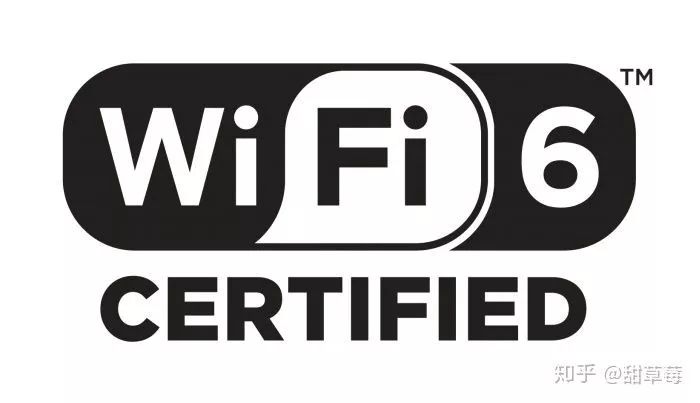
Please note the relationship between the Wi-Fi 6 trademark and the 802.11ax standard. In fact, since the IEEE TGax working group and the member companies of the Wi-Fi Alliance largely overlap, it can be said that passing Wi-Fi 6 validation essentially supports 802.11ax.What Improvements Does Wi-Fi 6 Bring?Comparing recent communication standards (5G/Wi-Fi 6), it can be felt that the focus of the communication industry in the coming years will be on the Internet of Things. This new generation of access standards mainly considers dense terminals, low power consumption, and high bandwidth access.Specific improvements include:
-
OFDM→OFDMA
-
Support for Target Wake Time (TWT) to reduce power consumption and improve battery life
-
Using 1024-QAM to improve throughput, with support for up to 8×8 MIMO
-
Support for spatial reuse and coloring
Well… just to mention, most of these improvements are already present in LTE systems (1024QAM is in 5G).Next, let’s take a look at these improvements individually:1. OFDM→OFDMAContinuing the MU-MIMO brought by 802.11ax, OFDM has been changed to OFDMA, where the ‘A’ means it can be used for multiple access, allowing carriers to be allocated to different users to increase system user connection capacity.
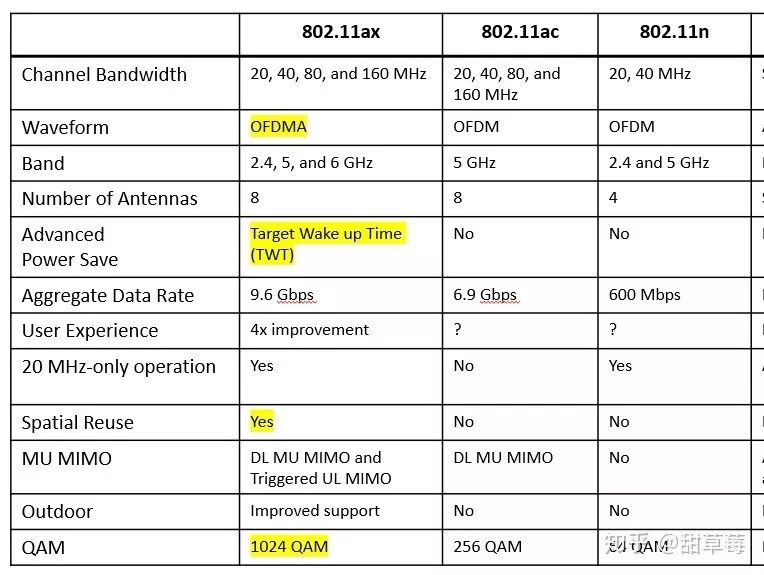
Comparison of ax/ac/nIn previous Wi-Fi protocols, such as 802.11ac, multiple wireless access users were supported through spatial separation (MU-MIMO) or time separation (time-sharing transmission/EDCA), while OFDMA means an additional resource allocation method for multiple users—frequency division.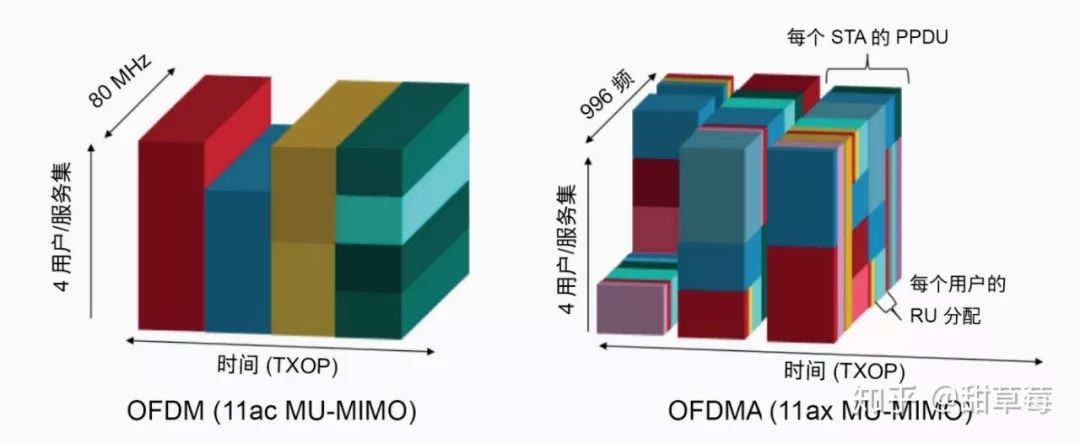 Comparison of OFDM and OFDMA multi-user resources, image from CiscoThis means that the minimum resource unit in Wi-Fi, which was just a time frame, has now become a resource block similar to LTE’s time/frequency resource blocks, allowing for more granular wireless resource allocation, such as assigning different resource blocks to different users.
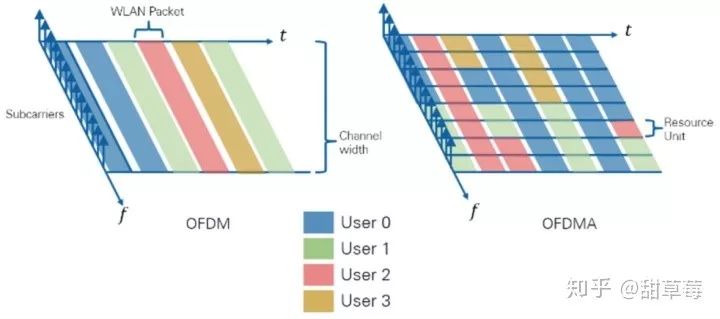 Image from https://zhuanlan.zhihu.com/p/244166102. Target Wake Time (TWT)Wi-Fi 6 continues the TWT (Target Wake Time) feature from 802.11ah, which is a method of device resource scheduling.It allows devices and access points to negotiate when to wake up after entering sleep mode, rather than the previous fixed time access to the network. Wi-Fi 6 access points can group client devices into different TWT cycles, allowing timed wake-ups for groups, which helps reduce the number of devices contending for the channel.
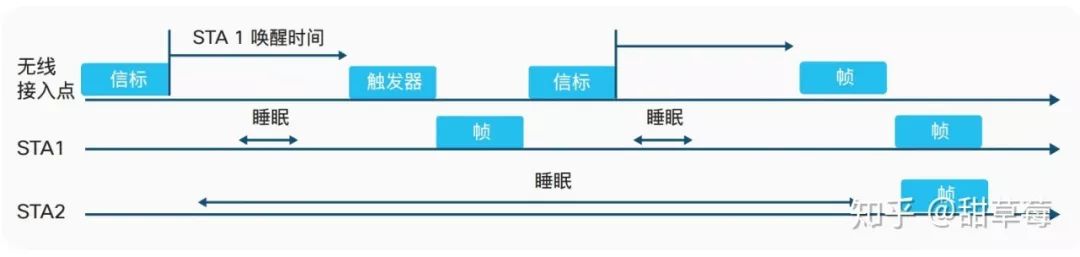 TWT Functionality3. 1024-QAMOFDM waveforms typically use QAM (Quadrature Amplitude Modulation) as the modulation method,
QAM Diagram, Image from Cisco
As the name suggests, 1024-QAM allows a single symbol to convey 10 bits (1024=2 to the power of 10) of data, which is a very effective way to increase wireless system speed. Thanks to 1024-QAM, a single antenna can achieve gigabit-level data transmission.
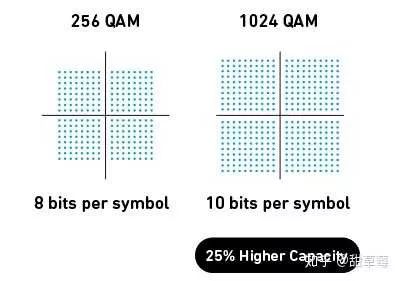
At the same time, Wi-Fi 6 can support 8×8 MIMO; however, currently, mobile phones do not support such a high number of MIMO layers due to antenna size constraints.Thus, the theoretical maximum speeds for Wi-Fi 6 are approximately:2.4Gbps (4×4 MIMO@80MHz)4.8Gbps (8×8 MIMO@80MHz)4.8Gbps (4×4 MIMO@160MHz)9.6Gbps (8×8 MIMO@160MHz)The above 80/160MHz refers to the single carrier bandwidth.From the perspective of increasing single carrier bandwidth and modulation order, the speed of Wi-Fi 6 will undoubtedly improve, even if mobile phones do not support 8×8 MIMO…However, the question is, does everyone have such fast broadband at home?4. Spatial Reuse and ColoringThis is also a variant of the inter-cell interference coordination technology that has been used in LTE systems for a long time.Traditionally, Wi-Fi, as a wireless local area network, does not consider too much about the networking and co-frequency interference issues between different access nodes. If such a network needs to be deployed, one would need to find more professional networking personnel. However, as Wi-Fi applications become more widespread, covering medium to large scenarios (such as corporate buildings) is becoming a common issue. (Of course, this may also be because people’s homes are getting larger )In such medium to large scenarios, it is common for a mobile phone to receive signals from two different wireless access points, but from the same wireless local area network (same BSS/SSID).In response to this situation, Wi-Fi 6 provides a BSS coloring mechanism. If the signal received by the phone comes from the same wireless local area network in the same frequency band (for example, from two repeaters), the phone will recognize the interference signal in a timely manner and raise the recognition threshold to stop receiving in order to avoid interference.Wi-Fi 6 and 5G RelationshipThe main difference lies in the application scenarios. Because the application scenarios are different, even though 5G and Wi-Fi 6 use very similar wireless communication technologies, the user experience is not the same. Various 5G to Wi-Fi solutions are currently emerging because current operator networks cannot effectively address the privacy issues demanded by users in wireless local area networks. The SIM card is not an issue, as IoT devices now use eSIM cards that support over-the-air writing, eliminating the need for physical replacement.For more details, please refer to this answer:https://www.zhihu.com/question/307558418/answer/568526548To avoid confusion, it is necessary to emphasize this paragraph from the news description,According to foreign media reports, there is currently a competition between 5G technology and Wi-Fi in the communication technology between vehicles and the Internet of Things. Companies like Volkswagen Group, Renault Group, Toyota, General Motors, and NXP support the use of Wi-Fi technology, while BMW, Daimler, Ford, Nissan, Peugeot Citroën, Bosch, Deutsche Telekom, Intel, Qualcomm, and Samsung support the use of 5G technology.Competing with the operator’s C-V2X communication is 802.11p, a protocol developed for dedicated short-range communication (DSRC) for the Internet of Things, which is different from the 802.11 a/g/n/ac/ax series used for wireless local area networks. Whether car manufacturers support DSRC or 5G is a matter of interest, not related to the technical application scenarios, nor related to the survival of Wi-Fi.As long as there are data privacy transmission requirements in wireless local area networks, Wi-Fi is unlikely to disappear. This article is reprinted from Zhihu, original author: Sweet StrawberryOriginal link: https://www.zhihu.com/question/346373079/answer/826685514Reprint authorized by the authorReferences:1. Status of Project IEEE 802.11ax: http://grouper.ieee.org/groups/802/11/Reports/tgax_update.htm2. Quadrature Amplitude Modulation: https://zh.wikipedia.org/wiki/%E6%AD%A3%E4%BA%A4%E5%B9%85%E5%BA%A6%E8%B0%83%E5%88%B6
*Disclaimer: This article is original by the author. The content reflects the author’s personal views, and Semiconductor Industry Observation reprints it solely to convey a different perspective, not representing Semiconductor Industry Observation’s endorsement or support for that view. If there are any objections, please contact Semiconductor Industry Observation.